
Puck, 1878-05-08 · page 10 of 16
Puck — May 8, 1878 — page 10: what you’re looking at
What you’re looking at
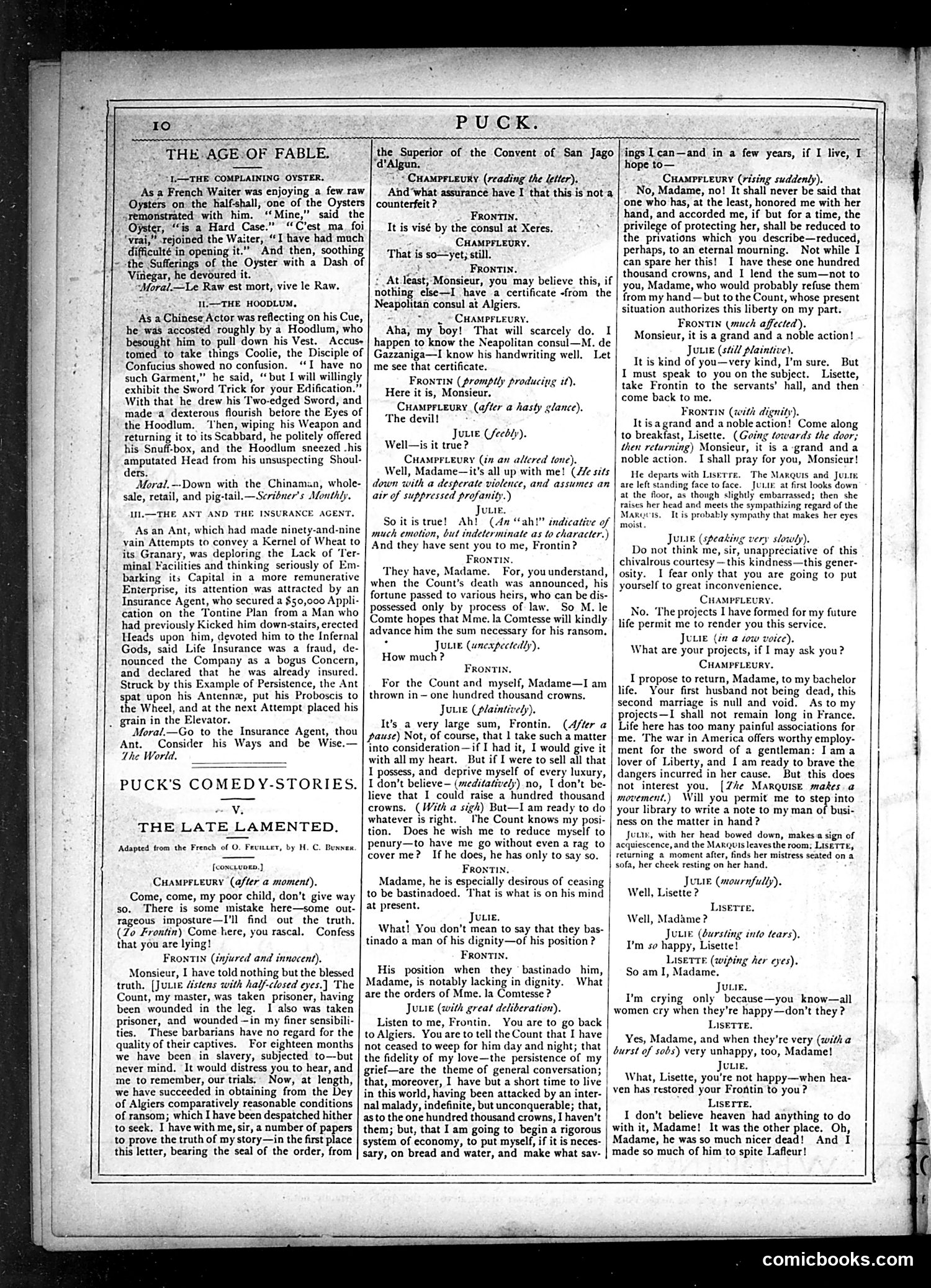
This page contains a theatrical comedy sketch titled "The Late Lamented," adapted from French by H.C. Bosseux. The dialogue features characters including Champfleury, Frontin, Julie, and Lisette engaging in a comedic plot involving a Countess, a Count's death, inheritance disputes, and romantic entanglements. The satire targets **French aristocratic absurdities**: the Count's death triggers complications over wealth distribution among various heirs, while characters engage in schemes around marriage, honor, and financial interest. Julie and Lisette represent servant/lower-class perspectives critiquing their "betters'" moral hypocrisy. The humor mocks **aristocratic pretension**—characters claim nobility while pursuing purely mercenary motives. The title "The Age of Fable" suggests the entire aristocratic system itself is fictional mythology rather than justified social reality.
📄 Transcribed text from this page (OCR, searchable)
Machine-transcribed from the original scan — historical spelling and the odd misread are preserved.
_ grain in the Elevator. PUCK. _. THE:AGE:OF FABLE. "<THE COMPLAINING OYSTER. As a French Waiter was enjoying a few raw Oysters on: the half-shall, one of the Oysters sremonstrated with him. ‘‘Mine,” said the yyster, “is a Hard Case.” “‘C’est_ma_ foi vrai,” rejoined the Waiter, “I have had much difficulté in opening it.” And then, soothing -the Sufferings of the Oyster with a Dash of Vinegar, he devoured it. “Moral.—Le Raw est mort, vive le Raw. “: 1I-—THE HOODLUM, As a Chinese Actor was reflecting on his Cue, he was accosted roughly by a Hoodlum, who besought him to pull down his Vest. Accus- tomed to take things Coolie, the Disciple of Confucius showed no confusion. ‘I have no such Garment,” he said, “but I will willingly exhibit the Sword Trick for your Edification.” With that he drew his Two-edged Sword, and made~a dexterous flourish betore the Eyes of the Hoodlum. ‘Then, wiping his Weapon and returning it to its Scabbard, he politely offered his Snuff-box, and the Hoodlum sneezed -his amputated Head from his unsuspecting Shoul- ders. Moral.—-Down with the Chinaman, whole- sale, retail, and pig-tail.—Scribner’s Monthly. U.—THE ANT AND THE INSURANCE AGENT. Asan Ant, which had made ninety-and-nine vain Attempts to convey a Kernel of Wheat to its Granary, was deploring the Lack of ‘Ter- minal Facilities and thinking seriously of barking its Capital in a more remunerative Enterprise, its attention was attracted by an Insurance Agent, who secured a $50,000 Appli- cation on the Tontine Plan from a Man who had previously Kicked him down-stairs, erected Heads upon him, devoted him to the Infernal Gods, said Life Insurance was a fraud, de- nounced the Company as a bogus Concern, and declared that he was already insured. Struck by this Example of Persistence, the Ant spat upon his Antenna, put his Proboscis to the Wheel, and at the next Attempt placed his Moral.—Go to the Insurance Agent, thou Ant. Consider his Ways and be Wise.— The World. PUCK’S COMEDY-STORIES. ~ Ve THE LATE LAMENTED. Adapted from the French of O. Fevuter, by H.C. Bunnex [conciuoen.} CuHamprLeury (after a moment), Come, come, my poor child, don’t give way so. There is some mistake here—some out- rageous imposture—I’ll find out the truth. (Zo Frontin) Come here, you rascal. Confess that you are lying! FRONTIN (injured and innocent), Monsieur, I have told nothing but the blessed truth, [JuLie distens with half-closed eyes.) The Count, my master, was taken prisoner, having been wounded in the leg. I also was taken prisoner, and wounded —in my finer sensibili- ties. These barbarians have no regard for the quality of their captives. For eighteen months we have been in slavery, subjected to—but never mind. It would distress you to hear, and | grief—are the theme of general conversation; me to remember, our trials. Now, at length, we have succeeded in obtaining from the Dey of Algiers comparatively reasonable conditions of ransom; which I have been despatched hither to seek. I have with me, sir, a number of papers to prove the truth of my story—in the first place | system of economy, to put myself, if it is neces- the Superior of the Convent of San Jago ‘d’Algun, \ Cuampr.euny (reading the (etter), And ‘what assurance have I that this is not a counterfeit ? s S ~ FRONTIN, * It is visé by the consul at Xeres. ae CHAMPFLEURY, That is so—yet, still. st FRONTIN. : At-Ieast, Monsieur, you may believe this, if nothing else—I have a certificate -from the Neapolitan consul at Algiers. ~~ CHAMPFLEURY. Aha, my boy! That will scarcely do. I happen to know the Neapolitan consul—M. de Gazzaniga—I know his handwriting well. Let me see that certificate. FRoNTIN (promptly producitig it), Here it is, Monsieur. Cuamprteury (after @ hasty glance). The devil! : Jurte (feebhy). Well—is it true? Cramprceury (in an altered fone), Well, Madame—it's all up with me! (He sits down with a desperate violence, and assumes an air of suppressed profanity.) Ju Soitistrue! Ah! (da “ah!” indicative of much emotion, but indeterminate as to character.) And they have sent you to me, Frontin? FRONTIN, ‘They have, Madame. For, you understand, when the Count’s death was announced, his fortune passed to various heirs, who can be dis- possessed only by process of law. So M. le advance him the sum necessary for his ransom, * Jutie (unexpectedly). How much ? FRontin. For the Count and myself, Madame—I am thrown in—one hundred thousand crowns, Juiie (plaintively). It’s a very large sum, Frontin. (After a pause) Not, of course, that 1 take such a matter into consideration—if I had it, I would give it with all my heart. But if I were to sell all that I possess, and deprive myself of every luxury, lieve that I could raise a hundred thousand crowns. (With a sigh) But—I am ready to do whatever is right. The Count knows my posi- tion. Does he wish me to reduce myself to penury—to have me go without even a rag to | cover me? If he does, he has only to say so. FRONTIN. Madame, he is especially desirous of ceasing to be bastinadoed. ‘That is what is on his mind at present. . Junie. What! You don’t mean to say that they bas- tinado a man of his dignity—of his position ? FRONTIN. His position when they “bastinado him, Madame, is notably lacking in dignity. What are the orders of Mme. la Comtesse ? Jutte (with great deliberation). Listen to me, Frontin. You are to go back to Algiers. You are to tell the Count that I have not ceased to weep for him day and night; that the fidelity of my love—the persistence of my that, moreover, I have but a short time to live | in this world, having been attacked by an inter- nal malady, indefinite, but unconquerable; that, asto the one hundred thousand crowns, I haven’t them; but, that I am going to begin a rigorous Comte hopes that Mme. la Comtesse will kindly | I don't believe— (meditatively) no, T don’t be- | ings | can—and in a few years, if I live, I hope to— Cuamprceury (rising suddenly). No, Madame, no! It shall never be said that one who has, at the least, honored me with her hand, and accorded me, if but for a time, the privilege of protecting her, shall be reduced to the privations which you describe—reduced, perhaps, to an eternal mourning. Not while I can spare her this! I have these one hundred thousand crowns, and I lend the sum—not to you, Madame, who would probably refuse them from my hand —but to the Count, whose present situation authorizes this liberty on my part. Frontin (uch affected). Monsieur, it is a grand and a noble action! Jute (still plaintive). It is kind of you—very kind, I’m sure. But I must speak to you on the subject. Lisette, take Frontin to the servants’ hall, and then come back to me. FRONTIN (with dignity’. It isagrand and anoble action! Come along to breakfast, Lisette. (Going towards the door; then returning) Monsieur, it is a-grand and a noble action. I shall pray for you, Monsicur! He departs with Liserre. The Maxquis and Jute are left standing face to face. ULL at first looks down at the floor, as’ though slightly embarrassed; then she raises her head and meets the sympathizing regard of the Manqcis, It is probably sympathy that makes her eyes moist. Julie (speaking very slowly). Do not think me, sir, unappreciative of this chivalrous courtesy —this kindness—this gener- osity. I fear only that you are going to put yourself to great inconvenience. CiiaMprLeury. No. ‘The projects I have formed for my future life permit me to render you this service. JuLie (in @ Low voice). What are your projects, if I may ask you? CHAMPFLEURY. I propose to return, Madame, to my bachelor life. Your first husband not being dead, this second marriage is null and void. As to my projects—I shall not remain long in France. Life here has too many painful associations for me. ‘The war in America offers worthy employ- ment for the sword of a gentleman: I ama lover of Liberty, and I am ready to brave the dangers incurred in her cause, But this does not interest you. [Z/e Marquise makes a movement.) Will you permit me to step into your library to write a note to my man. of busi. ness on the matter in hand ? Juu, with her head bowed down, makes a sign of acquiescence, and the MARQUIS leaves the room; LiseTTE, returning a moment after, finds her mistress seated on a sofa, her cheek resting on her hand. Jute (mournfully). Well, Lisetie ? Liserre. Well, Madame? Junie (bursting into tears), I'm so happy, Lisette! Lisette (wiping her eyes). So am I, Madame. Junie. I'm crying only’ because—you know—all women cry when they're happy—don’t they ? Lisette. and when they're very (witha unhappy, too, Madame! Junie. What, Lisette, you're not happy—when hea- ven has restored your Frontin to you? Liserre. I don’t believe heaven had anything to do with it, Madame! It was the other place. Oh, Madame, he was so much nicer dead! And I Yes, Madam burst of sobs) this letter, bearing the seal of the order, from | sary, on bread and water, and make what sav- made so much of him to spite Lafleur! comicbooks.com