
Puck, 1878-05-08 · page 4 of 16
Puck — May 8, 1878 — page 4: what you’re looking at
What you’re looking at
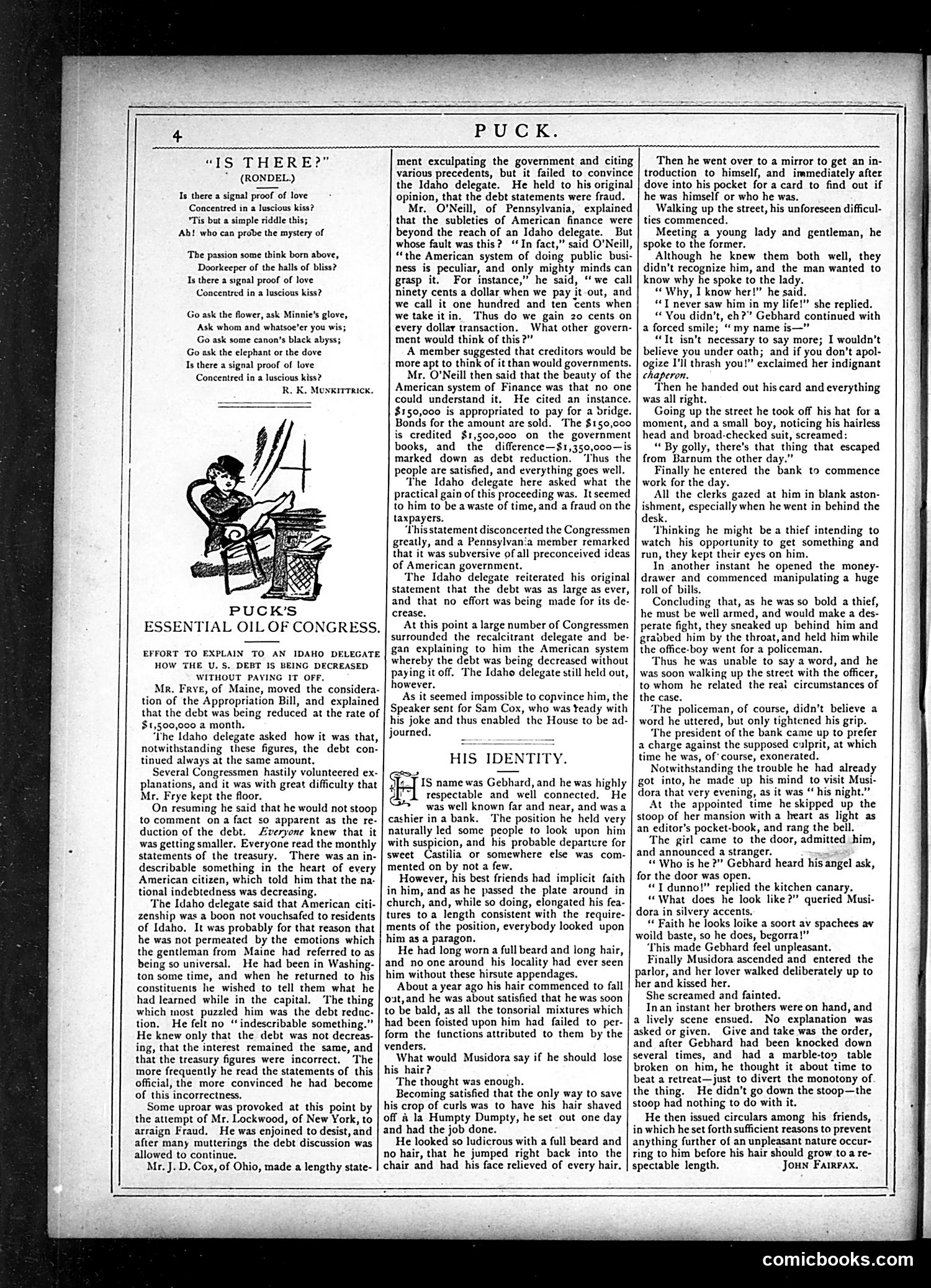
This page satirizes Congressional debates over the federal debt and deficit spending. The central cartoon, "Puck's Essential Oil of Congress," depicts a small figure (the Idaho delegate) presenting arguments about debt reduction to skeptical lawmakers. The text mocks an Idaho congressman's attempts to convince colleagues that creative accounting—counting debt reduction in creative ways—could resolve fiscal problems. Mr. O'Neill (Pennsylvania) and others dispute his claims, arguing the debt remains unchanged regardless of how it's presented. The satire targets government fiscal dishonesty: politicians making false claims about budget improvements through accounting manipulation rather than genuine spending cuts. The humor lies in exposing the gap between political rhetoric and economic reality—a timeless concern applicable to modern debates.
📄 Transcribed text from this page (OCR, searchable)
Machine-transcribed from the original scan — historical spelling and the odd misread are preserved.
PUCK. “IS THERE?” * (RONDEL.) Is there a signal proof of love Concentred in a luscious kiss? "Tis but a simple riddle this; Ab! who can probe the mystery of The passion some think born above, Doorkeeper of the halls of bliss? Is there a signal proof of love Concentred in a luscious kiss? Go ask the flower, ask Minnie’s glove, ‘Ask whom and whatsoe’er you wis; Go ask some canon’s black abyss; Go ask the elephant or the dove Is there a signal proof of love Concentred in a luscious kiss? Mowxrrrrick. PUCK’S ESSENTIAL OIL OF CONGRESS. EFFORT TO EXPLAIN TO AN IDAHO DELEGATE HOW THE U.S. DEBT IS BEING DECREASED WITHOUT PAVING IT OFF. Mr. Frye, of Maine, moved the considera- tion of the Appropriation Bill, and explained that the debt was being reduced at the rate of $1,500,000 a month. ‘The Idaho delegate asked how it was that, notwithstanding these figures, the debt con- tinued always at the same amount. Several Congressmen hastily volunteered ex- planations, and it was with great difficulty that Mr. Frye kept the floor. On resuming he said that he would not stoop to comment on a fact so apparent as the re- duction of the debt. veryone knew that it was getting smaller. Everyone read the monthly statements of the treasury. There was an in- describable something in the heart of every American citizen, which told him that the na- tional indebtedness was decreasing. The Idaho delegate said that American citi- zenship was a boon not vouchsafed to residents of Idaho. It was probably for that reason that he was not permeated by the emotions which the gentleman from Maine had referred to as being so universal. He had been in Washing- ton some time, and when he returned to his constituents he wished to tell them what he had learned while in the capital. The thing which most puzzled him was the debt redne- tion, He felt no “indescribable something.” He knew only that the debt was not decreas- ing, that the interest remained the same, and that the treasury figures were incorrect. The more frequently he read the statements of this official, the more convinced he had become of this incorrectness, Some uproar was provoked at this point by the attempt of Mr. Lockwood, of New York, to arraign Fraud, He was enjoined to desist, and after many mutterings the debt discussion was allowed to continue. Mr. J. D. Cox, of Ohio, made a lengthy state- ment exculpating the government and citing various precedents, but it failed to convince the Idaho delegate. He held to his original opinion, that the debt statements were fraud. Mr. O'Neill, of Pennsylvania, explained that the subleties of American finance were beyond the reach of an Idaho delegate. But whose fault was this? ‘‘In fact,” said O'Neill, “the American system of doing public busi- ness is peculiar, and only mighty minds can grasp it. For instance,” he said, ‘we call ninety cents a dollar when we pay it out, and we call it one hundred and ten cents when we take itin. Thus do we gain 20 cents on every dollar transaction. What other govern- ment would think of this?” A member suggested that creditors would be more apt to think of it than would governments. Mr. O'Neill then said that the beauty of the American system of Finance was that no one could understand it. He cited an instance. $150,000 is appropriated to pay for a bridge. Bonds for the amount are sold. The $150,c00 is credited $1,500,000 on the government books, and the difference—$1,350,000—is marked down as debt reduction. ‘hus the people are satisfied, and everything goes well. The Idaho delegate here asked what the practical gain of this proceeding was. It seemed to him to be a waste of time, and a fraud on the taxpayers. ‘This statement disconcerted the Congressmen greatly, and a Pennsylvania member remarked that it was subversive of all preconceived ideas of American government. The Idaho delegate reiterated his original statement that the debt was as large as ever, and that no effort was being made for its de- crease. At this point a large number of Congressmen surrounded the recalcitrant delegate and be- gan explaining to him the American system whereby the debt was being decreased without paying it off. The Idaho delegate still held out, however. As it seemed impossible to copvince him, the Speaker sent for Sam Cox, who was teady with his joke and thus enabled the House to be ad- journed. HIS IDENTITY. i {'s name was Gebhard, and he was highly a. respectable and well connected. He was well known far and near, and was a cashier in a bank. The position he held very naturally led some people to look upon him with suspicion, and his probable departure for sweet Castilia or somewhere else was com- mented on by not a few. However, his best friends had implicit faith in him, and as he passed the plate around in church, and, while so doing, elongated his fea- tures toa length consistent with the require- ments of the position, everybody looked upon him as a paragon. He had long worn a full beard and long hair, and no one around his locality had ever seen him without these hirsute appendages. About a year ago his hair commenced to fall out,and he was about satisfied that he was soon to be bald, as all the tonsorial mixtures which had been foisted upon him had failed to per- form the functions attributed to them by the venders. What would Musidora say if he should lose his hair? ‘The thought was enough. Becoming satisfied that the only way to save his crop of curls was to have his hair shaved off & la Humpty Dumpty, he set out one day and had the job done. He looked so ludicrous with a full beard and no hair, that he jumped right back into the chair and had his face relieved of every hair. Then he went over to a mirror to get an in- troduction to himself, and immediately after dove into his pocket for a card to find out if he was himself or who he was. Walking up the street, his unforeseen difficul- ties commenced. Meeting a young lady and gentleman, he spoke to the former. Although he knew them both well, they didn’t recognize him, and the man wanted to know why he spoke to the lady. “Why, I know her!”” he sai “T never saw him in my life!” she replied. “You didn’t, eh?” Gebhard continued with a forced smile; “my name is—” “Tt isn't necessary to say more; I wouldn’t believe you under oath; and if you don’t apol- ogize I'll thrash you!” exclaimed her indignant chaperon. Then he handed out his card and everything was all right. Going up the street he took off his hat for a moment, and a small boy, noticing his hairless head and broad-checked suit, screamed: “ By golly, there’s that thing that escaped from Barnum the other day.” Finally he entered the bank to commence work for the day. All the clerks gazed at him in blank aston- ishment, especially when he went in behind the desk. ‘Thinking he might bea thief intending to watch his opportunity to get something and run, they kept their eyes on him. In another instant he opened the money- drawer and commenced manipulating a huge roll of bills. Concluding that, as he was so bold a thief, he must be well armed, and would make a des- perate fight, they sneaked up behind him and grabbed him by the throat, and held him while the office-boy went for a policeman. ‘Thus he was unable to say a word, and he was soon walking up the street with the officer, to whom he related the reai circumstances of the case. ‘The policeman, of course, didn’t believe a word he uttered, but only tightened his grip. ‘The president of the bank came up to prefer a charge against the supposed culprit, at which time he was, of’ course, exonerated. Notwithstanding the trouble he had already got into, he made up his mind to visit Musi- dora that very evening, as it was “ his night.” At the appointed time he skipped up the stoop of her mansion with a heart as light as an editor’s pocket-book, and rang the bell. The girl came to the door, admitted him, and announced a stranger. “Who is he ?” Gebhard heard his angel ask, for the door was open. “J dunno!” replied the kitchen canary, “What does he look like?” queried Musi- dora in silvery accents. “ Faith he looks loike a soort av spachees av woild baste, so he does, begorra!”" ‘This made Gebhard feel unpleasant. Finally Musidora ascended and entered the parlor, and her lover walked deliberately up to her and kissed her. She screamed and fainted. Inan instant her brothers were on hand, and a lively scene ensued. No explanation was asked or given. Give and take was the order, and after Gebhard had been knocked down several times, and had a marble-ton table broken on him, he thought it about time to beat a retreat—just to divert the monotony of. the thing. He didn’t go down the stoop—the stoop had nothing to do with it. He then issued circulars among his friends, in which he set forth sufficient reasons to prevent anything further of an unpleasant nature occur- ring to him before his hair should grow toa re- spectable length. Joun Farrrax,