
A complete issue · 16 pages · 1878
Puck — April 3, 1878
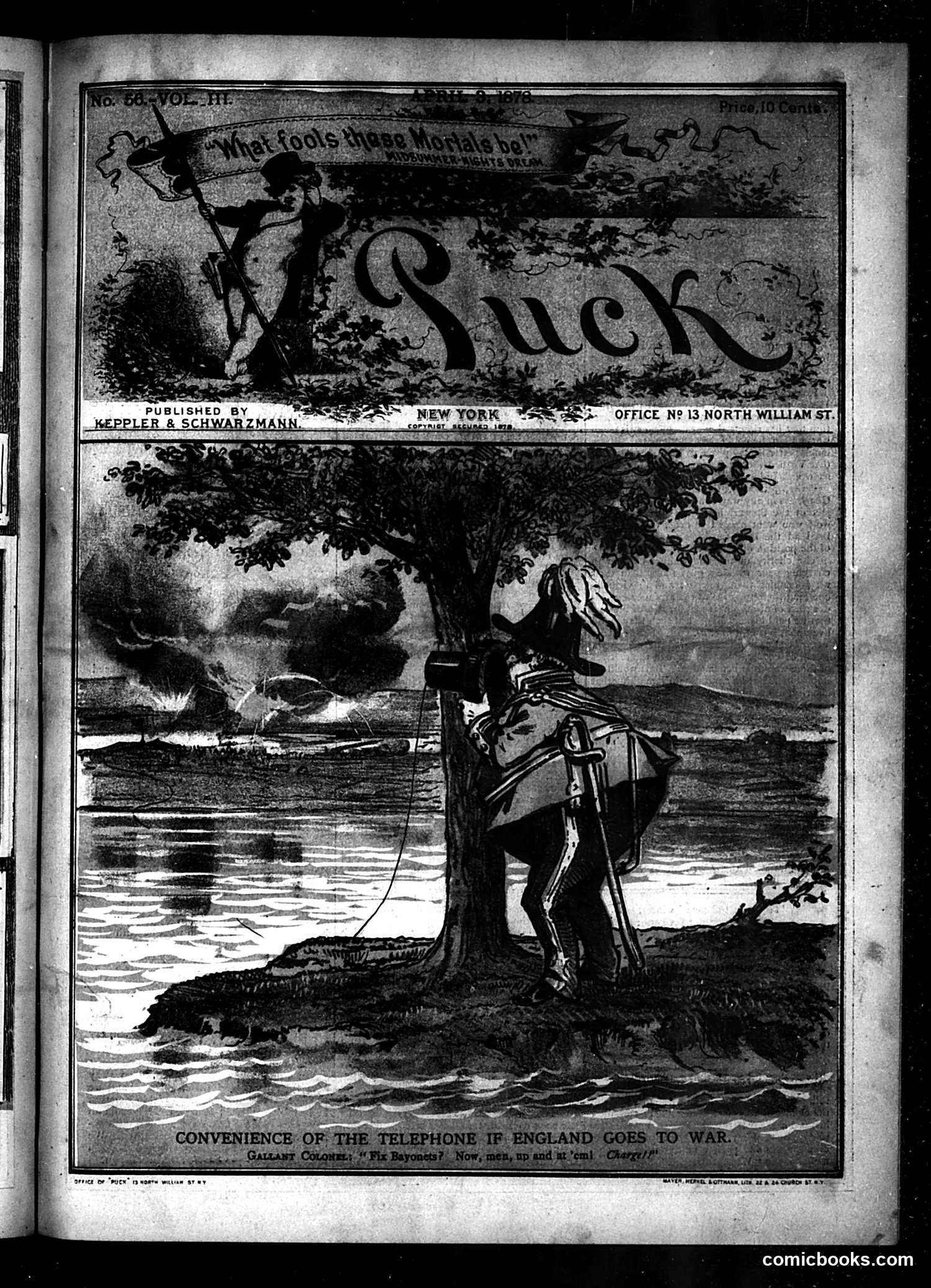
This Puck cartoon appears to comment on British military preparedness during a period of war tension (likely early 20th century, given the reference to "England goes to war"). The image shows a British soldier standing by a tree near water, apparently attempting to use a telephone. The caption's dialogue—"Fix Bayonets? Now, men, up and at 'em! Charge!"—suggests satire about outdated military communication methods. The joke critiques the "convenience of the telephone if England goes to war": the soldier must awkwardly position himself at this tree (presumably where a telephone line is located) to receive orders, rather than having modern tactical communication. This satirizes Britain's military infrastructure as inefficient or comically dependent on fixed telephone locations for command-and-control during combat operations.
This page (No. 13, North William Street, New York) contains three separate sections: 1. **"The Women's Home"** — An editorial praising charitable institutions, specifically comparing Stewart's Women's Home favorably to Judge Hilton's rival facility. It argues Stewart's charity is genuinely beneficial, while Hilton's is self-serving and insufficiently generous. 2. **"Stewart's Women's Hotel: Rules and Regulations"** — A detailed list of boarding house rules covering admission requirements, room assignments, meals, conduct, and pet policies. 3. **"Puckerings"** — A humor column with brief jokes and observations about social matters (chest-protectors, wives, daisies, etc.). The page primarily serves as **institutional advertising and social commentary** rather than political satire. It promotes Stewart's Women's Home as morally superior to competitors through editorializing.
This page contains two distinct articles: "The New Basis" (a political editorial) and "Mythology on the Half-Shell: Andromeda" (a satirical mythological narrative). "The New Basis" criticizes U.S. foreign policy, arguing that the nation should not adopt the diplomatic practices of European powers. The author defends American exceptionalism and "ninety-two per cent" honesty as a national advantage, protesting against what appears to be pressure to engage in duplicitous international dealings. "Andromeda" is a humorous retelling of Greek mythology, mocking the princess's rescue by Perseus. The satire ridicules romantic heroism and parental authority, presenting Andromeda's situation ironically—she's ultimately bound by family obligation rather than freed by her rescuer. Both pieces employ satire to critique contemporary social and political conventions through classical and diplomatic frameworks.
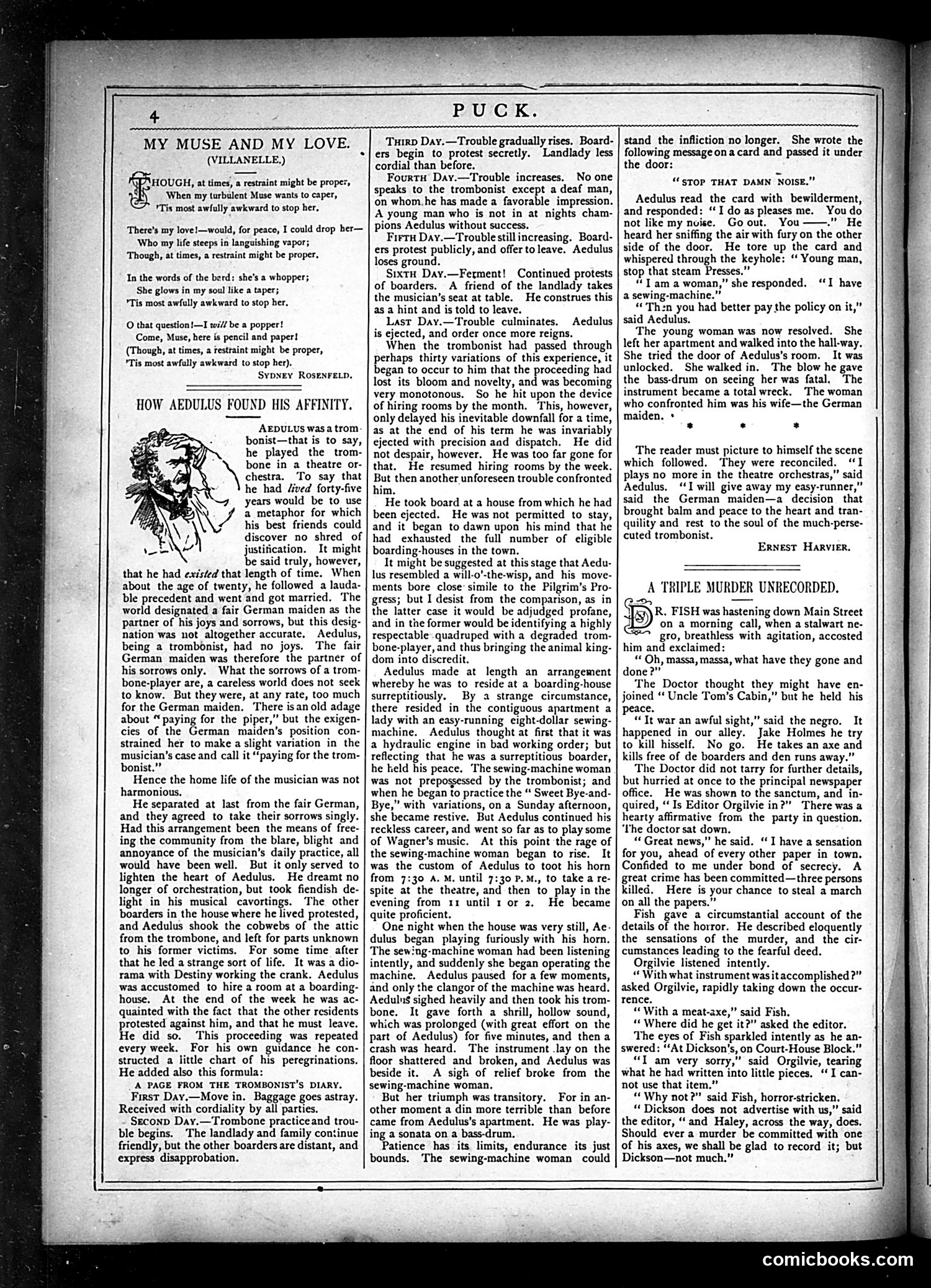
This page contains three distinct pieces of satirical fiction and humor rather than political cartoons: 1. **"My Muse and My Love"** - A short poem by Sidney Rosenfeld with an accompanying illustration of a woman's face. It's a romantic/humorous verse about artistic inspiration. 2. **"How Aedulus Found His Affinity"** - A longer satirical story about a trombonist named Aedulus struggling to find boarding accommodations in town. The narrative mocks his musical ambitions and social awkwardness, using his instrument as a source of comic conflict with landlords and neighbors. 3. **"A Triple Murder Unrecorded"** - A mystery story fragment involving characters named Fish, Holmes (likely referencing Sherlock Holmes), and others discussing a crime discovered in an alley. These appear to be entertainment fiction rather than political satire.
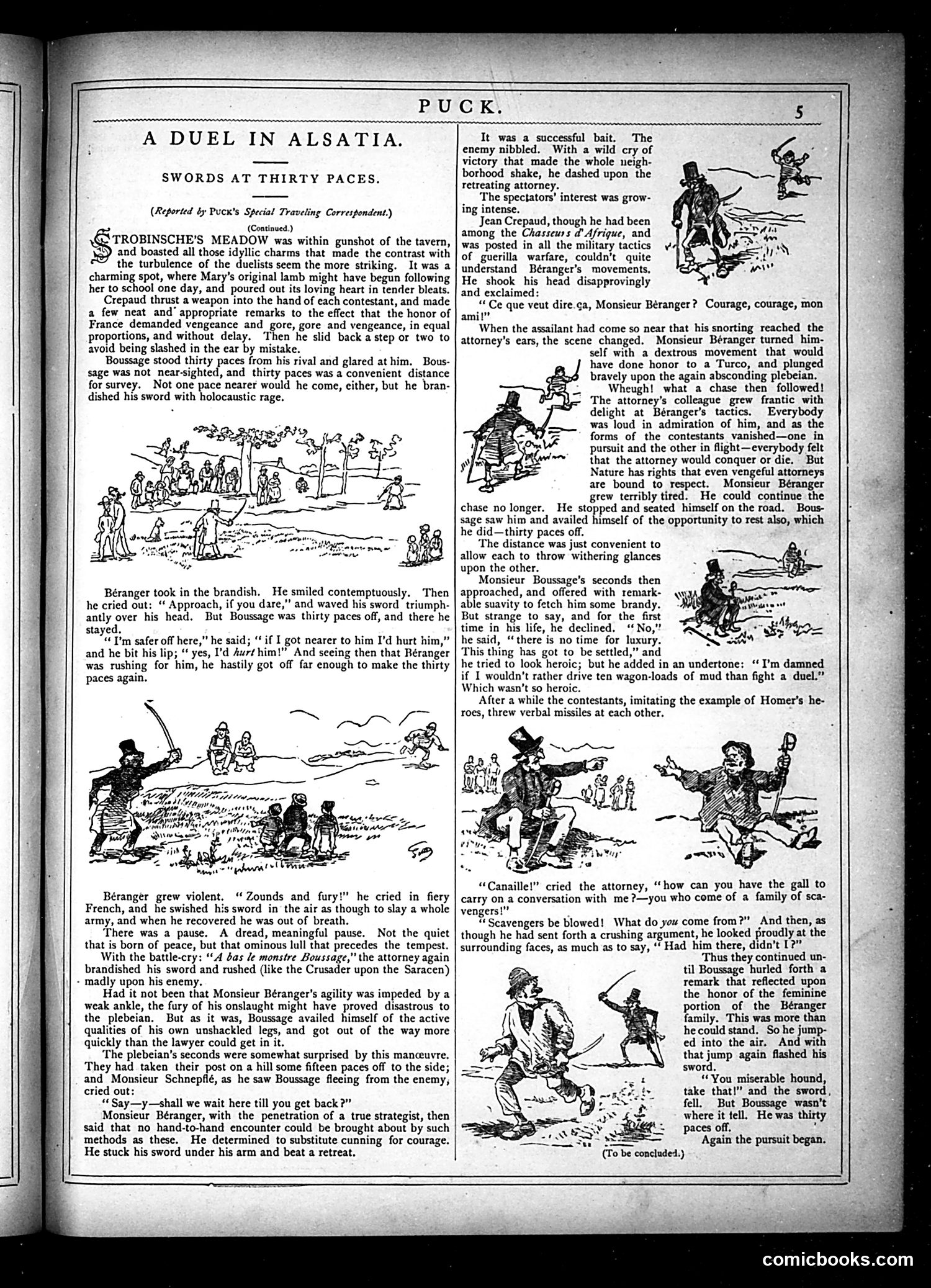
This satirical article describes a legal confrontation between two French figures—likely attorneys or public figures—presented as a mock-heroic duel. The text employs flowery, exaggerated language comparing their dispute to classical combat, with references to Homer and military tactics. The illustrations depict the "duelists" in increasingly absurd poses—striking theatrical sword-fighting stances, tumbling, and gesticulating wildly. The satire mocks the pretentiousness of French legal or political disputes, suggesting that heated verbal arguments are being artificially dramatized as matters of honor requiring combat. The humor targets French cultural affectation and the gap between grandiose rhetoric and actual substance—turning a professional disagreement into burlesque theatrical performance.
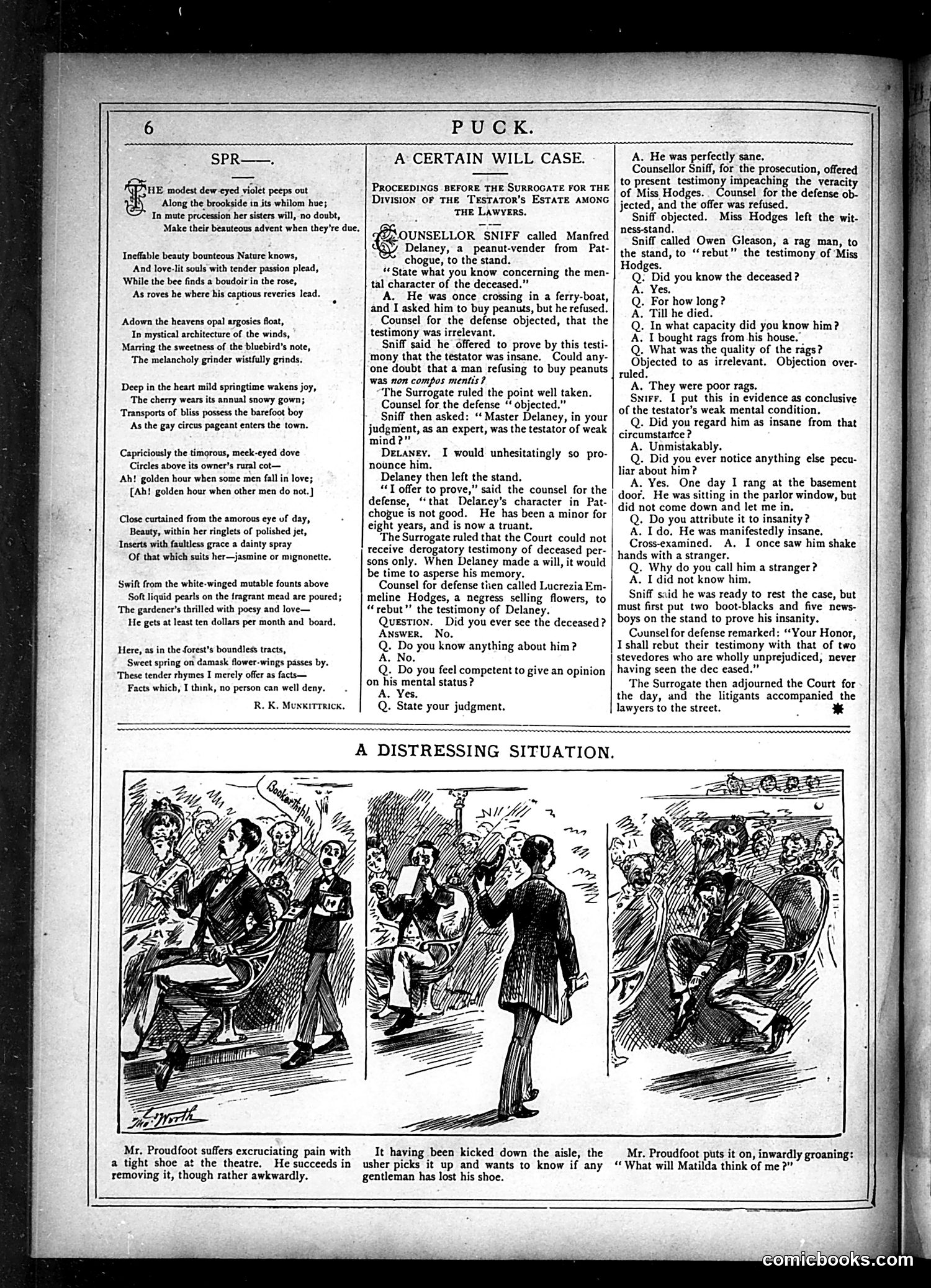
**Legal Satire Section ("A Certain Will Case"):** This section mocks courtroom proceedings where a peanut vendor's testimony about a deceased man's sanity is being used to prove the testator was mentally incompetent. The humor lies in the absurdity: a minor incident (refusing to buy peanuts) becomes "conclusive evidence" of insanity. It satirizes how lawyers construct weak arguments into legal precedents, and how courts accept dubious expert testimony. **"A Distressing Situation" Cartoon:** Three panels show Mr. Proudfoot suffering increasingly awkward consequences after his shoe is kicked off in a crowded venue. The humor derives from physical comedy and social embarrassment—his visible distress as he tries to retrieve his shoe and explain his predicament to onlookers. The caption suggests his wife Matilda will be displeased, adding domestic tension to the public humiliation.
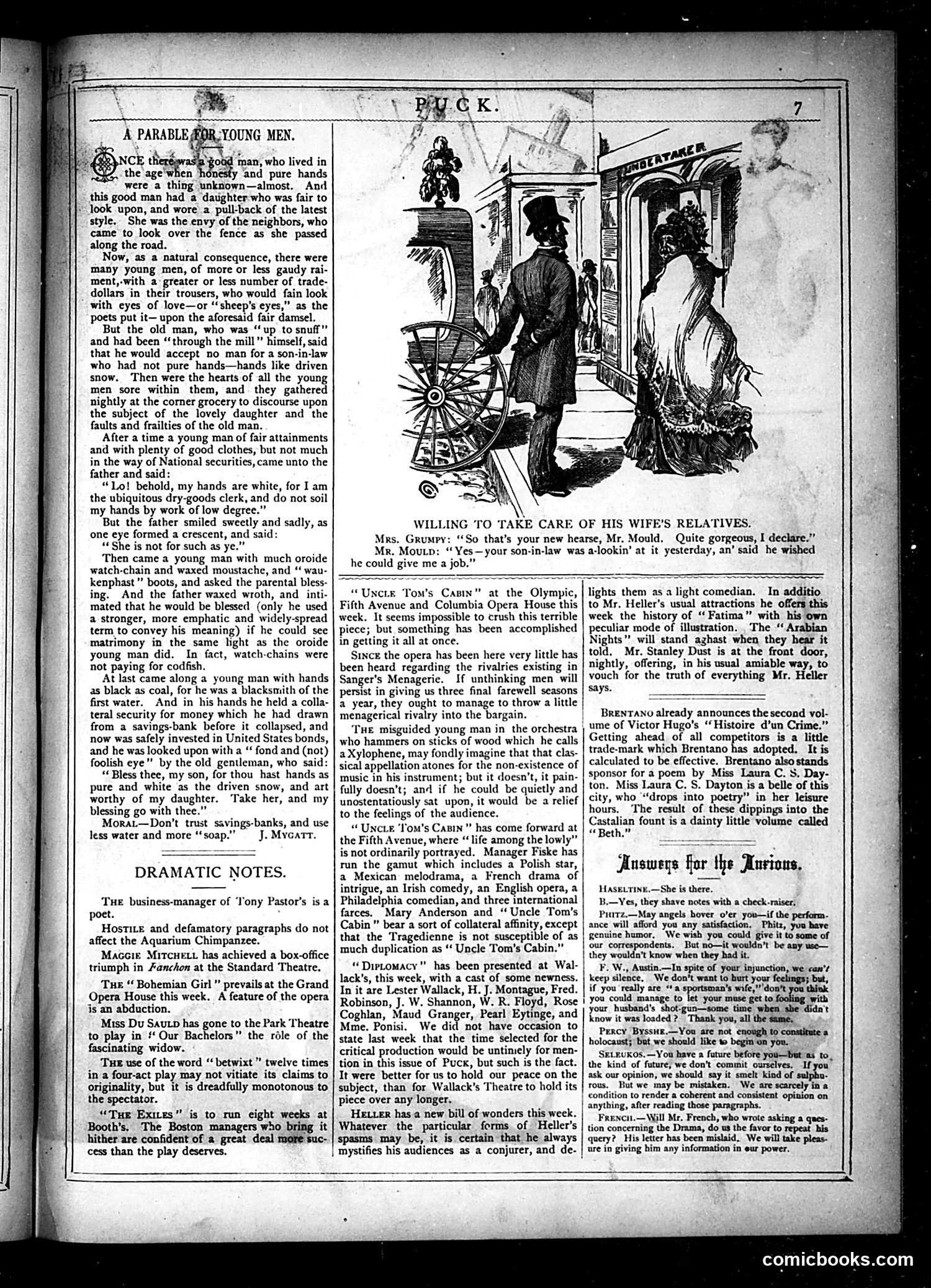
This page contains **"A Parable for Young Men,"** a morality tale about a good man whose daughter attracts suitors. The old man rejects a wealthy dry-goods clerk with "pure hands" as unsuitable, instead accepting a younger man of good character and honest labor. The accompanying illustration, titled **"Willing to Take Care of His Wife's Relatives,"** depicts a domestic scene where a man accepts a job to support his new wife's family. Mrs. Grumpy comments on their "gorgeous" new horse while Mr. Mould admits he's willing to work. The satire targets class pretension—mocking the wealthy merchant's snobbery while endorsing honest work and family duty. Below are theatrical notes covering opera productions and performances at various New York venues. The overall message: character and willingness to work matter more than wealth or status.
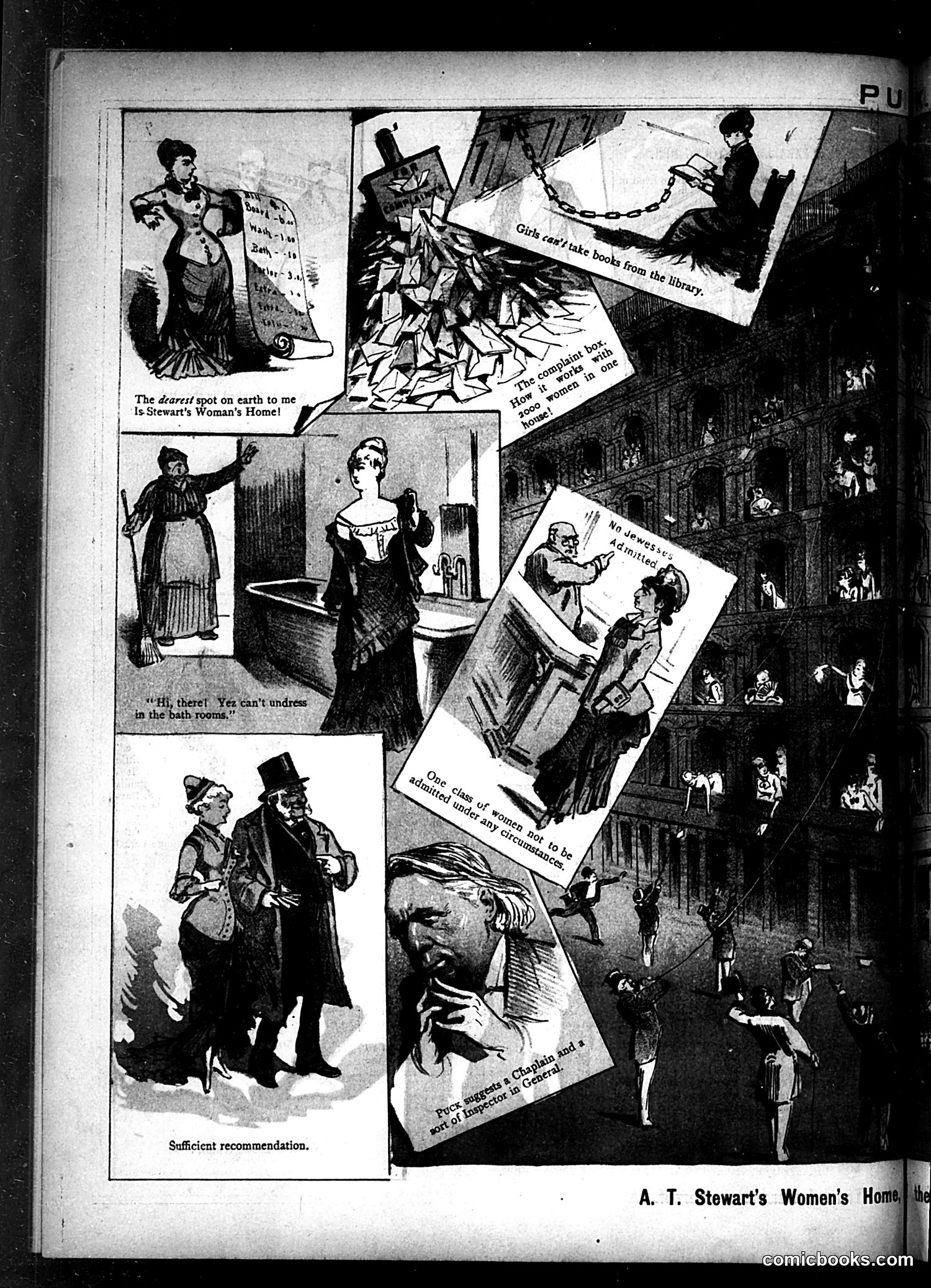
This appears to be a multi-panel comic satirizing **A. T. Stewart's Women's Home** (visible at bottom), likely a charitable institution or boarding house. The cartoons mock the establishment's claims and conditions through exaggerated scenes: a woman in tattered clothing calls it "the dearest spot on earth"; girls are shown chained while supposedly "taking books from the library"; a cramped bathing scene includes sarcastic commentary about "undress"; and residents appear confined or controlled. The final panel shows two men—one apparently representing authority—with the caption "Sufficient recommendation," suggesting corruption or inadequate oversight. The satire critiques what's presented as a respectable women's charity, exposing allegedly poor conditions, restriction of freedom, and questionable management. The tone suggests investigative exposure rather than simple humor.
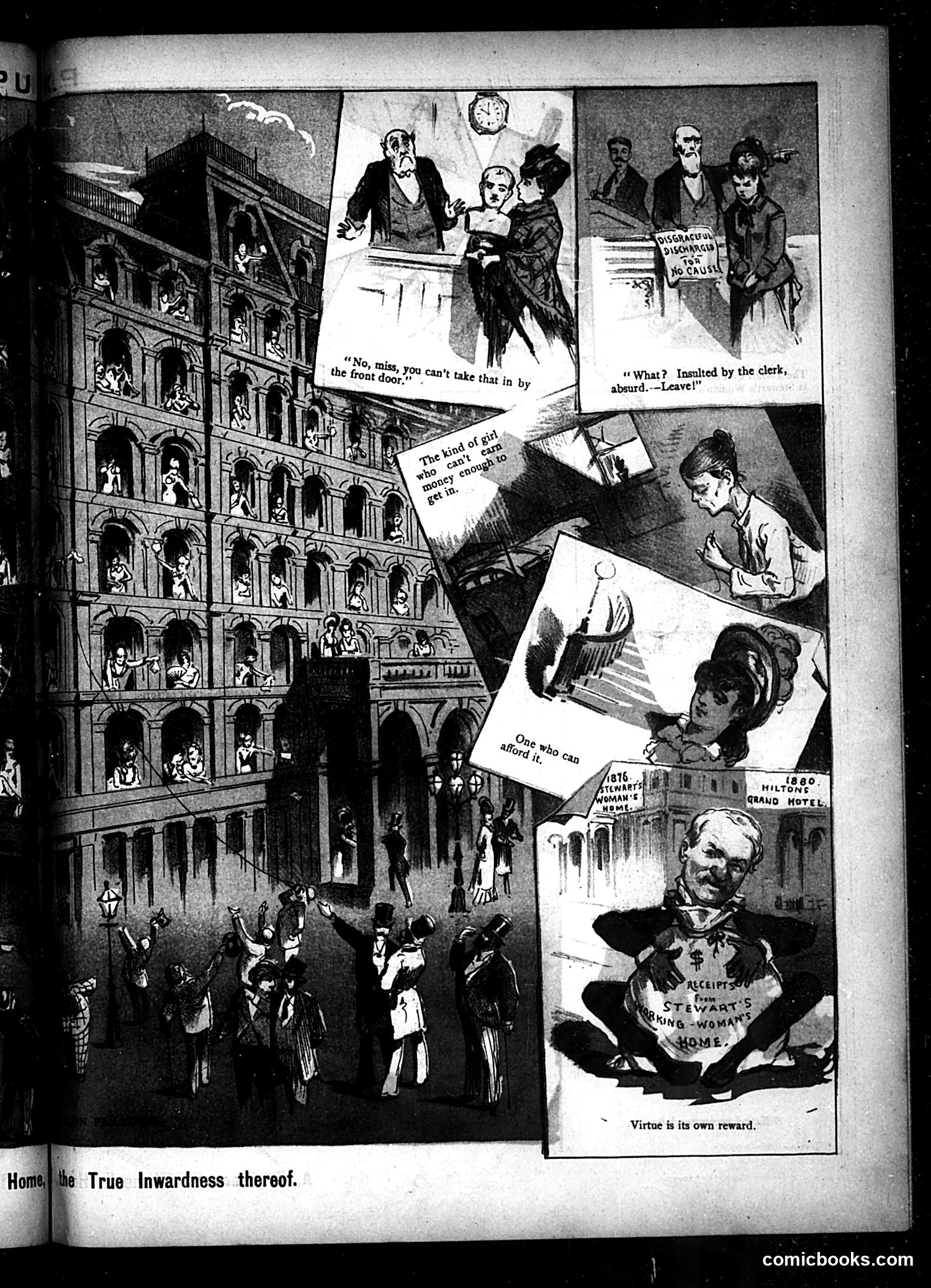
This appears to be a satirical comic about urban poverty and working-class housing conditions. The left panel shows a large, overcrowded tenement building with dozens of residents visible in windows—a visual critique of dense, inadequate housing. The right panels follow a narrative involving what appears to be a poor working woman. Dialogue includes "No, miss, you can't take that in by the front door" and references to a clerk being "insulted" and "absurd." The final panel shows a woman with text reading "RECEIPT OF ST. STEWART'S WORKING-WOMAN'S HOME" and concludes "Virtue is its own reward." The satire appears to mock charitable institutions that claimed to help working women while maintaining strict, degrading rules—suggesting that virtue and respectability were demanded of the poor while society denied them basic dignity.
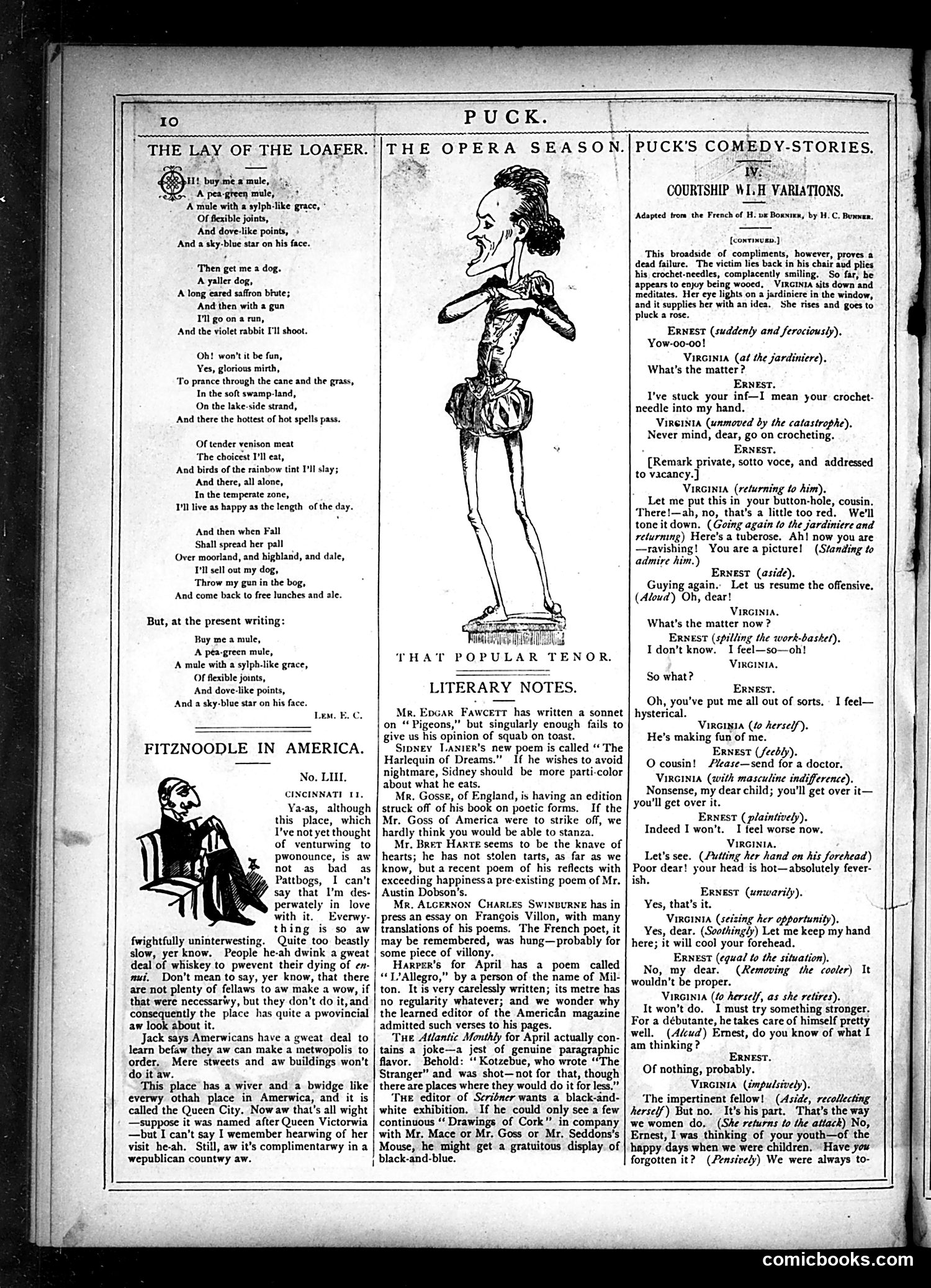
This caricature depicts an extremely thin, elongated male figure labeled "That Popular Tenor." The exaggerated skeletal proportions and grotesque facial features suggest satirical mockery of a contemporary opera singer who was apparently famous during this period. The cartoon likely ridicules both the performer's physical appearance and perhaps his reputation or performing style. Without additional context identifying which specific tenor this references, the exact target remains unclear, though the "popular" designation suggests he was a well-known figure of the era. The satirical intent focuses on physical caricature—a common Puck strategy—to make him an object of public mockery for readers familiar with this singer's fame.
This page contains dialogue from a theatrical scene, not a political cartoon. The text shows a romantic comedy between two characters, Ernest and Virginia, who are negotiating the terms of their relationship—specifically whether Virginia will marry Ernest. The scene involves verbal sparring typical of late 19th-century comedy: Ernest proposes marriage with conditions (Virginia cannot show him love), Virginia challenges these terms, and they banter about kissing, commitment, and emotional honesty. The humor derives from the artificial constraints Ernest places on their romance and Virginia's logical responses that expose the absurdity of his positions. Without seeing accompanying illustrations, the political or social satire—if any—remains unclear. This appears to be a play script rather than editorial commentary.
This page from *Puck* magazine contains no political cartoon. Instead, it presents **"The Two Neighbors of Quimper,"** a serialized short story by Katharine S. Macquoid appearing in Chapter V and VI. The narrative focuses on characters named Ernest, Virginia, Jean Picard, Olivier Logonna, and Françoise, discussing domestic troubles involving inheritance, a deceased husband, and family disputes in what appears to be a French provincial setting (Quimper). This is **literary fiction**, not satire or political commentary. The page demonstrates that *Puck*, while famous for satirical cartoons, also published serialized literature to fill editorial space and attract diverse readers during the late 19th/early 20th century.
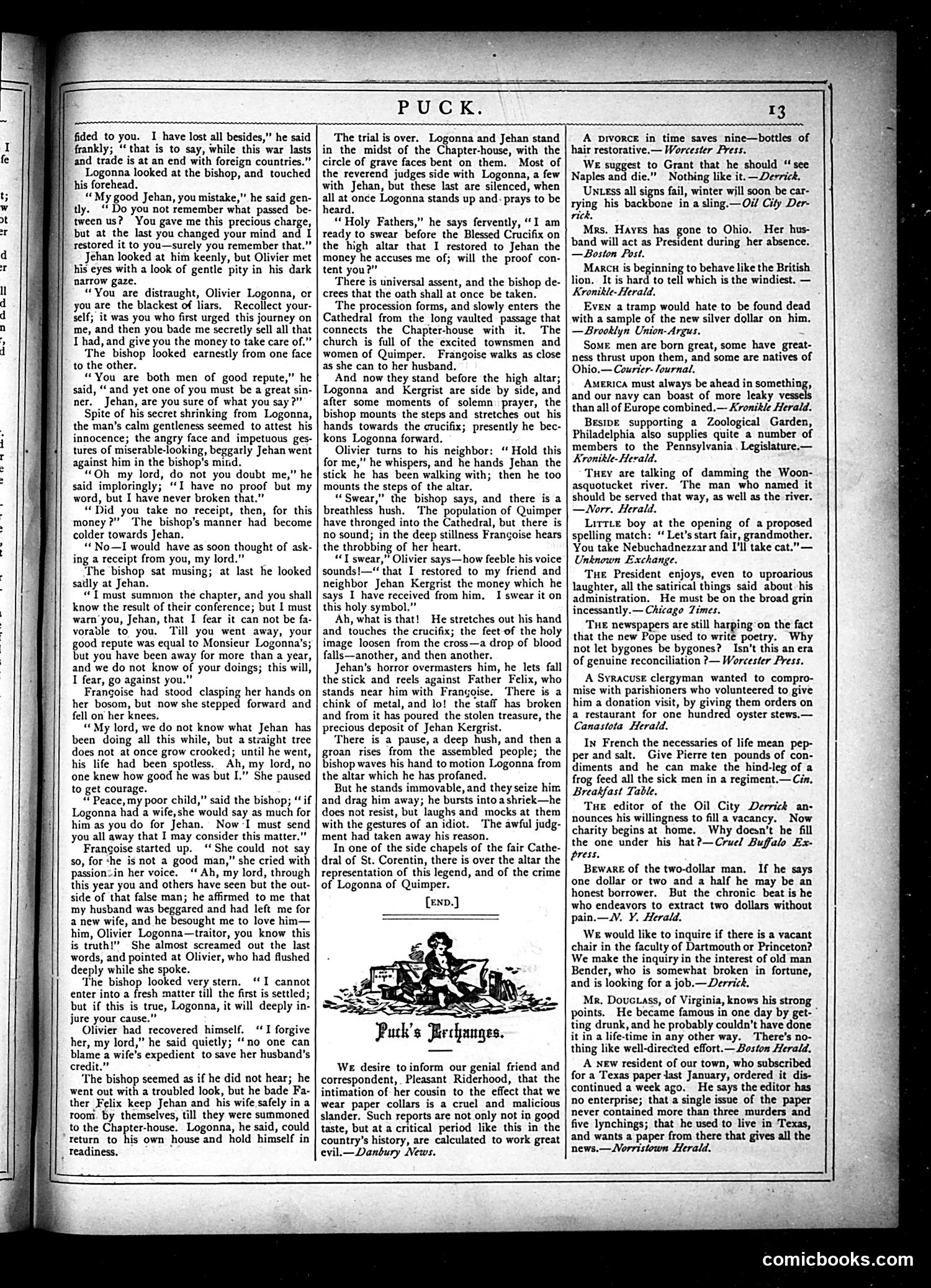
This page consists primarily of a serialized story titled "Puck's Perplexities" rather than political cartoons. The narrative involves a moral/legal dispute centered on Jehan and Logonna regarding disputed money and accusations of theft within a Cathedral setting. The page includes a small decorative illustration showing figures in classical dress, but this appears to be ornamental rather than satirical commentary. The remainder of the page contains brief news items and advertisements, including references to Ohio politics, British naval matters, and various civic issues—typical Puck filler content. **Without clear political caricatures or identifiable public figures visible in the artwork, I cannot determine specific satirical targets or commentary from this particular page.**
This page is primarily **advertising and announcements** for Puck Publishing Company, not political satire. The left column contains miscellaneous humorous quotes and editorial comments on various topics (New York Sun poetry, senators, editors' wives, doctors, silver dollars, etc.)—typical light satirical commentary rather than focused political cartooning. The main feature is **Puck's announcement of a new "Pictorial Department"** employing cartoonist **Joseph Keppler** to produce illustrations and lithographic portraits for theatrical clients and newspapers. A compressed yeast advertisement appears at bottom. There is **no major political cartoon visible** on this page. It functions as a business announcement and miscellaneous humor column, reflecting Puck's mixed content model of satire, jokes, and commercial notices.
This page is primarily advertising and back matter for Puck magazine, not political cartoons. The visible advertisements include: - Bitterwater (a patent medicine) - Portrait photography services - Dunlap & Co. (gentlemen's hats) - Printing ink manufacturers - A tailor shop - Pachtmann & Moelich (watches and jewelry) - Aberle's Tivoli Theatre (variety entertainment) - Vanity Fair Tobacco and Cigarettes - Puck's Almanac for 1878 - Wawerner Champagnes (wine) - Otto Stiehl's New York Glass Letter Co. The page concludes with notices about patent covers for filing Puck, back number availability, and publisher contact information. There are no significant political cartoons or satirical content visible on this page—it functions as a commercial and administrative section of the magazine.
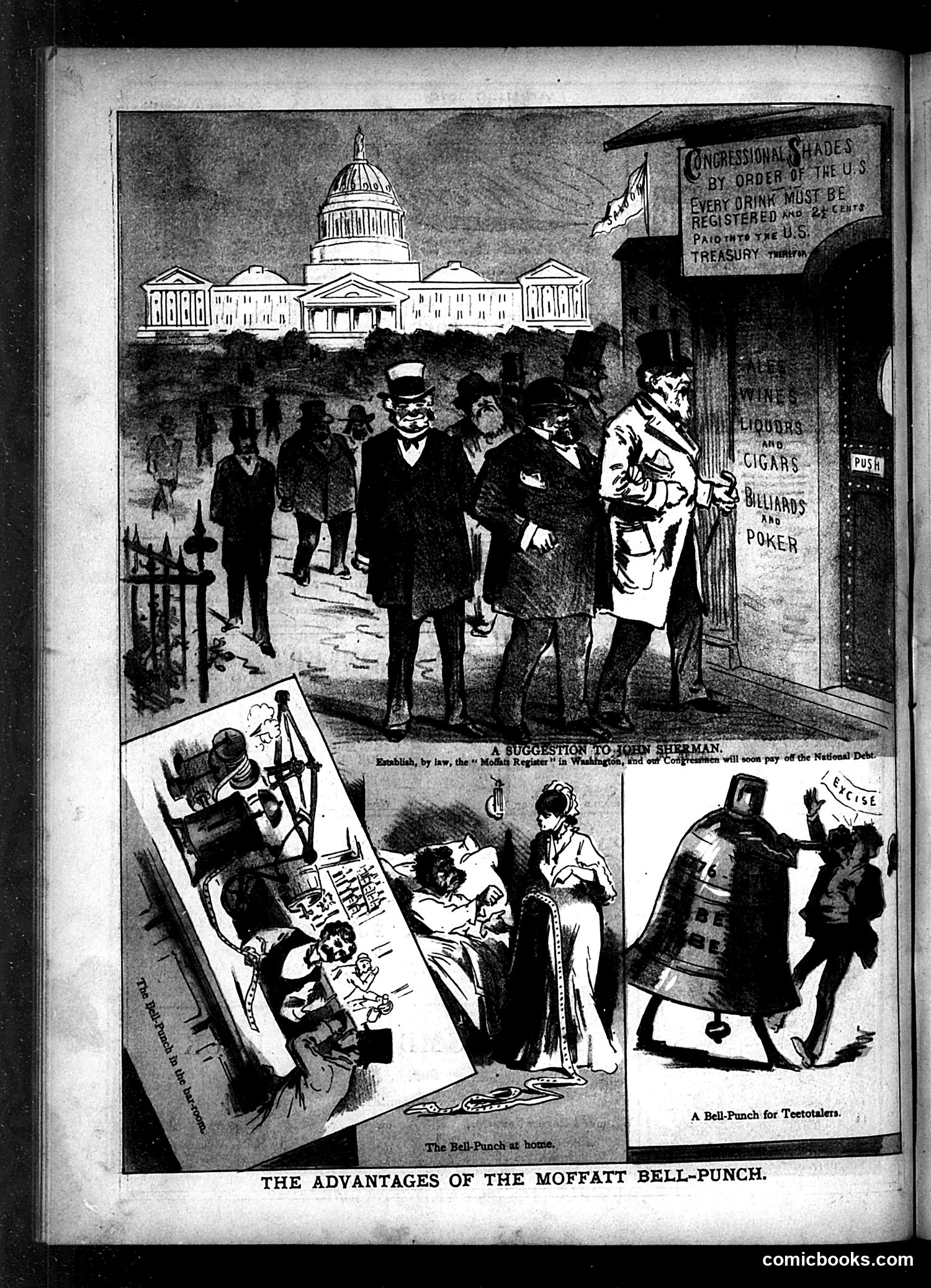
This page satirizes the **Moffatt Bell-Punch**, apparently a mechanical device for registering transactions. The top panel shows men in formal dress near the Capitol, with a sign advertising "Congressional Shades" (likely window coverings) and registration requirements—suggesting government corruption or hidden dealings. The bottom panels depict the bell-punch's "advantages": one shows it being used at home, another shows "A Bell-Punch for Teetotalers" (people abstaining from alcohol), suggesting the device could be ironically applied to enforce temperance or control drinking. The satire appears to mock both the mechanical device's promoters and, more broadly, government transparency efforts or prohibition-era regulation. The overall message critiques bureaucratic or regulatory excess through absurdist humor.