
Puck, 1878-04-03 · page 5 of 16
Puck — April 3, 1878 — page 5: what you’re looking at
What you’re looking at
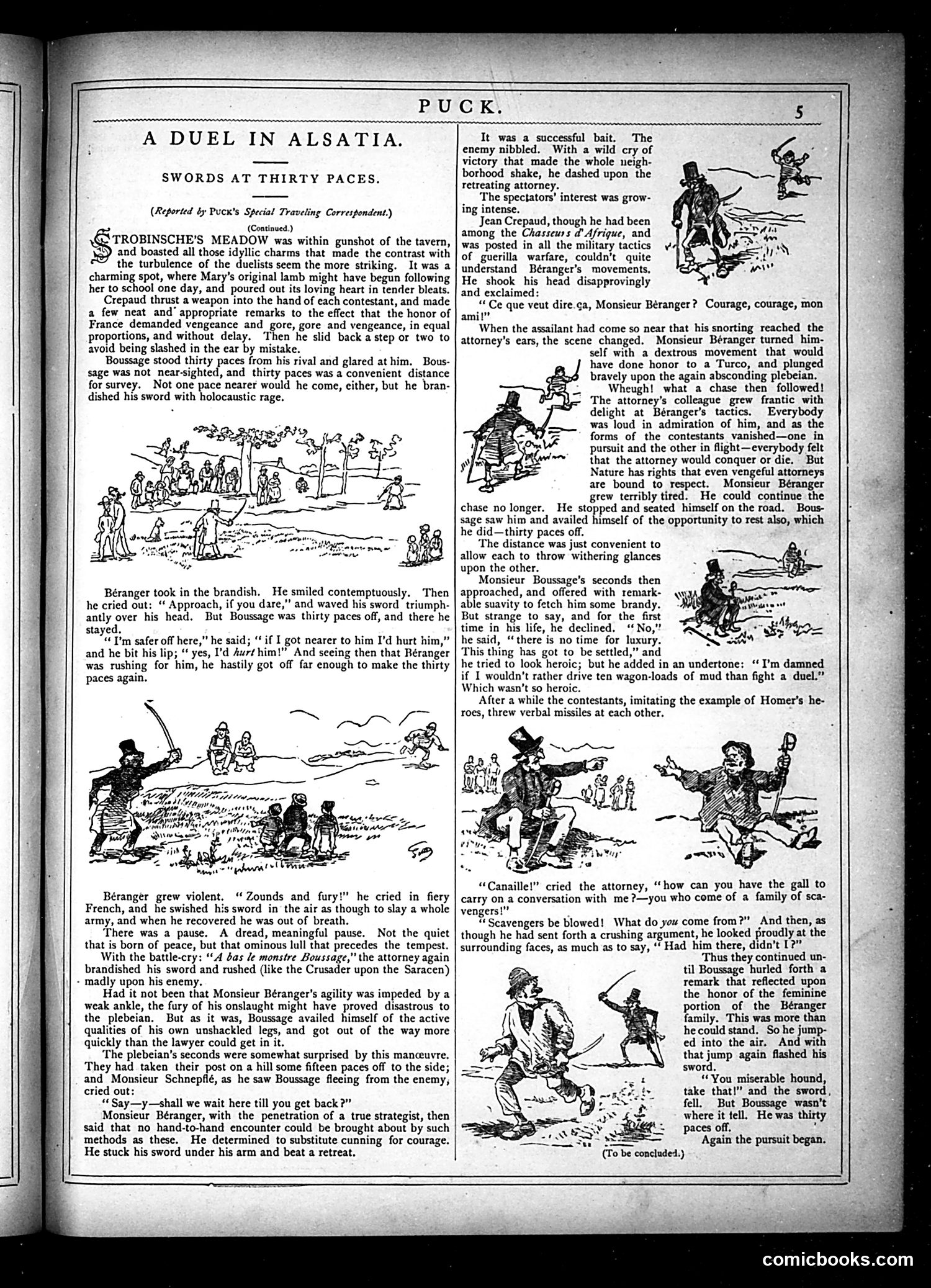
This satirical article describes a legal confrontation between two French figures—likely attorneys or public figures—presented as a mock-heroic duel. The text employs flowery, exaggerated language comparing their dispute to classical combat, with references to Homer and military tactics. The illustrations depict the "duelists" in increasingly absurd poses—striking theatrical sword-fighting stances, tumbling, and gesticulating wildly. The satire mocks the pretentiousness of French legal or political disputes, suggesting that heated verbal arguments are being artificially dramatized as matters of honor requiring combat. The humor targets French cultural affectation and the gap between grandiose rhetoric and actual substance—turning a professional disagreement into burlesque theatrical performance.
📄 Transcribed text from this page (OCR, searchable)
Machine-transcribed from the original scan — historical spelling and the odd misread are preserved.
PU CK. A DUEL IN ALSATIA. SWORDS AT THIRTY PACES. (Reported by Pucx's Special Traveling Correspondent.) (Continued.) TROBINSCHE'S MEADOW was within gunshot of the tavern, <s) and boasted all those idyllic charms that made the contrast with the turbulence of the duelists seem the more striking. It was a charming spot, where Mary’s original lamb might have begun following her to school one day, and poured out its loving heart in tender bleats. Crepaud thrust a weapon into the hand of each contestant, and made a few neat and’ appropriate remarks to the effect that the honor of France demanded vengeance and gore, gore and vengeance, in equal proportions, and without delay. ‘Then he slid back a step or two to avoid being slashed in the ear by mistake. Boussage stood thirty paces from his rival and glared at him. Bous- sage was not near-sighted, and thirty paces was a convenient distance for survey. Not one pace nearer would he come, either, but he bran- dished his sword with holocaustic rage. Béranger took in the brandish. He smiled contemptuously, ‘Then he cried out: “ Approach, if you dare,” and waved his sword. triumph- antly over his head. But Boussage was thirty paces off, and there he stayed, Me I'm safer off here,” he said; “‘ if 1 got nearer to him I'd hurt him,” and he bit his lip; ‘ yes, I'd Aurt him!” And seeing then that Réranger was rushing for him, he hastily got off far enough to make the thirty paces again. Kec Fea Qe ees at tne, a A cael comme areas Béranger grew violent. ‘Zounds and fury!” he cried in fiery French, and _ he swished his sword in the air as though to slay a whole army, and when he recovered he was out of breath. There was a pause. A dread, meaningful pause. Not the quiet that is born of peace, but that ominous lull that precedes the tempest. With the battle-cry: ‘(4 das /e monstre Boussage," the attorney again brandished his sword and rushed (like the Crusader upon the Saracen) - madly upon his enemy. Had it not been that Monsieur Béranger’s agility was impeded by a weak ankle, the fury of his onslaught might have proved disastrous to the plebeian. But as it was, Boussage availed himself of the active qualities of his own unshackled legs, and got out of the way more quickly than the lawyer could get in it. ‘The plebeian’s seconds were somewhat surprised by this manceuvre. They had taken their post on a hill some fifteen paces off to the side; and Monsieur Schnepfié, as he saw Boussage fleeing from the enemy, cried out: “ Say—y—shall we wait here till you get back?” Monsieur Béranger, with the penetration of a true strategist, then said that no hand-to-hand encounter could be brought about by such methods as these. He determined to substitute cunning for courage. He stuck his sword under his arm and beat a retreat. It was a successful bait. The enemy nibbled. With a wild cry of victory that made the whole neigh- borhood shake, he dashed upon the retreating attorney. The spectators’ interest was grow- ing intense. Jean Crepaud, though he had been among the Chasseurs d'Afrique, and was posted in all the military tactics of guerilla warfare, couldn't quite understand Béranger’s movements, He shook his head disapprovingly and exclaimed: “Ce que veut dire.ca, Monsieur Béranger? Courage, courage, mon ami!” When the assailant had come so near that his snorting reached the attorney's ears, the scene changed. Monsieur Béranger turned him- self with a dextrous movement that would have done honor to a Turco, and plunged bravely upon the again absconding plebeian. Wheugh! what a chase then followed! The attorney’s colleague grew frantic with delight at Béranger’s tactics. Everybody was loud in admiration of him, and as the forms of the contestants vanished—one in pursuit and the other in flight—everybody felt that the attorney would conquer or die. But Nature has rights that even vengeful attorneys are bound to respect. Monsieur Béranger grew terribly tired. He could continue the chase no longer. He stopped and seated himself on the road. Bous- sage saw him and availed himself of the opportunity to rest also, which he did—thirty paces off. The distance was just convenient to allow each to throw withering glances upon the other. Monsieur Boussage’s seconds then approached, and offered with remark- able suavity to fetch him some brandy. But strange to say, and for the first time in his life, he declined. ‘ No," he said, ‘there is no time for luxury. This thing has got to be settled,” and he tried to look heroic; but he added in an undertone: ‘I’m damned if I wouldn't rather drive ten wagon-loads of mud than fight a duel.” Which wasn’t so heroic. After a while the contestants, imitating the example of Homer’s he- roes, threw verbal missiles at each other. “Canaille!” cried the attorney, “how can you have the gall to carry on a conversation with me ?—you who come of a family of sca- vengers!"" > “Scavengers be blowed! What do you come from?” And then, as though he had sent forth a crushing argument, he looked proudly at the surrounding faces, as much as to say, “ Had him there, didn’t 1?” Thus they continued un- til Boussage hurled forth a remark that reflected upon the honor of the feminine portion of the Béranger family. This was more than hecould stand. So he jump- ed into the air. And with that jump again flashed his sword. “You miserable hound, take that!” and the sword, fell. But Boussage wasn't where it tell. He was thirty paces off, : Again the pursuit began. (To be concluded.) comicbooks.com