
Puck, 1878-04-03 · page 10 of 16
Puck — April 3, 1878 — page 10: what you’re looking at
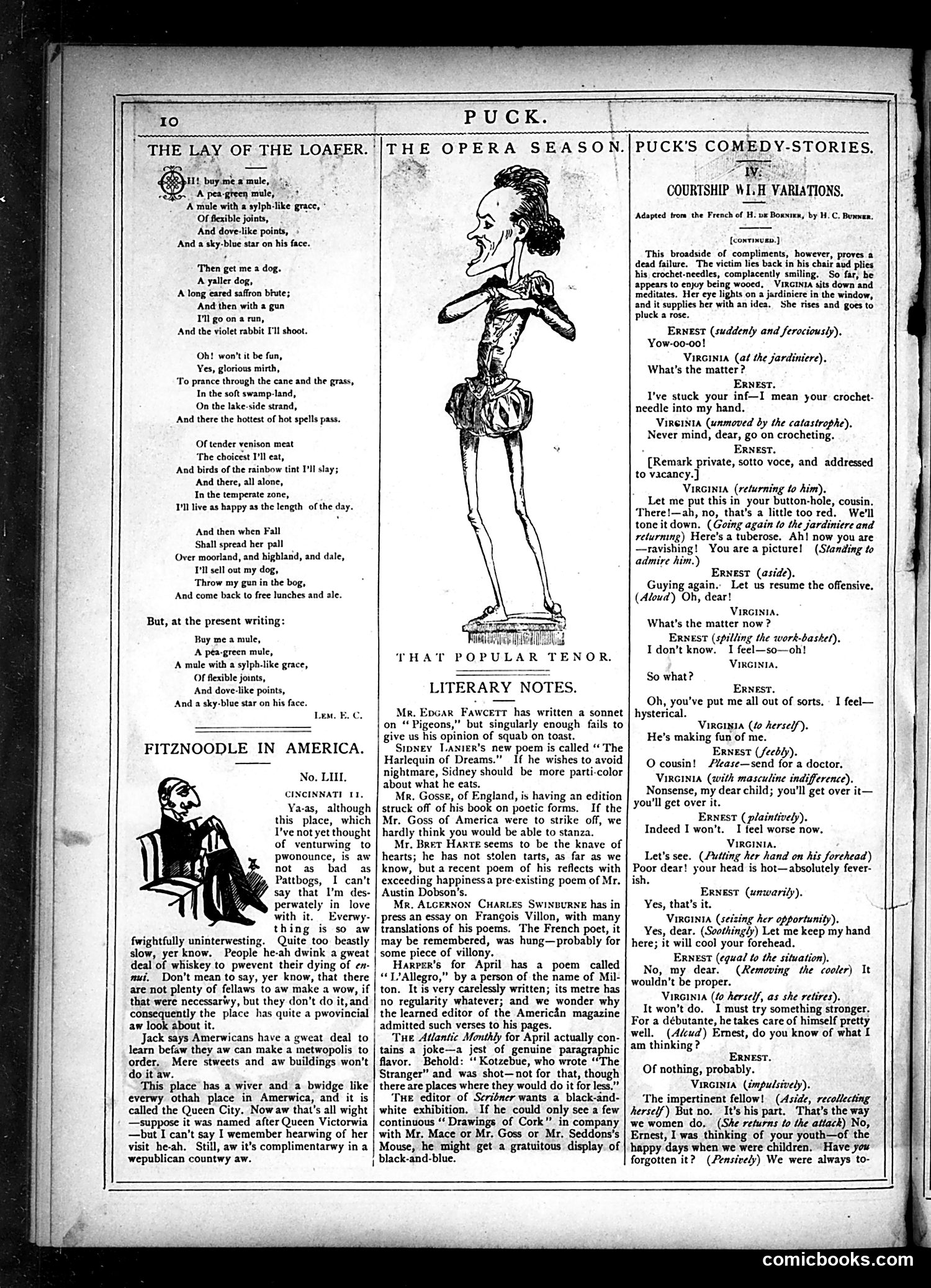
What you’re looking at
This caricature depicts an extremely thin, elongated male figure labeled "That Popular Tenor." The exaggerated skeletal proportions and grotesque facial features suggest satirical mockery of a contemporary opera singer who was apparently famous during this period. The cartoon likely ridicules both the performer's physical appearance and perhaps his reputation or performing style. Without additional context identifying which specific tenor this references, the exact target remains unclear, though the "popular" designation suggests he was a well-known figure of the era. The satirical intent focuses on physical caricature—a common Puck strategy—to make him an object of public mockery for readers familiar with this singer's fame.
📄 Transcribed text from this page (OCR, searchable)
Machine-transcribed from the original scan — historical spelling and the odd misread are preserved.
‘A pea-gteen mule, THE LAY OF THE LOAFER. | A niale with a eylph like grace,” Of flexible joints, And doveslike points,» And a sky-blue star on his face. ‘Then get me a dog. Ayaller dog, ‘A long eared saffron brute; ‘And then with a gun Tl go ona run, And the violet rabbit I'll shoot. Oh! won't it be fun, Yes, glorious mirth, To prance through the cane and the grass, In the soft swamp-land, On the lake-side strand, And there the hottest of hot spells pass. Of tender venison meat ‘The choicest I'll eat, And birds of the rainbow tint I'll slay; And there, all alone, In the temperate zone, T'll live as happy as the length of the day. And then when Fall Shall spread her pall Over moorland, and highland, and dale, I'l sell out my dog, ‘Throw my gun in the bog, ‘And come back to free lunches and ale. But, at the present writing: Buy me a mule, A péagreen mule, A male with a sylph-like grace, Of flexible joints, And dove-like points, And a sky-blue star on his face. Len. FITZNOODLE IN AMERICA. No. LIL. NCINNATI 11, Ya-as, although this place, which I've not yet thought of venturwing to pwonounce, is aw not as bad as Pattbogs, I can’t say that I’m des- perwately in love with it. Everwy- thing is so aw fwightfully uninterwesting. Quite too beastly slow, yer know. People he-ah dwink a gweat deal of whiskey to pwevent their dying of en- nui. Don’t mean to say, yer know, that there are not plenty of fellaws to aw make a wow, if that were necessarivy, but they don’t do it, and consequently the piace has quite a pwovincial | aw look about it. | Jack says Amerwicans have a gweat deal to learn befaw they aw can make a metwopolis to order. Mere stweets and aw buildings won't do it aw. This place has a wiver and a bwidge like eve othah place in Amerwica, and it is called the Queen City. Now aw that’s all wight —suppose it was named after Queen Victorwia —but I can’t say I wemember hearwing of her visit he-ah. Still, aw it’s complimentarwy in a wepublican countwy aw. | THE OPERA SEASON. pass 2 } THAT POPULAR TENOR. LITERARY NOTES. Mr. Epcar Fawcett has written a sonnet on “Pigeons,” but singularly enough fails to give us his opinion of squab on toast. Sipvey Lanier’s new poem is called “The Harlequin of Dreams.” If he wishes to avoid nightmare, Sidney should be more parti-color about what he eats. Mr. Gosse, of England, is having an edition struck off of his book on poetic forms. If the Mr. Goss of America were to strike off, we hardly think you would be able to stanza. Mr. Bret Harte seems to be the knave of hearts; he has not stolen tarts, as far as we know, but a recent poem of his reflects with exceeding happinessa pre-existing poem of Mr. Austin Dobson's. Mr. ALGERNON CHARLES SwINBURNE has in press an essay on Francois Villon, with many translations of his poems. The French poet, it may be remembered, was hung—probably for some piece of villony. Harper's for April has a poem called “T?Allegro,” by a person of the name of Mil- ton. It is very carelessly written; its metre has no regularity whatever; and we wonder why the learned editor of the Americin magazine admitted such verses to his pages. Tue Adlantic Monthly for April actually con- tains a joke—a jest of genuine paragraphic flavor. Behold: ‘Kotzebue, who wrote “The Stranger” and was shot—not for that, though there are places where they would do it for less.” ‘Tue editor of Scribner wants a black-and- white exhibition. If he could only see a few continuous ‘‘ Drawings of Cork” in company with Mr. Mace or Mr. Goss or Mr. Seddons’s Mouse, he might get a gratuitous display of black-and-blue. PUCK’S COMEDY-STORIES. COURTSHIP WI. H VARIATIONS. Adapted trom the French of H. pe Boxximn, by H.C. Burxan, [conrimvnp.) This broadside of compliments, however, proves a dead failure. The victim lies back in his chair aud plies his crochet-needles, complacently smiling. So far, be appears to enjuy being wooed, VIRGINIA sits down and meditates. Her eye lights on a jardiniere in the window, and it supplies her with an idea. She rises and goes to pluck a rose. Ernest (suddenly and ferociously), Yow-00-00! Viroinia (at the jardiniere). What's the matter ? ERNEsT. I’ve stuck your inf—I mean your crochet- needle into my hand. Vireinia (unmoved by the catastrophe). Never mind, dear, go on crocheting. ERNEST. [Remark private, sotto voce, and addressed to vacancy.] ‘Vircinia (returning to him). Let me put this in your button-hole, cousin. ‘There!—ah, no, that’s a little too red. We'll tone itdown. (Going again to the jardiniereand returning) Here's a tuberose. Ah! now you are —ravishing! You area picture! (Standing to admire him.) Ernest (aside). Guying again.. Let us resume the offensive, (Aloud) Oh, dear! VIRGINIA. What's the matter now ? Ernest (spilling the work-bashel). I don’t know. 1 feel—so—oh! Vircinia. So what? Ernest. Oh, you've put me all out of sorts. I feel— hysterical. Viroiysa (to herself). He's making fun of me. Ernest (feebly). O cousin! /vease—send for a doctor. Vircinia (with masculine indifference). Nonsense, my dear child; you'll get over it— you'll get over it. Ernest (plaintively). Indeed I won't. I feel worse now. VIRGINIA. Let's see. (Putting her hand on his forehead) Poor dear! your head is hot—absolutely fever- ish. Ernest (unwarily). Yes, that’s it. Virainta (seizing her opportunity), Yes, dear. (Soothingly) Let me keep my hand here; it will cool your forehead. Ernest (equal to the situation). No, my dear. (Removing the cooler) It wouldn't be proper. Viroinia (to herself, as she retires). It won't do. I must try something stronger. For a débutante, he takes care of himself pretty well. (Aud) Emmest, do you know of what I am thinking ? ERNEST. Of nothing, probably. Vircinia (impulsively). The impertinent fellow! (Aside, recollecting herself) But no. It’s his part. That's the way we women do. (She returns to the attack) No, Ernest, I was thinking of your youth—of the happy days when we were children. “Have you forgotten it? (Pensively) We were always to- comicbooks.com