
Puck, 1878-04-03 · page 4 of 16
Puck — April 3, 1878 — page 4: what you’re looking at
What you’re looking at
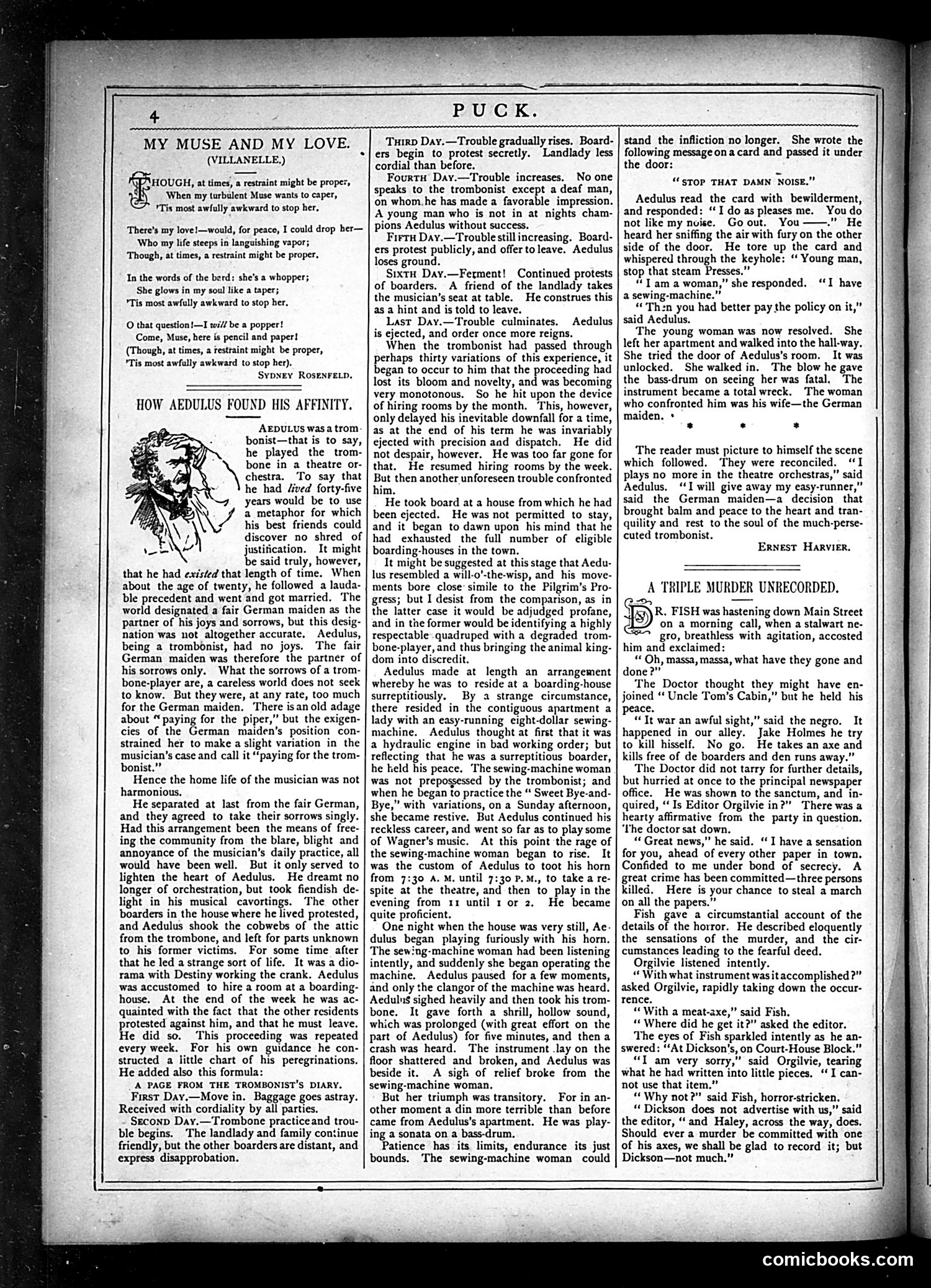
This page contains three distinct pieces of satirical fiction and humor rather than political cartoons: 1. **"My Muse and My Love"** - A short poem by Sidney Rosenfeld with an accompanying illustration of a woman's face. It's a romantic/humorous verse about artistic inspiration. 2. **"How Aedulus Found His Affinity"** - A longer satirical story about a trombonist named Aedulus struggling to find boarding accommodations in town. The narrative mocks his musical ambitions and social awkwardness, using his instrument as a source of comic conflict with landlords and neighbors. 3. **"A Triple Murder Unrecorded"** - A mystery story fragment involving characters named Fish, Holmes (likely referencing Sherlock Holmes), and others discussing a crime discovered in an alley. These appear to be entertainment fiction rather than political satire.
📄 Transcribed text from this page (OCR, searchable)
Machine-transcribed from the original scan — historical spelling and the odd misread are preserved.
PUCK. MY MUSE AND MY LOVE. (VILLANELLE.) ‘ HOUGH, at times, a restraint might be proper, When my turbulent Muse wants to caper, ‘Tis most awfully awkward to stop her. There’s my love!—would, for peace, I could drop her— ‘Who my life steeps in languishing vapor; ‘Though, at times, a restraint might be proper. In the words of the berd: she’s a whopper; She glows in my soul like a taper; ‘Tis most awfully awkward to stop her. O that question!—I wil! be a popper! Come, Muse, here is pencil and paper! (Though, at times, a restraint might be proper, "Tis most awfully awkward to stop her). SypNEY ROSENFELD, HOW AEDULUS FOUND HIS AFFINITY. AEDULUS wasa trom bonist—that is to say, he played the trom- bone in a theatre or- a ~ chestra, To say that Xe Vhe had Jived forty-five YC years would be to use PON 7 2 metaphor for which Ny his best friends could i) discover no shred of ot justification. It might be said truly, however, that he had existed that length of time. When about the age of twenty, he followed a lauda- ble precedent and went and got married. The world designated a fair German maiden as the partner of his joys and sorrows, but this desig- nation was not altogether accurate, Aedulus, being a trombonist, had no joys. The fair German maiden was therefore the partner of his sorrows only. What the sorrows of a trom- bone-player are, a careless world does not seek to know. But they were, at any rate, too much for the German maiden. There isan old adage about “paying for the piper,” but the exigen- cies of the German maiden’s position con- strained her to make a slight variation in the musician’s case and call it ‘paying for the trom- bonist.”” Hence the home life of the musician was not harmonious. He separated at last from the fair German, and they agreed to take their sorrows singly. Had this arrangement been the means of free- ing the community from the blare, blight and annoyance of the musician's daily practice, all would have been well. But it only served to lighten the heart of Aedulus. He dreamt no longer of orchestration, but took fiendish de- light in his musical cavortings. The other boarders in the house where he lived protested, and Aedulus shook the cobwebs of the attic from the trombone, and left for parts unknown to his former victims. For some time after that he led a strange sort of life. It was a dio- rama with Destiny working the crank. Aedulus was accustomed to hire a room at a boarding- house. At the end of the week he was ac- quainted with the fact that the other residents protested against him, and that he must leave. He did so. This proceeding was repeated every week. For his own guidance he con- structed a little chart of his peregrinations. He added also this formula: A PAGE FROM THE TROMBONIST’S DIARY. First Day.—Move in. Baggage goes astray. Received with cordiality by all parties. Seconp Day.—Trombone practiceand trou- Dle begins. The landlady and family continue friendly, but the other boarders are distant, and express disapprobation. Tuirp Day.—Trouble gradually rises. Board- ers begin to protest secretly. Landlady less cordial than before. FourtH Day.—Trouble increases. No one speaks to the trombonist except a deaf man, on whom.he has made a favorable impression. A young man who is not in at nights cham- pions Aedulus without success. Firtx Day.—Troublestill increasing. Board- ers protest publicly, and offer to leave. Aedulus loses ground. Sixtn Day.—Ferment! Continued protests of boarders. A friend of the landlady takes the musician's seat at table. He construes this as a hint and is told to leave. Last Day.—Trouble culminates, Aedulus is ejected, and order once more reigns. When the trombonist had passed through perhaps thirty variations of this experience, it began to occur to him that the proceeding had lost its bloom and novelty, and was becoming very monotonous. So he hit upon the device of hiring rooms by the month. This, however, only delayed his inevitable downfall for a time, as at the end of his term he was invariably ejected with precision aad dispatch. He did not despair, however. He was too far gone for that, He resumed hiring rooms by the week. fae then another unforeseen trouble confronted im. He took board at a house from which he had been ejected. He was not permitted to stay, and it began to dawn upon his mind that he had exhausted the full number of eligible boarding-houses in the town, It might be suggested at this stage that Aedu- lus resembled a will-o'-the-wisp, and his move- ments bore close: simile to the Pilgrim’s Pro- gress; but I desist from the comparison, as in the latter case it would be adjudged profane, and in the former would be identifying a highly respectable. quadruped with a degraded trom- bone-player, and thus bringing the animal king- dom into discredit. Aedulus made at length an arrangement whereby he was to reside at a boarding-house surreptitiously, By a strange circumstance, there resided in the contiguous apartment a lady with an casy-running eight-dollar sewing- machine. Aedulus thought at first that it was a hydraulic engine in bad working order; but reflecting that he was a surreptitious boarder, he held his peace. ‘The sewing-machine woman was not prepossessed by the trombonist; and when he began to practice the “ Sweet Bye-and- Bye,” with variations, on a Sunday afternoon, she became restive. But Aedulus continued his reckless career, and went so far as to play some of Wagner's music, At this point ‘the rage of the sewing-machine woman began to rise. It was the custom of Aedulus to toot his horn from 7:30 A.M. until 7:30 P.M., to take a re- spite at the theatre, and then to play in the evening from 11 until r or 2, He became quite proficient. One night when the house was very still, Ae- dulus began playing furiously with his horn. ‘The sewing-machine woman had been listening intently, and suddenly she began operating the machine. Aedulus paused for a few moments, and only the clangor of the machine was heard. Aedulus sighed heavily and then took his trom- bone. It gave forth a shrill, hollow sound, which was prolonged (with great effort on the part of Aedulus) for five minutes, and then a crash was heard. The instrument -lay on the floor shattered and broken, and Aedulus was beside it. A sigh of relief broke from the sewing-machine woman. But her triumph was transitory. For in an- other moment a din more terrible than before came from Aedulus’s apartment. He was play- ing a sonata on a bass-drum. Patience has its limits, endurance its just bounds. The sewing-machine woman could stand the infliction no longer. She wrote the following message on a card and passed it under the door: “(STOP THAT DAMN NOISE.” Aedulus read the card with bewilderment, and responded: “I do as pleases me. You do not like my nvise. Go out. You——.” He heard her sniffing the air with fury on the other side of the door. He tore up the card and whispered through the keyhole: “ Young man, stop that steam Presses.”” “Tam a woman,” she responded. “I have a sewing-machine.” “Thin you had better pay the policy on it,” said Aedulus. ‘The young woman was now resolved. She left her spertunect and walked into the hall-way. She tried the door of Aedulus’s room. It was unlocked. She walked in. The blow he gave the bass-drum on seeing her was fatal. The instrument became a total wreck. The woman who confronted him was his wife—the German maiden, + * * The reader must picture to himself the scene which followed. ‘They were reconciled. “1 plays no more in the theatre orchestras,” said Aedulus. ‘I will give away my easy-runner,” said the German maiden—a decision that brought balm and peace to the heart and tran- quility and rest to the soul of the much-perse- cuted trombonist. Ernest HArviER. A TRIPLE MURDER UNRECORDED. Da Is) R. FISH was hastening down Main Street on a morning call, when a stalwart ne- gro, breathless with agitation, accosted him and exclaimed: “Oh, massa, massa, what have they gone and done?” The Doctor thought they might have en- joined “ Uncle Tom’s Cabin,” but he held his peace. “Tt war an awful sight,” said the negro. It happened in our alley. Jake Holmes he try to kill hisself. No go. He takes an axe and kills free of de boarders and den runs away.” The Doctor did not tarry for further details, but hurried at once to the principal newspaper office. He was shown to the sanctum, and in- quired, ‘Is Editor Orgilvie in?” There was a hearty affirmative from the party in question. ‘The doctor sat down, “Great news,” he said. ‘I have a sensation for you, ahead of every other paper in town. Confided to me under bond of secrecy. A great crime has been committed—three persons killed. Here is your chance to steal a march on all the papers.” Fish gave a circumstantial account of the details of the horror. He described eloquently the sensations of the murder, and the cir- cumstances leading to the fearful deed. Orgilvie listened intently. “ With what instrument wasit accomplished?” asked Orgilvie, rapidly taking down the occur- rence. “With a meat-axe,” said Fish. ‘ Where did he get it?” asked the editor. ‘The eyes of Fish sparkled intently as he an- swered: “At Dickson’s, on Court-House Block.” “I am very sorry,” said Orgilvie, tearing what he had written into little pieces. ‘I can- not use that item.” “‘ Why not?” said Fish, horror-stricken. “Dickson does not advertise with us,” said the editor, “and Haley, across the way, does. Should ever a murder be committed with one of his axes, we shall be glad to record it; but Dickson—not much.” <4 comicbooks.com