
Puck, 1878-04-03 · page 3 of 16
Puck — April 3, 1878 — page 3: what you’re looking at
What you’re looking at
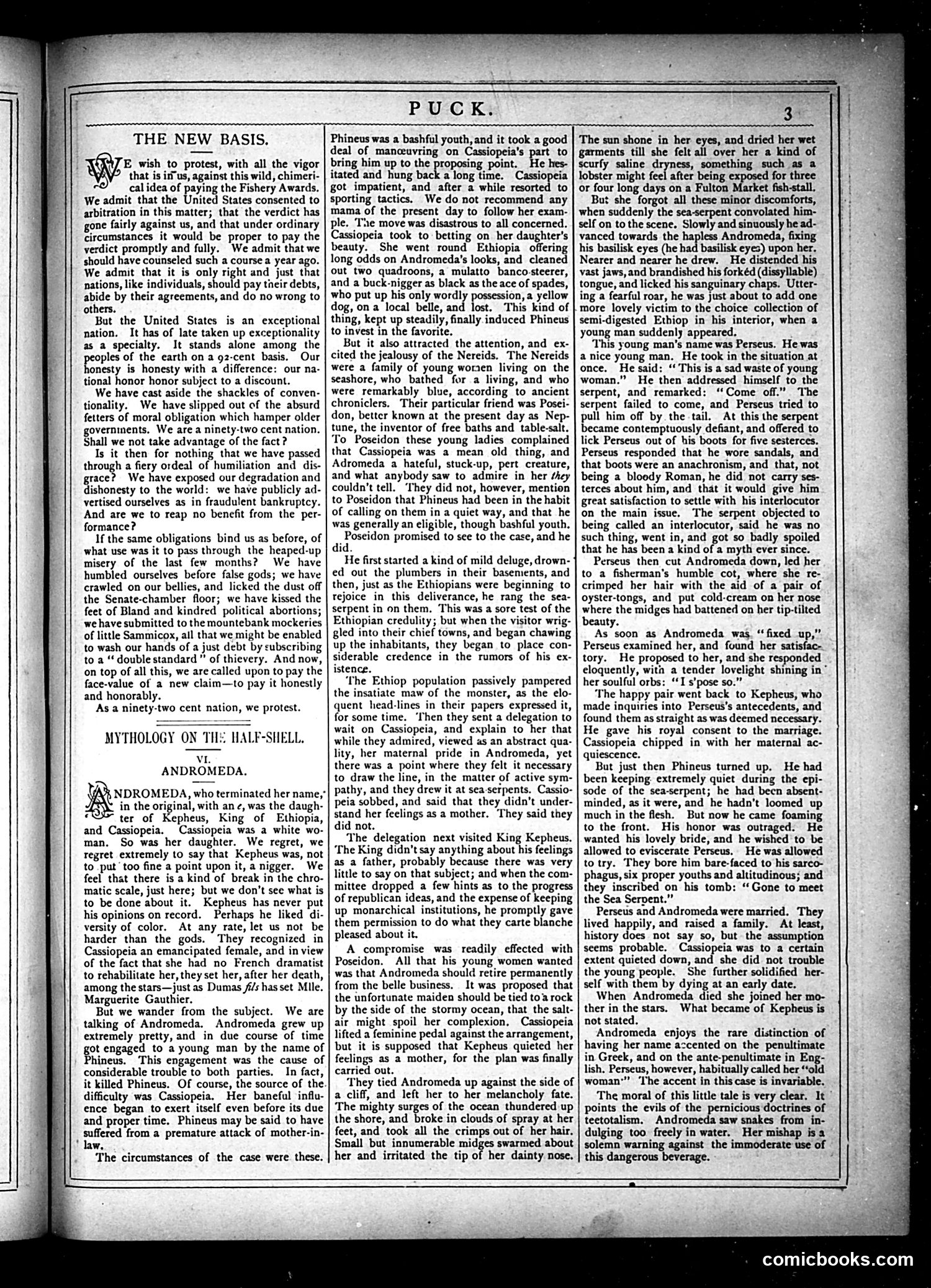
This page contains two distinct articles: "The New Basis" (a political editorial) and "Mythology on the Half-Shell: Andromeda" (a satirical mythological narrative). "The New Basis" criticizes U.S. foreign policy, arguing that the nation should not adopt the diplomatic practices of European powers. The author defends American exceptionalism and "ninety-two per cent" honesty as a national advantage, protesting against what appears to be pressure to engage in duplicitous international dealings. "Andromeda" is a humorous retelling of Greek mythology, mocking the princess's rescue by Perseus. The satire ridicules romantic heroism and parental authority, presenting Andromeda's situation ironically—she's ultimately bound by family obligation rather than freed by her rescuer. Both pieces employ satire to critique contemporary social and political conventions through classical and diplomatic frameworks.
📄 Transcribed text from this page (OCR, searchable)
Machine-transcribed from the original scan — historical spelling and the odd misread are preserved.
PUCK. THE NEW BASIS. i E wish to protest, with all the vigor that is ir us, against this wild, chimeri- cal idea of paying the Fishery Awards. We admit that the United States consented to arbitration in this matter; that the verdict has gone fairly against us, and that under ordinary circumstances it would be proper to pay the verdict promptly and fully, We admit that we should have counseled such a course a year ago. We admit that it is only right and just that nations, like individuals, should pay their debts, abide by their agreements, and do no wrong to others. But the United States is an exceptional nation. It has of late taken up exceptionality as a specialty. It stands alone among the peoples of the earth on a g2-cent basis. Our honesty is honesty with a difference: our na- tional honor honor subject to a discount. We have cast aside the shackles of conven- tionality, We have slipped out of the absurd fetters of moral obligation which hamper older governments, We are a ninety-two cent nation. Shall we not take advantage of the fact? Is it then for nothing that we have passed through a fiery ordeal of humiliation and dis- grace? We have exposed our degradation and dishonesty to the world: we have publicly ad- vertised ourselves as in fraudulent bankruptcy. And are we to reap no benefit from the per- formance? If the same obligations bind us as before, of what use was it to pass through the heaped-up misery of the last few months? We have humbled ourselves before false gods; we have crawled on our bellies, and licked the dust off the Senate-chamber floor; we have kissed the feet of Bland and kindred political abortions; we have submitted to the mountebank mockeries of little Sammicox, all that we might be enabled to wash our hands of a just debt by subscribing to a ‘double standard ” of thievery. And now, on top of all this, we are called upon to pay the face-value of a new claim—to pay it honestly and honorably. As a ninety-two cent nation, we protest. MYTHOLOGY ON THE HALF-SHELL. VIL ANDROMEDA. Ferrous who terminated her name, in the original, with an ¢, was the daugh- ter of Kepheus, King of Ethiopia, and Cassiopeia. Cassiopeia was a white wo- man. So was her daughter. We regret, we regret extremely to say that Kepheus was, not to put too fine a point upon it, a nigger. We feel that there is a kind of break in the chro- matic scale, just here; but we don’t see what is to be done about it. Kepheus has never put his opinions on record. Perhaps he liked di- versity of color. At any rate, let us not be harder than the gods. They recognized in Cassiopeia an emancipated female, and in view of the fact that she had no French dramatist to rehabilitate her, they set her, after her death, among the stars—just as Dumas /i/s has set Mile. Marguerite Gauthier. But we wander from the subject. We are talking of Andromeda. Andromeda grew up extremely pretty, and in due course of time got engaged to a young man by the name of Phineus. This engagement was the cause of considerable trouble to both parties. In fact, it killed Phineus. Of course, the source of the. difficulty was Cassiopeia. Her baneful influ- ence began to exert itself even before its due and proper time. Phineus may be said to have suffered from a premature attack of mother-in- * law. The circumstances of the case were. these. Phineus was a bashful youth, and it took a good deal of manceuvring on Cassiopeia’s pa to bring him up to the proposing point. He hes- itated and hung back a long time. Cassiopeia got impatient, and after a while resorted to sporting tactics. We do not recommend any mama of the present day to follow her exam- ple, Te move was disastrous to all concerned. Cassiopeia took to betting on her daughter's beauty. She went round Ethiopia offering long odds on Andromeda’s looks, and cleaned out two quadroons, a mulatto banco-steerer, and a buck-nigger as black as the ace of spades, who put up his only wordly possession, a yellow dog, on a local belle, and lost. This kind of thing, kept up steadily, finally induced Phineus to invest in the favorite. But it also attracted the attention, and ex- cited the jealousy of the Nereids. The Nereids were a family of young woren living on the seashore, who bathed for a living, and who were remarkably blue, according to ancient chroniclers. Their particular friend was Posei- don, better known at the present day as Nep- tune, the inventor of free baths and table-salt. To Poseidon these young ladies complained that Cassiopeia was/a mean old thing, and Adromeda a hateful, stuck-up, pert creature, and what anybody saw to admire in her they couldn't tell. ‘hey did not, however, mention to Poseidon that Phineus had been in the habit of calling on them in a quiet way, and that he was generally an eligible, though bashful youth. Poseidon promised to see to the case, and he did. He first started a kind of mild deluge, drown- ed out the plumbers in their basements, and then, just as the Ethiopians were beginning to rejoice in this deliverance, he rang the sea- serpent in on them. This was a sore test of the Ethiopian credulity; but when the visitor wrig- gled into their chief towns, and began chawing up the inhabitants, they began to place con- siderable credence in the rumors of his ex- istence. ‘the Ethiop population passively pampered the insatiate maw of the monster, as the elo- quent head-lines in their papers expressed it, for some time. ‘Then they sent a delegation to wait on Cassiopeia, and explain to her that while they admired, viewed as an abstract qua- lity, her maternal pride in Andromeda, yet there was a point where they felt it necessary to draw the line, in the matter of active sym- pathy, and they drew it at sea-serpents. Cassio- peia sobbed, and said that they didn’t under- stand her feelings as a mother. They said they did not. ‘The delegation next visited King Kepheus. ‘The King didn’t say anything about his feelings as a father, probably because there was very little to say on that subject; and when the com- mittee dropped a few hints as to the progress of republican ideas, and the expense of keeping up monarchical institutions, he promptly gave them permission to do what they carte blanche pleased about it. A compromise was readily effected with Poseidon. All that his young women wanted was that Andromeda should retire permanently from the belle business. It was proposed that the unfortunate maiden should be tied toa rock by the side of the stormy ocean, that the salt- air might spoil her complexion, Cassiopeia lifted a feminine pedal against the arrangement, but it is supposed that Kepheus quieted her feelings as a mother, for the plan was finally carried out. ‘They tied Andromeda up against the side of a cliff, and left her to her melancholy fate. ‘The mighty surges of the ocean thundered up the shore, and broke in clouds of spray at her feet, and took all the crimps out of her hair. Small but innumerable midges swarmed about her and irritated the tip of her dainty nose. The sun shone in her eyes, and dried her wet garments till she felt all over her a kind of scurfy saline dryness, something such as a lobster might feel after being exposed for three or four long days on a Fulton Market fish-stall. But she forgot all these minor discomforts, when suddenly the sea-serpent convolated him- self on to the scene. Slowly and sinuously he ad- vanced towards the bsfles Andromeda, fixing his basilisk eyes (he had basilisk eyes) upon her. Nearer and nearer he drew. He distended his vast jaws, and brandished his forkéd (dissyllable) tongue, and licked his sanguinary chaps. Utter- ing a fearful roar, he was just about to add one more lovely victim to the choice collection of semi-digested Ethiop in his interior, when a young man suddenly appeared, ‘This young man’s name was Perseus. He was a nice young man. He took in the situation at once. He said: ‘“ This is a sad waste of young woman.” He then addressed himself to the serpent, and remarked: ‘‘Come off.” The serpent failed to come, and Perseus tried to pull him off by the-tail. At this the serpent became contemptuously defiant, and offered to lick Perseus out of his boots for five sesterces. Perseus responded that he wore sandals, and that boots were an anachronism, and that, not being a bloody Roman, he did not carry ses- terces about him, and that it would give him great satisfaction to settle with his interlocutor on the main issue. The serpent objected to being called an interlocutor, said he was no such thing, went in, and got so badly spoiled that he has been a kind of a myth ever since. Perseus then cut Andromeda down, led her to a fisherman's humble cot, where she re- crimped her hair with the aid of a pair of oyster-tongs, and put cold-cream on her nose where the midges had battened on her tip-tilted beauty. As soon as Andromeda was. “fixed up,’” Perseus examined her, and found her satisfac- tory. He proposed to her, and she responded eloquently, with a tender lovelight shining in” her soulful orbs: ‘I s'pose so.”” ‘The happy pair went back to Kepheus, who made inquiries into Perseus’s antecedents, and found them as straight as was deemed necessary. He gave his royal consent to the marriage. Cassiopeia chipped in with her maternal ac- quiescence. But just then Phineus turned up. He had been keeping. extremely quiet during the epi- sode of the sea-serpent; he had becn absent- minded, as it were, and he hadn't loomed up much in the flesh. But now he came foaming to the front. His honor was outraged. He wanted his lovely bride, and he wished’ to be allowed to eviscerate Perseus. He was allowed to try. They bore him bare-faced to his sarco- phagus, six proper youths and altitudinous; and they inscribed on his tomb: ‘Gone to meet the Sea Serpent.” Perseus and Andromeda were married. They lived happily, and raised a family. At least, history does not say so, but the assumption seems probable. Cassiopeia was to a certain extent quieted down, and she did not trouble the young people. She further solidified her- self with them by dying at an early date. When Andromeda died she joined her mo- ther in the stars. What became of Kepheus is not stated. Andromeda enjoys the rare distinction of having her name accented on the penultimate in Greek, and on the ante-penultimate in Eng- lish. Perseus, however, habitually called her “old woman” ‘The accent in this case is invariable. The moral of this little tale is very clear, It points the evils of the pernicious'doctrines of teetotalism. Andro saw snakes from in- dulging too freely in water. Her mishap is a solemn warning against the immoderate use of this dangerous beverage. comicbooks.com