
Puck, 1878-04-03 · page 7 of 16
Puck — April 3, 1878 — page 7: what you’re looking at
What you’re looking at
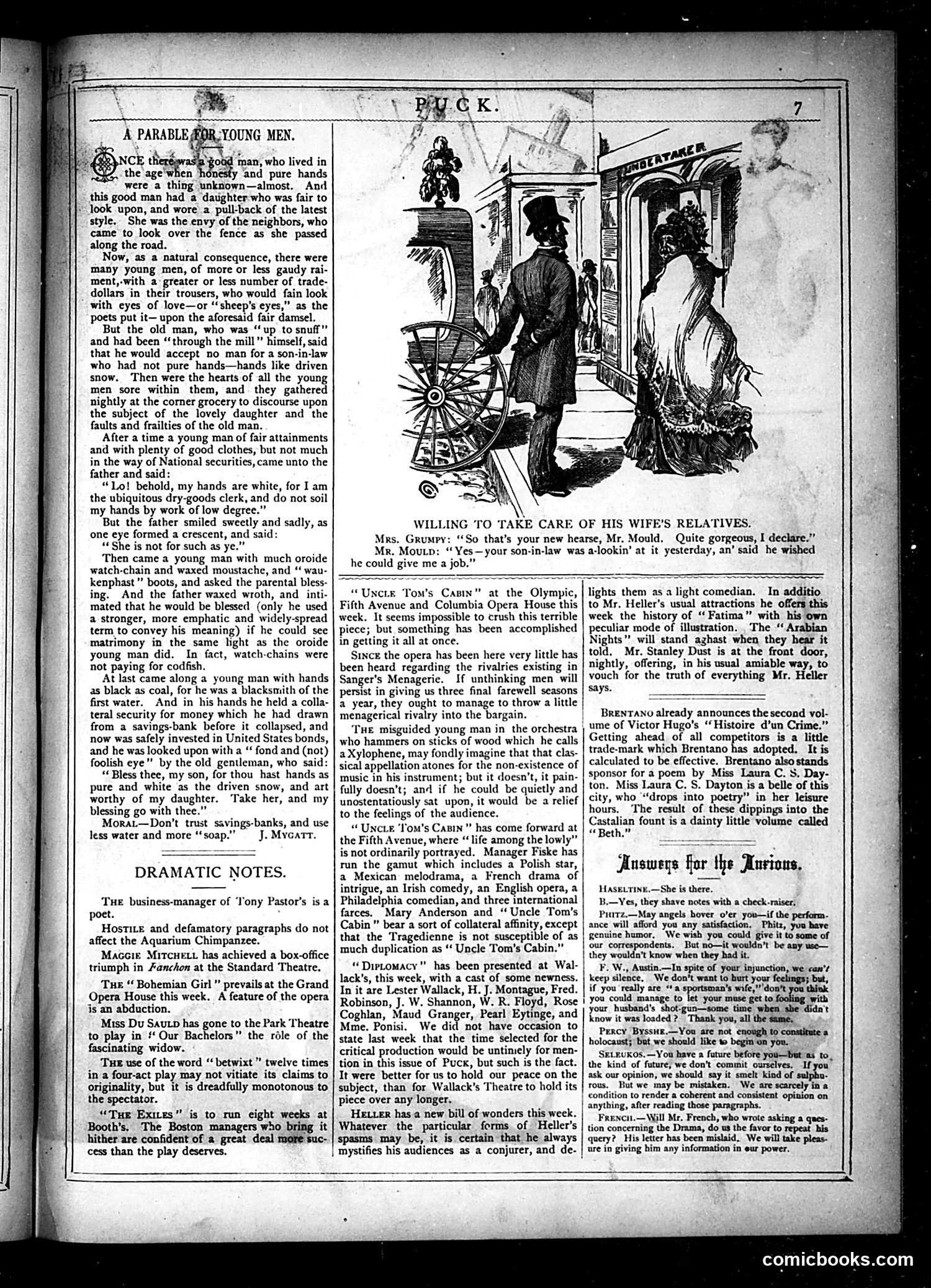
This page contains **"A Parable for Young Men,"** a morality tale about a good man whose daughter attracts suitors. The old man rejects a wealthy dry-goods clerk with "pure hands" as unsuitable, instead accepting a younger man of good character and honest labor. The accompanying illustration, titled **"Willing to Take Care of His Wife's Relatives,"** depicts a domestic scene where a man accepts a job to support his new wife's family. Mrs. Grumpy comments on their "gorgeous" new horse while Mr. Mould admits he's willing to work. The satire targets class pretension—mocking the wealthy merchant's snobbery while endorsing honest work and family duty. Below are theatrical notes covering opera productions and performances at various New York venues. The overall message: character and willingness to work matter more than wealth or status.
📄 Transcribed text from this page (OCR, searchable)
Machine-transcribed from the original scan — historical spelling and the odd misread are preserved.
man, who lived in 1 esty ‘and pure hands were a thing unknown—almost. And this good man had a daughter who was fair to © look upon, and wore’ a pull-back of the latest style. She was the envy of the neighbors, who came to look over the fence as she passed along the road. Now, as a natural consequence, there were many young men, of more or less gaudy rai- ment,.with a greater or less number of trade- dollars in their trousers, who would fain look with eyes of love—or ‘sheep's eyes,” as the poets put it— upon the aforesaid fair damsel. But the old man, who was “up to snuff” and had been “through the mill” himself, said that he would accept no man for a son-in-law who had not pure hands—hands like driven snow. Then were the hearts of all the young men sore within them, and they gathered nightly at the corner grocery to discourse upon the subject of the lovely daughter and the faults and frailties of the old man. After a time a young man of fair attainments and with plenty of good clothes, but not much in the way of National securities, came unto the father and said: “Lo! behold, my hands are white, for I am the ubiquitous dry-goods clerk, and do not soil my hands by work of low degree.” But the father smiled sweetly and sadly, as one eye formed a crescent, and said: “ She is not for such as ye.” Then came a young man with much oroide watch-chain and waxed moustache, and “ wau- kenphast” boots, and asked the parental bless- ing. And the father waxed wroth, and inti- mated that he would be blessed (only he used a stronger, more emphatic and widely-spread term to convey his meaning) if he could see matrimony in the same hight as the oroide young man did. In fact, watch-chains were not paying for codfish. At last came along a young man with hands as black as coal, for he was a blacksmith of the first water. And in his hands he held a colla- teral security for money which he had drawn from a savings-bank before it collapsed, and now was safely invested in United States bonds, and he was looked upon with a “fond and (not) foolish eye” by the old gentleman, who said: “Bless thee, my son, for thou hast hands as pure and white as the driven snow, and art worthy of my daughter. ‘Take her, and my blessing go with thee.” Morat—Don’t trust savings-banks, and use less water and more “soap.” ‘J. Mycatt. DRAMATIC NOTES. Tue business-manager of ‘lony Pastor’s is a poet. Hostite and defamatory paragraphs do not affect the Aquarium Chimpanzee. Macoie Mitcuett has achieved a box-office triumph in Fanchon at the Standard Theatre, Tue “ Bohemian Girl ” prevails at the Grand Opera House this week. A feature of the opera is an abduction. Miss Du Sautp has gone to the Park Theatre to play in Our Bachelors” the réle of the fascinating widow. ‘Tue use of the word “ betwixt ” twelve times in a four-act play may not vitiate its claims to originality, but it is dreadfully monotonous to the spectator. “Tue Exites” is to run eight weeks at Booth’s, The Boston managers who bring it hither/are confident of a great deal more suc- cess than the play deserves. WILLING TO TAKE CARE OF HIS WIFE'S RELATIVES. Mrs. Grumpy: ‘So that’s your new hearse, Mr. Mould. Quite gorgeous, I declare.” Mr. Moutp: “ Yes—your son-in-law was a-lookin’ at it yesterday, an’ said he wished he could give me a job.” “Uncie Tom's Canin” at the Olympic, Fifth Avenue and Columbia Opera House this week. It seems impossible to crush this terrible piece; but something has been accomplished in getting it all at once. Since the opera has been here very little has been heard regarding the rivalries existing in Sanger’s Menagerie. If unthinking men will persist in giving us three final farewell seasons a year, they ought to manage to throw a little menagerical rivalry into the bargain. ‘Tue misguided young man in the orchestra who hammers on sticks of wood which he calls aXylophene, may fondly imagine that that clas- sical appellation atones for the non-existence of music in his instrument; but it doesn’t, it pain- fully doesn’t; and if he could be quietly and unostentatiously sat upon, it would be a relief to the feelings of the audience. “ Uncie ‘lom’s Canin ” has come forward at the Fifth Avenue, where “life among the lowly” is not ordinarily portrayed. Manager Fiske has run the gamut which includes a Polish star, | a Mexican melodrama, a French drama of intrigue, an Irish comedy, an English opera, a Philadelphia comedian, and three international farces. Mary Anderson and ‘Uncle Tom's Cabin ” bear a sort of collateral affinity, except that the Tragedienne is not susceptible of as much duplication as ‘‘ Uncle Tom's Cabin.” “DipLomacy” has been presented at Wal- lack’s, this week, with a cast of some newness. In it are Lester Wallack, H. J. Montague, Fred. Robinson, J. W. Shannon, W. R. Floyd, Rose Coghlan, Maud Granger, Pearl Eytinge, and Mme. Ponisi. We did not have occasion to state last week that the time selected for the critical production would be untimely for men- tion in this issue of Puck, but such is the fact. It were better for us to hold our peace on the subject, than for Wallack’s Theatre to hold its piece over any longer. HEtter has a new bill of wonders this week. Whatever the particular forms of Heller's may be, it is certain that he always mystifies his audiences as a conjurer, and de- lights them as. light comedian. In additio to Mr. Heller's usual attractions he offers this week the history of ‘“ Fatima” with his own peculiar mode of illustration. The ‘Arabian Nights” will stand aghast when they hear it told, Mr. Stanley Dust is at the front door, nightly, offering, in his usual amiable way, to vouch for the truth of everything Mr. Heller says. ume of Victor Hugo's ‘Histoire d’un Crime.” Getting ahead of all competitors is a little trade-mark which Brentano has adopted. It is calculated to be effective. Brentano also stands sponsor for a poem by Miss Laura C. S, Day- ton. Miss Laura C. S. Dayton is a belle of this city, who “drops into poetry” in her leisure hours. The result of these dippings into the Castalian fount is a dainty little volume “Beth.” Auswers for the Aueions, Haseurine.—She is aes B.—Yes, they shave notes with a check-raiser, Punrz.—May angels hover o'er you—if the perform. ance will afford you any satisfaction, Phitz, you have genuine humor. We wish you could give it to some of our correspondents. But no—it wouldn’t be any use— | they wouldn't know when they had it. F. W., Austin.—In spite of your injunction, we can’t keep silence. We don’t want to burt your fe if you really are “a Binney wife,”'don't | you could manage to let your muse get to: your husband's shot:gun—some time when she didn't know it was loaded? Thank you, all the same, Percy ‘Byssiz.—You are not enough to constitute a holocaust} but we should like to begin on you. SELEUKOS.—You have a future before you—but as to. the kind of future, we don’t commit ourselves, Ifyou ask our opinion, we should say it smelt kind of sulpho. rous. But we may be mistaken. We are scarcely in a condition to render a coherent and consistent opinion on anything, after reading those paragraphs. Frencit.—Will Mr. French, who wrote asking a ques- tion concerning the Drama, do us the favor to repeat his query? His letter has been mislaid. We will take pleas- ure in giving him any information in eur power. comicbooks.com