
Puck, 1878-04-03 · page 12 of 16
Puck — April 3, 1878 — page 12: what you’re looking at
What you’re looking at
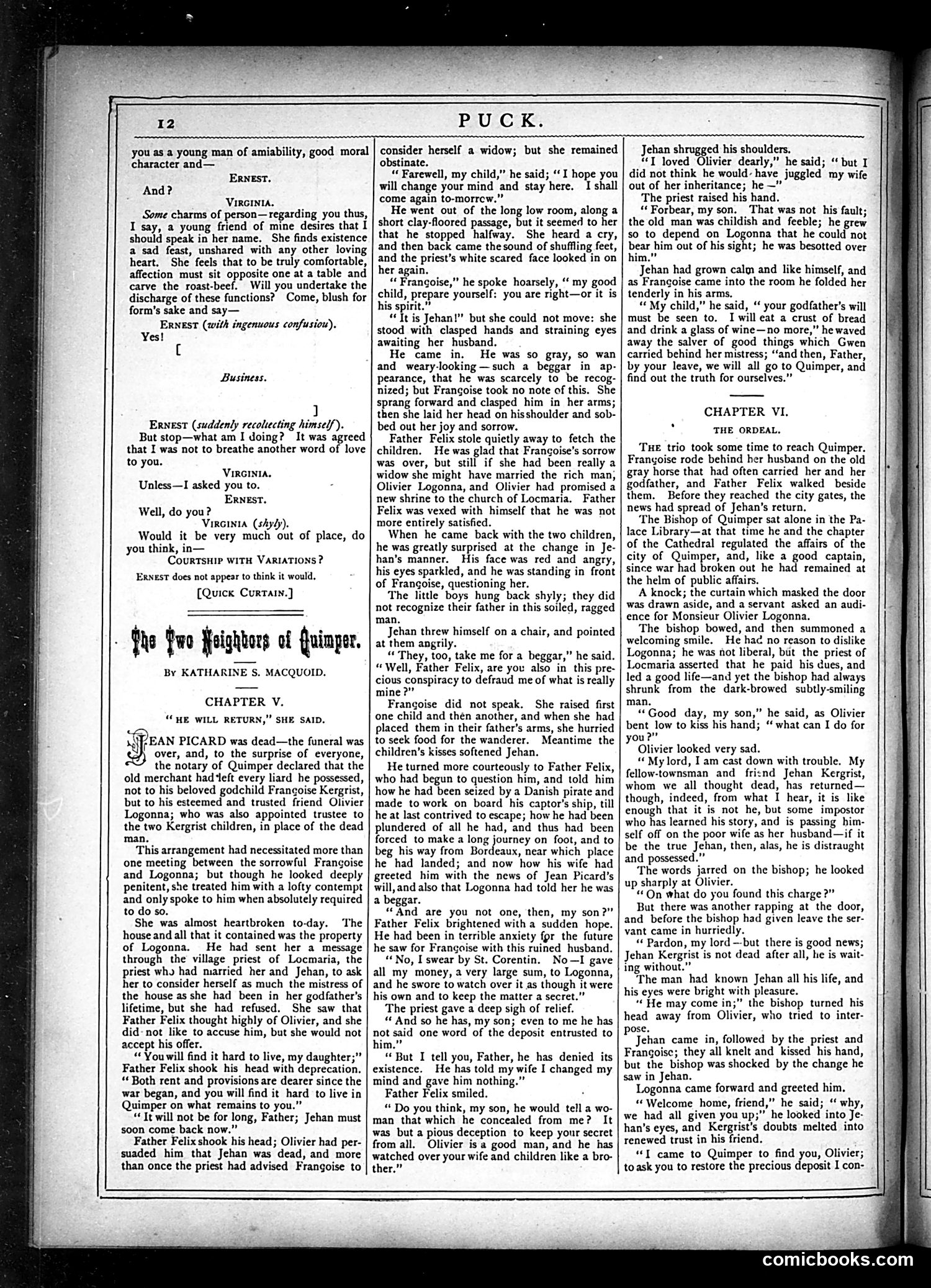
This page from *Puck* magazine contains no political cartoon. Instead, it presents **"The Two Neighbors of Quimper,"** a serialized short story by Katharine S. Macquoid appearing in Chapter V and VI. The narrative focuses on characters named Ernest, Virginia, Jean Picard, Olivier Logonna, and Françoise, discussing domestic troubles involving inheritance, a deceased husband, and family disputes in what appears to be a French provincial setting (Quimper). This is **literary fiction**, not satire or political commentary. The page demonstrates that *Puck*, while famous for satirical cartoons, also published serialized literature to fill editorial space and attract diverse readers during the late 19th/early 20th century.
📄 Transcribed text from this page (OCR, searchable)
Machine-transcribed from the original scan — historical spelling and the odd misread are preserved.
PUCK. you as a young man of amiability, good moral character and— ERNEST. And? Vircinia. Some charms of person—regarding you thus, I say, a young friend of mine desires that 1 should speak in her name. She finds existence a sad feast, unshared with any other loving heart. She feels that to be truly comfortable, affection must sit opposite one at a table and carve the roast-beef. Will you undertake the discharge of these functions? Come, blush for form's sake and say— Ernest (with ingenuous confusiou). Yes! Business. Ernest (suddenly recoluecting himself). But stop—what am I doing? It was agreed that I was not to breathe another word of love to you. Vircinia. Unless—I asked you to. ERNEST. Well, do you? Virainia (shyly). Would it be very much out of place, do you think, in— CourtsHip wiTH VARIATIONS? Ernest does not appear to think it would, (Quick Curtain.] Fe Pwo feightors of fuimper, By KATHARINE S. MACQUOID. CHAPTER V. “(HE WILL RETURN,” SHE SAID. pean PICARD was dead—the funeral was over, and, to the surprise of everyone, the notary of Quimper declared that the old merchant had ‘eft every liard he possessed, not to his beloved godchild Frangoise Kergrist, but to his esteemed and trusted friend Olivier Logonna; who was also appointed trustee to the two Kergrist children, in place of the dead man. This arrangement had necessitated more than one meeting between the sorrowful Frangoise and Logonna; but though he looked deeply penitent, she treated him with a lofty contempt and only spoke to him when absolutely required to do so. She was almost heartbroken to-day. The house and all that it contained was the property of Logonna. He had sent her a message through the village priest of Locmaria, the priest who had married her and Jehan, to ask her to consider herself as much the mistress of the house as she had been in her godfather’s lifetime, but she had refused. She saw that Father Felix thought highly of Olivier, and she did-not like to accuse him, but she would not accept his offer. “ Youwill find it hard to live, my daughter;” Father Felix shook his head with deprecation. “Both rent and provisions are dearer since the war began, and you will find it hard to live in Quimper on what remains to you.” “Tt will not be for long, Father; Jehan must soon come back now.” Father Felix shook his head; Olivier had per- suaded him that Jehan was dead, and more than once the priest had advised Frangoise to consider herself a widow; but she remained obstinate. “ Farewell, my child,” he said; “I hope you will change your mind and stay here. I shall come again to-morrew.” He went out of the long low room, along a short clay-floored passage, but it seemed to her that he stopped halfway. She heard a cry, and then back came the sound of shuffling feet, and the priest’s white scared face looked in on her again. “ Frangoise,” he spoke hoarsely, “ my good child, prepare yourself: you are right—or it is his spirit.” “Tt is Jehan!” but she could not move: she stood with clasped hands and straining eyes awaiting her husband. He came in, He was so gray, so wan and weary-looking—such a beggar in ap- pearance, that he was scarcely to be recog- nized; but Frangoise took no note of this. She sprang forward and clasped him in her arms; then she laid her head on hisshoulder and sob- bed out her joy and sorrow. Father Felix stole quietly away to fetch the children, He was glad that Francoise’s sorrow was over, but still if she had been really a widow she might have married the rich man, Olivier Logonna, and Olivier had promised a new shrine to the church of Locmaria. Father Felix was vexed with himself that he was not more entirely satisfied. When he came back with the two children, he was greatly surprised at the change in Je- han’s manner. His face was red and angry, his eyes sparkled, and he was standing in front of Frangoise, questioning her. The little boys hung back shyly; they did not recognize their father in this soiled, ragged man. Jehan threw himself on a chair, and pointed at them angrily. “ They, too, take me for a beggar,” he said. “ Well, Father Felix, are you also in this pre- cious conspiracy to defraud me of what is really mine?” Frangoise did not speak. She raised first one child and thén another, and when she had placed them in their father’s arms, she hurried to seek food for the wanderer. Meantime the children’s kisses softened Jehan. He turned more courteously to Father Felix, who had begun to question him, and told him how he had been seized by a Danish pirate and made to work on board his captor’s ship, till he at last contrived to escape; how he had been plundered of all he had, and thus had been forced to make a long journey on foot, and to beg his way from Bordeaux, near which place he had landed; and now how his wife had greeted him with the news of Jean Picard’s will, and also that Logonna had told her he was a beggar. “And are you not one, then, my son?” Father Felix brightened with a sudden hope. He had been in terrible anxiety {pr the future he saw for Frangoise with this ruined husband. “No, I swear by St. Corentin. No—I gave all my money, a very large sum, to Logonna, and he swore to watch over it as though it were his own and to keep the matter a secret.” The priest gave a deep sigh of relief. “And so he has, my son; even to me he has not said one word of the deposit entrusted to him.” “ But I tell you, Father, he has denied its existence. He has told my wife I changed my mind and gave him nothing.” Father Felix smiled. E “ Do you think, my son, he would tell a wo- man that which he concealed from me? It was but a pious deception to keep your secret from all. Olivier is a good man, and he has watched over your wife and children like a bro- ther.” Jehan shrugged his shoulders. “T loved Olivier dearly,” he said; “ but I did not think he would-have juggled my wife out of her inheritance; he —” The priest raised his hand. ‘‘Forbear, my son. That was not his fault; the old man was childish and feeble; he grew so to depend on Logonna that he could not bear him out of his sight; he was besotted over him.” Jehan had grown calm and like himself, and as Francoise came into the room he folded her tenderly in his arms. “My child,” he said, “ your godfather’s will must be seen to. I will eat a crust of bread and drink a glass of wine—no more,” he waved away the salver of good things which Gwen carried behind her mistress; ‘‘and then, Father, by your leave, we will all go to Quimper, and find out the truth for ourselves.” CHAPTER VI. THE ORDEAL, Tue trio took some time to reach Quimper. Frangoise rode behind her husband on the old gtay horse that had often carried her and her godfather, and Father Felix walked beside them. Before they reached the city gates, the news had spread of Jehan’s return. The Bishop of Quimper sat alone in the Pa- lace Library—at that time he and the chapter of the Cathedral regulated the affairs of the city of Quimper, and, like a good captain, since war had broken out he had remained at the helm of public affairs. A knock; the curtain which masked the door was drawn aside, and a servant asked an audi- ence for Monsieur Olivier Logonna. The bishop bowed, and then summoned a welcoming smile. He had no reason to dislike Logonna; he was fot liberal, but the priest of Locmaria asserted that he paid his dues, and led a good life—and yet the bishop had always shrunk from the dark-browed subtly-smiling man, “Good day, my son,” he said, as Olivier bent low to kiss his hand; “ what can I do for ou?” Olivier looked very sad. “ My lord, I am cast down with trouble. My fellow-townsman and frisnd Jehan Kergrist, whom we all thought dead, has returned— though, indeed, from what I hear, it is like enough that it is not he, but some impostor who has learned his story, and is passing him- self off on the poor wife as her husband—if it be the true Jehan, then, alas, he is distraught and possessed. ‘The words jarred on the bishop; he looked up sharply at Olivier. “On what do you found this charge?” But there was another rapping at the door, and before the bishop had given leave the ser- vant came in hurriedly. «Pardon, my lord —but there is good news; Jehan Kergrist is not dead after all, he is wait- ing without.” ‘The man had known Jehan all his life, and his eyes were bright with pleasure. “He may come in;” the bishop turned his head away from Olivier, who tried to inter- pose. Jehan came in, followed by the priest and Frangoisc; they all knelt and kissed his hand, but the bishop was shocked by the change he saw in Jehan. Logonna came forward and greeted him. “Welcome home, friend,” he said; ‘ why, we had all given you up;” he looked into Je- han’s eyes, and Kergrist’s doubts melted into renewed trust in his friend. “I came to Quimper to find you, Olivier; to ask you to restore the precious deposit I con- comicbooks.com