
A complete issue · 16 pages · 1878
Puck — March 20, 1878
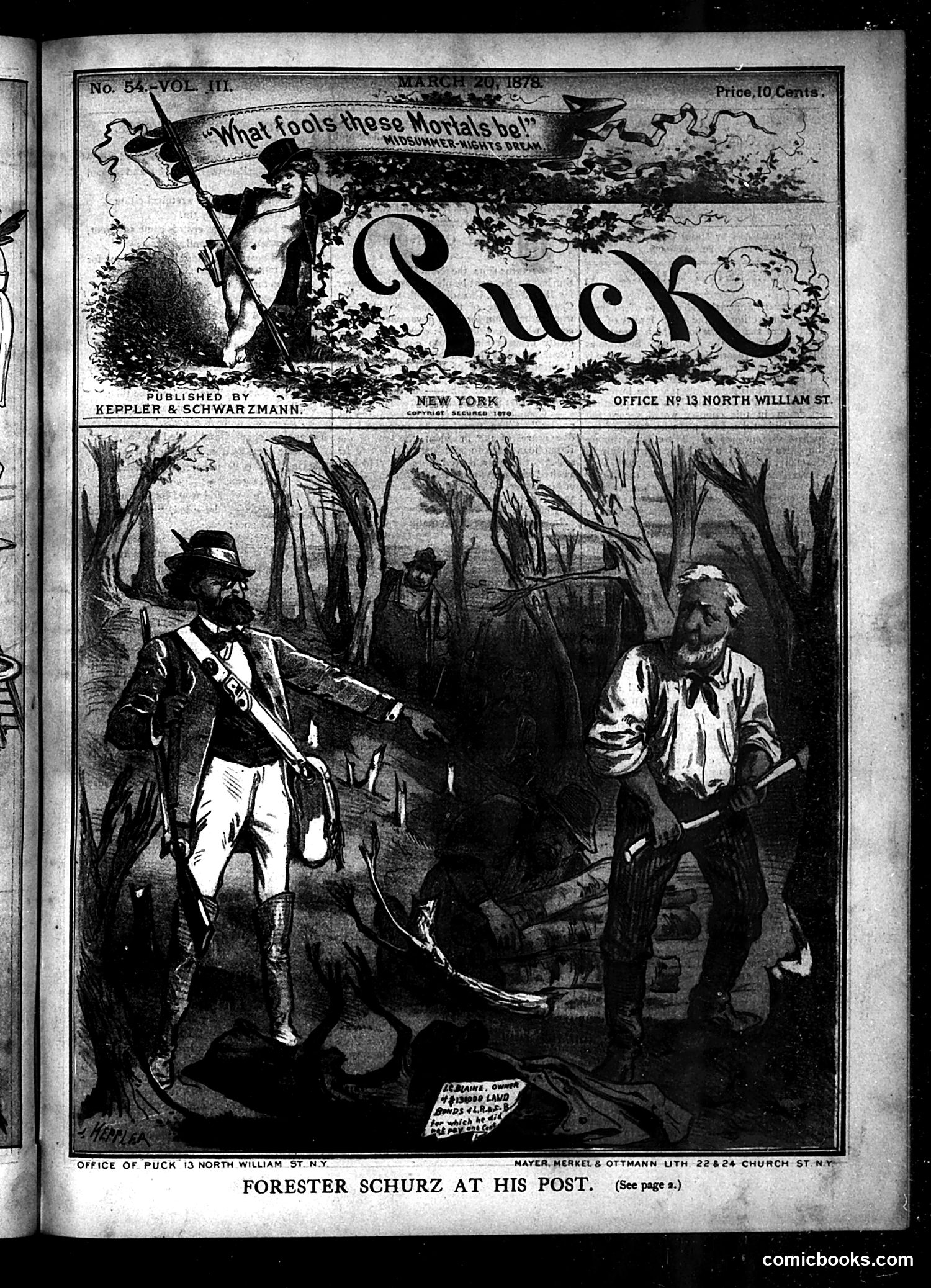
This appears to be from Puck's satirical commentary on **General Carl Schurz**, a prominent 19th-century German-American political figure. The header "What fools these Mortals be!" frames the satire. The main illustration titled "Forester Schurz at His Post" depicts two figures in a wooded setting. The left figure wears military attire with insignia, while the right figure appears to be a common laborer or frontiersman. The satire likely critiques Schurz's role or competence in a specific government position (possibly Secretary of Interior, given "Forester" reference). The contrast between the ornately-dressed official and the ordinary worker suggests mockery of either Schurz's pretension, inadequacy for the role, or hypocrisy regarding his duties. Without additional context, the specific criticism remains unclear.
This page combines political commentary with satirical poetry and advertisements. The main text sections address: **"Exit Bill Chandler"** — A critique of New Hampshire politician Bill Chandler, attacking him as representative of a corrupt political class who abandons principles when elections end. The piece sarcastically notes Chandler "carried New Hampshire in his pocket," suggesting he manipulated the state's Republican ticket. **"Tammany and the School-Teachers"** — Commentary on New York City municipal corruption, criticizing Tammany Hall's waste and underfunding of teachers' salaries while enriching city departments. **"Puck in the French Republic"** — Celebrating Puck magazine's influence on French political cartooning, noting a hawker named Nancey was prosecuted for selling anti-republican satire. The remaining content consists of brief political jokes and advertisements for Puck subscriptions. The satire targets Democratic political machines and administrative corruption.
This page contains two distinct articles: **"A Baptismal Drama"** discusses an artist's editorial decision to follow a minister conducting a baptism ceremony in Clayville. The piece critiques the minister's handling of an African American woman's baptism in the Tombigbee River, where she nearly drowned. The satirical account questions the minister's competence and judgment, particularly regarding safety protocols for conducting such ceremonies among "colored" congregants. **"Fitznoodle in America"** presents a travel narrative mocking American regional characteristics, with a figure named Jack observing peculiarities of American life and manners, apparently comparing them unfavorably to European standards. Both pieces employ satire and irony typical of Puck's social commentary, though the racial language reflects the publication's late 19th-century context.
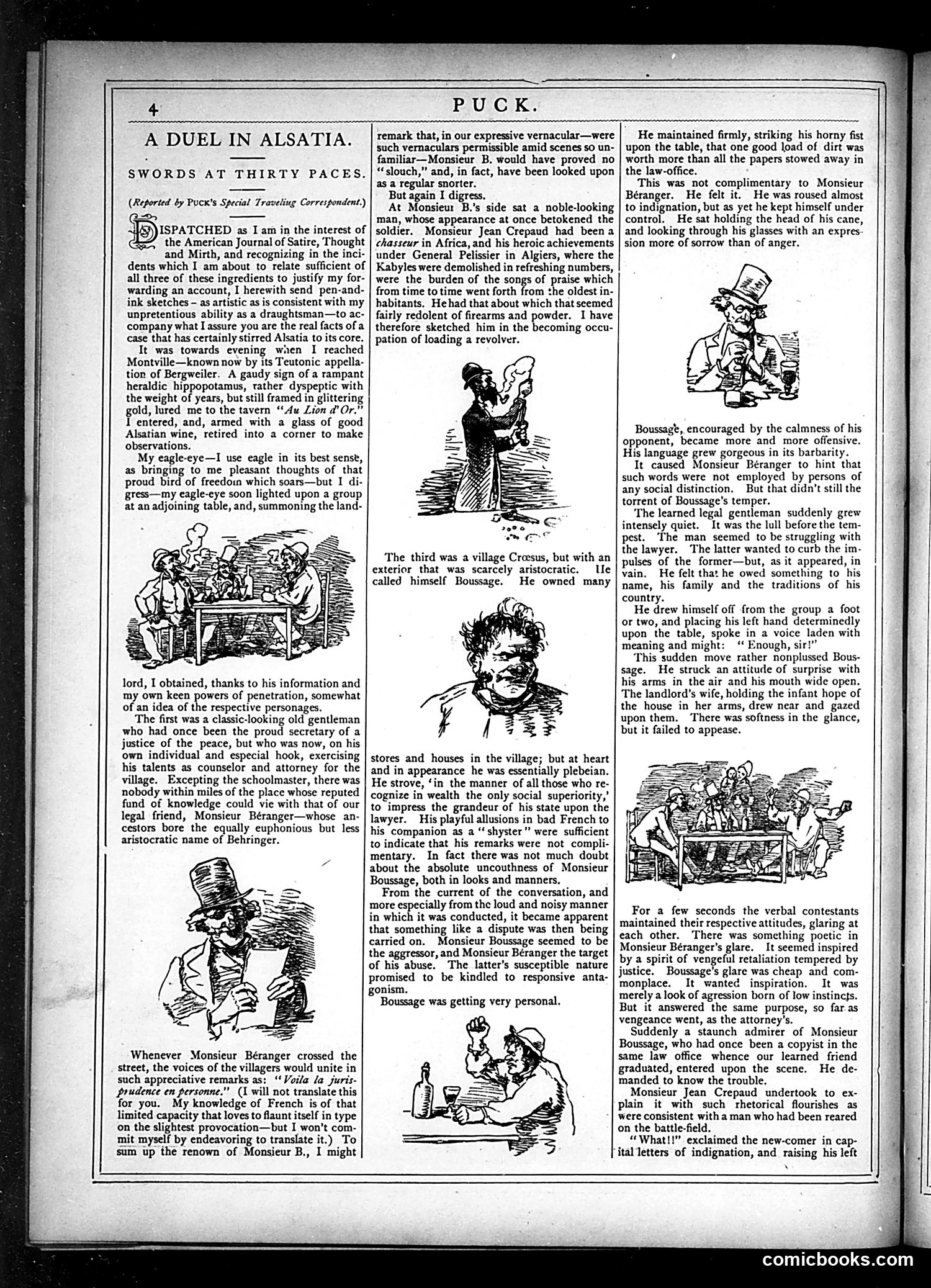
This article satirizes a verbal dispute between three Alaskan figures: a former justice secretary, a lawyer named Monsieur Béranger, and a village notable called Monsieur Boussage. The piece mocks their heated argument—described as a "duel" conducted entirely through insults and theatrical posturing rather than actual combat. The satire targets their pretentiousness: the secretary's aristocratic pretensions, Béranger's legal pomposity, and Boussage's attempts to appear refined despite his humble origins. The illustrations show them gesturing wildly, delivering heated remarks. The humor lies in depicting grown men engaged in this absurd verbal combat as though it were a serious confrontation, critiquing their inflated self-importance and the ridiculous nature of their dispute over social status and reputation in a remote Alaskan setting.
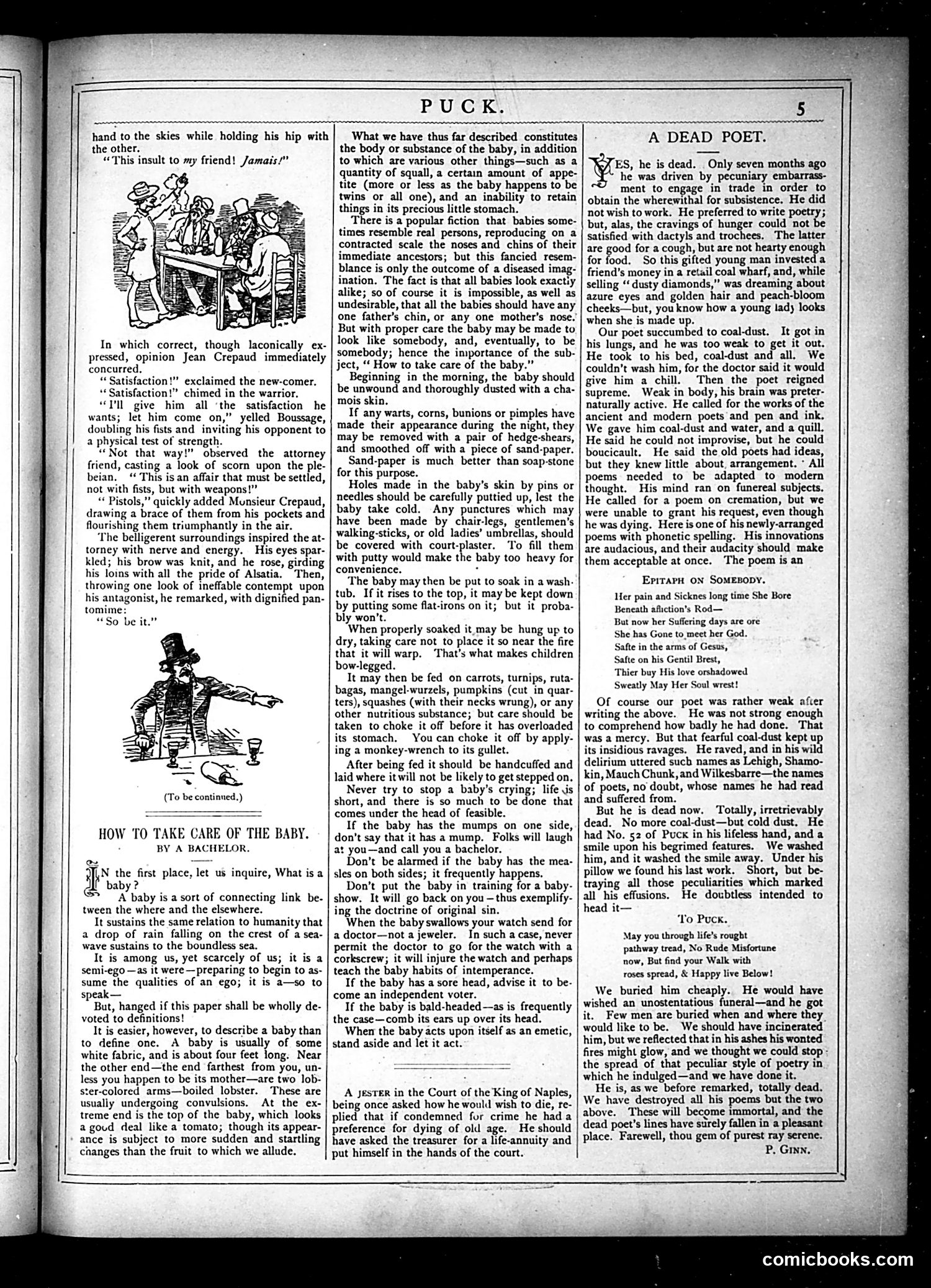
This page contains two distinct sections: **Upper cartoon**: Shows a scene where a man (appearing to be addressing a friend named "Jamais") gestures animatedly while holding a hip flask. The surrounding figures appear to be engaged in social drinking. The dialogue suggests someone is offering reassurance about intoxication. **Lower section**: A lengthy instructional article titled "How to Take Care of a Baby" by A Bachelor. This is satirical advice on infant care, offering absurd and impractical suggestions (using hedge-shears, soaking in wash tubs, feeding odd vegetables). The humor derives from a bachelor—someone with no parental experience—dispensing mock-serious baby care guidance. The right column includes a poem titled "A Dead Poet," mocking a recently deceased writer of poor quality verse. This represents typical Puck content: social satire through exaggerated advice and literary criticism.
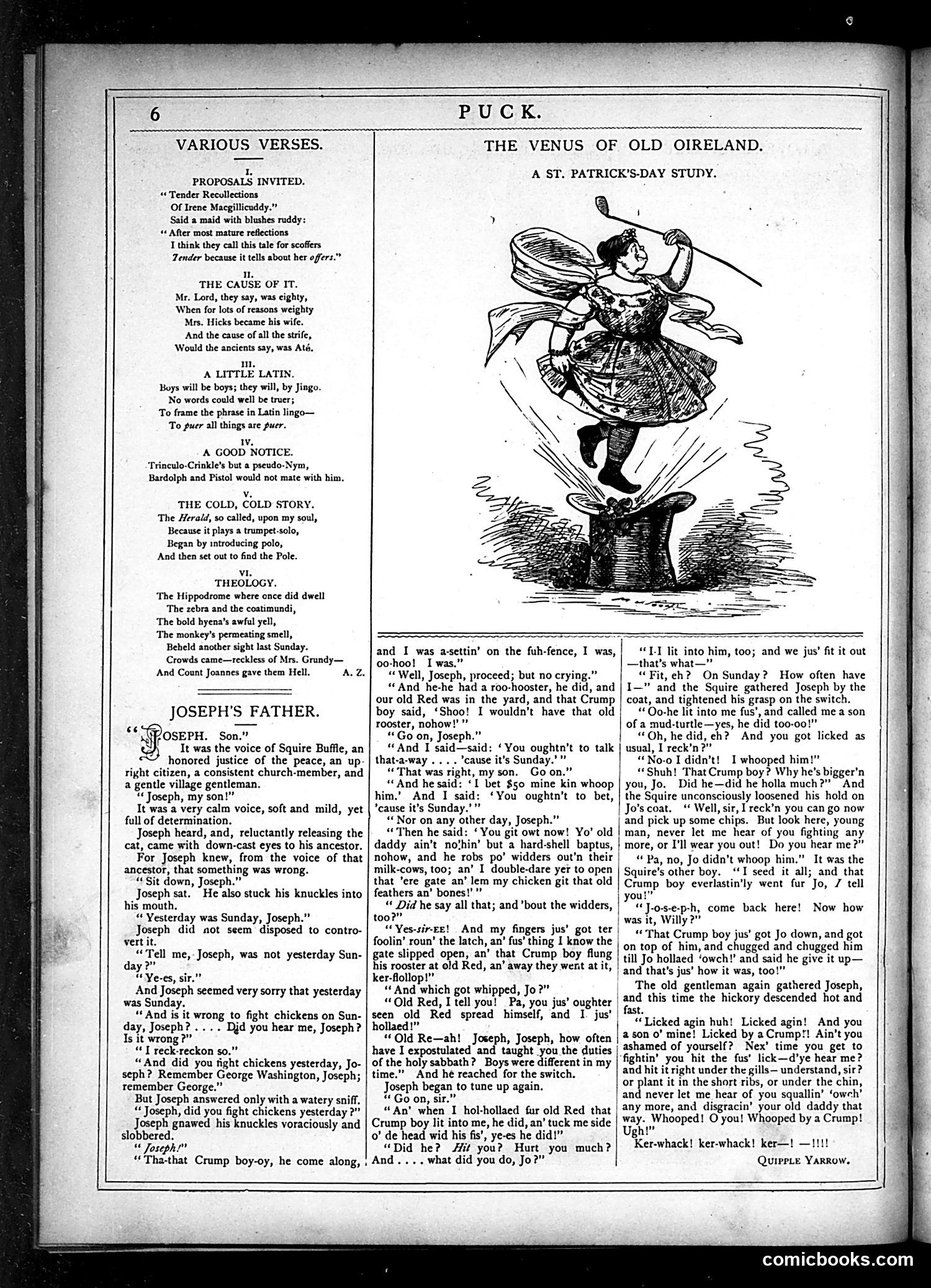
This page contains two distinct sections: **Left column:** "Joseph's Father" - a humorous short story about a village gentleman (Squire Buffle) and his conflicts with a boy named Joseph over Sunday chicken-fighting. The narrative depicts their escalating quarrel with comedic dialogue. **Right column:** "The Venus of Old Oireland" - a St. Patrick's Day illustration showing a fairy-like female figure in Irish dress, depicted in a caricatured style typical of period depictions of Irish folklore and stereotypes. The page primarily features literary humor and folklore-themed content rather than direct political satire. The Joseph story uses class dynamics (gentleman versus boy) for comedy, while the Irish illustration invokes ethnic stereotyping common to 1890s American humor magazines.
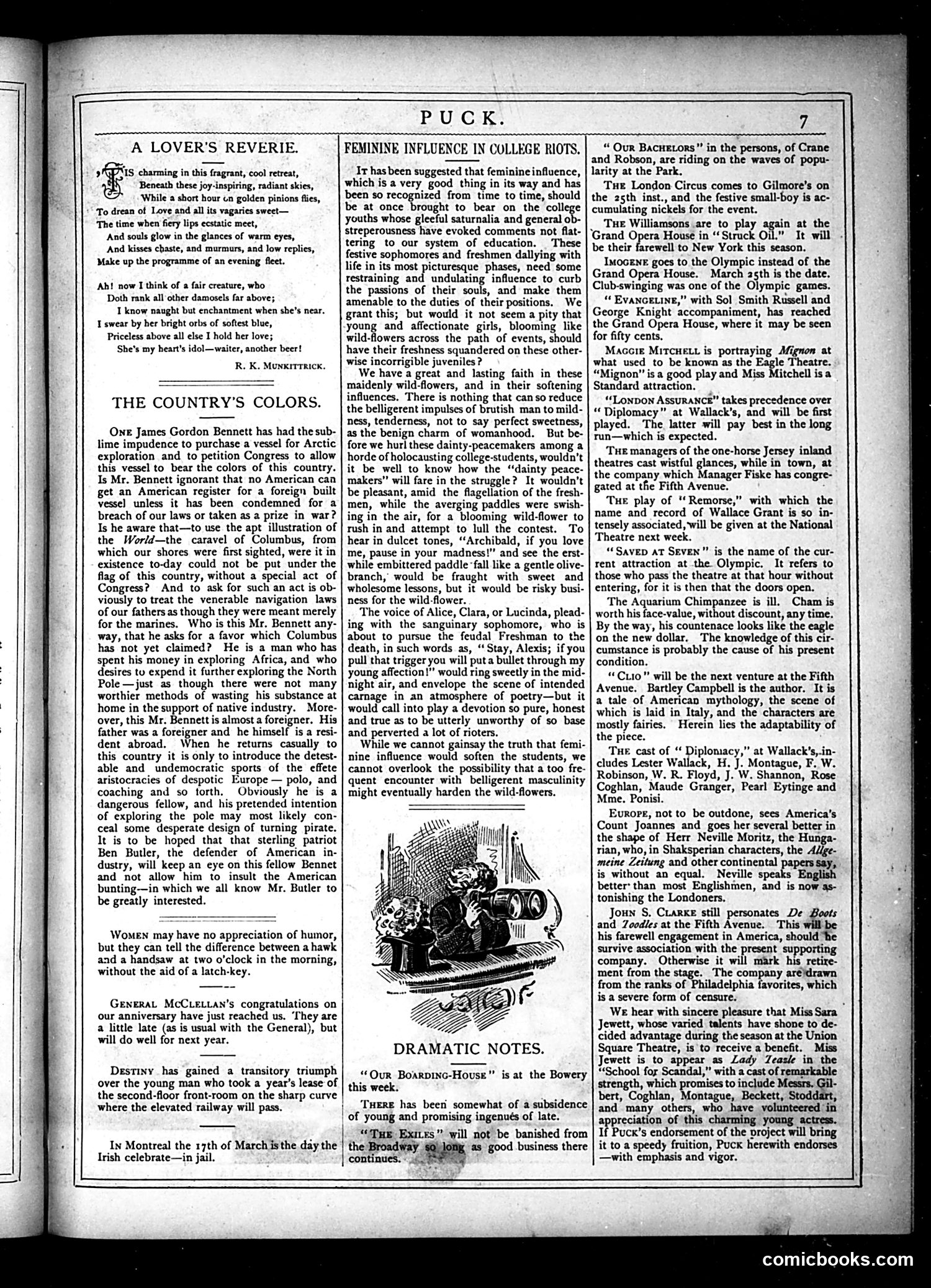
This page is primarily **text-based commentary** rather than political cartoons. The "Dramatic Notes" section reviews theater productions and entertainments of the era. The small illustration shows a figure in a vehicle or mechanical device, but lacks clear identifying details. The text discusses various theatrical productions ("Our Boarding-House," "London Assurance," "Saved at Seventeen") and performers, along with commentary on college life and feminine influence on students. One substantial article, "The Country's Colors," argues for adopting a national color scheme, discussing explorer James Gordon Bennett's petition to Congress. The author criticizes American cultural identity and naval symbolism compared to other nations. Without clearer visual caricatures or labeled figures, the specific satirical targets remain difficult to identify with certainty.
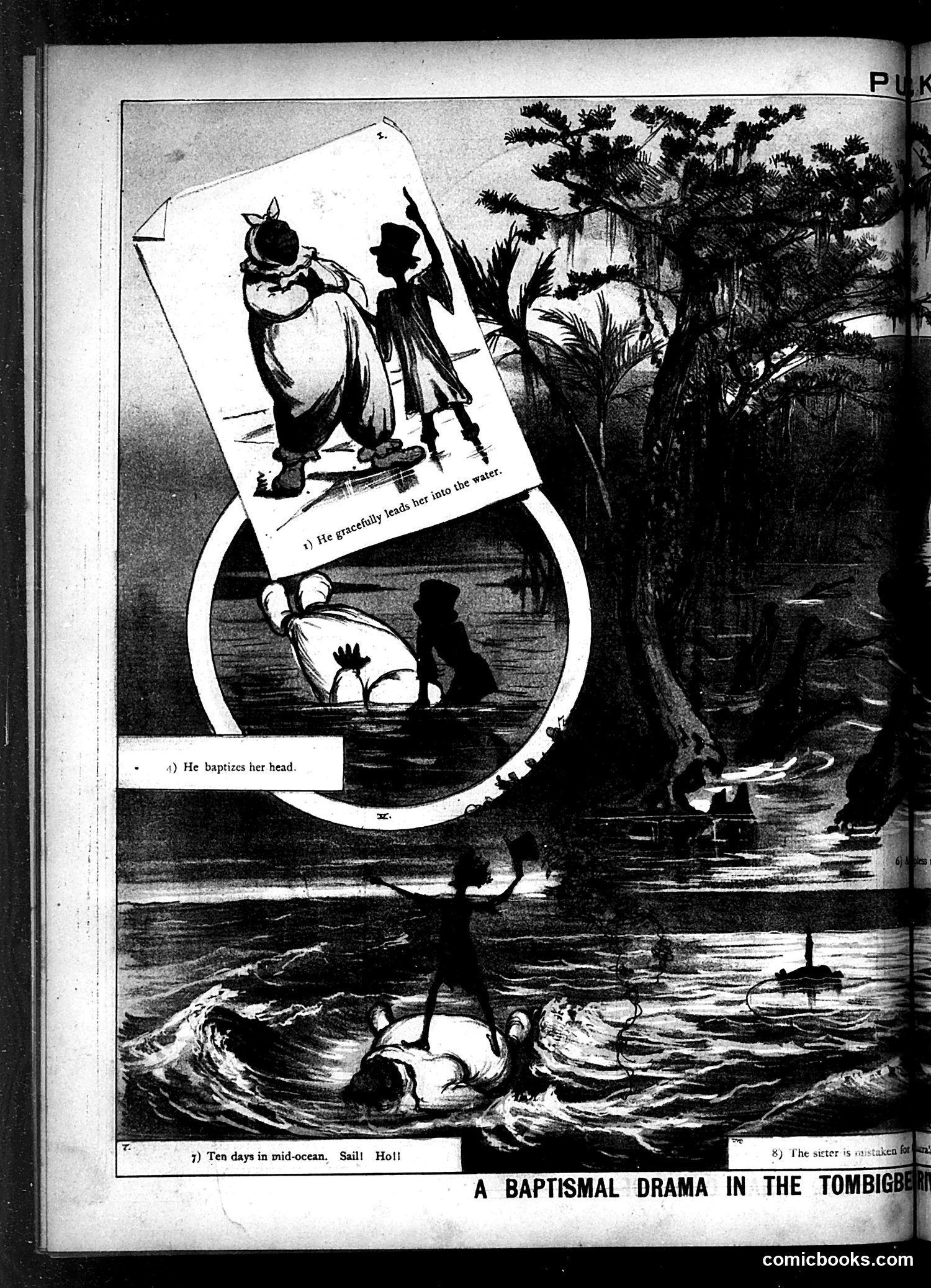
This appears to be a satirical comic strip depicting a sequence of events along the Tombigbee River (in Alabama/Mississippi). The numbered panels show: 1) A gracious host leading someone to water 2) A baptism scene where someone's head is submerged 7) "Ten days in mid-ocean. Sail! Ho!" 8) Reference to "The sister is mistaken" The satire seems to mock a literal or exaggerated interpretation of religious baptism, possibly critiquing religious extremism, forced conversions, or dark humor about river dangers. The progression from apparent hospitality to water-based peril suggests ironic commentary—presenting a "baptism" that becomes something sinister or deadly. Without clearer context about specific historical events on the Tombigbee, the exact target remains unclear, though the tone suggests criticism of religious fanaticism or river-related tragedies treated comedically.
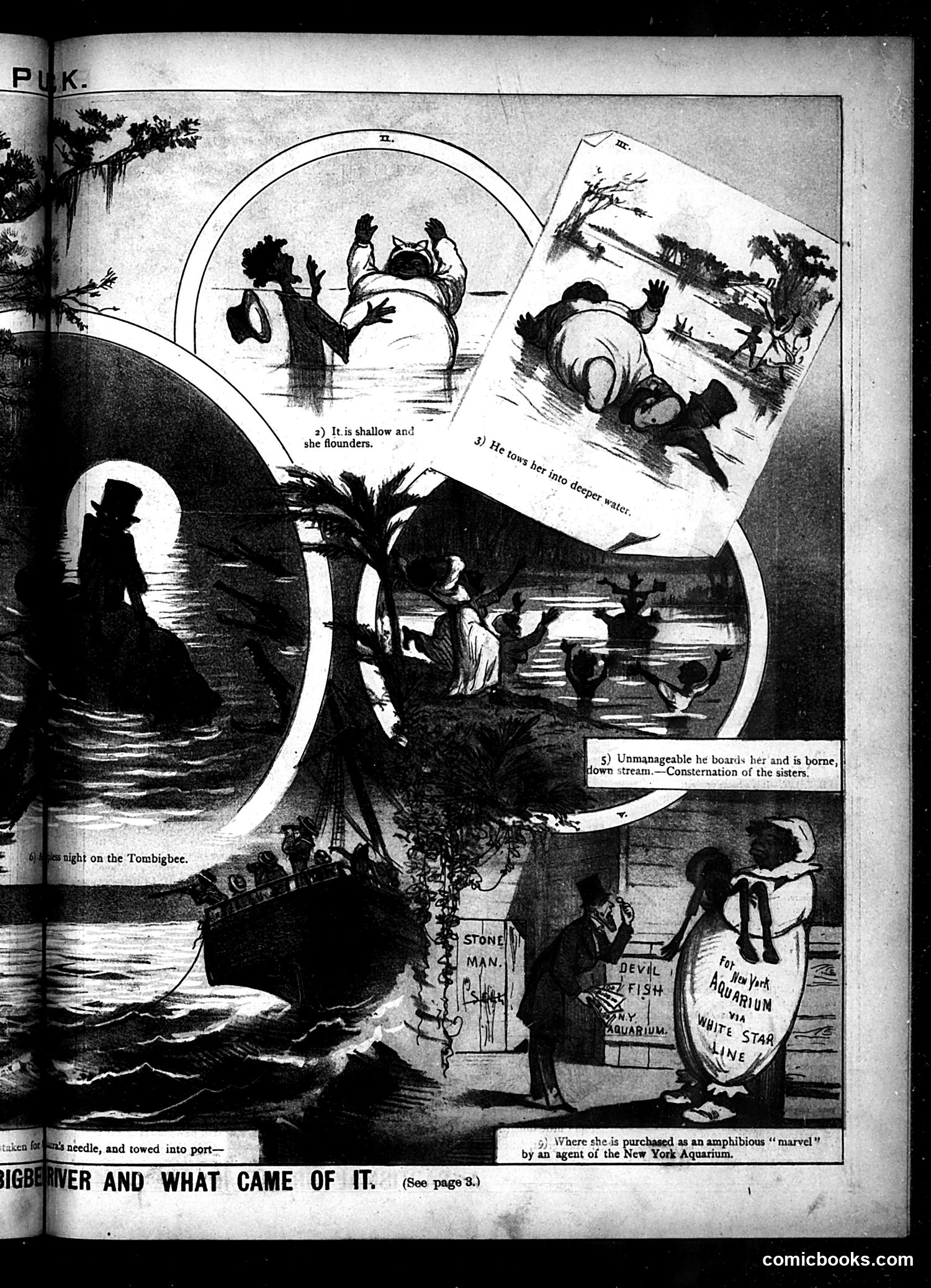
This appears to be a narrative comic strip satirizing the acquisition of an exotic animal—specifically what the captions identify as an amphibious "marvel" purchased by an agent of the New York Aquarium. The sequence shows the creature's journey: initially found in shallow water, it ventures into deeper water, becomes unmanageable aboard ship during transport, and ultimately ends up displayed at the aquarium alongside other attractions (a "Stone Man," "Devil Fish," and other curiosities). The satire likely mocks both the aquarium's sensationalist marketing of exotic specimens and the public's fascination with such "marvel" displays. The progression from capture to commercial exhibition reflects Puck's critique of treating nature as entertainment commodity.
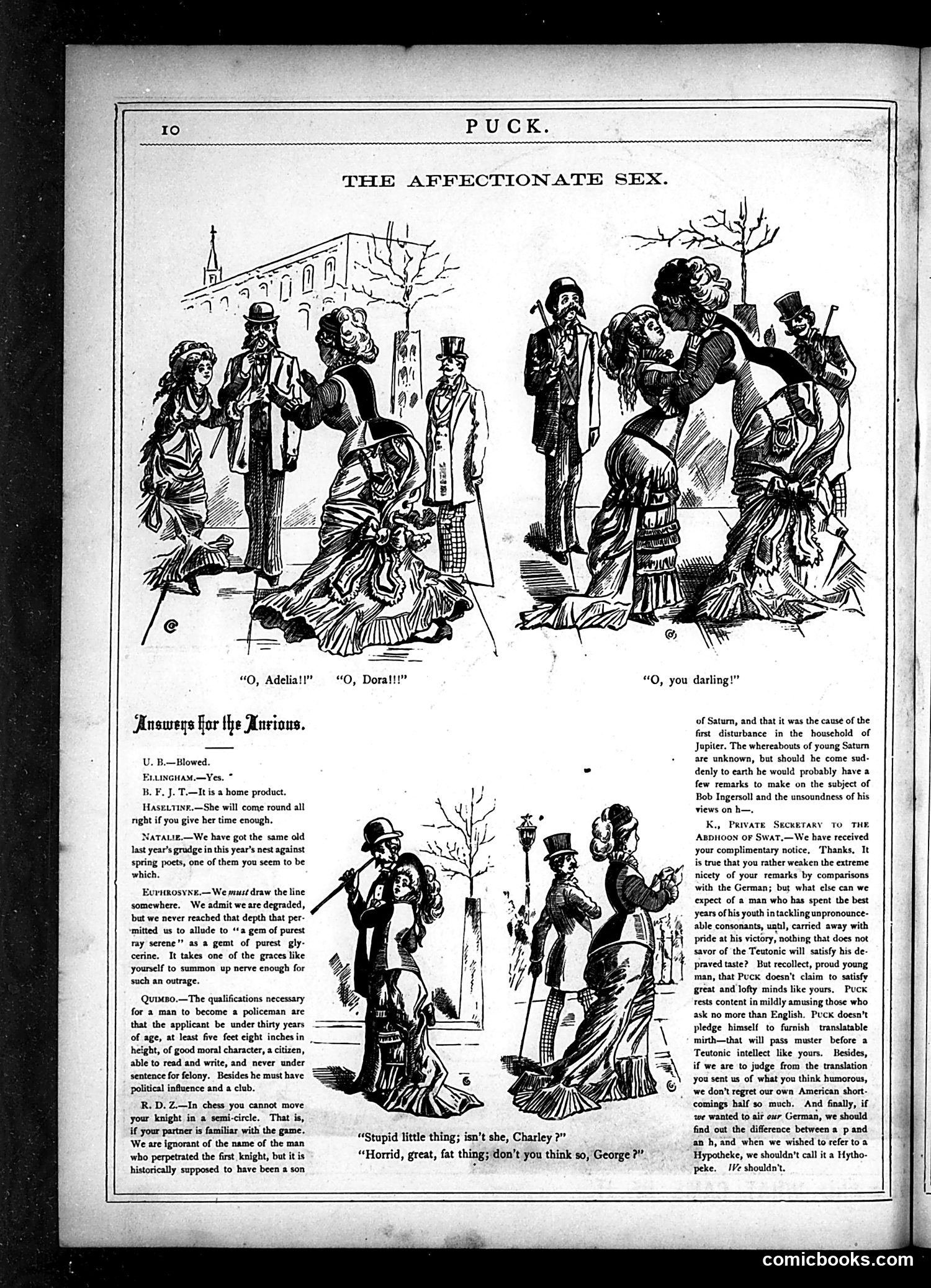
This page satirizes Victorian-era courtship and gender relations. The title "The Affectionate Sex" refers to women, whom the cartoons mock for their emotional displays and romantic behavior. The upper illustrations show women pursuing men in various public settings (near a church, in parks), with captions like "O, Adelia!" and "O, you darling!"—exaggerating feminine emotional expressiveness. The lower illustrations depict similar scenes with dialogue like "Stupid little thing; isn't she, Charley?" suggesting men find women's affection ridiculous or bothersome. The "Answers for the Curious" section provides humorous responses to reader questions about etiquette, romance, and chess, maintaining the satirical tone about social pretension and gender dynamics of the period.
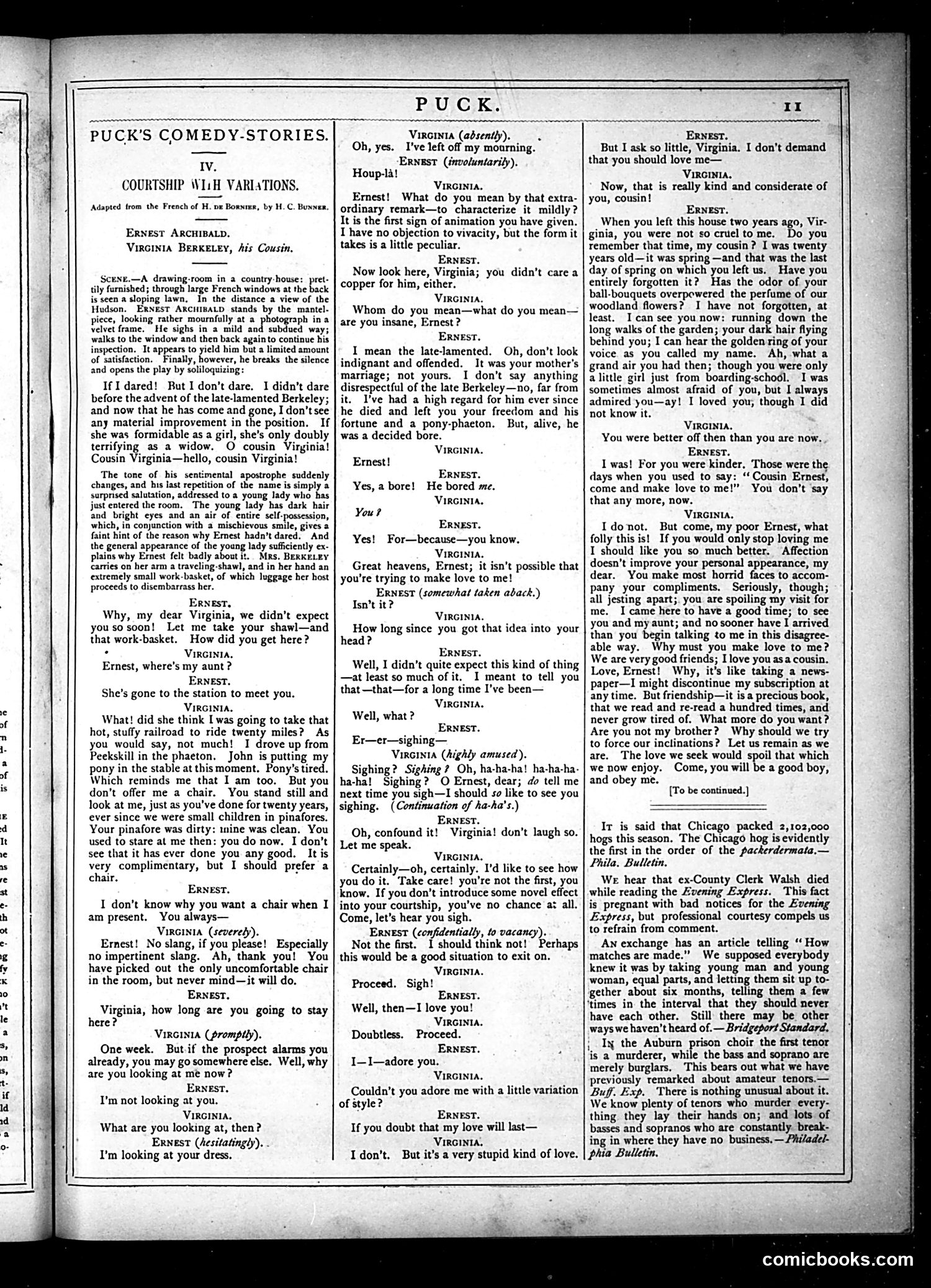
This page from Puck magazine presents a comedic dialogue between **Ernest Archibald** and his cousin **Virginia Berkeley**. The sketch satirizes courtship conventions of the era through their stilted, overly formal conversation. The humor relies on Ernest's awkward attempts at romance—he's clumsy, self-deprecating, and struggles to express genuine affection while Virginia alternates between encouraging and mocking him. The piece pokes fun at Victorian courtship rituals: the artificial language of romance, class consciousness (Ernest worries about his station), and the absurdity of prescribed romantic behavior. The "variations" in the title likely reference how the same awkward dynamics repeat throughout their exchange, suggesting that proper courtship—despite its rules—often devolves into confusion and mutual exasperation.
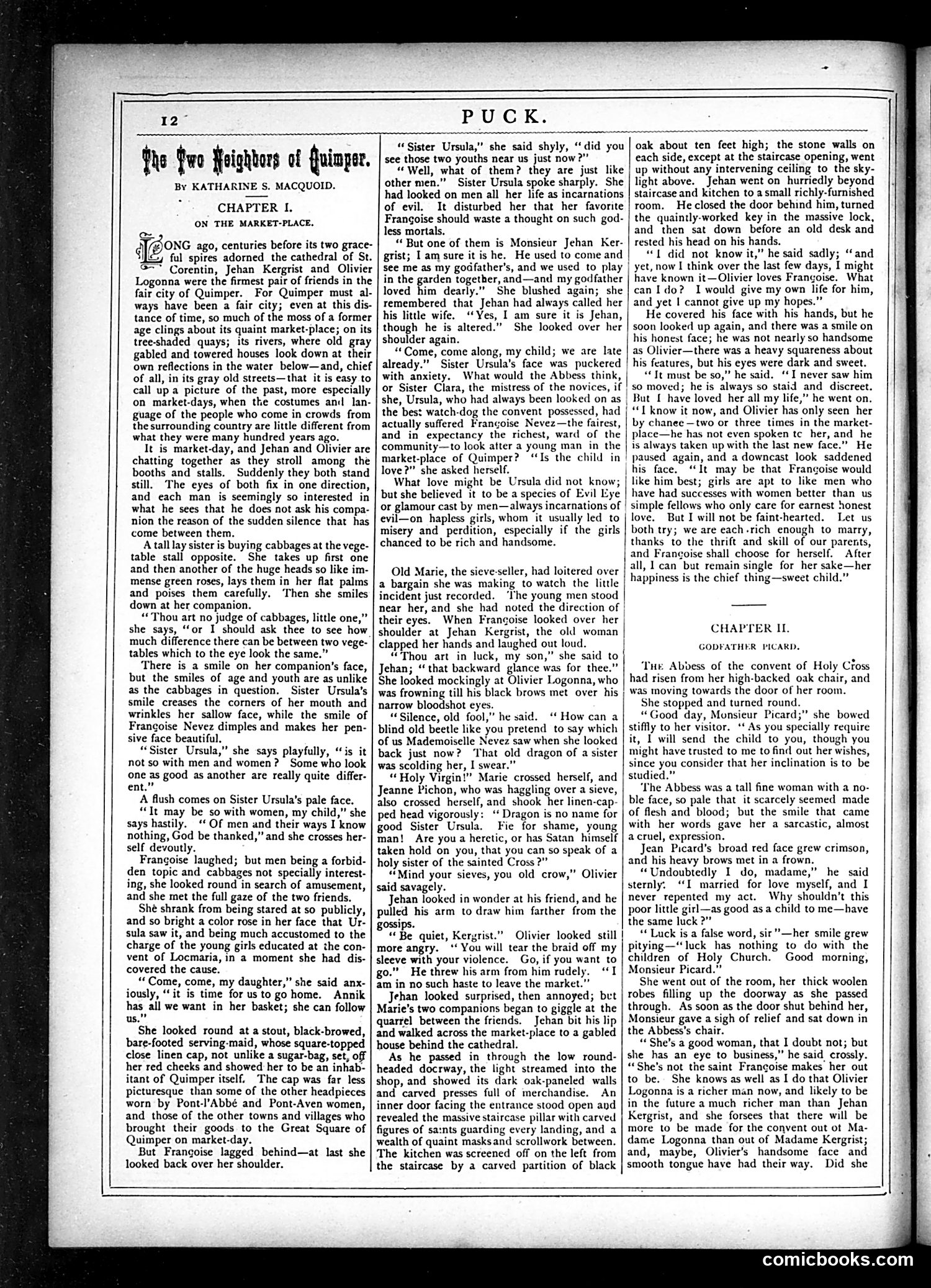
This page contains the opening of a serialized fiction story titled "The Two Neighbors of Quimper" by Katharine S. Macquoid, appearing in what seems to be the literary section of Puck magazine rather than a political cartoon. The story, set in the French town of Quimper, involves characters named Sister Ursula, Jehan Kergrist, Olivier Logonna, and Françoise Nevez. It appears to be a romantic or domestic drama centered on young women in a convent setting, with themes of love, social class, and religious life. This is **not satire or political commentary** but rather serialized European fiction typical of Puck's literary content, which supplemented its famous cartoons and humor pieces.
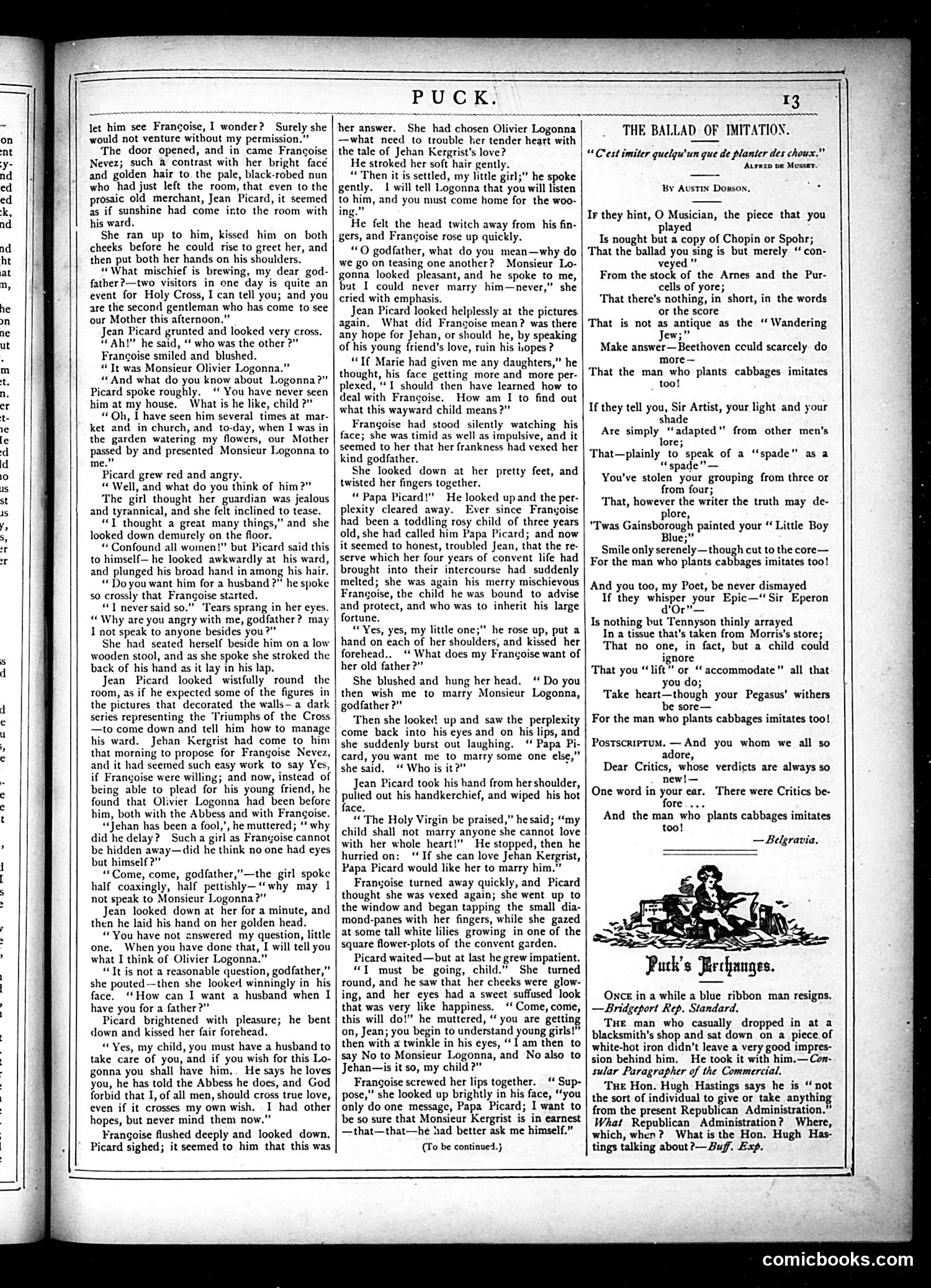
This page contains primarily text content rather than political cartoons. The left column continues a narrative story ("Puck") involving characters named Françoise, Jean Picard, and Olivier Lagonna, appearing to be a serialized fiction piece. The right side features "The Ballad of Imitation" by Austin Dobson, a poem satirizing artistic imitation. It mocks artists and critics who merely copy existing works rather than create original pieces, using the metaphor of "planting cabbages" to represent unoriginal effort. At the bottom, "Puck's Archieves" offers brief satirical snippets about contemporary figures and issues, though specific references are unclear without additional context. The overall thrust criticizes artistic and intellectual plagiarism—a common Puck theme.
This page is primarily **advertising and announcements** rather than political cartoons. The main content announces Puck's newly opened **General Designing Office**, featuring renowned cartoonist **Joseph Keppler** (whose name appears prominently). The office offers illustration services for "the Theatrical Profession," including lithographic portraits, at reasonable rates. The left column contains the "Pictorial Department"—a collection of brief satirical items and humorous anecdotes from various newspapers, typical of Puck's format. These range from weather-related quips to observations about society. Below is a **Notice** advertising a puzzle-picture supplement about the "European Question"—likely referencing contemporary geopolitical tensions—sold separately for five cents. The page functions primarily as a business announcement and subscription promotion rather than presenting editorial satire.
This is primarily an **advertising and notices page** from Puck magazine (page 15), not a satirical cartoon page. The visible content includes: - **Advertisements** for various 19th-century products and services: compressed yeast, glass letters, printing inks, champagne, cigars, tailoring services, and a tailor named Nicoll - **Puck's Almanac for 1878** announcement—a printed publication available for 15 cents - **Patent covers for filing Puck** ($1 each) - **Back number availability notice** for past issues - A memorial notice regarding Brigham Young The page serves the magazine's business operations rather than containing editorial satire. The advertisements reflect typical late-1870s New York commerce and consumer goods.
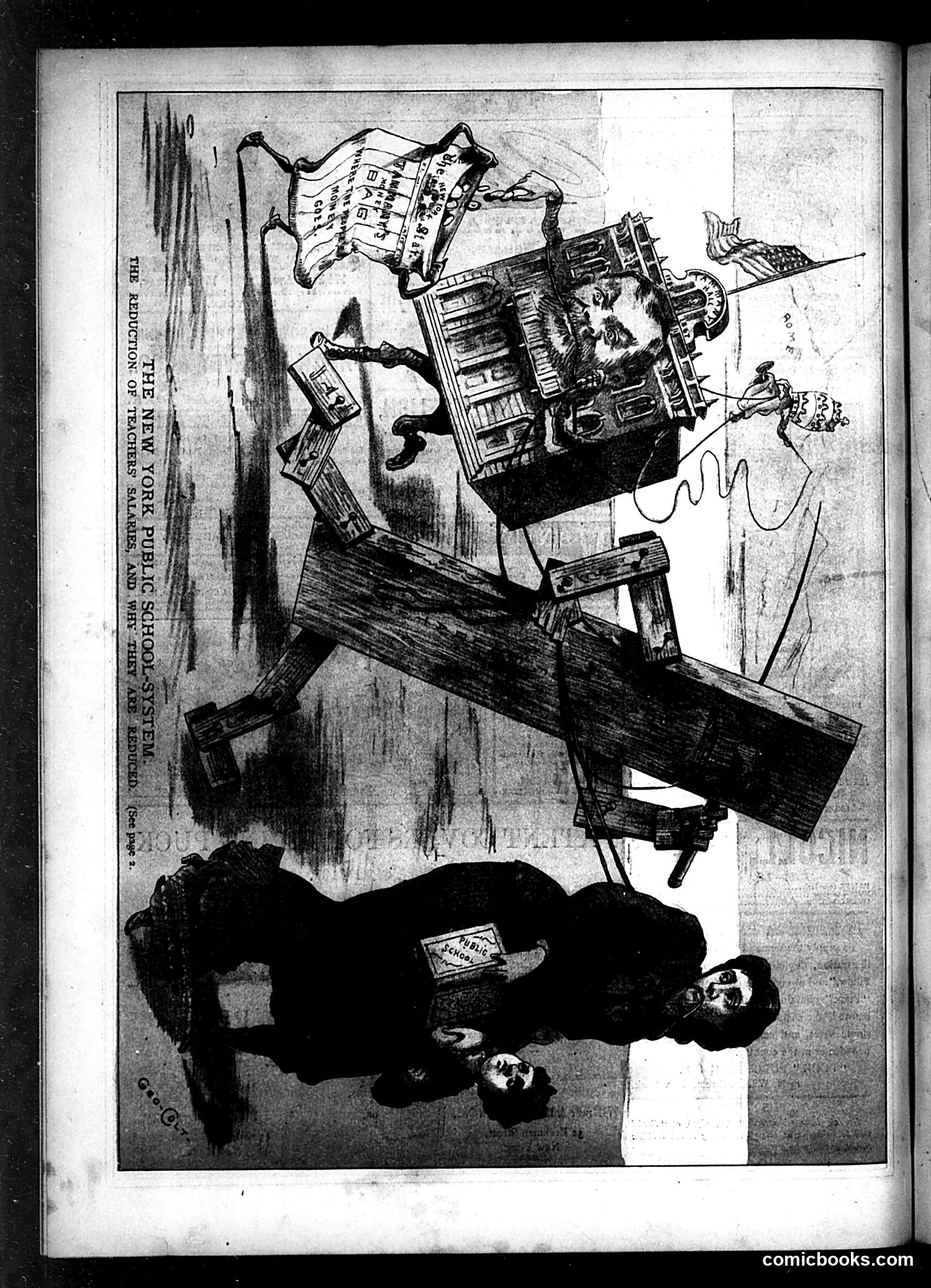
I can see this is a Puck magazine page with a political cartoon, but the OCR text provided appears to be blank or illegible. The image itself shows a rotated illustration featuring what appears to be a figure in formal dress near some architectural or mechanical elements, with additional silhouetted figures at the bottom of the page. Without legible text identifying the specific political figures, events, or satire target, I cannot reliably explain what this cartoon means to modern readers. To provide accurate historical context as you've requested, I would need either: clearer OCR text, visible captions/titles on the page, or confirmation of the publication date. If you can provide the readable text or additional identifying information, I'd be happy to explain the satire's historical context.