
Puck, 1878-03-20 · page 12 of 16
Puck — March 20, 1878 — page 12: what you’re looking at
What you’re looking at
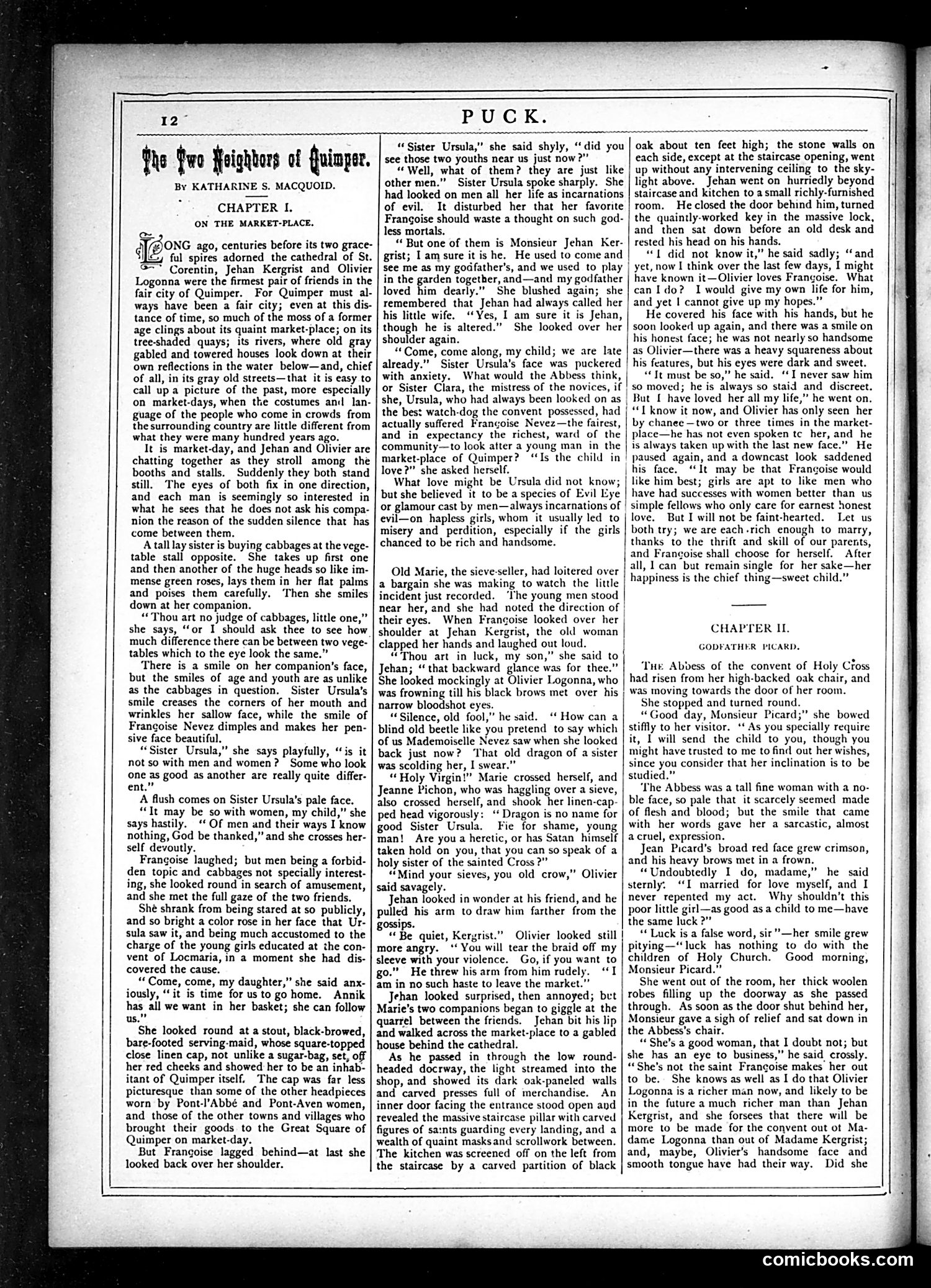
This page contains the opening of a serialized fiction story titled "The Two Neighbors of Quimper" by Katharine S. Macquoid, appearing in what seems to be the literary section of Puck magazine rather than a political cartoon. The story, set in the French town of Quimper, involves characters named Sister Ursula, Jehan Kergrist, Olivier Logonna, and Françoise Nevez. It appears to be a romantic or domestic drama centered on young women in a convent setting, with themes of love, social class, and religious life. This is **not satire or political commentary** but rather serialized European fiction typical of Puck's literary content, which supplemented its famous cartoons and humor pieces.
📄 Transcribed text from this page (OCR, searchable)
Machine-transcribed from the original scan — historical spelling and the odd misread are preserved.
12 Phe Pwo feighdors of Quimper. By KATHARINE S. MACQUOID. CHAPTER I. ON THE MARKET-PLACE. F) (BONG ago, centuries before its two grace- WS, ful spires adorned the cathedral of St. @" Corentin, Jehan Kergrist and Olivier Logonna were the firmest pair of friends in the fair city of Quimper. For Quimper must al- ways have been a fair city; even at this dis- tance of time, so much of the moss of a former age clings about its quaint market-place; on its tree-shaded quays; its rivers, where old gray gabled and towered houses look down at their own reflections in the water below—and, chief of all, in its gray old streets—that it is easy to call up a picture of the past, more especially on market-days, when the costumes and lan- guage of the people who come in crowds from the surrounding country are little different from what they were many hundred years ago. It is market-day, and Jehan and Olivier are chatting together as they stroll among the booths and stalls. Suddenly they both stand still. The eyes of both fix in one direction, and each man is seemingly so interested in what he sees that he does not ask his compa- nion the reason of the sudden silence that has come between them. A tall lay sister is buying cabbages at the vege- table stall opposite. She takes up first one and then another of the huge heads so like im- mense green roses, lays them in her flat palms and poises them carefully. ‘Then she smiles down at her companion. ‘Thou art no judge of cabbages, little one,” she says, ‘or I should ask thee to see how much difference there can be between two vege- tables which to the eye look the same. There is a smile on her companion’s face, but the smiles of age and youth are as unlike as the cabbages in question. Sister Ursula’s smile creases the corners of her mouth and wrinkles her sallow face, while the smile of Francoise Nevez dimples and makes her pen- sive face beautiful. “Sister Ursula,” she says playfully, “is it not so with men and women? Some who look one as good as another are really quite differ- ent.” A flush comes on Sister Ursula’s pale face. “It may be so with women, my child,” she says hastily. ‘‘ Of men and their ways I know nothing, God be thanked,” and she crosses her- self devoutly. Frangoise laughed; but men being a forbid- den topic and cabbages not specially interest- ing, she looked round in search of amusement, and she met the full gaze of the two friends. She shrank from being stared at so publicly, and so bright a color rose in her face that Ur- sula saw it, and being much accustomed to the charge of the young girls educated at the con- vent of Locmaria, in a moment she had dis- covered the cause. “Come, come, my daughter,” she said anx- iously, “it is time for us to go home. Annik has all we want in her basket; she can follow us.” She looked round at a stout, black-browed, bare-footed serving-maid, whose square-topped close linen cap, not unlike a sugar-bag, set, off her red cheeks and showed her to be an inhab- itant of Quimper itself. The cap was far less picturesque than some of the other headpieces worn by Pont-l’Abbé and Pont-Aven women, and those of the other towns and villages who brought their goods to the Great Square of Quimper on market-day. But Frangoise lagged behind—at last she looked back over her shoulder. “Sister Ursula,” she said shyly, “did you see those two youths near us just now?” “Well, what of them? they are just like other men.” Sister Ursula spoke sharply. She had looked on men all her life as incarnations of evil. It disturbed her that her favorite Frangoise should waste a thought on such god- less mortals. “ But one of them is Monsieur Jehan Ker- grist; I am sure it is he. He used to come and | see me as my godfather’s, and we used to play in the garden together, and—and my godfather loved fim dearly.” She blushed again; she remembered that Jehan had always called her his little wife. “Yes, I am sure it is Jehan, though he is altered.” She looked over her shoulder again. “Come, come along, my child; we are late already.” Sister Ursula’s face was puckered with anxiety. What would the Abbess think, | or Sister Clara, the mistress of the novices, if she, Ursula, who had always been looked on’as | the bes: watch-dog the convent possessed, had actually suffered Frangoise Nevez—the fairest, and in expectancy the richest, ward of the community—to look atter a young man in the market-place of Quimper? ‘Is the child in love?” she asked herself. What love might be Ursula did not know; but she believed it to be a species of Evil Eye or glamour cast by men—always incarnations of | evil—on hapless girls, whom it usually led to misery and perdition, especially if the girls chanced to be rich and handsome. Old Marie, the sieve-seller, had loitered over a bargain she was making to watch the little | incident just recorded. ‘The young men stood near her, and she had noted the direction of their eyes. When Francoise looked over her | shoulder at Jehan Kergrist, the old woman clapped her hands and laughed out loud. “Thou art in luck, my son,” she said to Jehan; “that backward glance was for thee.” She looked mockingly at Olivier Logonna, who was frowning till his black brows met over his narrow bloodshot eyes. “Silence, old fool,” he said. ‘‘ How can a blind old beetle like you pretend to say which of us Mademoiselle Nevez saw when she looked back just now? ‘hat old dragon of a sister was scolding her, I swear.” “ Holy Virgin!” Marie crossed herself, and Jeanne Pichon, who was haggling over a sieve, also crossed herself, and shook her linen-cap- ped head vigorously: “Dragon is no name for good Sister Ursula. Fie for shame, young man! Are you a heretic, or has Satan himself taken hold on you, that you can so speak of a holy sister of the sainted Cross 2” “Mind your sieves, you old crow,” Olivier said savagely. Jehan looked in wonder at his friend, and he pulled his arm to draw him farther from the gossips. “Be quiet, Keryrist.” Olivier looked still more angry.‘ You will tear the braid off my sleeve with your violence. Go, if you want to go.” He threw his arm from him rudely. “I am in no such haste to leave the market.” Jehan looked surprised, then annoyed; bet Marie’s two companions began to giggle at the quarrel between the friends. Jehan bit his lip and walked across the market-place to a gabled house behind the cathedral. As he passed in through the low round- headed docrway, the light streamed into the shop, and showed its dark oak-paneled walls and carved presses full of merchandise. An inner door facing the entrance stood open and revealed the massive staircase pillar with carved figures of sa:nts guarding every landing, and a wealth of quaint masksand scrollwork between. The kitchen was screened off on the left from the staircase by a carved partition of black | and Frangoise shall choose for herself. oak about ten feet high; the stone walls on each side, except at the staircase opening, went up without any intervening ceiling to the sky- light above. Jehan went on hurriedly beyond staircase and kitchen to a small richly-furnished room. Heclosed the door behind him, turned the quaintly-worked key in the massive lock, and then sat down before an old desk and rested his head on his hands. “{ did not know it,” he said sadly; “and yet, now I think over the last few days, I might have known it—Olivier loves Francoise. What can Ido? I would give my own life for him, and yet | cannot give up my hopes.” He covered his face with his hands, but he soon looked up again, and there was a smile on his honest face; he was not nearly so handsome as Olivier—there was a heavy squareness about his features, but his eyes were dark and sweet. “Tt must be so,” he said. ‘I never saw him so moved; he is always so staid and discreet. But { have loved her all my life,” he went on. “I know it now, and Olivier has only seen her by chanee—two or three times in the market- place—he has not even spoken tc her, and he is always taken up with the last new face.” He paused again, and a downcast look saddened his face. ‘It may be that Frangoise would like him best; girls are apt to like men who have had successes with women better than us simple fellows who only care for earnest honest love. But I will not be faint-hearted. Let us both try; we are each.rich enough to marry, thanks to the thrift and skill of our parents, After all, 1 can but remain single for her sake—her happiness is the chief thing—sweet chil CHAPTER IL. GODFATHER PICARD, ‘Tne Abbess of the convent of Holy Cross had risen from her high-backed oak chair, and was moving towards the door of her room. She stopped and turned round. “Good day, Monsieur Picard;” she bowed stiffly to her visitor. ‘As you specially require it, I will send the child to you, though you might have trusted to me to find out her wishes, since you consider that her inclination is to be studied.” ‘The Abbess was a tall fine woman with a no- ble face, so pale that it scarcely seemed made of flesh and blood; but the smile that came with her words gave her a sarcastic, almost acruel, expression. Jean Picard’s broad red face grew crimson, and his heavy brows met in a frown, “Undoubtedly I do, madame,” he said sternly: “I married for love myself, and I never repented my act. Why shouldn't this poor little girl—as good asa child to me—have the same luck ?”” “Luck is a false word, sir"—her smile grew pitying—“luck has nothing to do with the children of Holy Church. Good morning, Monsieur Picard.” She went out of the room, her thick woolen robes filling up the doorway as she passed through. As soon as the door shut behind her, Monsieur gave a sigh of relief and sat down in the Abbess’s chair. “ She’s a good woman, that I doubt not; but she has an eye to business,” he said crossly. “She's not the saint Francoise makes her out to be. She knows as well as I do that Olivier Logonna is a richer man now, and likely to be in the future a much richer man than Jehan Kergrist, and she forsees that there will be more to be made for the convent out ot Ma- dame Logonna than out of Madame Kergrist; and, maybe, Olivier’s handsome face and smooth tongue have had their way. Did she comicbooks.com