
Puck, 1878-03-20 · page 13 of 16
Puck — March 20, 1878 — page 13: what you’re looking at
What you’re looking at
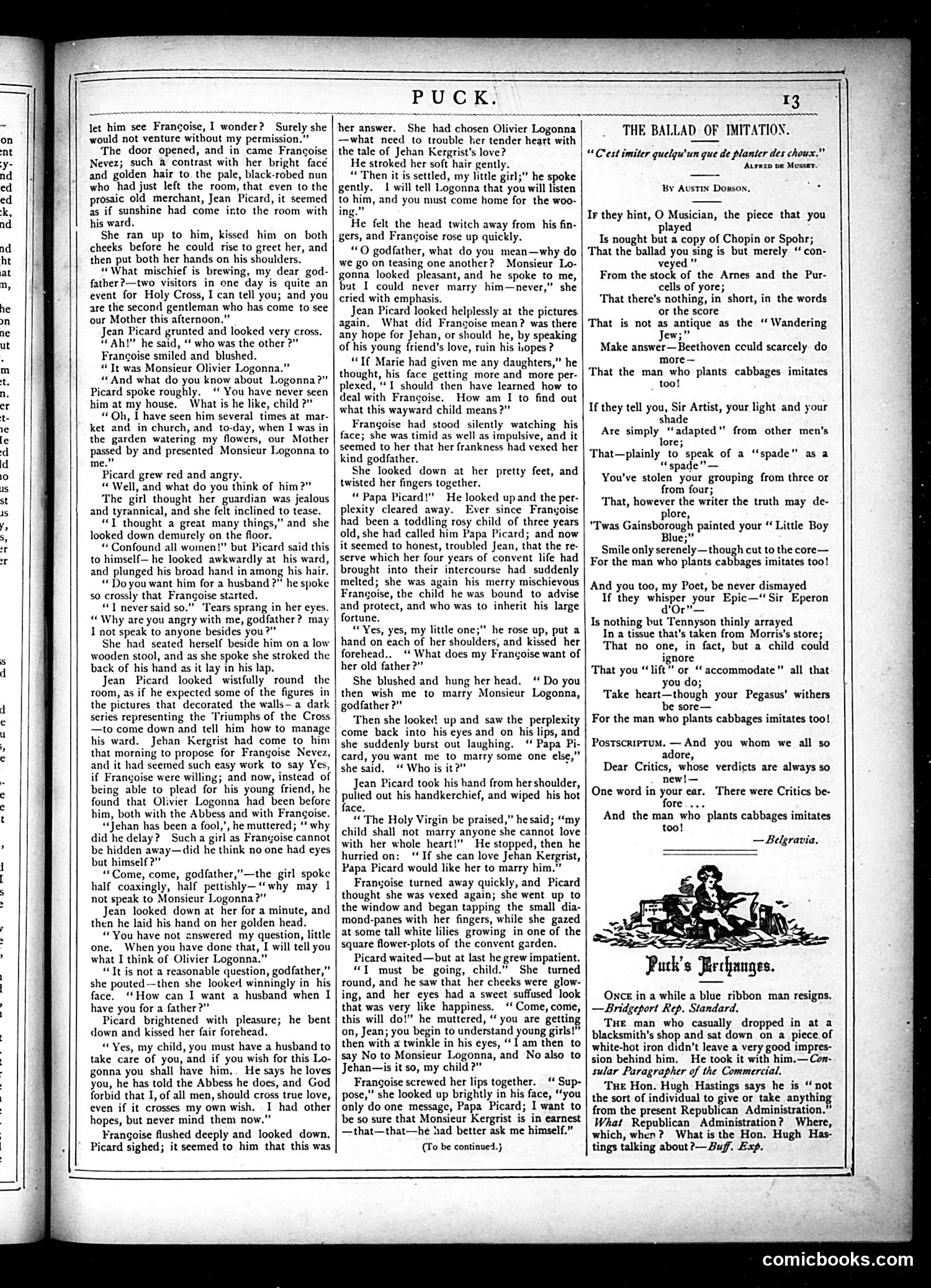
This page contains primarily text content rather than political cartoons. The left column continues a narrative story ("Puck") involving characters named Françoise, Jean Picard, and Olivier Lagonna, appearing to be a serialized fiction piece. The right side features "The Ballad of Imitation" by Austin Dobson, a poem satirizing artistic imitation. It mocks artists and critics who merely copy existing works rather than create original pieces, using the metaphor of "planting cabbages" to represent unoriginal effort. At the bottom, "Puck's Archieves" offers brief satirical snippets about contemporary figures and issues, though specific references are unclear without additional context. The overall thrust criticizes artistic and intellectual plagiarism—a common Puck theme.
📄 Transcribed text from this page (OCR, searchable)
Machine-transcribed from the original scan — historical spelling and the odd misread are preserved.
let him see Francoise, 1 wonder? Surely she would not venture without my permission.”” The door opened, and in came Francoise Nevez; such a contrast with her bright face and golden hair to. the pale, black-robed nun who had just left the room, that even to the prosaic old merchant, Jean Picard, it seemed as if sunshine had come into the room with his ward. She ran up to him, kissed him on both cheeks before he could rise to greet her, and then put both her hands on his shoulders. “What mischief is brewing, my dear god- father ?—two visitors in one day is quite an event for Holy Cross, I can tell you; and you are the second gentleman who has come to see our Mother this afternoon.” Jean Picard grunted and looked very cross. “Ah!” he said, ‘‘ who was the other ?” Francoise smiled and blushed. “ Tt was Monsieur Olivier Logonna.” “And what do you know about Logonna?” Picard spoke roughly.‘ You have never seen him at my house, What is he like, child ?” “Oh, I have seen him several times at mar- ket and in church, and to-day, when I was in the garden watering my flowers, our Mother passed by and presented Monsieur Logonna to me.” Picard grew red and angry. “ Well, and what do you think of him?” The girl thought her guardian was jealous and tyrannical, and she felt inclined to tease. “T thought a great many things,” and she looked down demurely on the floor. “ Confound all women!” but Picard said this to himself— he looked awkwardly at his ward, and plunged his broad hand in among his hair. «Do you want him for a husband ?” he spoke so crossly that Frangoise started. “T never said so.” Tears sprang in her eyes. “Why are you angry with me, godfather? may I not speak to anyone besides you?” She had seated herself beside him on a low wooden stool, and as she spoke she stroked the back of his hand as it lay in his lap. Jean Picard looked’ wistfully round the room, as if he expected some of the figures in the pictures that decorated the walls—a dark series representing the ‘Triumphs of the Cross —to come down and tell him how to manage his ward. Jehan Kergrist had come to him that morning to propose for Frangoise Nevez, and it had seemed such easy work to say Yes, if Francoise were willing; and now, instead of being able to plead for his young friend, he found that Olivier Logonna had been before him, both with the Abbess and with Frangoise. “Jehan has been a fool,’, he muttered; “ why did he delay? Such a girl as Frangoise cannot be hidden away—did he think no one had eyes but himself ?”” “Come, come, godfather,”—the girl spoke half coaxingly, half pettishly—“why may I not speak to Monsieur Logonna?” Jean looked down at her for a minute, and then he laid his hand on her golden head. “You have not answered my question, little one. When you have done that, I will tell you what I think of Olivier Logonna.” “Tt is not a reasonable question, godfather,” she pouted—then she looked winningly in his face. ‘How can I want a husband when I have you for a father?” Picard brightened with pleasure; he bent down and kissed her fair forehead. “Yes, my child, you must have a husband to take care of you, and if you wish for this Lo- gonna you shall have him.. He says he loves you, he has told the Abbess he does, and God forbid that I, of all men, should cross true love, even if it crosses my own wish. I had other hopes, but never mind them now.” Frangoise flushed deeply and looked down. Picard sighed; it seemed to him that this was PUCK. her answer. She had chosen Olivier Logonna —what need to trouble her tender heart with | the tale of Jehan Kergrist’s love? | He stroked her soft hair gently. “ Then it is settled, my little girl; he spoke gently. 1 will tell Logonna that you will listen to him, and you must come home for the woo- ing.” He felt the head twitch away from his fin- gers, and Frangoise rose up quickly. “O godfather, what do you mean—why do we go on teasing one another? Monsieur Lo- gonna looked pleasant, and he spoke to me, but I could never marry him—never,” she cried with emphasis. Jean Picard looked helplessly at the pictures. again, What did Francoise mean? was there any hope for Jehan, or should he, by speaking of his young friend’s love, ruin his iopes ? “If Marie had given me any daughters,” he thought, his face getting more and more per- plexed, “I should then have learned how to deal with Francoise. How am I to find out what this wayward child means?” Frangoise had stood silently watching his face; she was timid as well as impulsive, and it seemed to her that her frankness had vexed her kind godfather. She looked down at her pretty feet, and twisted her fingers together. “Papa Picard!” He looked up and the per- plexity cleared away. Ever since Frangoise had been a toddling rosy child of three years old, she had called him Papa Picard; and now it seemed to honest, troubled Jean, that the re- serve which her four years of convent life had brought into their intercourse had suddenly melted; she was again his merry mischievous Frangoise, the child he was bound to advise and protect, and who was to inherit his large fortune. “Yes, yes, my little one;” he rose up, put a hand on each of her shoulders, and kissed her forehead.. ‘ What does my Francoise want of her old father?” She blushed and hung her head.“ Do you then wish me to marry Monsieur Logonna, godfather ?” ‘Then she looked up and saw the perplexity come back into his eyes and on his lips, and she suddenly burst out laughing. “ Papa Pi- card, you want me to marry some one else,” she said. ‘ Who is it?” Jean Picard took his hand from her shoulder, pulted out his handkerchief, and wiped his hot face, “The Holy Virgin be praised,” he said; “my child shall not marry anyone she cannot love with her whole heart!” He stopped, then he hurried on: ‘If she can love Jehan Kergrist, Papa Picard would like her to marry him.” Frangoise turned away quickly, and Picard thought she was vexed again; she went up to the window and began tapping the small dia- mond-panes with her fingers, while she gazed at some tall white lilies growing in one of the square flower-plots of the convent garden. Picard waited—but at last he grew impatient. “T must be going, child.” She turned round, and he saw that her cheeks were glow- ing, and her eyes had a sweet suffused look that was very like happiness. ‘‘ Come, come, this will do!” he muttered, ‘ you are getting on, Jean; you begin to understand young girls!” then with a twinkle in his eyes, “1am then to say No to Monsieur Logonna, and No also to Jehan—is it so, my child?” Francoise screwed her lips together.“ Sup- pose,” she looked up brightly in his face, “you only do one message, Papa Picard; I want to be so sure that Monsieur Kergrist is in earnest —that—that—he had better ask me himself.” (To be continued.} THE BALLAD OF IMITATION. “ Cest imiter quelgu'un que de planter des choux.” Aurazp pe Musser, By Austin Dosson. i Ir they hint, O Musician, the piece that you played Is nought but a copy of Chopin or Spohr; That the ballad you sing is but merely “con- veyed” From the stock of the Arnes and the Pur- cells of yore; That there's nothing, in short, in the words or the score That is not as antique as the ‘ Wandering Jew;” Make answer—Beethoven cculd scarcely do more — That the man who plants cabbages imitates too! If they tell you, Sir Artist, your light and your shade Are simply “adapted” from other men’s lore; That—plainly to’ speak of a “spade” as a “spade” — You've stolen your grouping from thrce or from four; ‘That, however the writer the truth may de- plore, ’Twas Gainsborough painted your “ Little Boy lue;”” Smile only serenely—though cut to the core— For the man who plants cabbages imitates too! And you too, my Poet, be never dismayed If they whisper your Epic— Sir Eperon d’Or"— Is nothing but Tennyson thinly arrayed In a tissue that's taken from Morris’s store; That no one, in fact, but a child could ignore That you “lift” or ‘ accommodate” all that you do; Take heart—though your Pegasus’ withers be sore— For the man who plants cabbages imitates too! PostscriptuM. — And you whom we all so adore, Dear Critics, whose verdicts are always so new!— One word in your ear, There were Critics be- fore And the man who plants cabbages imitates too! —Belgravia. pee utk’s Firchanges. Once in a while a blue ribbon man resigns. —Bridgeport Rep. Standard. Tue man who casually dropped in at a blacksmith’s shop and sat down on a piece of white-hot iron didn’t leave a very good impres- sion behind him. He took it with him.— Con- sular Paragrapher of the Commercial. ‘Tue Hon. Hugh Hastings says he is “not the sort of individual to give or take anythin from the present Republican Administration.” What Republican Administration? Where, which, when? What is the Hon. Hugh Has- tings talking about ?—Buf. Exp. comicbooks.com