
Puck, 1878-03-20 · page 3 of 16
Puck — March 20, 1878 — page 3: what you’re looking at
What you’re looking at
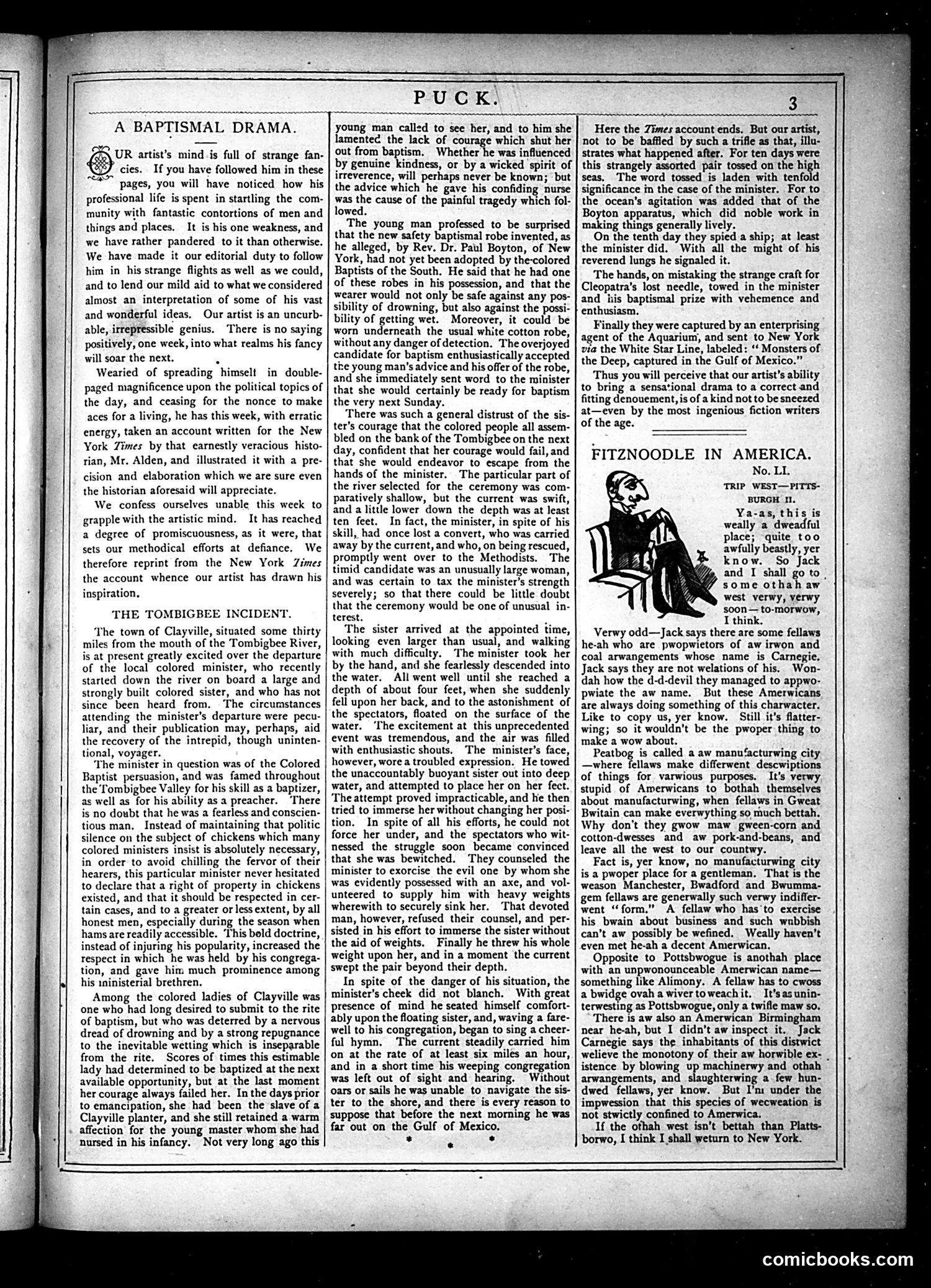
This page contains two distinct articles: **"A Baptismal Drama"** discusses an artist's editorial decision to follow a minister conducting a baptism ceremony in Clayville. The piece critiques the minister's handling of an African American woman's baptism in the Tombigbee River, where she nearly drowned. The satirical account questions the minister's competence and judgment, particularly regarding safety protocols for conducting such ceremonies among "colored" congregants. **"Fitznoodle in America"** presents a travel narrative mocking American regional characteristics, with a figure named Jack observing peculiarities of American life and manners, apparently comparing them unfavorably to European standards. Both pieces employ satire and irony typical of Puck's social commentary, though the racial language reflects the publication's late 19th-century context.
📄 Transcribed text from this page (OCR, searchable)
Machine-transcribed from the original scan — historical spelling and the odd misread are preserved.
A BAPTISMAL DRAMA. +\ UR artist’s mind is full of strange fan- cies. If you have followed him in these pages, you will have noticed how his professional life is spent in startling the com- munity with fantastic contortions of men and things and places. It is his one weakness, and we have rather pandered to it than otherwise. We have made it our editorial duty to follow him in his strange flights as well as we could, and to lend our mild aid to what we considered almost an interpretation of some of his vast and wonderful ideas. Our artist is an uncurb- able, irrepressible genius. ‘There is no saying positively, one week, into what realms his fancy will soar the next. . Wearied of spreading himself in double- paged magnificence upon the political topics of the day, and ceasing for the nonce to make aces for a living, he has this week, with erratic energy, taken an account written for the New York Zimes by that earnestly veracious histo- rian, Mr. Alden, and illustrated it with a pre- cision and elaboration which we are sure even the historian aforesaid will appreciate. We confess ourselves unable this week to grapple with the artistic mind. It has reached a degree of promiscuousness, as it were, that sets our methodical efforts at defiance. We therefore reprint from the New York Zimes the account whence our artist has drawn his inspiration. THE TOMBIGBEE INCIDENT. The town of Clayville, situated some thirty miles from the mouth of the Tombigbee River, is at present greatly excited over the departure of the local colored minister, who recently started down the river on board a large and strongly built colored sister, and who has not since been heard from. The circumstances attending the minister’s departure were pecu- liar, and their publication may, perhaps, aid the recovery of the intrepid, though uninten- tional, voyager. The minister in question was of the Colored Baptist persuasion, and was famed throughout the Tombigbee Valley for his skill as a baptizer, as well as for his ability as a preacher. ‘There is no doubt that he was a fearless and conscien- tious man. Instead of maintaining that politic silence on the subject of chickens which many colored ministers insist is absolutely necessary, in order to avoid chilling the fervor of their hearers, this particular minister never hesitated to declare that a right of property in chickens existed, and that it should be respected in cer- tain cases, and to a greater or less extent, by all honest men, especially during the season when hams are readily accessible. ‘This bold doctrine, instead of injuring his popularity, increased the respect in which he was held by his congrega- tion, and gave him much prominence among his ininisterial brethren. Among the colored ladies of Clayville was one who had long desired to submit to the rite of baptism, but who was deterred by a nervous dread of drowning and by a strong repugnance to the inevitable wetting which is inseparable from the rite. Scores of times this estimable lady had determined to be baptized at the next available opportunity, but at the last moment her courage always failed her. Inthe days prior to emancipation, she had been the slave of a Clayville planter, and she still retained a warm » affection for the young master whom she had nursed in his infancy. Not very long ago this PUCK) young man called to see her, and to him she lamentec the lack of courage which shut her out from baptism. Whether he was influenced by genuine kindness, or by a wicked spirit of irreverence, will perhaps never be known; but the advice which he gave his confiding nurse was the cause of the painful tragedy which fol- lowed. The young man professed to be surprised that the new safety baptismal robe invented, as he alleged, by Rev. Dr. Paul Boyton, of New York, had not yet been adopted by the-colored Baptists of the South. He said that he had one of these robes in his possession, and that the wearer would not only be safe against any pos- sibility of drowning, but also against the possi- bility of getting wet. Moreover, it could be worn underneath the usual white cotton robe, without any danger of detection. The overjoyed candidate for baptism enthusiastically accepted the young man’s advice and his offer of the robe, and she immediately sent word to the minister that she would certainly be ready for baptism the very next Sunday. There was such a general distrust of the sis- ter’s courage that the colored people all assem- bled on the bank of the Tombigbee on the next day, confident that her courage would fail, and that she would endeavor to escape from the hands of the minister. The particular part of the river selected for the ceremony was com- paratively shallow, but the current was swift, and a little lower down the depth was at least ten feet. In fact, the minister, in spite of his skill, had once lost a convert, who was carried away by the current, and who, on being rescued, promptly went over to the Methodists. The timid candidate was an unusually large woman, and was certain to tax the minister’s strength severely; so that there could be little doubt that the ceremony would be one of unusual in- terest. . The sister arrived at the appointed time, looking even larger than usual, and walking with much difficulty, The minister took her by the hand, and she fearlessly descended into the water. All went well until she reached a depth of about four feet, when she suddenly fell upon her back, and to the astonishment of the spectators, floated on the surface of the water. ‘The excitement at this unprecedented event was tremendous, and the air was filled with enthusiastic shouts. The minister’s face, however, wore a troubled expression. He towed the unaccountably buoyant sister out into deep water, and attempted to place her on her fect. ‘The attempt proved impracticable, and he then tried to immerse her without changing her posi- tion. In spite of all his efforts, he could not force her under, and the spectators who wit- nessed the struggle soon became convinced that she was bewitched. They counseled the minister to exorcise the evil one by whom she was evidently possessed with an axe, and vol- unteered to supply him with heavy weights wherewith to securely sink her. That devoted man, however, refused their counsel, and per- sisted in his effort to immerse the sister without the aid of weights. Finally he threw his whole weight upon her, and in a moment the current swept the pair beyond their depth. In spite of the danger of his situation, the minister’s cheek did not blanch. With great presence of mind he seated himself comfort- ably upon the floating sister, and, waving a fare- well to his congregation, began to sing a cheer- ful hymn. The current steadily carried him on at the rate of at least six miles an hour, and in a short time his weeping congregation was left out of sight and hearing. Without oars or sails he was unable to navigate the sis- ter to the shore, and there is every reason to suppose that before the next morning he was far out on the Gulf of Mexico. * * * Here the Zimes account ends. But our artist, not to be baffled by such a trifle as that, illu- strates what happened after. For ten days were this strangely assorted pair tossed on the high seas, The word tossed is laden with tenfold significance in the case of the minister. For to the ocean's agitation was added that of the Boyton apparatus, which did noble work in making things generally lively. On the tenth day they spied a ship; at least the minister did. With all the might of his reverend lungs he signaled it. The hands, on mistaking the strange craft for Cleopatra's lost needle, towed in the minister and his baptismal prize with vehemence and enthusiasm. Finally they were captured by an enterprising agent of the Aquarium, and sent to New York via the White Star Line, labeled: ‘¢ Monsters of the Deep, captured in the Gulf of Mexico.” Thus you will perceive that our artist's ability to bring a sensational drama to a correct and fitting denouement, is of a kind not to be sneezed at—even by the most ingenious fiction writers of the age. FITZNOODLE IN AMERICA. No. LI. TRIP WEST—PITTS- BURGH 11. Ya-as, this is weally a dweadful place; quite too awfully beastly, yer know. Jack and I shall go to. some othah aw west verwy, verwy soon— to-morwow, I think. Verwy odd—Jack says there are some fellaws he-ah who are pwopwietors of aw irwon and coal arwangements whose name is Carnegie. Jack says they are not welations of his. Won- dah how the d-d-devil they managed to appwo- pwiate the aw name. But these Amerwicans are always doing something of this charwacter. Like to copy us, yer know. Still it’s flatter- wing; so it wouldn’t be the pwoper thing to make a wow about. Peatbog is called a aw manu‘acturwing city —where fellaws make differwent descwiptions of things for varwious purposes. It's v stupid of Amerwicans to bothah themselves about manufacturwing, when fellaws in Gweat Bwitain can make everwything so much bettah. Why don't they gwow maw gween-corn and cotton-dwesses and aw pork-and-beans, and leave all the west to our countwy. Fact is, yer know, no manufacturwing city is a pwoper place for a gentleman. That is the weason Manchester, Bwadford and Bwumma- gem fellaws are generwally such verwy indiffer- went “form.” A_fellaw who has‘to exercise his bwain about business and such wabbish can’t aw possibly be wefined. Weally haven't even met he-ah a decent Amerwican. Opposite to Pottsbwogue is anothah place with an unpwonounceable Amerwican name— something like Alimony. A fellaw has to cwoss a bwidge ovah a wiver toweachit, It’sasunin- terwesting as Pottsbwogue, only a twifle maw so. There is aw also an Amerwican Birmingham near he-ah, but I didn’t aw inspect it. Jack Carnegie says the inhabitants of this distwict welieve the monotony of their aw horwible ex- istence by blowing ep machinerwy and othah arwangements, and laughterwing a few hun- dwed fellaws, yer know. But I’m under the impwession that this species of wecweation is not stwictly confined to Amerwica. If the othah west isn’t bettah than Platts- borwo, I think I shall weturn to New York. comicbooks.com