
Puck, 1878-03-20 · page 4 of 16
Puck — March 20, 1878 — page 4: what you’re looking at
What you’re looking at
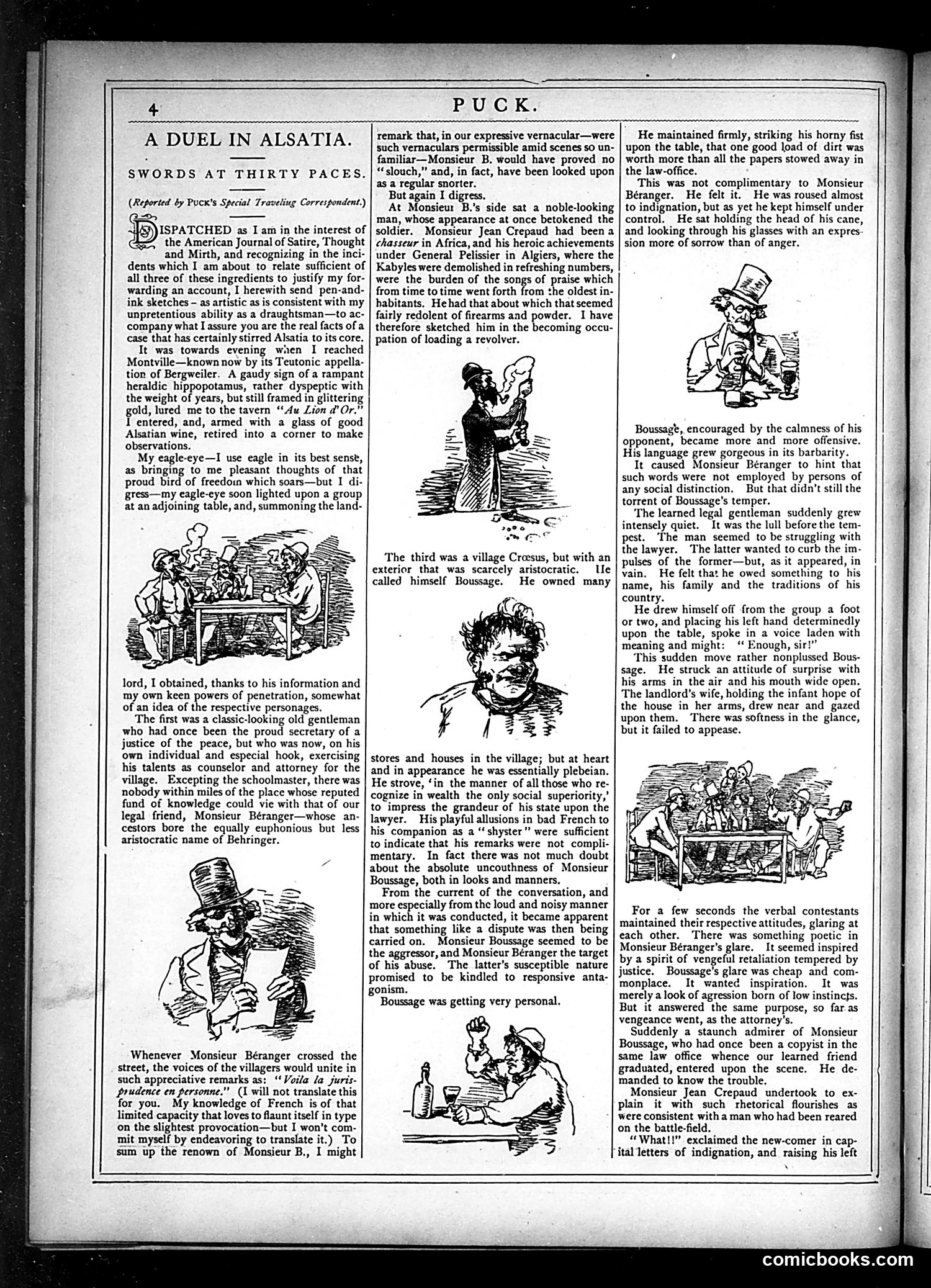
This article satirizes a verbal dispute between three Alaskan figures: a former justice secretary, a lawyer named Monsieur Béranger, and a village notable called Monsieur Boussage. The piece mocks their heated argument—described as a "duel" conducted entirely through insults and theatrical posturing rather than actual combat. The satire targets their pretentiousness: the secretary's aristocratic pretensions, Béranger's legal pomposity, and Boussage's attempts to appear refined despite his humble origins. The illustrations show them gesturing wildly, delivering heated remarks. The humor lies in depicting grown men engaged in this absurd verbal combat as though it were a serious confrontation, critiquing their inflated self-importance and the ridiculous nature of their dispute over social status and reputation in a remote Alaskan setting.
📄 Transcribed text from this page (OCR, searchable)
Machine-transcribed from the original scan — historical spelling and the odd misread are preserved.
PUCK. A DUEL IN ALSATIA. SWORDS AT THIRTY PACES. (Reported by Puck's Special Traveling Correspondent.) ISPATCHED as I am in the interest of the American Journal of Satire, Thought and Mirth, and recognizing in the inci- dents which I am about to relate sufficient of all three of these ingredients to justify my for- warding an account, I herewith send pen-and- ink sketches - as artistic as is consistent with my unpretentious ability as a draughtsman—to ac- company what I assure you are the real facts of a case that has certainly stirred Alsatia to its core. It was towards evening when I reached Montville—known now by its Teutonic appella- tion of Bergweiler. A gaudy sign of a rampant heraldic hippopotamus, rather dyspeptic with the weight of years, but still framed in glittering gold, lured me to the tavern “du Lion d'Or.” 1 entered, and, armed with a glass of good Alsatian wine, retired into a corner to make observations. My eagle-eye—I use eagle in its best senst, as bringing to me pleasant thoughts of that proud bird of freedoin which soars—but I di- gress—my eagle-eye soon lighted upon a group at an adjoining table, and, summoning the land- lord, I obtained, thanks to his information and my own keen powers of penetration, somewhat of an idea of the respective personages. The first was a classic-looking old gentleman who had once been the proud secretary of a justice of the peace, but who was now, on his own individual and especial hook, exercising his talents as counselor and attorney for the village. Excepting the schoolmaster, there was nobody within miles of the place whose reputed fund of knowledge could vie with that of our legal friend, Monsieur Béranger—whose an- cestors bore the equally euphonious but less aristocratic name of Behringer. Whenever Monsieur Béranger crossed the street, the voices of the villagers would unite in such appreciative remarks as: ‘Voila a juris- prudence en personne.” (I will not translate this for you. My knowledge of French is of that limited capacity that loves to flaunt itself in type on the slightest provocation—but I won’t com- mit myself by endeavoring to translate it.) To sum up the renown of Monsieur B., I might remark that, in our expressive vernacular—were such vernaculars permissible amid scenes so un- familiar—Monsieur B, would have proved no ‘slouch,” and, in fact, have been looked upon as a regular snorter. But again I digress. At Monsieur B.’s side sat a noble-looking man, whose appearance at once betokened the soldier. Monsieur Jean Crepaud had been a chasseur in Africa, and his heroic achievements under General Pelissier in Algiers, where the Kabyles were demolished in refreshing numbers, were the burden of the songs of praise which from time to time went forth from the oldest in- habitants. Hehad that about which that seemed fairly redolent of firearms and powder. I have therefore sketched him in the becoming occu- pation of loading a revolver. The third was a village Croesus, but with an exterior that was scarcely aristocratic. Ue called himself Boussage. He owned many stores and houses in the village; but at heart and in appearance he was essentially plebeian. He strove, ‘in the manner of all those who re- cognize in wealth the only social superiority,’ to impress the grandeur of his state upon the lawyer. His playful allusions in bad French to his companion as a “ shyster” were sufficient to indicate that his remarks were not compli- mentary. In fact there was not much doubt about the absolute uncouthness of Monsieur Boussage, both in looks and manners, From the current of the conversation, and more especially from thc loud and noisy manner in which it was conducted, it became apparent that something like a dispute was then being carried on. Monsieur Boussage seemed to be the aggressor, and Monsieur Béranger the target of his abuse. The latter's susceptible nature promised to be kindled to responsive anta- gonism. Boussage was getting very personal. He maintained firmly, striking his horny fist upon the table, that one good load of dirt was worth more than all the papers stowed away in the law-office. This was not complimentary to Monsieur Béranger. He felt it. He was roused almost to indignation, but as yet he kept himself under control. He sat holding the head of his cane, and looking through his glasses with an expres. sion more of sorrow than of anger. Boussage, encouraged by the calmness of his opponent, became more and more offensive. His language grew gorgeous in its barbarity. It caused Monsieur Béranger to hint that such words were not employed by persons of any social distinction, But that didn’t still the torrent of Boussage’s temper. ‘The learned legal gentleman suddenly grew intensely quiet. It was the lull before the tem- pest. ‘The man seemed to be struggling with the lawyer. The latter wanted to curb the im- pulses of the former—but, as it appeared, in vain. He felt that he owed something to his name, his family and the traditions of his country. He drew himself off from the group a foot or two, and placing his left hand determinedly upon the table, spoke in a voice laden with meaning and might: Enough, sir!” This sudden move rather nonplussed Bous- sage. He struck an attitude of surprise with his arms in the air and his mouth wide open. The landlord's wife, holding the infant hope of the house in her arms, drew near and gazed upon them. There was softness in the glance, but it failed to appease. For a few seconds the verbal contestants maintained their respective attitudes, glaring at each other. There was something poetic in Monsieur Béranger’s glare. _It seemed inspired by a spirit of vengeful retaliation tempered by justice. Boussage’s glare was cheap and com- monplace. It wanted inspiration. It was merely a look of agression born of low instinc}s. But it answered the same purpose, so far as vengeance went, as the attorney’s. Suddenly a staunch admirer of Monsieur Boussage, who had once been a copyist in the same law office whence our learned friend graduated, entered upon the scene. He de- manded to know the trouble. Monsieur Jean Crepaud undertook to ex- plain it with such rhetorical flourishes as were consistent with a man who had been reared on the battle-field. “What!!" exclaimed the new-comer in cap- ital letters of indignation, and raising his left comicbooks.com