
Puck, 1878-03-20 · page 11 of 16
Puck — March 20, 1878 — page 11: what you’re looking at
What you’re looking at
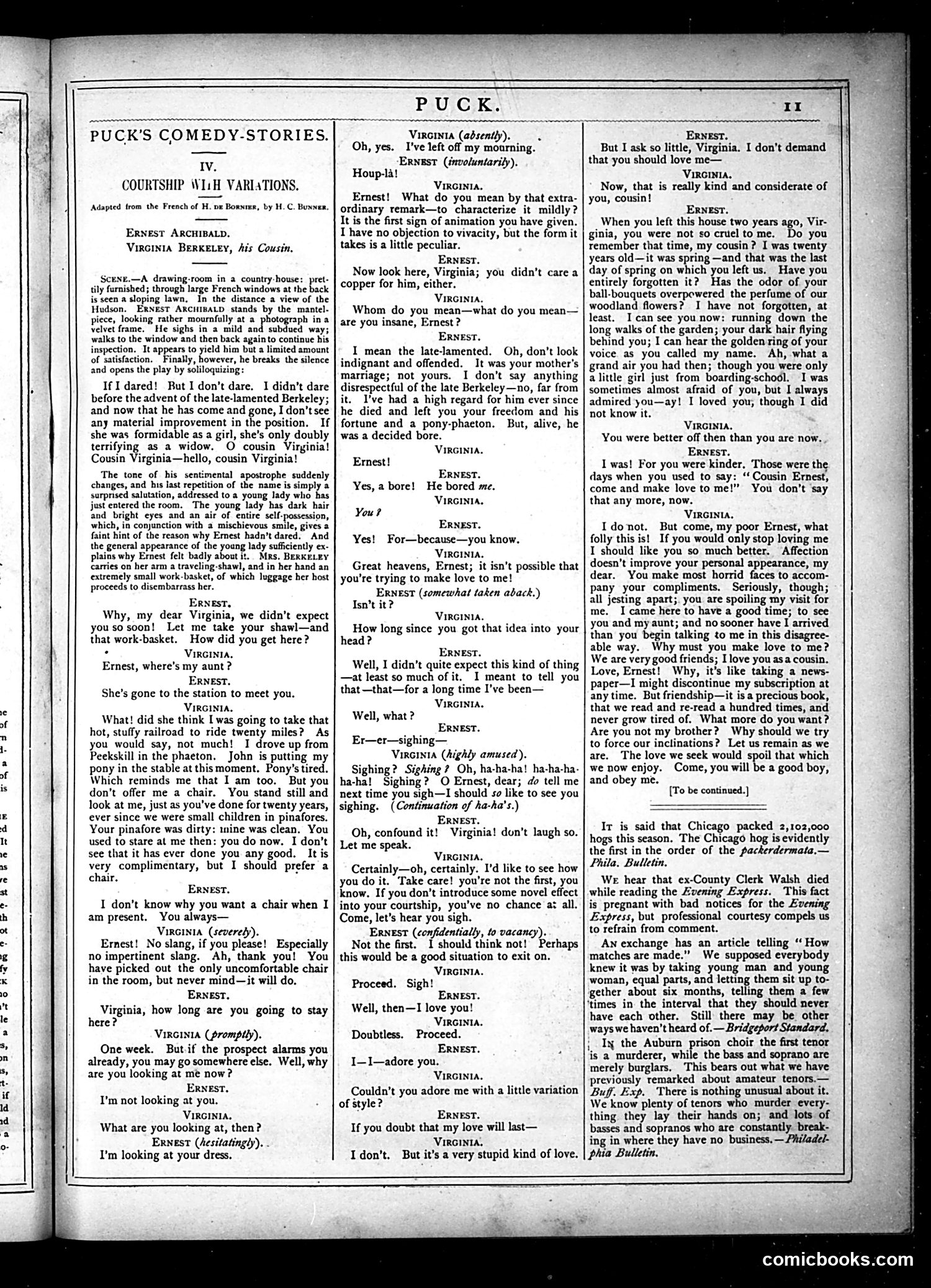
This page from Puck magazine presents a comedic dialogue between **Ernest Archibald** and his cousin **Virginia Berkeley**. The sketch satirizes courtship conventions of the era through their stilted, overly formal conversation. The humor relies on Ernest's awkward attempts at romance—he's clumsy, self-deprecating, and struggles to express genuine affection while Virginia alternates between encouraging and mocking him. The piece pokes fun at Victorian courtship rituals: the artificial language of romance, class consciousness (Ernest worries about his station), and the absurdity of prescribed romantic behavior. The "variations" in the title likely reference how the same awkward dynamics repeat throughout their exchange, suggesting that proper courtship—despite its rules—often devolves into confusion and mutual exasperation.
📄 Transcribed text from this page (OCR, searchable)
Machine-transcribed from the original scan — historical spelling and the odd misread are preserved.
PUCK'S COMEDY-STORIES. Iv. COURTSHIP WIiH VARIATIONS. Adapted from the French of H. pe Borxms, by H.C. Buxwer, ERNEST ARCHIBALD. VirGINIA BERKELEY, Ais Cousin. Scexe.—A drawing-room in a country-house: pret- tily furnished; through large French windows at the back is seen a sloping lawn, In the distance a view of the Hudson. ERNest ARcIIBALD stands by the mantel- piece, looking rather mournfully at a photograph ina velvet frame. He sighs in a mild and subdued way; walks to the window and then back again to continue his inspection. It appears to yield him but a limited amount of satisfaction. Finally, however, he breaks the silence and opens the play by soliloquizing : IfI dared! But I don’t dare. 1 didn’t dare before the advent of the late-lamented Berkeley; and now that he has come and gone, I don’t see any material improvement in the position. If she was formidable as a girl, she’s only doubly terrifying as a widow. O cousin Virginia! Cousin Virginia—hello, cousin Virginia! The tone of his sentimental apostrophe suddenly changes, and his last repetition of the name is simply a surprised salutation, addressed to a young lady who has just entered the room. The young lady has dark hair and bright eyes and an air of entire self- ion, which, in conjunction with a mischievous smile, gives a faint hint of the reason why Emest hadn’t dared. And the general appearance of the young lady sufficiently ex- plains why Ernest felt badly about it. Mrs, BERKELEY carries on her arm a traveling-shawl, and in her hand an extremely small work-basket, of which luggage her host proceeds to disembarrass her. ERNEST, Why, my dear Virginia, we didn’t expect you so soon! Let me take your shawl—and that work-basket. How did you get here? iy ‘Vircinia, Ernest, where's my aunt ? ERNEST. She’s gone to the station to meet you. VirGiNia. What! did she think I was going to take that hot, stuffy railroad to ride twenty miles? As you would say, not much! I drove up from Peekskill in the phaeton, John is putting my pony in the stable at this moment. Pony’s tired. Which reminds me that I am too. But you don’t offer me a chair. You stand still and look at me, just as you've done for twenty years, ever since we were small children in pinafores. Your pinafore was dirty: mine was clean. You used to stare at me then: you do now. I don’t see that it has ever done you any good. It is very complimentary, but I should prefer a chair. * ERNEST. 1 don’t know why you want a chair when I am present. You always— Vircinia (severed). Ernest! No slang, if you please! Especially no impertinent slang. Ah, thank you! You have picked out the only uncomfortable chair in the room, but never mind—it will do. ERNEST. Virginia, how long are you going to stay here? Vircinia (promptly). One week. But.if the prospect alarms you already, you may go somewhere else. Well, why are you looking at me now? ERNEST. I'm not looking at you. Viroinia, What are you looking at, then? Ernest (hesitatingly). . I'm looking at your dress, Virainia (adsently). . I've left off my mourning. Erngst (svoluntarily). Houp-la! Oh, yes. Vircinia. Ernest! What do you mean by that extra- ordinary remark—to characterize it mildly? It is the first sign of animation you have given. I have no objection to vivacity, but the form it takes is a little peculiar. ERNEST. Now look here, Virginia; you didn’t care a copper for him, either. Vircinia, Whom do you mean—what do you mean— are you insane, Ernest ? ERNEST. 1 mean the late-lamented. Oh, don’t look indignant and offended. It was your mother’s marriage; not yours. I don’t say anything disrespectful of the late Berkeley—no, far from it. I've had a high regard for him ever since he died and left you your freedom and his fortune and a pony-phaeton. But, alive, he was a decided bore. VirGINiA. Ernest! ERNEST. He bored me. ‘VIRGINIA. Yes, a bore! You? ERNEST. For—because—you know. ViroINia. Great heavens, Ernest; it isn’t possible that you're trying to make love to me! Ernest (somewhat taken aback.) Isn’t it? Yes! ‘Vircinia. How long since you got that idea into your head? ERNEST. Well, I didn’t quite expect this kind of thing —at least so much of it. I meant to tell you that —that—for a long time I’ve been— Vireinia. Well, what ? ERNEST. Er—er—sighing— Vircinta (highly amused). Sighing? Sighing ? Oh, ha-ha-ha! ha-ha-ha- ha-ha! Sighing? O Ernest, dear; do tell me next time you sigh—I should so like to see you sighing. (Continuation of ha-ha’s.) ERNEST. Oh, confound it! Virginia! don’t laugh so. Let me speak. Vircinia. Certainly—oh, certainly. I'd like to see how you do it. Take care! you're not the first, you know. If you don’t introduce some novel effect into your courtship, you’ve no chance at all. Come, let’s hear you sigh. Ernest (confidentially, to vacancy). Not the first. I should think not! Perhaps this would be a good situation to exit on. Vircinia. Proceed. Sigh! ERNEST. Well, then—I love you! ‘VirGINIA. Doubtless. Proceed. ERNEST. I—I—adore you. Vircinia, Couldn’t you adore me with a little variation of style? Ernest. If you doubt that my love will last— VIRGINIA, Idon’t. But it’s a very stupid kind of love. ERNEST. But I ask so little, Virginia. I don’t demand that you should love me— Viroinia, Now, that is really kind and considerate of you, cousin! ERNEST. When you left this house two years ago, Vir- ginia, you were not so cruel tome. Do you remember that time, my cousin? I was twenty years old—it was spring —and that was the last day of spring on which you left us. Have you entirely forgotten it? Has the odor of your ball-bouquets overpowered the perfume of our woodland flowers? I have not forgotten, at least. I can see you now: running down the long walks of the garden; your dark hair flying behind you; I can hear the golden ring of your voice as you called my name. Ah, what a grand air you had then; though you were only alittle girl just from boarding-schodl. I was sometimes almost afraid of you, but I always admired you—ay! I loved you; though I did not know it. Virciia, You were better off then than you are now. . Ernest. I was! For you were kinder. Those were the days when you used to say: “Cousin Ernest, come and make love to me!” You don’t ‘say that any more, now. ‘Vircinia, Idonot. But come, my poor Ernest, what folly this is! If you would only stop loving me I should like you so much better. “Affection doesn’t improve your personal appearance, my dear. You make most horrid faces to accom- pany your compliments. Seriously, though; all jesting apart; you are spoiling my visit for me. I came here to have a good time; to see you and my aunt; and no sooner have I arrived than you begin talking to me in this disagree- able way. Why must you make love to me? We are very good friends; I love you asa cousin. Love, Ernest! Why, it’s like taking a news- paper—I might discontinue my subscription at any time. But friendship—it isa precious book, that we read and re-read a hundred times, and never grow tired of. What more do you want? Are you not my brother? Why should we try to force our inclinations? Let us remain as we are. The love we seek would spoil that which we now enjoy. Come, you will be a good boy, and obey me. [To be continued.} Ir is said that Chicago packed 2,102,000 hogs this season. The Chicago hog is evidently the first in the order of the packerdermata,— Phila, Bulletin. We hear that ex-County Clerk Walsh died while reading the Evening Express. This fact is pregnant with bad notices for the Evening Express, but professional courtesy compels us to refrain from comment. An exchange has an article telling ‘How matches are made.” We supposed everybody knew it was by taking young man and young woman, equal parts, and letting them sit up to- gether about six months, telling them a few ‘times in the interval that they should never have each other. Still there may be. other wayswe haven't heard of.— Bridgeport Standard, Ix the Auburn prison choir the first tenor is a murderer, while the bass and soprano are merely burglars. This bears out what we have previously remarked about amateur tenors.— Buff. Exp. There is nothing unusual about it. We know plenty of tenors who murder every- thing they lay their hands on; and lots of basses and sopranos who are constantly. break. ing in where they have no business. —Phi/adel- phia Bulletin. comicbooks.com