
Puck, 1878-03-20 · page 5 of 16
Puck — March 20, 1878 — page 5: what you’re looking at
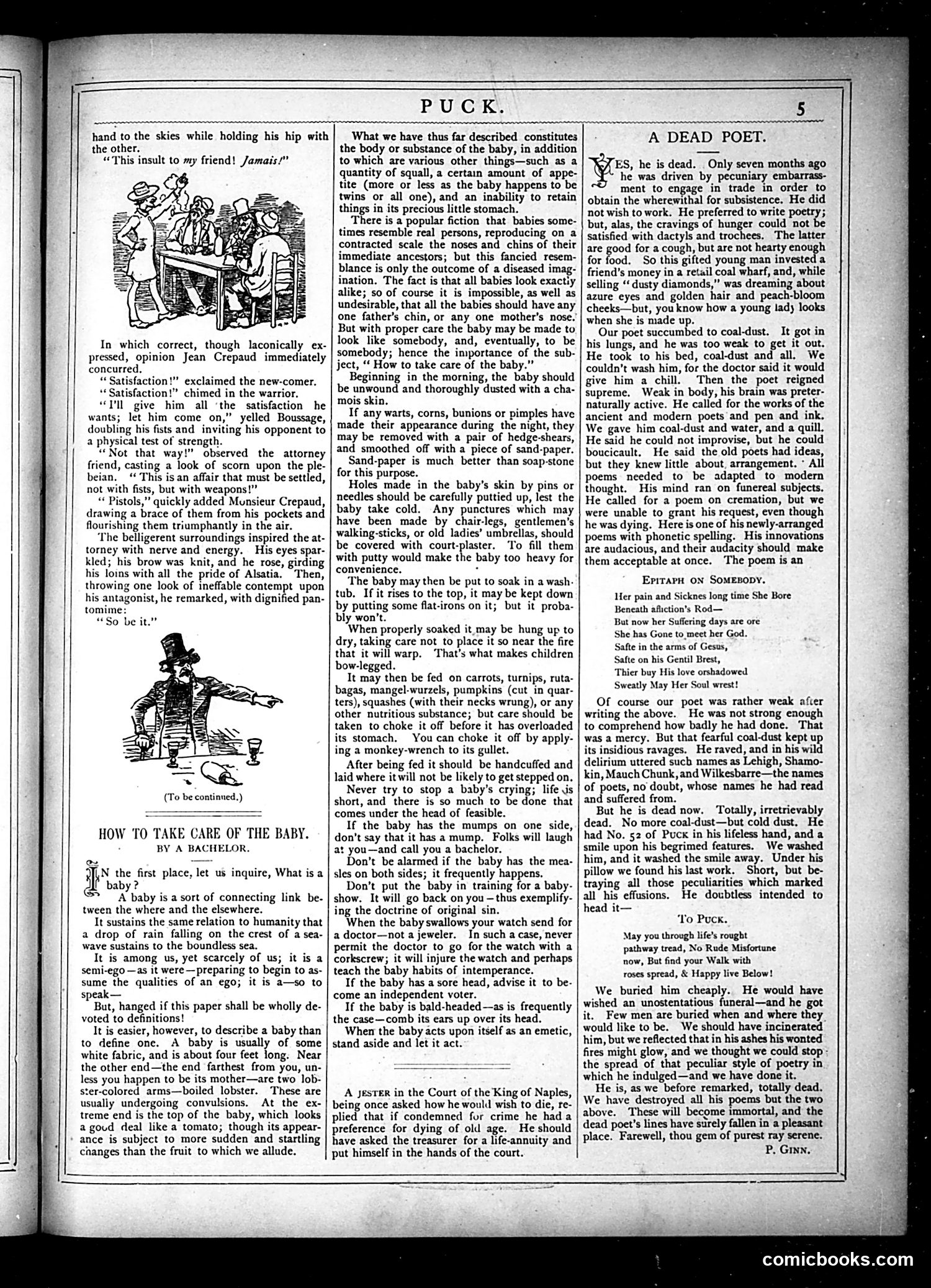
What you’re looking at
This page contains two distinct sections: **Upper cartoon**: Shows a scene where a man (appearing to be addressing a friend named "Jamais") gestures animatedly while holding a hip flask. The surrounding figures appear to be engaged in social drinking. The dialogue suggests someone is offering reassurance about intoxication. **Lower section**: A lengthy instructional article titled "How to Take Care of a Baby" by A Bachelor. This is satirical advice on infant care, offering absurd and impractical suggestions (using hedge-shears, soaking in wash tubs, feeding odd vegetables). The humor derives from a bachelor—someone with no parental experience—dispensing mock-serious baby care guidance. The right column includes a poem titled "A Dead Poet," mocking a recently deceased writer of poor quality verse. This represents typical Puck content: social satire through exaggerated advice and literary criticism.
📄 Transcribed text from this page (OCR, searchable)
Machine-transcribed from the original scan — historical spelling and the odd misread are preserved.
hand to the skies while holding his hip with the other. “This insult to my friend! Jamais/” In which correct, though laconically ex- pressed, opinion Jean Crepaud immediately concurred, “ Satisfaction!” exclaimed the new-comer. “Satisfaction!” chimed in the warrior. “I'll give him all ‘the satisfaction he wants; let him come on,” yelled Boussage, doubling his fists and inviting his opponent to a physical test of strength. “Not that way!” observed the attorney friend, casting a look of scorn upon the ple- beian. “ This is an affair that must be settled, not with fists, but with weapons!”” “ Pistols,” quickly added Munsieur Crepaud, drawing a brace of them from his pockets and flourishing them triumphantly in the air. ‘The belligerent surroundings inspired the at- torney with nerve and energy. His eyes spar- kled; his brow was knit, and he rose, girding his loins with all the pride of Alsatia. Then, throwing one look of ineffable contempt upon his antagonist, he remarked, with dignified pan- tomime: “So be it.” (To be continned.) HOW TO TAKE ARE OF THE BABY. BY A BACHELOR. ox — a the first place, let us inquire, What is a baby ? A baby is a sort of connecting link be- tween the where and the elsewhere. It sustains the same relation to humanity that a drop of rain falling on the crest of a sea- wave sustains to the boundless sea. It is among us, yet scarcely of us; it is a semi-ego —as it were —preparing to begin to as- sume the qualities of an ego; it is a—so to speak— But, hanged if this paper shall be wholly de- voted to definitions! It is easier, however, to describe a baby than to define one. A baby is usually of some white fabric, and is about four feet long. Near the other end—the end farthest from you, un- less you happen to be its mother—are two lob- ster-colored arms—boiled lobster. These are usually undergoing convulsions. At the ex- treme end is the top of the baby, which looks agoud deal like a tomato; though its appear- ance is subject to more sudden and startling changes than the fruit to which we allude. or What we have thus far described constitutes the body or substance of the baby, in addition to which are various other things—such as a quantity of squall, a certain amount of appe- tite (more or less as the baby happens to be twins or all one), and an inability to retain things in its precious little stomach. There is a popular fiction that babies some- times resemble real persons, reproducing on a contracted scale the noses and chins of their immediate ancestors; but this fancied resem- blance is only the outcome of a diseased imag- ination. The fact is that all babies look exactiy alike; so of course it is impossible, as well as undesirable, that all the babies should have any one father’s chin, or any one mother’s nose. But with proper care the baby may be made to look like somebody, and, eventually, to be somebody; hence the importance of the sub- ject, “‘ How to take care of the baby.” Beginning in the morning, the baby should be unwound and thoroughly dusted with a cha- mois skin. If any warts, corns, bunions or pimples have made their appearance during the night, they may be removed with a pair of hedge-shears, and smoothed off with a piece of sand-paper. Sand-paper is much better than soap-stone for this purpose. Holes made in the baby’s skin by pins or needles should be carefully puttied up, lest the baby take cold. Any punctures which may have been made by chair-legs, gentlemen’s walking-sticks, or old ladies’ umbrellas, should be covered with court-plaster. ‘To fill them with putty would make the baby too heavy for convenience. : ‘The baby may then be put to soak in a wash- tub. If it rises to the top, it may be kept down by putting some flat-irons on it; but it proba- bly won't. ‘When properly soaked it,may be hung up to dry, taking care not to place it so near the fire that it will warp. That’s what makes children bow-legged. It may then be fed on carrots, turnips, ruta- bagas, mangel-wurzels, pumpkins (cut in quar- ters), squashes (with their necks wrung), or any other nutritious substance; but care should be taken to choke it off before it has overloaded its stomach. You can choke it off by apply- ing a monkey-wrench to its gullet. After being fed it should be handcuffed and laid where it will not be likely to get stepped on. Never try to stop a baby’s crying; life Js short, and there is so much to be done that comes under the head of feasible. If the baby has the mumps on one side, don’t say that it has a mump. Folks will laugh at you—and call you a bachelor. Don’t be alarmed if the baby has the mea- sles on both sides; it frequently happens. Don’t put the baby in training for a baby- show. It will go back on you —thus exemplify- ing the doctrine of original sin. When the baby swallows your watch send for a doctor—not a jeweler. In such a case, never permit the doctor to go for the watch with a corkscrew; it will injure the watch and perhaps teach the baby habits of intemperance. If the baby has a sore head, advise it to be- come an independent voter. If the baby is bald-headed—as is frequently the case—comb its ears up over its head. When the baby acts upon itself as an emetic, stand aside and let it act. A jesTer in the Court of the King of Naples, being once asked how he would wish to die, re- plied that if condemned for crime he hada preference for dying of old age. He should have asked the treasurer for a life-annuity and put himself in the hands of the court. A DEAD POET. ES, he is dead. Only seven months ago he was driven by pecuniary embarrass- ment to engage in trade in order to obtain the wherewithal for subsistence. He did not wish to work. He preferred to write poetry; but, alas, the cravings of hunger could not be satisfied with dactyls and trochees, The latter are good for a cough, but are not hearty enough for food. So this gifted young man invested a friend’s money in a retail coal wharf, and, while selling ‘dusty diamonds,” was dreaming about azure eyes and golden hair and peach-bloom cheeks—but, you know how a young lady looks when she is made up. Our poet succumbed to coal-dust. It got in his lungs, and he was too weak to get it out. He took to his bed, coal-dust and all. We couldn’t wash him, for the doctor said it would give him a chill. Then the poet reigned supreme, Weak in body, his brain was preter- naturally active. He called for the works of the ancient and modern poets and pen and ink. We gave him coal-dust and water, and a quill, He said he could not improvise, but he could boucicault. He said the old poets had ideas, but they knew little about, arrangement. * All poems needed to be adapted to modern thought. His mind ran on funereal subjects. He called for a poem on cremation, but we were unable to grant his request, even though he was dying. Here is one of his newly-arranged poems with phonetic spelling. His innovations are audacious, and their audacity should make them acceptable at once. The poem is an EpitapH ON SOMEBODY. Her pain and Sicknes long time She Bore Beneath afliction’s Rod— But now her Suffering days are ore She has Gone to meet her God. Safte in the arms of Gesus, Safte on his Gentil Brest, Thier buy His love orshadowed Sweatly May Her Soul wrest! Of course our poet was rather weak after writing the above. He was not strong enough to comprehend how badly he had done. That was a mercy. But that fearful coal-dust kept up its insidious ravages. He raved, and in his wild delirium uttered such names as Lehigh, Shamo- kin, Mauch Chunk, and Wilkesbarre—the names of poets, no doubt, whose names he had read and suffered from. But he is dead now. Totally, irretrievably dead. No more coal-dust—but cold dust. He had No. 52 of Pucx in his lifeless hand, and a smile upon his begrimed features. We washed him, and it washed the smile away. Under his pillow we found his last work. Short, but be- traying all those peculiarities which marked all his effusions. He doubtless intended to head it— ‘To Puck. May you through life’s rought pathway tread, No Rude Misfortune now, But find your Walk with roses spread, & Happy live Below! We buried him cheaply. He would have wished an unostentatious funeral—and he got it. Few men are buried when and where they would like to be. We should have incinerated him, but we reflected that in his ashes his wonted fires might glow, and we thought we could stop: the spread of that peculiar style of poetry in which he indulged—and we have done it. He is, as we before remarked, totally dead. We have destroyed all his poems but the two above. These will become immortal, and the dead poet’s lines have surely fallen in a pleasant place. Farewell, thou gem of purest ray serene. P. Ginn, comicbooks.com