
Puck, 1878-03-20 · page 2 of 16
Puck — March 20, 1878 — page 2: what you’re looking at
What you’re looking at
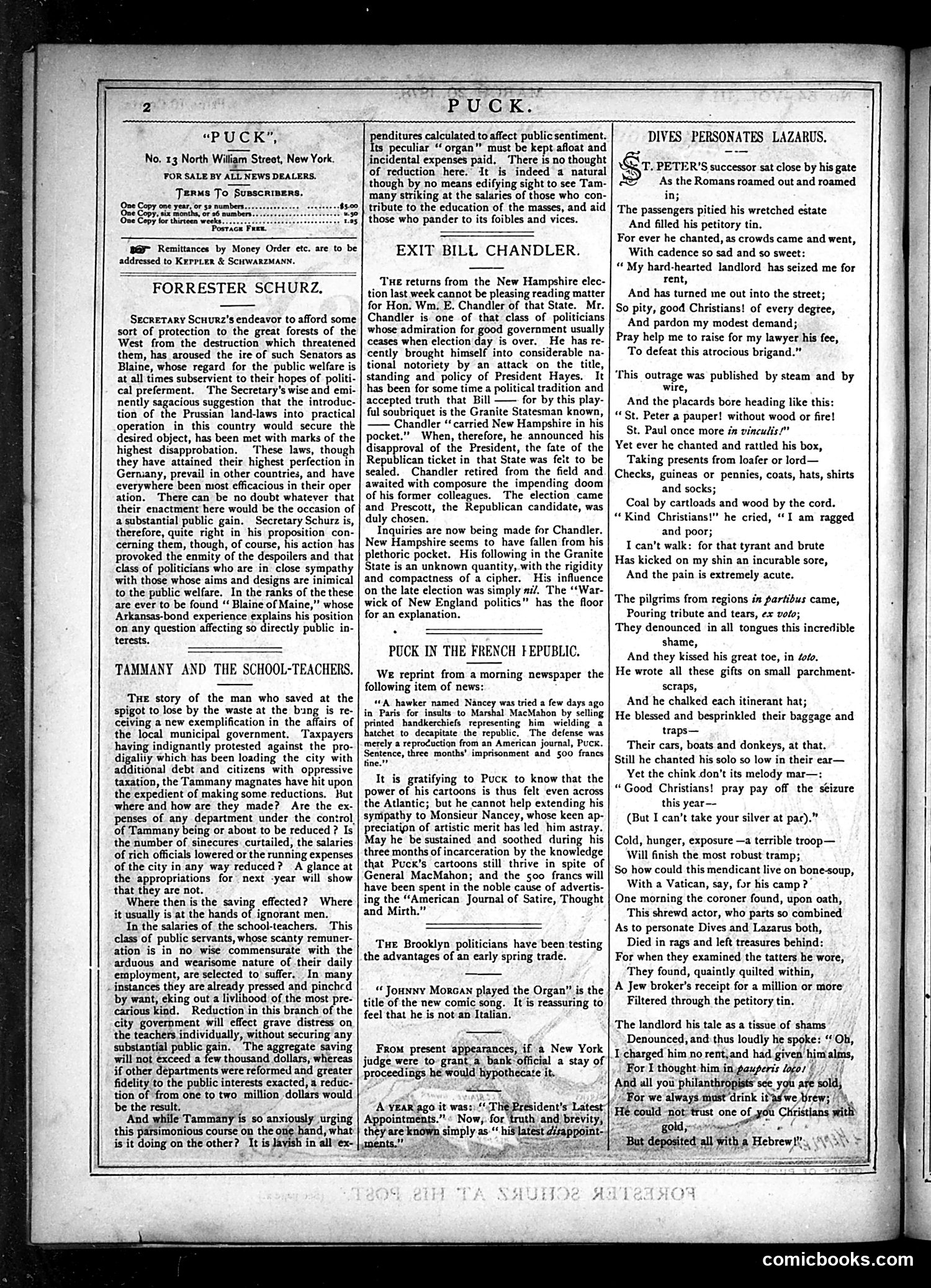
This page combines political commentary with satirical poetry and advertisements. The main text sections address: **"Exit Bill Chandler"** — A critique of New Hampshire politician Bill Chandler, attacking him as representative of a corrupt political class who abandons principles when elections end. The piece sarcastically notes Chandler "carried New Hampshire in his pocket," suggesting he manipulated the state's Republican ticket. **"Tammany and the School-Teachers"** — Commentary on New York City municipal corruption, criticizing Tammany Hall's waste and underfunding of teachers' salaries while enriching city departments. **"Puck in the French Republic"** — Celebrating Puck magazine's influence on French political cartooning, noting a hawker named Nancey was prosecuted for selling anti-republican satire. The remaining content consists of brief political jokes and advertisements for Puck subscriptions. The satire targets Democratic political machines and administrative corruption.
📄 Transcribed text from this page (OCR, searchable)
Machine-transcribed from the original scan — historical spelling and the odd misread are preserved.
PUCK. B6F- Remittances by Money Order etc. are to be addressed to Kerrier & SCHWARZMANN. FORRESTER SCHURZ., Secretary Scuurz’s endeavor to afford some sort of protection to the great forests of the West from the destruction which threatened them, has aroused the ire of such Senators as Blaine, whose regard for the public welfare is at all times subservient to their hopes of politi- cal preferment. ‘The Secretary's wise and emi- nently sagacious suggestion that the introduc- tion of the Prussian land-laws into practical operation in this country would secure the desired object, has been met with marks of the highest disapprobation. ‘These laws, though they have attained their highest perfection in Gerniany, prevail in other countries, and have everywhere been most efficacious in their oper ation. There can be no doubt whatever that their enactment here would be the occasion of a substantial public gain. Secretary Schurz is, therefore, quite right in his proposition con- cerning them, though, of course, his action has provoked the enmity of the despoilers and that class of politicians who are in. close sympathy with those whose aims and designs are inimical to the public welfare. In the ranks of the these are ever to be found ‘Blaine of Maine,” whose ‘Arkansas-bond experience explains his position on any question affecting so directly public in- terests. TAMMANY AND THE SCHOOL-TEACHERS. Tue story of the man who saved at the spigot to lose by the waste at the bung is re- ceiving a new exemplification in the affairs of the local municipal government. Taxpayers having indignantly protested against the pro- digality which has been loading the city with additional debt and citizens with oppressive taxation, the Tammany magnates have hit upon the expedient of making some reductions. But where and how are they made? Are the ex- penses of any department under the control, of Tammany being or about to be reduced ? Is the number of sinecures curtailed, the salaries of rich officials lowered or the running expenses of the city in any way reduced? A glance at the appropriations for next -year will show that they are not. Where then is the saving effected? Where it usually is at the hands of ignorant men. In the salaries of the school-teachers. This class of public servants, whose scanty remuner- ation is in no wise commensurate with the arduous and wearisome nature of their daily employment, are selected to’ suffer. In many _ instances they are already pressed and pinched by want, eking out a livithbod of the most pre- carious kind. Reduction in this branch of the city government will effect grave distress on the teachers individually, without securing any substantial public gain. The aggregate saving will not exceed a few thousand dollars, whereas if other departments were reformed and greater fidelity'to the public interests exacted, a reduc- tion of from one to two million dollars would be the result. And while Tammany is so anxiously’ urging this parsimonious course on the one. hand, w! sends’ calculated to affect public sentiment. ts peculiar “organ” must be kept afloat and incidental expenses paid. ‘There is no thought ‘of reduction here.’ It is indeed a natural though by no means edifying sight to see Tam- many striking at the salaries of those who con- tribute to the education of the masses, and aid those who pander to its foibles and vices. EXIT BILL CHANDLER. Tue returns from the New Hampshire elec- tion last week cannot be pleasing reading matter for Hon. Wm. E. Chandler of that State. Mr. Chandler is one of that class of politicians whose admiration for good government usually ceases when election day is over. He has re- cently brought himself into considerable na- tional notoriety by an attack on the title, standing and policy of President Hayes. It has been for some time a political tradition and accepted truth that Bill ——. for by this play- ful soubriquet is the Granite Statesman known, —— Chandler ‘‘ carried New Hampshire in his pocket.” When, therefore, he announced his disapproval of the President, the fate of the Republican ticket in that State was feit to be sealed. Chandler retired from the field and awaited with composure the impending doom of his former colleagues. The election came and Prescott, the Republican candidate, was duly chosen. Inquiries are now being made for Chandler. New Hampshire seems to have fallen from his plethoric pocket. His following in the Granite State is an unknown quantity, with the rigidity and compactness of a cipher. His influence on the late election was simply mi/. The ‘‘War- wick of New England politics” has the floor for an explanation. PUCK IN THE FRENCH FEPUBLIC. We reprint from a morning newspaper the following item of news: ““A hawker named Nancey was tried a few days ago in Paris for insults to Marshal MacMahon by selling printed handkerchiefs representing him wielding a hatchet to decapitate the republic, The defense was merely a reproduction from an American journal, Puck. Sentence, three months’ imprisonment and 500 francs fine.”” It is gratifying to Puck to know that the power of his cartoons is thus felt even across the Atlantic; but he cannot help extending his synipathy to Monsieur Nancey, whose keen ap- preciation of artistic merit has led him astray. May he be sustained and soothed during his three months of incarceration by the knowledge that Puck’s cartoons still thrive in spite of General MacMahon; and the soo francs will have been spent in the noble cause of advertis- ing the “American Journal of Satire, Thought and Mirth.” Tue Brooklyn politicians have been testing the advantages of an early spring trade. « Jounny Moran played the Organ” is the title of the new comic song. It is reassuring to feel that he is not-an Italian. From present appearances, if a New York judge were to-grant_a. bank-official a stay of Proceedings he sronld pepamiccste it. ‘A-YEAR ago it was:) ‘ The President's Latest” Appointments.”* Now,. for truth’ and, Bray isp hat'} they are known simply as: his! is it doing on the other? It is Fegan i in ave ‘ex- ; DIVES PERSONATES LAZARUS. Sr. PETER’S successor sat close by his gate e& As the Romans roamed out and roamed in; The passengers pitied his wretched estate And filled his petitory tin, For ever he chanted, as crowds came and went, With cadence so sad and so sweet: “ My hard-hearted landlord has seized me for rent, And has turned me out into the street; So pity, good Christians! of every degree, And pardon my modest demand; Pray help me to raise for my lawyer his fee, To defeat this atrocious brigand.” ‘This outrage was published by steam and by wire, And the placards bore heading like this: “St, Peter a pauper! without wood or fire! St. Paul once more én vinculis!" Yet ever he chanted and rattled his box, Taking presents from loafer or lord— Checks, guineas or pennies, coats, hats, shirts and socks; Coal by cartloads and wood by the cord. “Kind Christians!" he cried, “I am ragged and poor; I can’t walk: for that tyrant and brute Has kicked on my shin an incurable sore, And the pain is extremely acute. The pilgrims from regions in partibus came, Pouring tribute and tears, ¢x voto; They denounced in all tongues this incredible shame, And they kissed his great toe, in foto, He wrote all these gifts on small parchment- scraps, And he chalked each itinerant hat; He blessed and besprinkled their baggage and traps— Their cars, boats and donkeys, at that. Still he chanted his solo so low in their ear— Yet the chink don’t its melody mar—; “Good Christians! pray pay off the stizure this year— (But I can’t take your silver at par).” Cold, hunger, exposure —a terrible troop— Will finish the most robust tramp; So how could this mendicant live on bone-soup, With a Vatican, say, for his camp? One morning the coroner found, upon oath, This shrewd actor, who parts so combined As to personate Dives and Lazarus both, Died in rags and left treasures behind: For when they examined the tatters he wore, ‘They found, quaintly quilted within, A Jew broker’s receipt for a million or more’ Filtered through the petitory tin. The landlord his tale as a tissue of shams Denounced, and: thus loudly he spoke: ‘Ob, I-charged him no rent,and had given’ him alms, For'I thought him inpauperis lofor ij And all you philanthropists see you ate sold, “For we always must drink itadwe; Urew; 4. \Hé could -not: ae one of, of yt Ciitians with <~ gold;- sei et enact ail = a Hebrem!t ie geasial comicbooks.com