
A complete issue · 16 pages · 1878
Puck — February 13, 1878
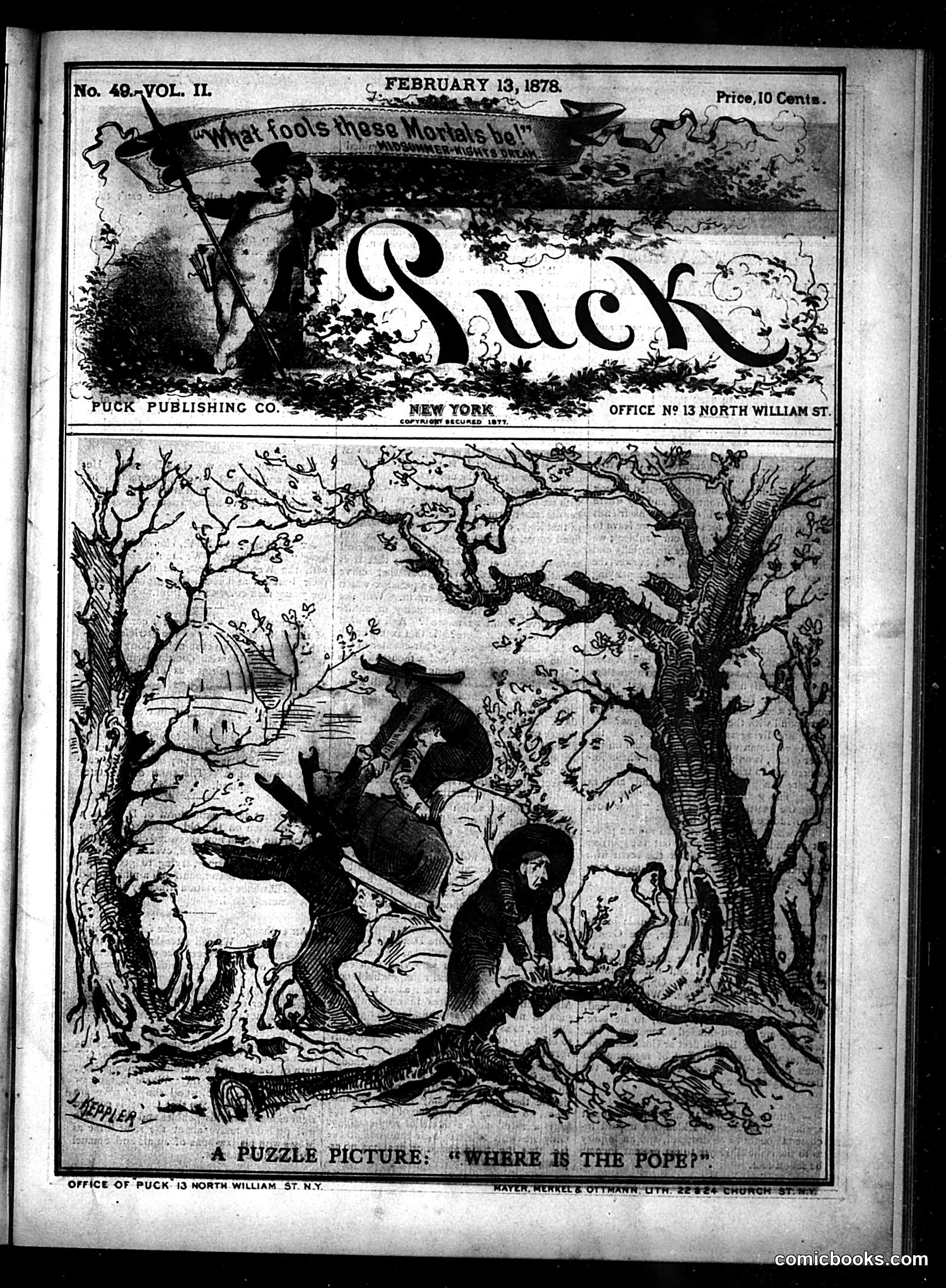
This is a puzzle picture titled "WHERE IS THE POPE?" The satirical image depicts figures searching among gnarled trees and forest vegetation for the Pope—a visual riddle asking readers to locate a hidden figure within the illustration. The cartoon likely references Pope Pius IX's political situation in 1878. The Pope had been confined to the Vatican since Italian unification in 1870, refusing to leave in protest over the loss of the Papal States. The "where is the pope?" puzzle satirizes his self-imposed isolation and reduced political power—he's literally missing from the world stage, hidden away like the concealed figure readers must find in this visual game.
This page is primarily **text-based editorial content** rather than political cartoons. It includes: 1. **Magazine masthead and subscription information** for Puck magazine (New York) 2. **"Puck's Almanac" advertisement** promoting over 10,000 copies sold 3. **"Where is the Pope?"** - A lengthy article discussing Pope Pius IX's death and its artistic/theological implications, examining whether the Pope should be depicted in modern artwork and cosmic symbolism 4. **"Puck's Valentines on Skates"** - Commentary on figure skating performances by "Carl Schurz on Skates," discussing how artists can create "stronger combinations" in artistic skating 5. **Various short satirical items** about contemporary figures and social commentary (Mrs. Sherman, elections, church fairs) The page functions as a **satirical newspaper/magazine** mixing humor, social criticism, and entertainment rather than featuring prominent political cartoons. The tone is witty and critical of contemporary society and figures.
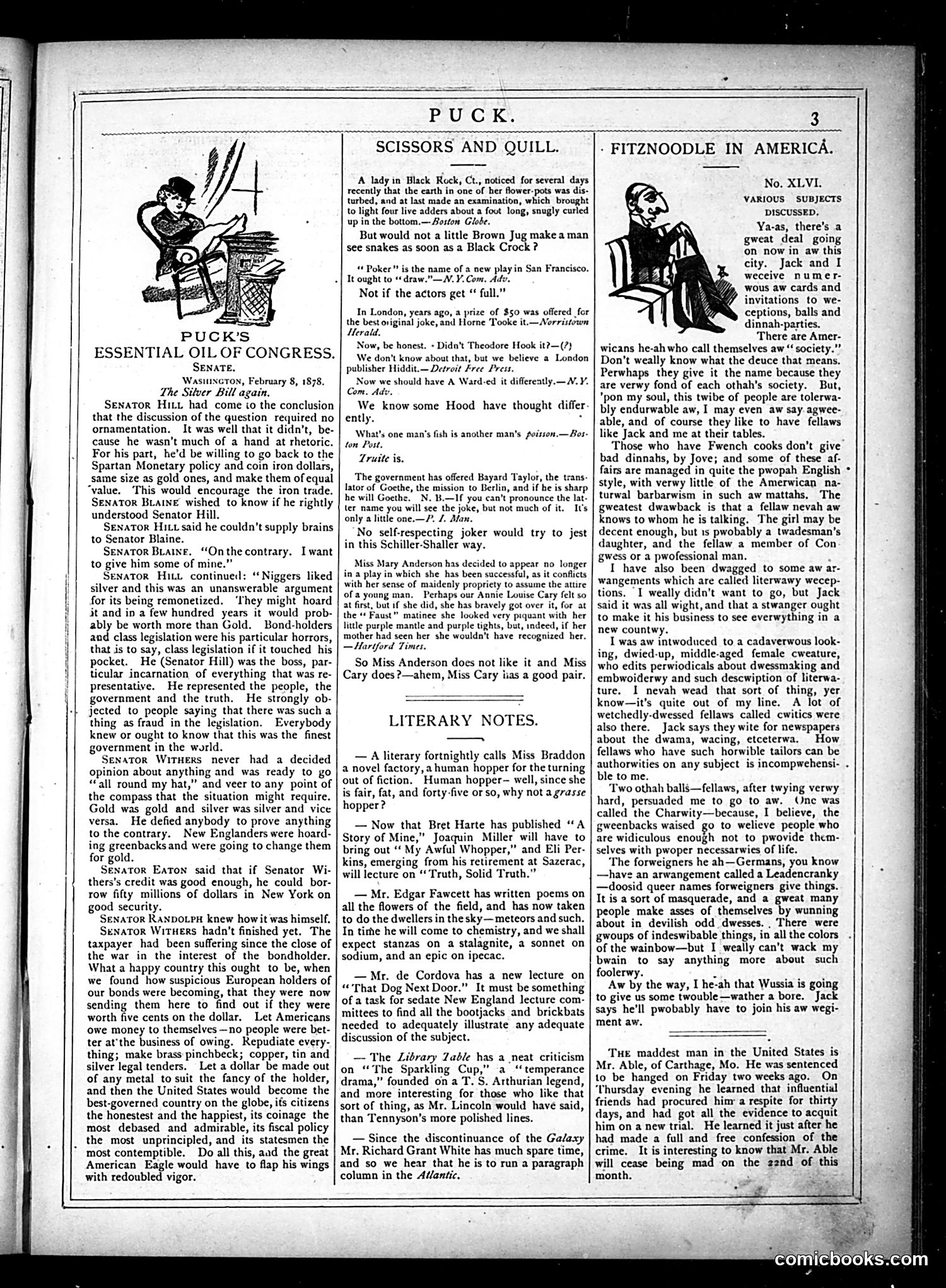
The page contains three distinct sections: **"Puck's Essential Oil of Congress"** (left): A satirical cartoon depicting Senator Hill and other lawmakers debating monetary policy. The satire mocks their proposal to replace silver coinage with gold—suggesting this would benefit wealthy gold-holders while harming ordinary citizens. The cartoon ridicules the contradiction of calling themselves "friends of the people" while pursuing legislation that favors the rich. **"Scissors and Quill"** (center): A miscellaneous humor column with brief jokes and observations about contemporary life, theater, and society figures. **"Fitznoodle in America"** (right): A conversational piece where a character named Jack discusses American society and customs, seemingly contrasting American and European social behaviors and pretensions. The overall tone is typical Puck satire: mocking political hypocrisy, social affectation, and contemporary controversies.
This page is primarily a humorous **essay about Valentine's Day traditions** rather than a political cartoon. The small illustration at top left shows a cherub-like Cupid figure, a standard Valentine's Day symbol. The article offers satirical **advice to men about sending valentines**, mocking both romantic pretension and masculine awkwardness. It jokes about the valentine trade, suggests practical alternatives to expensive gifts (stockings, potato-peelers), and humorously describes the consequences of sending valentines to the "wrong" woman or composing poor rhymes. The piece includes sample Valentine's verses at the article's conclusion. This is **social satire about courtship customs** rather than political commentary—the humor targets typical Valentine's Day anxieties and masculine uncertainty in romantic matters.
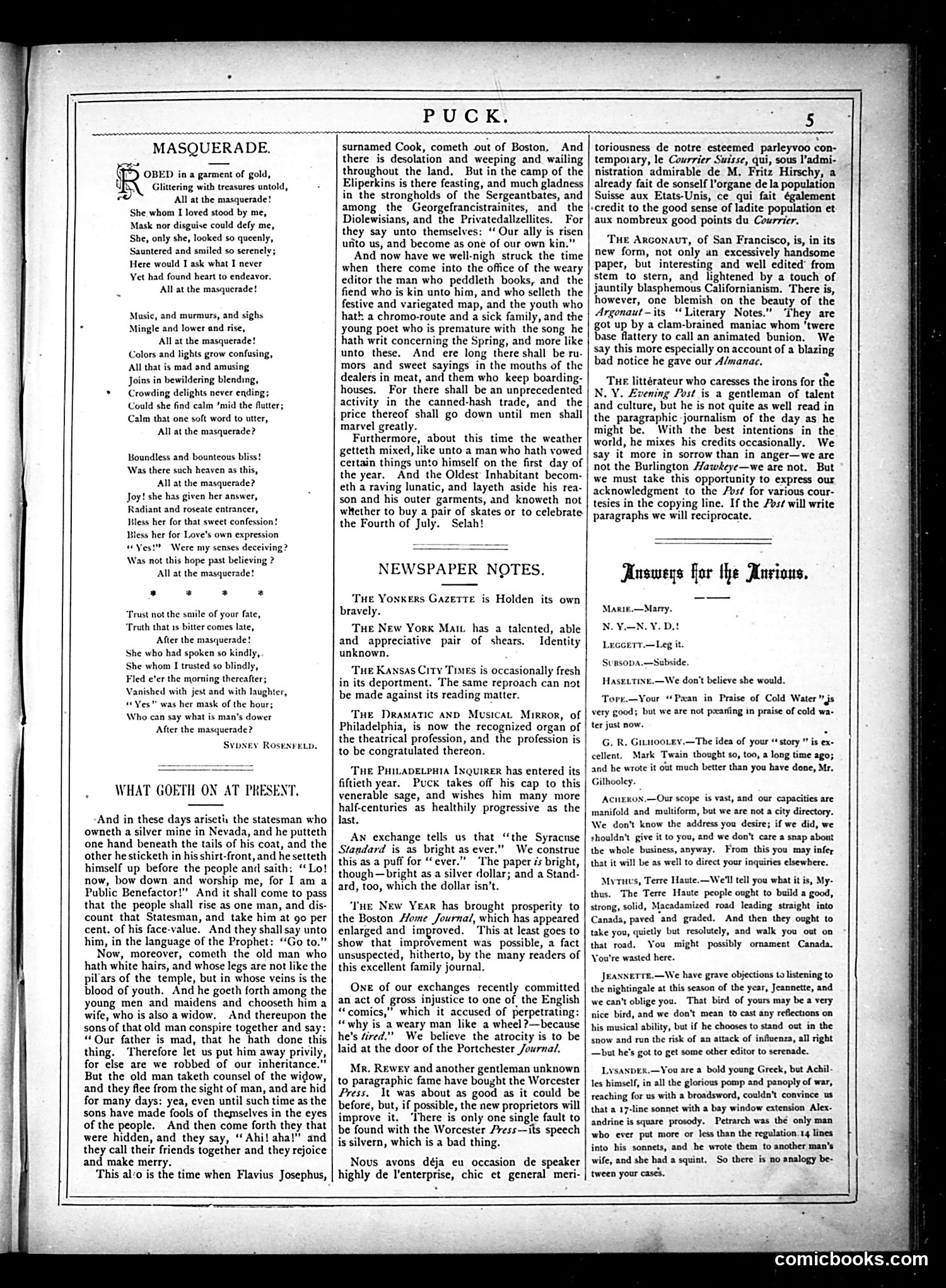
This page contains three distinct sections: a poem titled "Masquerade," an article "What Goeth On at Present," and a section called "Answers for the Curious." The "Masquerade" poem appears satirical, using masquerade ball imagery as metaphor for social hypocrisy—people wearing masks to hide their true selves. The accompanying verses mock pretense and artifice in society. "What Goeth On at Present" references political/social commentary, mentioning a "statesman" and discussing governance and prophecy, though specific figures aren't clearly identified in the visible text. The page primarily consists of editorial commentary and reader Q&A rather than illustrated political cartoons. Without seeing detailed illustrations, the exact satirical targets remain unclear, though the tone suggests critique of contemporary American political and social conventions of the Gilded Age era.
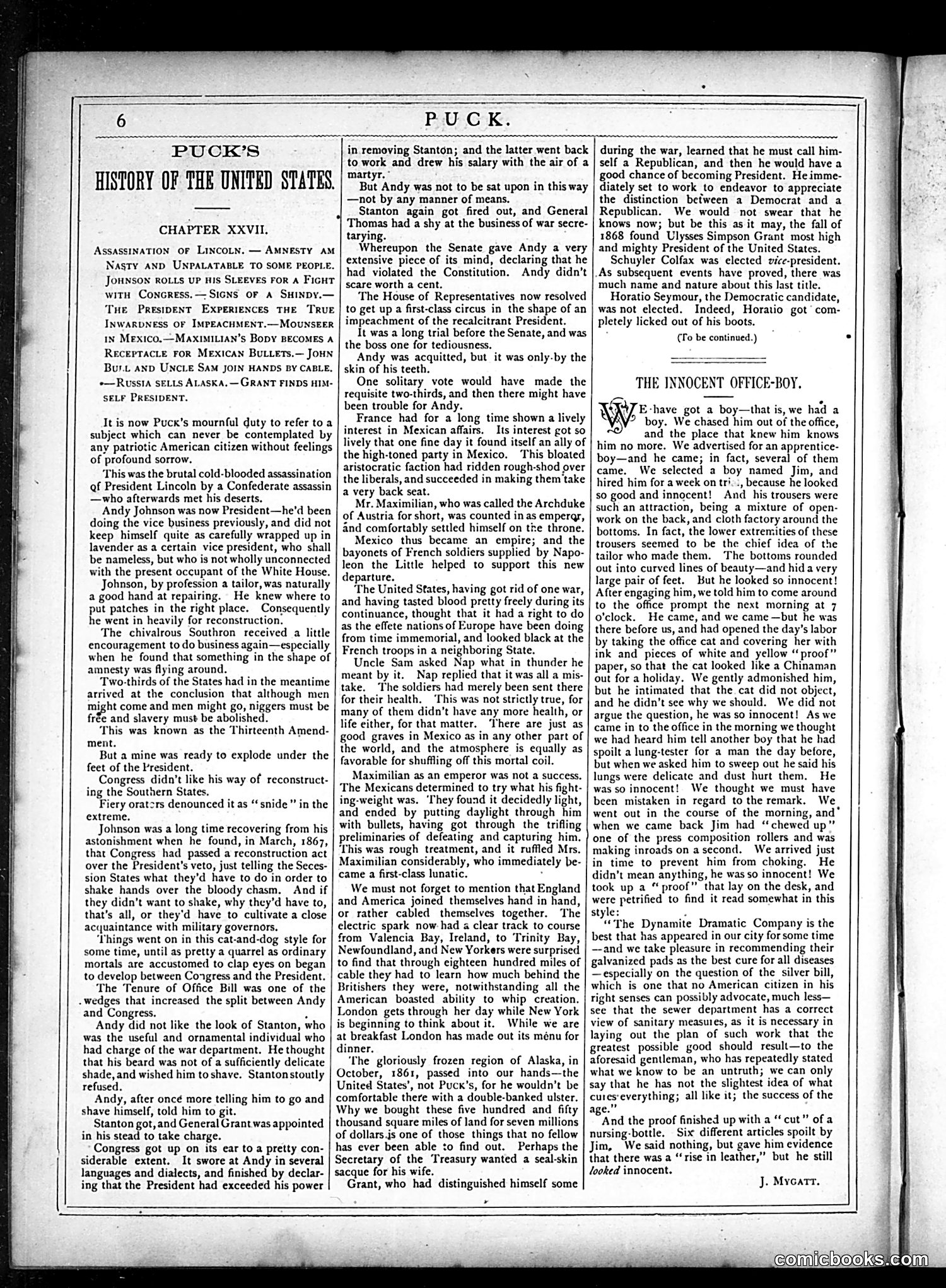
This page primarily contains text rather than political cartoons. The left column continues "Puck's History of the United States," focusing on Lincoln's assassination and Andrew Johnson's presidency. The right side features "The Innocent Office-Boy," a humorous narrative (not a cartoon) by J. Mycatt about chasing a boy from an office. The boy's innocent appearance and good behavior made him seem trustworthy, but he caused mischief—including opening the office safe, damaging property, and leaving ink-stained "proof" papers about. The piece satirizes misplaced trust in seemingly innocent people and the chaos their deception creates in a workplace—a common comedic theme of the era. This appears to be a lighter, satirical anecdote rather than political commentary.
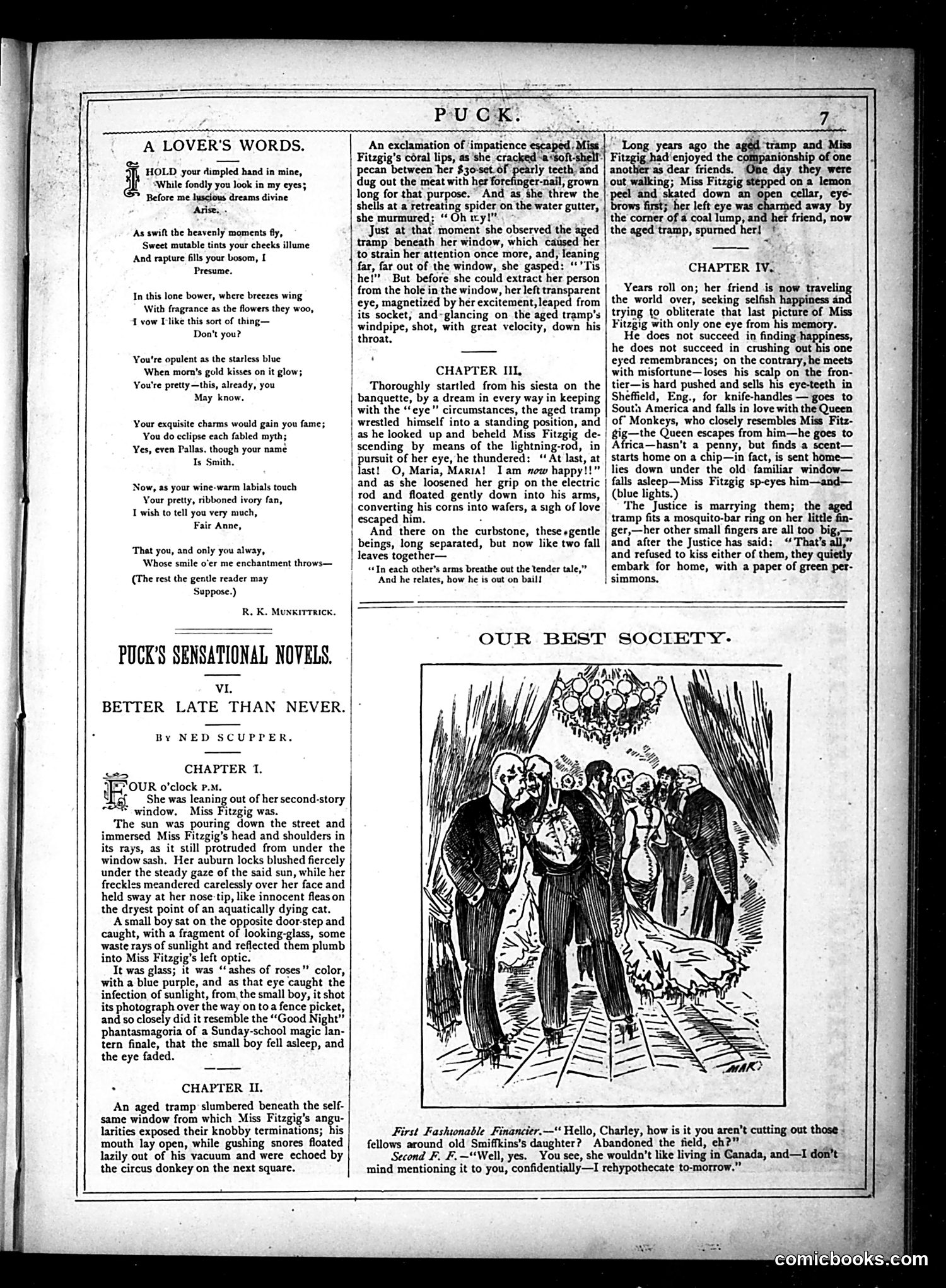
This cartoon satirizes upper-class social hypocrisy and pretension. The illustration shows well-dressed figures in an elegant interior (note the chandelier and curtains), but the caption reveals their true nature through dialogue between "First Fashionable Financier" and "Second F.F." The joke hinges on abandoned morality: the first character questions why the second isn't "cutting out those fellows around old Smithkins's daughter," implying seduction or exploitation. The response—claiming he wouldn't risk "living in Canada"—suggests he abandoned such schemes due to legal consequences, not principle. The satire targets wealthy society's facade of respectability masking opportunism, greed, and willingness to exploit others when consequences seem distant. The cartoon mocks both the characters' amorality and their transparent self-interest.
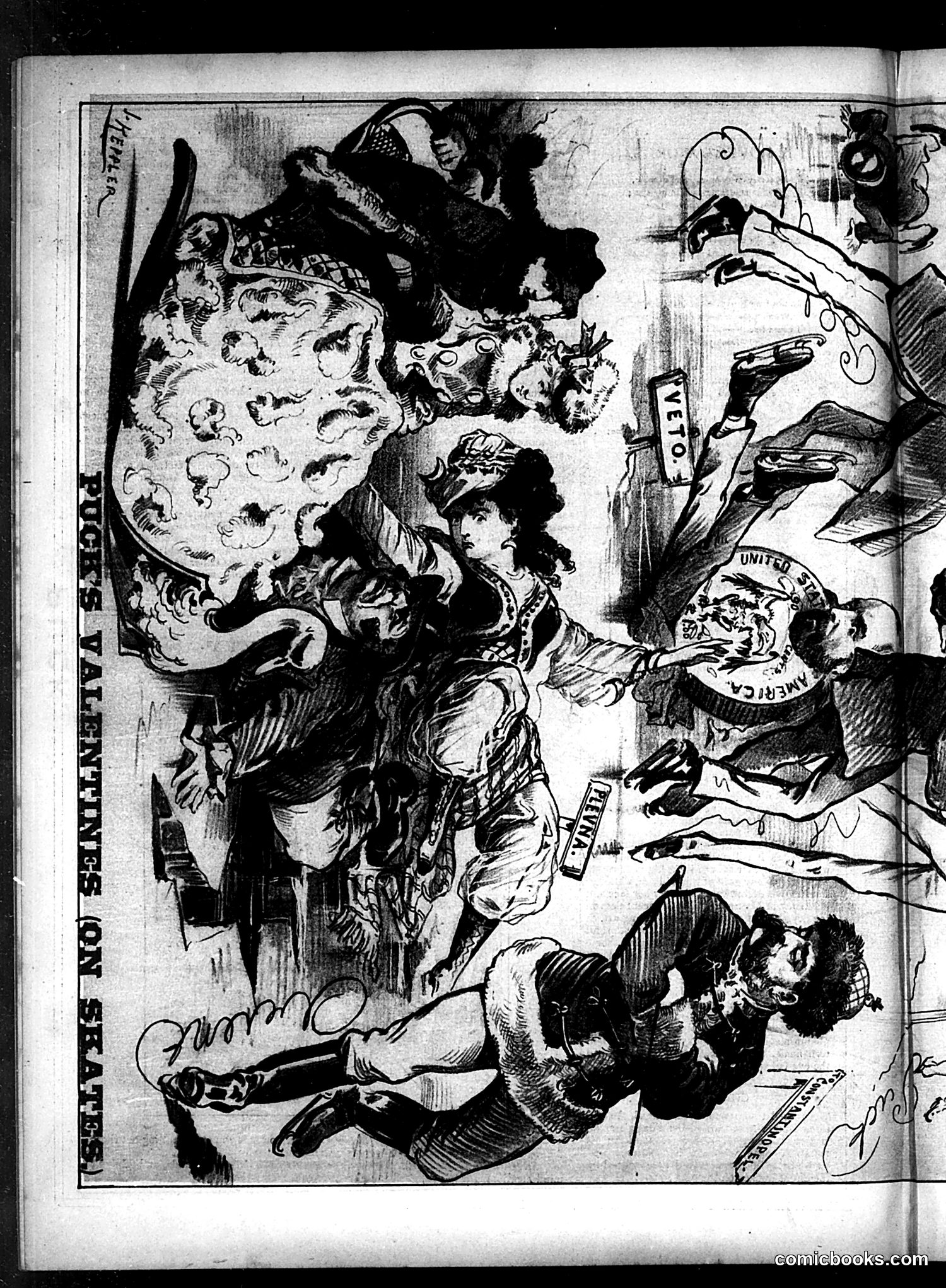
This appears to be a satirical cartoon from *Puck* magazine depicting concerns about immigration and foreign influence in America. The large grotesque head at top-left likely represents disease, corruption, or undesirable foreign elements threatening the nation. The figures below appear to be American political or business leaders reacting with alarm or complicity. Labels visible include "VETO" and what appears to be references to "UNITED STATES" governance. The cartoon uses exaggerated caricature—a common *Puck* technique—to mock either: - Political resistance (or failure) to restrict immigration - Concerns about foreign workers undercutting American labor - Debates over immigration policy and assimilation Without clearer text legibility or a specific date, the exact political moment remains unclear, though the imagery suggests late 19th or early 20th-century nativist anxieties about immigration.
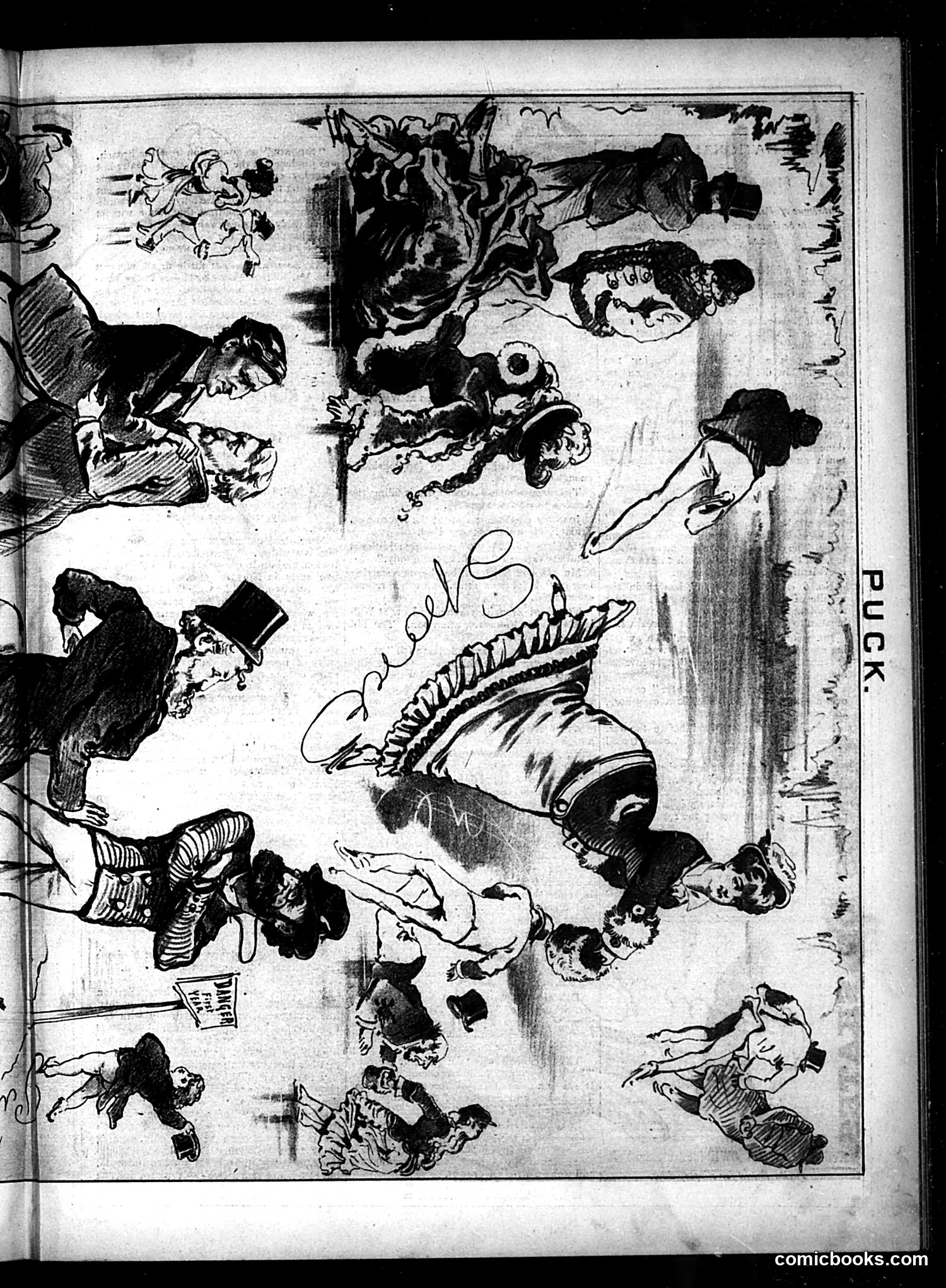
This page appears to be a satirical cartoon titled "Puck" (visible on the right margin), though the OCR text is largely illegible. The image shows multiple figures drawn in a chaotic, exaggerated style typical of late-19th/early-20th century political satire. The central figure appears to be a large, grotesque character wearing formal attire, surrounded by smaller figures in various poses of distress or commotion. There's handwritten text reading what appears to be "Puck's" or similar. Without clearer text or identifying labels, I cannot definitively identify the specific political figures or events being satirized. The style suggests commentary on corruption, greed, or social chaos—common Puck themes—but the specific target remains unclear from this reproduction quality.
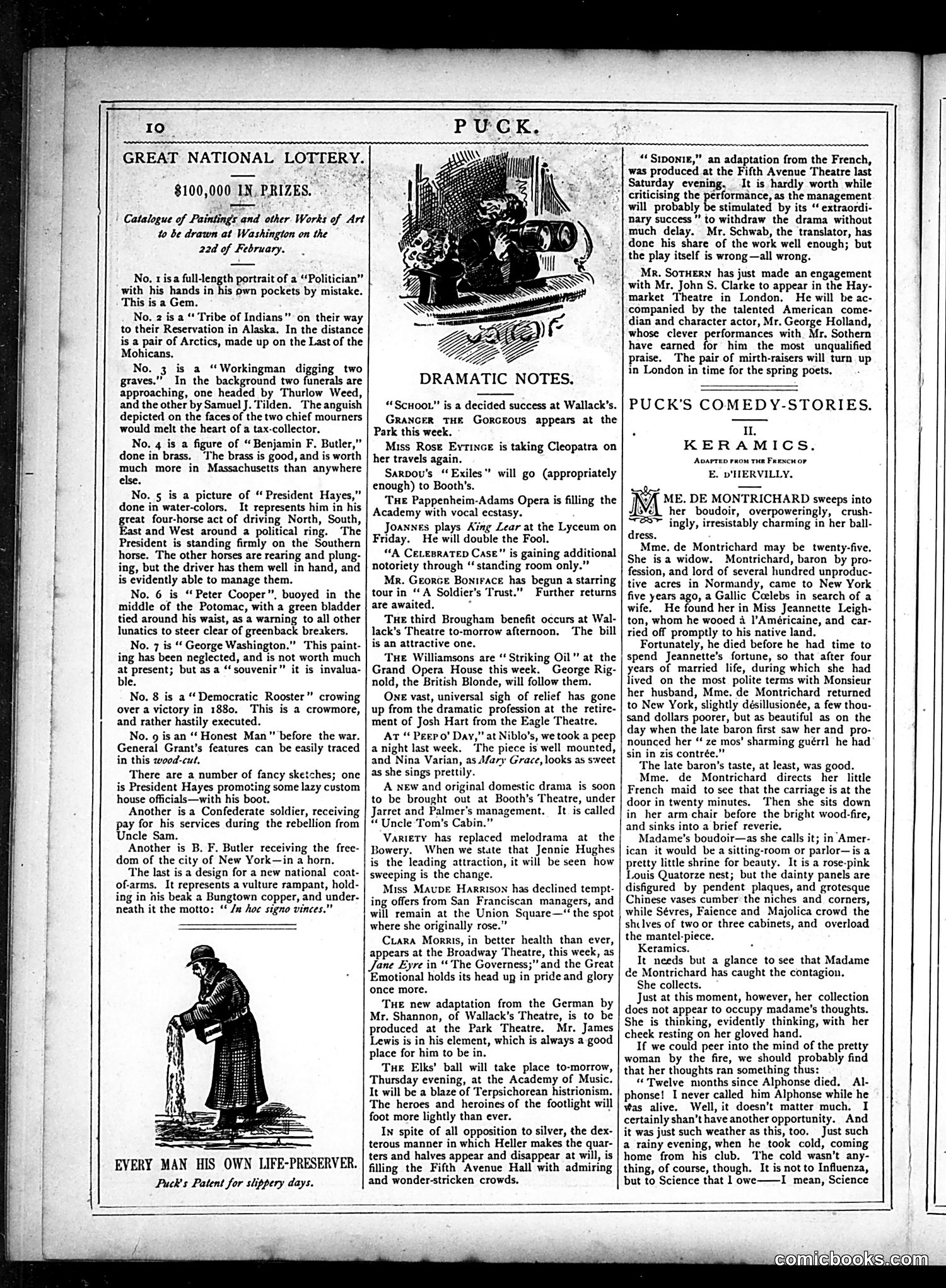
This page contains theatrical reviews and advertisements rather than political cartoons. The main illustrated content shows two figures: 1. **Top illustration**: A dramatic scene depicting what appears to be a theatrical performance or comedic moment with two figures in period dress. 2. **Bottom illustration**: A man in formal attire labeled "EVERY MAN HIS OWN LIFE-PRESERVER" advertising "Puck's Patent for slippery days"—a humorous advertisement, likely for footwear or anti-slip devices, playing on winter weather hazards. The page primarily features "Dramatic Notes" covering New York theater productions of the period, including shows at various theaters and commentary on actors and performances. This is entertainment journalism rather than political satire.
This page contains dialogue from what appears to be a serialized satirical story rather than a political cartoon. The text discusses a character named "Señor Breu y Tabóddos" and involves plot elements about a wandering Christian, a collection of ceramics, a soup tureen, and various interpersonal conflicts over money and social obligations. Without seeing the accompanying illustration clearly, I cannot identify the specific figures or determine what political or social satire is intended. The references to collectors, French characters, and financial disputes suggest social commentary on wealthy American collectors and European art dealings of the period, but the specific targets and point of the satire remain unclear from the text alone. The page appears primarily text-based rather than cartoon-focused.
This page contains a serialized story titled "The Duel in Herne Wood," attributed to Wilkie Collins, with the byline "(Concluded.)" The narrative appears to be a Victorian-era romance/mystery tale involving characters named Miss Duval, Captain Stanwick, and various other figures engaged in dramatic personal conflicts. The page is entirely text-based—there are no visible cartoons or satirical illustrations. It functions as a literary installment rather than political satire. The content focuses on romantic entanglement, honor, dueling, and character revelations typical of 19th-century serialized fiction. Without visible cartoon imagery or clear political/social commentary, this page serves as *Puck*'s literary content rather than its signature satirical commentary.
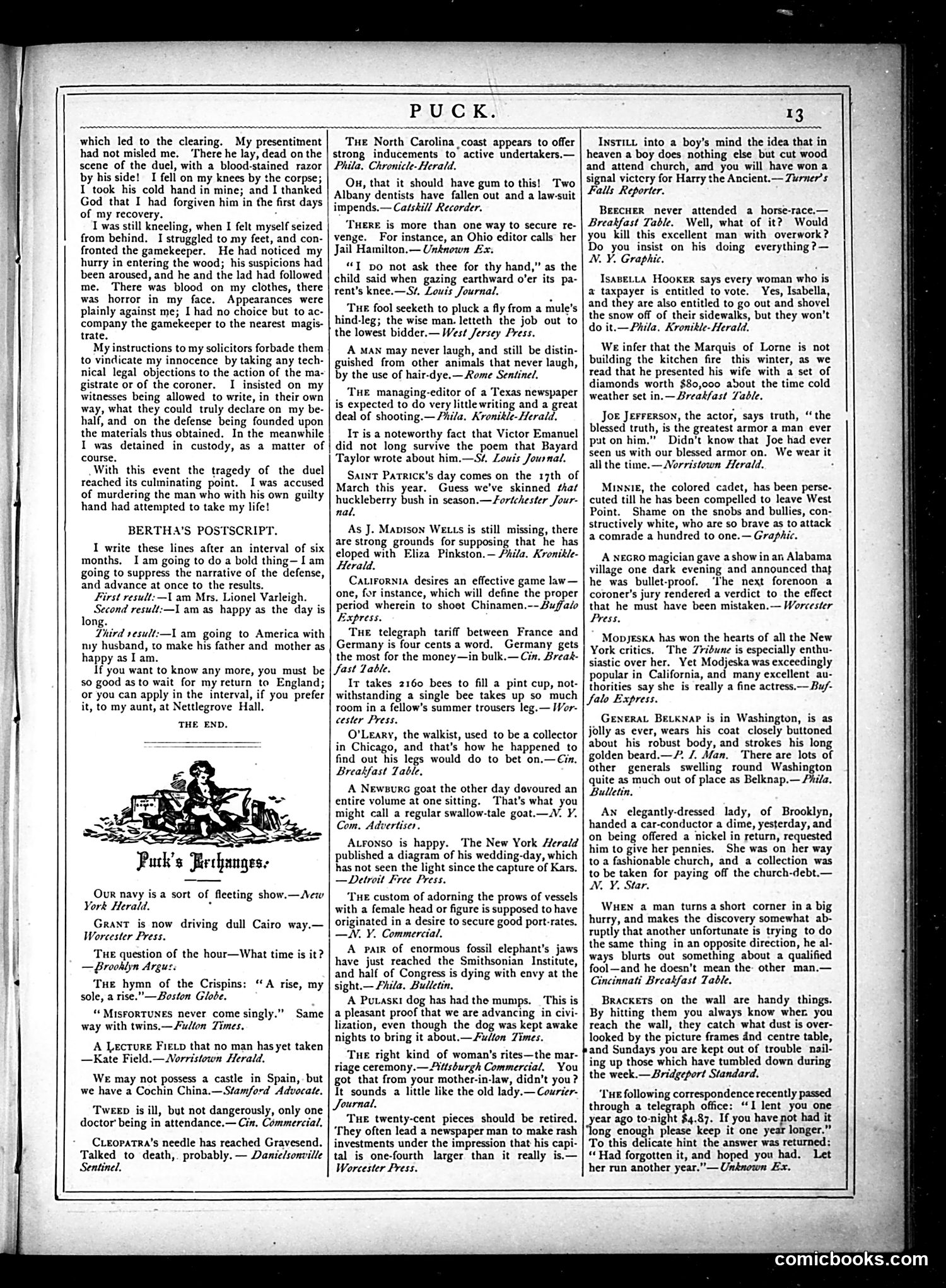
This page consists primarily of **"Puck's Persuasions"** — a column of brief satirical quips and jokes on various topics — rather than a political cartoon. The content mocks contemporary subjects including: - A murderer's trial and guilty conscience - Dentistry and tooth loss - Small-town journalism and pretension - Various social absurdities (plucking flies from mules, colored cadets, game laws) The single illustrated element at bottom shows a figure in a rural/peasant setting, though its specific satirical target is unclear from the image alone. The page functions as **humor commentary on everyday American life** — social behavior, professions, and news — rather than focused political satire. Most jokes target universal human foibles rather than specific current events or identifiable public figures.
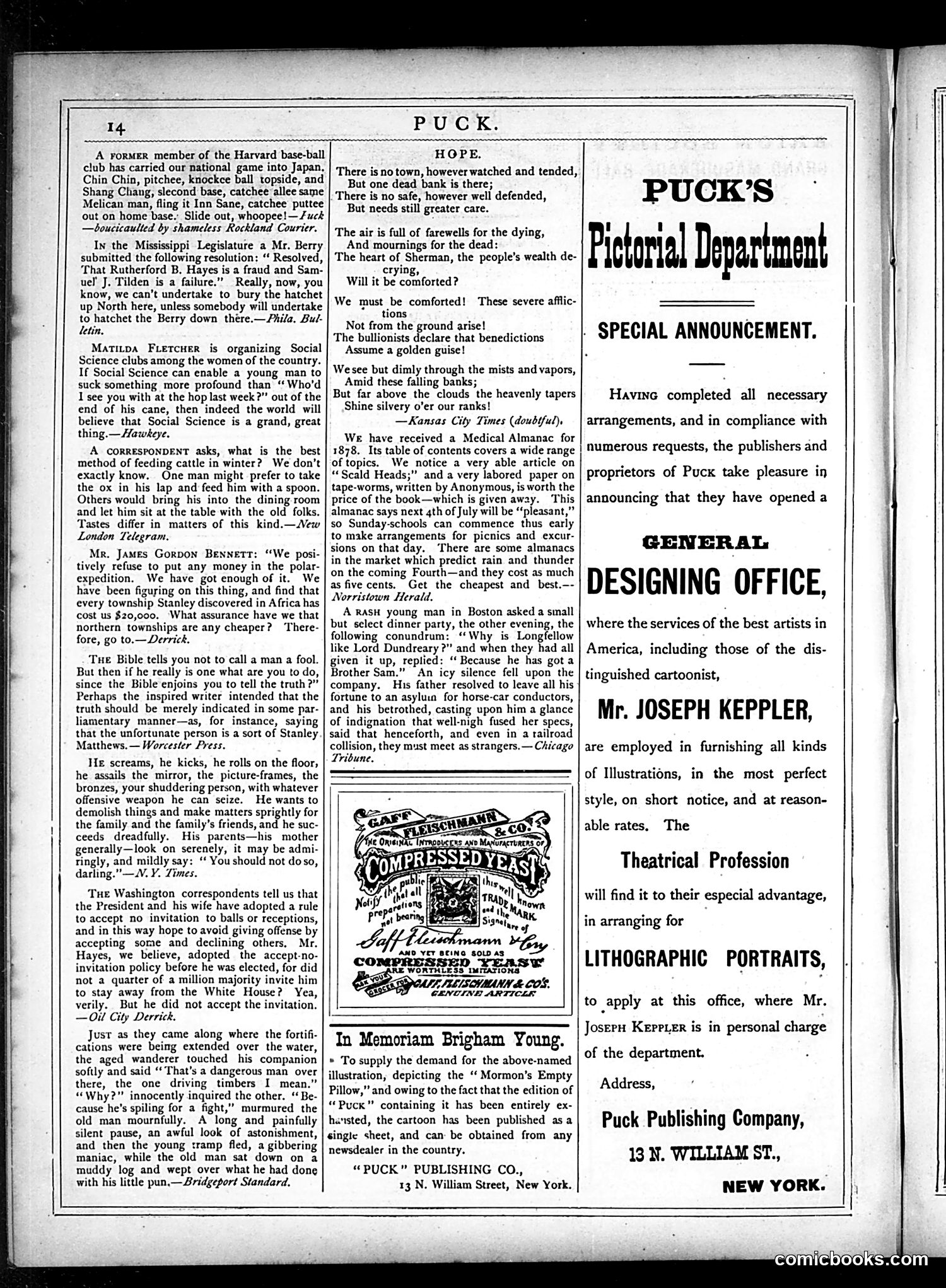
This is primarily **advertising and announcements** rather than political satire. The page contains: 1. **Editorial notes and anecdotes** about baseball, social science, and various humorous incidents from American life 2. **A large advertisement** for Gaff, Fleischmann & Co.'s compressed yeast product 3. **Puck's Pictorial Department announcement** — a new "General Designing Office" employing cartoonist **Joseph Keppler** to provide illustrations and lithographic portraits for theatrical professionals and others 4. **In Memoriam** notice for Brigham Young, discussing a cartoon about the "Mormon's Empty Pillow" The page is largely **commercial/institutional** rather than satirical political commentary. It showcases Puck's services and business operations from the late 19th century rather than critiquing contemporary politics or society.
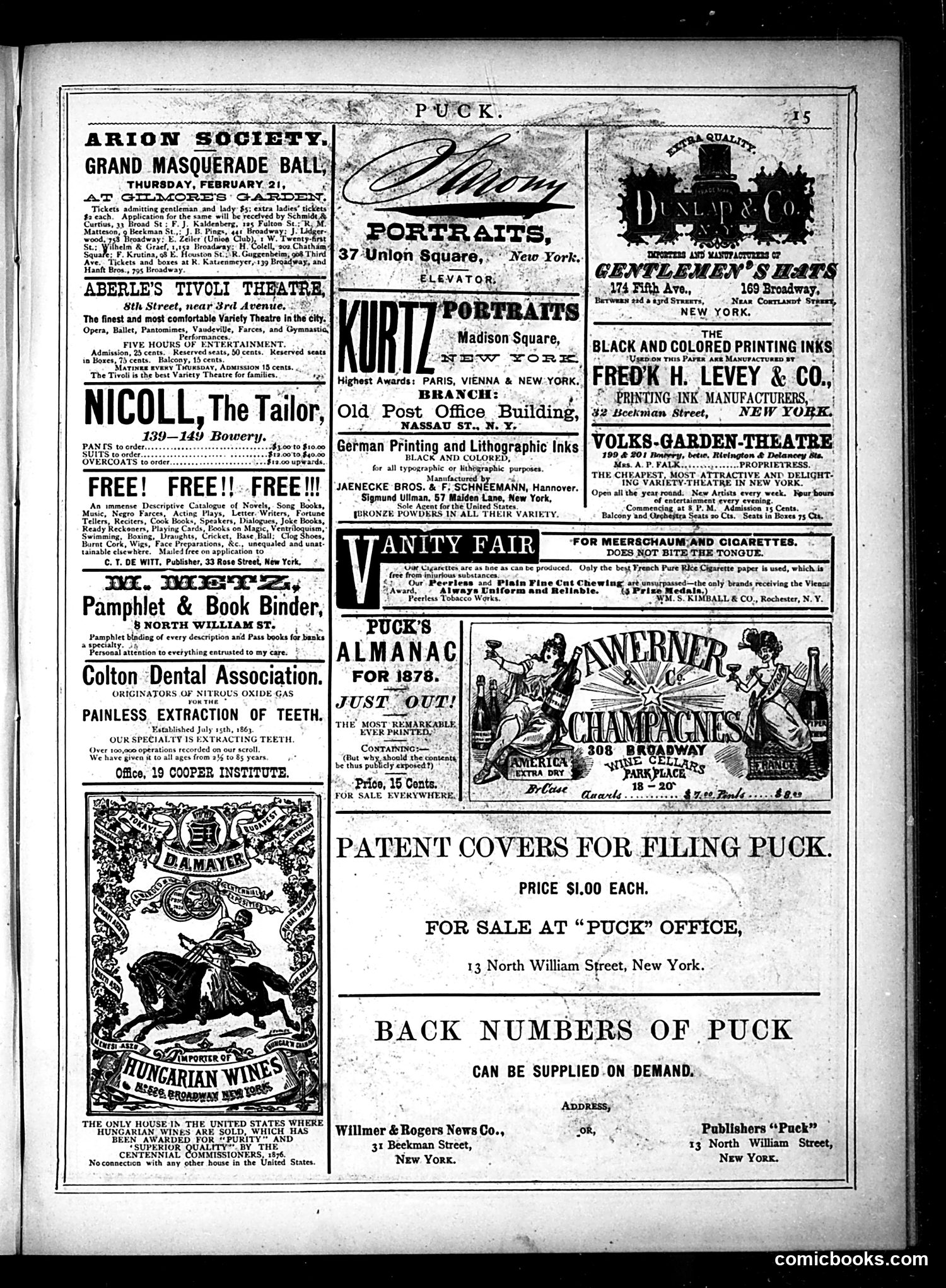
This page is **primarily advertisements** for New York City businesses and services, typical of Puck magazine's back pages. Notable ads include: - **Arion Society's Grand Masquerade Ball** (theatrical entertainment) - **Aberle's Tivoli Theatre** (variety entertainment) - **Nicoll, the Tailor** (clothing) - **Colton Dental Association** (dentistry) - **Puck's Almanac for 1878** (the magazine's own publication) - **Werner's Champagnes** (wine/spirits) The page also advertises **patent covers for filing Puck** ($1.00) and notes that **back numbers** are available through the publisher. One decorative advertisement features what appears to be a **Hungarian wine label** with a horse rider motif. The content reflects late-19th-century urban commerce rather than satirical political commentary.
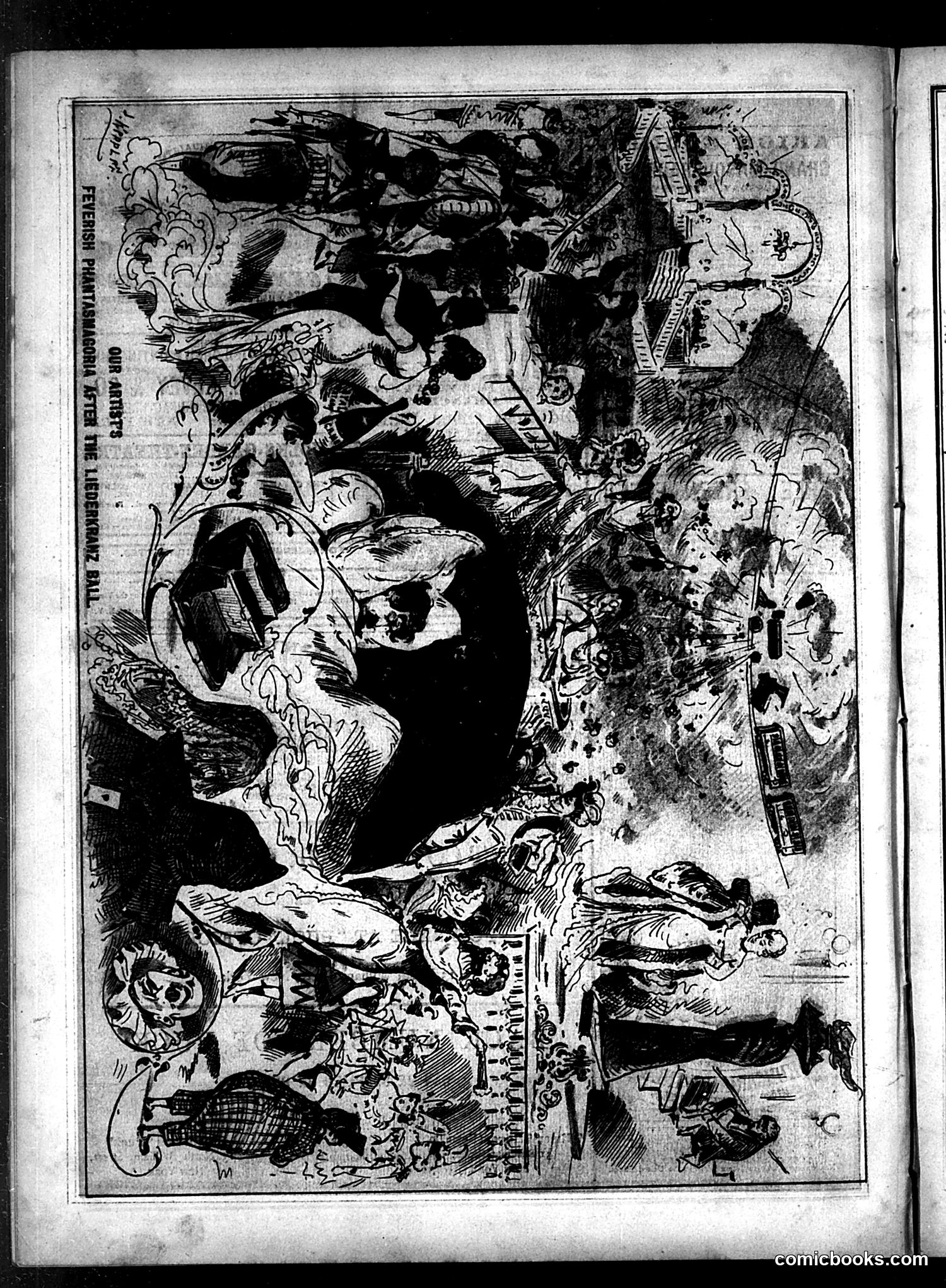
This page appears to be rotated 90 degrees, making the full content difficult to read with certainty. The visible OCR text is fragmentary and unclear. However, the image shows a dense, chaotic engraving in Puck's characteristic style, featuring multiple human figures, fantastical creatures, and ornate decorative elements typical of late 19th-century satirical illustration. Without legible text or clear identification of specific figures, I cannot reliably identify the political figures, events, or satirical targets depicted. The composition suggests a commentary on social or political chaos, possibly involving multiple competing interests or factions, but asserting specific meanings would require clearer visibility of labels, captions, or text that would identify the subjects and point of the satire. A higher-quality or properly oriented image would be needed for accurate analysis.