
Puck, 1878-02-13 · page 5 of 16
Puck — February 13, 1878 — page 5: what you’re looking at
What you’re looking at
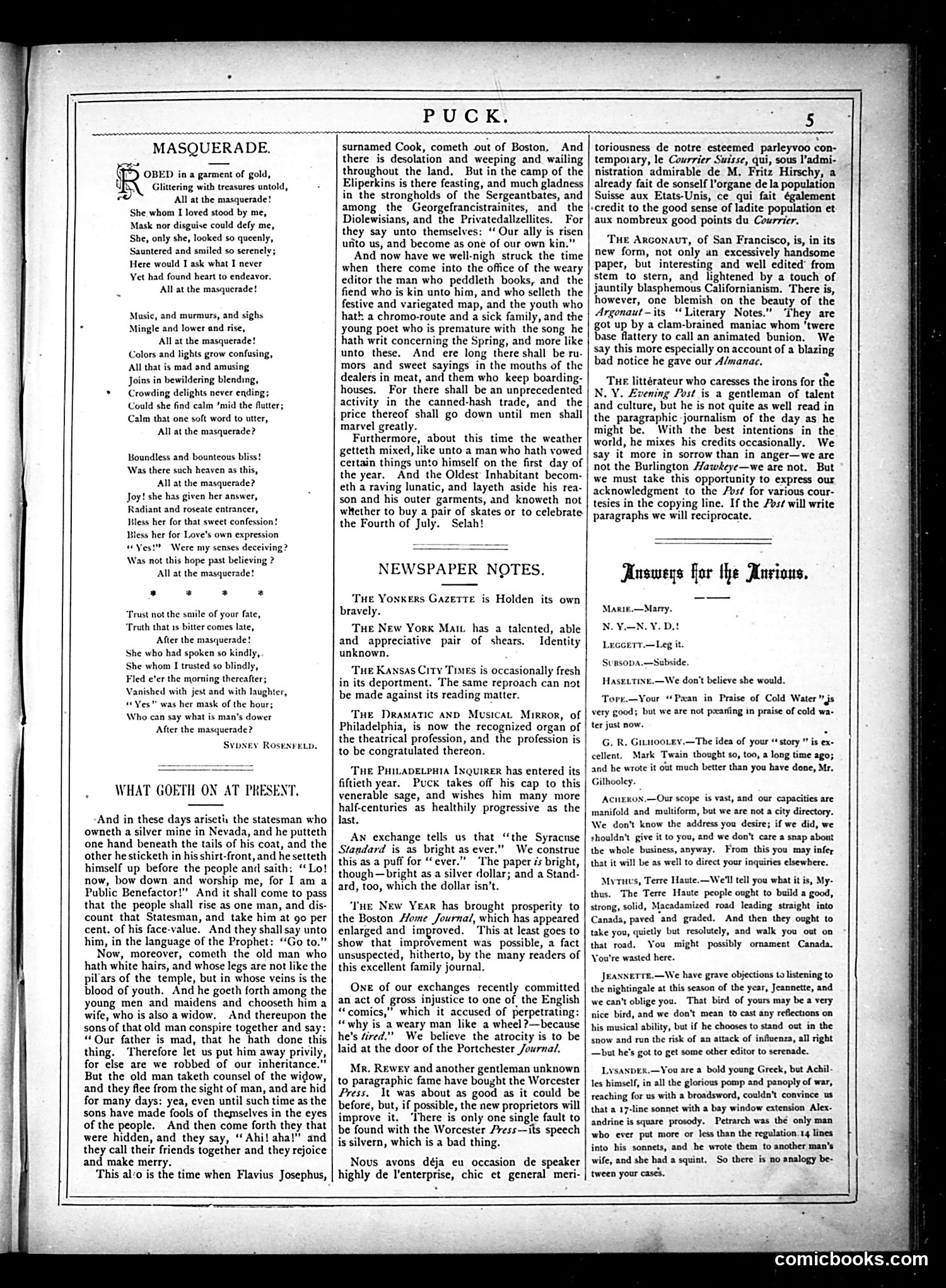
This page contains three distinct sections: a poem titled "Masquerade," an article "What Goeth On at Present," and a section called "Answers for the Curious." The "Masquerade" poem appears satirical, using masquerade ball imagery as metaphor for social hypocrisy—people wearing masks to hide their true selves. The accompanying verses mock pretense and artifice in society. "What Goeth On at Present" references political/social commentary, mentioning a "statesman" and discussing governance and prophecy, though specific figures aren't clearly identified in the visible text. The page primarily consists of editorial commentary and reader Q&A rather than illustrated political cartoons. Without seeing detailed illustrations, the exact satirical targets remain unclear, though the tone suggests critique of contemporary American political and social conventions of the Gilded Age era.
📄 Transcribed text from this page (OCR, searchable)
Machine-transcribed from the original scan — historical spelling and the odd misread are preserved.
Dia allied MASQUERADE. re (5 opED ina garment of gold, R Glittering with treasures untold, G All at the masquerade! She whom I loved stood by me, Mask nor disguise could defy me, She, only she, looked so queenly, Sauntered and smiled so serenely; Here would I ask what I never Yet had found heart to endeavor. All at the masquerade! Music, and murmurs, and sighs Mingle and lower and rise, All at the masquerade! Colors and lights grow confusing, All that is mad and amusing Joins in bewildering blending, * Crowding delights never ending; Could she find calm 'mid the flutter; Calm that one soft word to utter, All at the masquerade? Boundless and bounteous bliss! Was there such heaven as this, All at the masquerade? Joy! she has given her answer, Radiant and roseate entrancer, Bless her for that sweet confession! Bless her for Love's own expression «Yes! Were my senses deceiving? Was not this hope past believing ? All at the masquerade! * * 2 * Trust not the smile of your fate, ‘Truth that 1s bitter comes late, After the masquerade! She who had spoken so kindly, She whom I trusted so blindly, Fled e’er the morning thereaft Vanished with jest and with laughter, “Yes” was her mask of the hour; Who can say what is man’s dower After the masquerade? Sypxey Rosexrenp. WHAT GOETH ON AT PRESENT. And in these days ariseti: the statesman who owneth a silver mine in Nevada, and he putteth one hand beneath the tails of his coat, and the other he sticketh in his shirt-front, and he setteth himself up before the people and saith: “Lo! now, bow down and worship me, for I am a Public Benefactor!” And it shall come to pass that the people shall rise as one man, and dis- count that Statesman, and take him at go per cent. of his face-value. And they shall say unto him, in the language of the Prophet: “Go t Now, moreover, cometh the old man who hath white hairs, and whose legs are not like the pil'ars of the temple, but in whose veins is the blood of youth. And he goeth forth among the young men and maidens and chooseth him a wife, who is also a widow. And thereupon the sons of that old man conspire together and say: “Our father is mad, that he hath done this thing. Therefore let us put him away privily, for else are we robbed of our inheritanc But the old man taketh counsel of the widow, and they flee from the sight of man, and are hid for many days: yea, even until such time as the sons have made fools of themselves in the eyes of the people. And then come forth they that were hidden, and they say, ‘Ahi! aha!” and they call their friends together and they rejoice make merry. This al:o is the time when Flavius Josephus, PUCK. surnamed Cook, cometh out of Boston, And there is desolation and weeping and wailing throughout the land, But in the camp of the Eliperkins is there feasting, and much gladness in the strongholds of the Sergeantbates, and among the Georgefrancistrainites, and the Diolewisians, and the Privatedallzellites. For they say unto themselves: ‘Our ally is risen unito us, and become as one of our own kin.” And now have we well-nigh struck the time when there come into the office of the weary editor the man who peddleth books, and the fiend who is kin unto him, and who selleth the festive and variegated map, and the youth who hath a chromo-route and a sick family, and the young poet who is premature with the song he hath writ concerning the Spring, and more like unto these. And ere long there shall be ru- mors and sweet sayings in the mouths of the dealers in meat, and them who keep boarding- houses, For there shall be an unprecedented activity in the canned-hash trade, and the price thereof shall go down until men shall marvel greatly. Furthermore, about this time the weather getteth mixed, like unto a man who hath vowed certain things unto himself on the first day of the year. And the Oldest Inhabitant becom- eth a raving lunatic, and layeth aside his rea- son and his outer garments, and knoweth not wktether to buy a pair of skates or to celebrate the Fourth of July. Selah! NEWSPAPER NOTES. ‘Tue Yonkers Gazette is Holden its own bravely. Tue New York Matt has a talented, able and appreciative pair of shears. Identity unknown. Tue Kansas City Times is occasionally fresh in its deportment. The same reproach can not be made against its reading matter. Tue Dramatic AND Musicat Mirror, of Philadelphia, is now the recognized organ of | the theatrical profession, and the profession is to be congratulated thereon. Tue Puitapecpuia Inquirer has entered its fiftieth year, Puck takes off his cap to this venerable sage, and wishes him many more half-centuries as healthily progressive as the last. Aw exchange tells us that “the Syracuse Standard is as bright as ever.” We construe this as a puff for “ever.” ‘The paper és bright, though—bright as a silver dollar; and a Stand- ard, too, which the dollar isn’t. ‘Tne New Year has brought prosperity to the Boston Home Journal, which has appeared enlarged and improved. ‘This at least goes to show that improvement was possible, a fact unsuspected, hitherto, by the many readers of this excellent family journal. One of our exchanges recently committed an act of Bross injustice to one of, the English “comics,” which it accused of perpetrating: “why is a weary man like a wheel?—because he’s fired.” We believe the atrocity is to be laid at the door of the Portchester Journa/. Mr. Rewey and another gentleman unknown to paragraphic fame have bought the Worcester Press. Wt was about as good as it could be before, but, if possible, the new proprietors will improve it. ‘There is only one single fault to be found with the Worcester Press—its speech is silvern, which is a bad thing. Nous avons déja eu occasion de speaker highly de l'enterprise, chic et general meri- credit to the good sense of ladite population et. toriousness de notre esteemed parleyvoo con- temporary, le Courrier Suisse, qui, sous l’admi- nistration admirable de M. Fritz Hirschy, a already fait de sonself l'organe de la population Suisse aux Etats-Unis, ce qui fait également aux nombreux good points du Courrier, Tue Arconavt, of San Francisco, is, in its new form, not only an excessively handsome paper, but interesting and well edited’ from stem to stern, and lightened by a touch of jauntily blasphemous Californianism. ‘There is, however, one blemish on the beauty of the Argonaut—its “Literary Notes.” They are got up by a clam-brained maniac whom ‘twere base flattery to call an animated bunion. We say this more especially on account of a blazing bad notice he gave our A’manac. Tue littérateur who caresses the irons for the Y. Evening Post is a gentleman of talent and culture, but he is not quite as well read in the paragraphic journalism of the day as he might be. With the best intentions in the world, he mixes his credits occasionally. We say it more in sorrow than in anger—we are not the Burlington Hawkeye—we are not. But we must take this opportunity to express our acknowledgment to the ost for various cour- tesies in the copying line. If the /os¢ will write paragraphs we will reciprocate. Answeys for the Anrious, Manie.—Marry. ~~ N. Y.=N. Y. D.! Leccerr.—Leg it. Svpsopa.—Subside. Haseitixe.—We don't believe she would. Torr.—Your Pxan in Praise of Cold Water "js very good; but we are not paring in praise of cold wa- ter just now. G. R. GintooLey.—The idea of your story "" is ex- cellent. Mark Twain thought so, too, a long time ago; and he wrote it out much better than you have done, Mr. Githooley. AciteKxoN.—Our scope is vast, and our capacities are manifold and multiform, but we are not a city directory. We don't know the address you desire; if we did, we shouldn't give it to you, and we don’t care a snap about the whole business, anyway. From this you may infer that it will be as well to direct your inquiries elsewhere. Myris, Terre Haute,—We'll tell you what it is, My- thus. The Terre Haute people ought to build a good, strong, solid, Macadamized road leading straight into Canada, paved ‘and graded. And then they ought to take you, quietly but resolutely, and walk you out on that road. You might possibly ornament Canada. You're wasted here. EANNETTE.—We have grave objections to listening to the nightingale at this season of the year, Jeannette, and we can't oblige you. That bird of yours may be a very nice bird, and we don't mean to cast any reflections on his musical ability, but if he chooses to stand out in the snow and run the risk of an attack of influenza, all right —but he’s got to get some other editor to serenade. Lysaxpex.—You are a bold young Greek, but Ackil- les himself, in all the glorious pomp and panoply of war, reaching for us with a broadsword, couldn't convince us that a 17-line sonnet with a bay window extension Alex- andrine is square prosody. Petrarch was thé only man who ever put more or less than the regulation.14 lines I into his sonnets, and he wrote them to another man's So there is no analogy be- wife, and she had a squint, tween your cases, comicbooks.com