
Puck, 1878-02-13 · page 4 of 16
Puck — February 13, 1878 — page 4: what you’re looking at
What you’re looking at
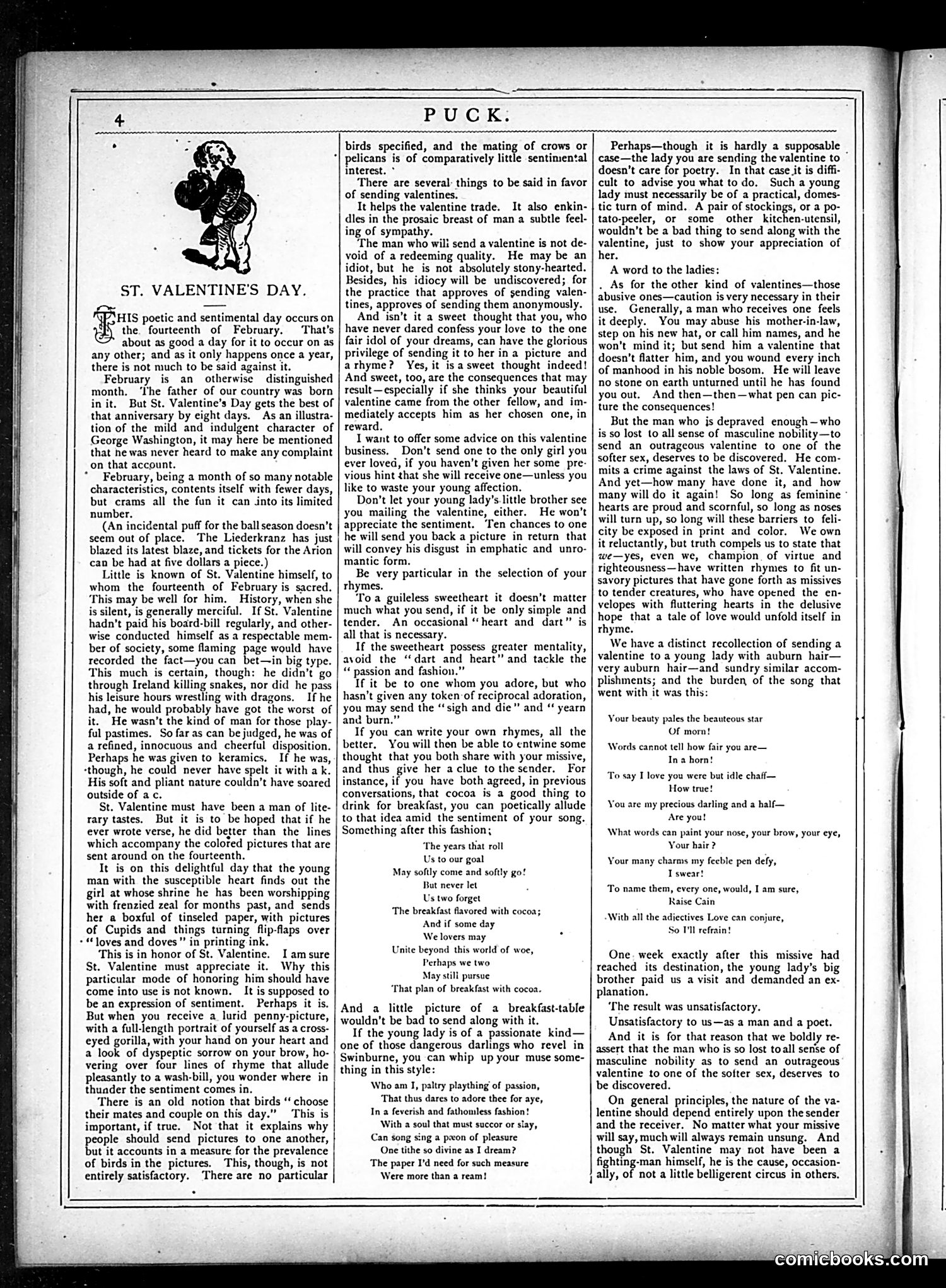
This page is primarily a humorous **essay about Valentine's Day traditions** rather than a political cartoon. The small illustration at top left shows a cherub-like Cupid figure, a standard Valentine's Day symbol. The article offers satirical **advice to men about sending valentines**, mocking both romantic pretension and masculine awkwardness. It jokes about the valentine trade, suggests practical alternatives to expensive gifts (stockings, potato-peelers), and humorously describes the consequences of sending valentines to the "wrong" woman or composing poor rhymes. The piece includes sample Valentine's verses at the article's conclusion. This is **social satire about courtship customs** rather than political commentary—the humor targets typical Valentine's Day anxieties and masculine uncertainty in romantic matters.
📄 Transcribed text from this page (OCR, searchable)
Machine-transcribed from the original scan — historical spelling and the odd misread are preserved.
PUCK. ST. VALENTINE'S DAY. HIS poetic and sentimental day occurs on the. fourteenth of February. That's about as good a day for it to occur on as any other; and as it only happens once a year, there is not much to be said against it. February is an otherwise ‘inguished month. ‘The father of our country was born init. But St. Valentine’s Day gets the best of that anniversary by eight days. As an illustra- tion of the mild and indulgent character of George Washington, it may here be mentioned that he was never heard to make any complaint on that account. February, being a month of so many notable characteristics, contents itself with fewer days, but crams all the fun it can into its limited number. (An incidental puff for the ball season doesn’t seem out of place. The Liederkranz has just blazed its latest blaze, and tickets for the Arion can be had at five dollars a piece.) Little is known of St. Valentine himself, to whom the fourteenth of February is sacred. ‘This may be well for him. History, when she is silent, is generally merciful. If St. Valentine hadn't paid his board-bill regularly, and other- wise conducted himself as a respectable mem- ber of society, some flaming page would have recorded the fact—you can bet—in big type. This much is certain, though: he didn’t go through Ireland killing snakes, nor did he pass his leisure hours wrestling with dragons. If he had, he would probably have got the worst of it. He wasn’t the kind of man for those play- ful pastimes. So far as can be judged, he was of a refined, innocuous and cheerful disposition. Perhaps he was given to keramics. If he was, ‘though, he could never have spelt it with ak. His soft and pliant nature couldn’t have soared outside of ac. St. Valentine must have been a man of lite- rary tastes. But it is to be hoped that if he ever wrote verse, he did better than the lines which accompany the colored pictures that are sent around on the fourteenth, It is on this delightful day that the young man with the susceptible heart finds out the girl at whose shrine he has been worshipping with frenzied zeal for months past, and sends her a boxful of tinseled paper, with pictures of Cupids and things turning flip-flaps over “loves and doves” in printing ink. This is in honor of St. Valentine. I amsure St. Valentine must appreciate it. Why this particular mode of honoring him should have come into use is not known. It is supposed to be an expression of sentiment. Perhaps it is. But when you receive a lurid penny-picture, with a full-length portrait of yourself as a cross- eyed gorilla, with your hand on your heart and a look of dyspeptic sorrow on your brow, ho- vering over four lines of rhyme that allude pleasantly to a wash-bill, you wonder where in thuader the sentiment comes in. There is an old notion that birds ‘‘ choose their mates and couple on this day.” This is important, if true. Not that it explains why eople should send pictures to one another, bat it accounts in a measure for the prevalence of birds in the pictures. This, though, is not entirely satisfactory. There are no particular birds specified, and the mating of crows or "| pelicans is of comparatively little sentiniental interest. * There are several: things to be said in favor of sending valentines. It helps the valentine trade. It also enkin- dies in the prosaic breast of man a subtle feel- ing of sympathy. ‘The man who wili send a valentine is not de- void of a redeeming quality. He may be an idiot, but he is not absolutely stony-hearted. Besides, his idiocy will be undiscovered; for the practice that approves of sending valen- tines, approves of sending them anonymously. And isn’t it a sweet thought that you, who have never dared confess your love to the one fair idol of your dreams, can have the glorious privilege of sending it to her in a picture and arhyme? Yes, it isa sweet thought indeed! And sweet, too, are the consequences that may result—especially if she thinks your beautiful valentine came from the other fellow, and im- mediately accepts him as her chosen one, in reward. 1 want to offer some advice on this valentine business. Don’t send one to the only girl you ever loved, if you haven't given her some pre- vious hint that she will receive one—unless you like to waste your young affection. Don’t let your young lady’s.little brother see you mailing the valentine, either. He won't appreciate the sentiment. ‘Ten chances to one he will send you back a picture in return that will convey his disgust in emphatic and unro- mantic form. Be very particular in the selection of your rhymes. Toa guileless sweetheart it doesn’t matter much what you send, if it be only simple and tender. An occasional “heart and dart” is all that is necessary. If the sweetheart possess greater mentality, avoid the “dart and heart” and tackle the “passion and fashion.” If it be to one whom you adore, but who hasn't given any token:of reciprocal adoration, you may send the “sigh and die” and “ yearn and burn.” If you can write your own rhymes, all the better, You will then be able to entwine some thought that you both share with your missive, and thus give her aclue to the sender. For instance, if you have both agreed, in previous conversations, that cocoa is a good thing to drink for breakfast, you can poetically allude to that idea amid the sentiment of your song. Something after this fashion; ‘The years that roll Us to our goal May sofily come and softly go! But never let Us two forget ‘The breakfast flavored with cocoa; And if some day We lovers may Unite beyond this world of woe, Perhaps we two May still pursue ‘That plan of breakfast with cocoa. And a little picture of a breakfast-table wouldn't be bad to send along with it. If the young lady is of a passionate kind— one of those dangerous darlings who revel in Swinburne, you can whip up your muse some- thing in this style: Who am J, paltry plaything’ of passion, ‘That thus dares to adore thee for aye, In a feverish and fathouiless fashio With a soul that must succor or slay, Can song sing a pon of pleasure One tithe so divine as I dream? ‘The paper I’d need for such measure Were more than a ream! Perhaps—though it is hardly a supposable _ case—the lady you are sending the valentine to doesn’t care for poetry. In that case it is diffi- cult to advise you what to do. Such a young lady must necessarily be of a practical, domes- tic turn of mind. A pair of stockings, or a po- tato-peeler, or some other kitchen-utensil, wouldn't be a bad thing to send along with the valentine, just to show your appreciation of her. A word to the ladies: . As for the other kind of valentines—those abusive ones—caution is very necessary in their use. Generally, a man who receives one feels it deeply. You may abuse his mother-in-law, step on his new hat, or call him names, and he won't mind it; but send him a valentine that doesn’t flatter him, and you wound every inch of manhood in his noble bosom. He will leave no stone on earth unturned until he has found you out. And then—then—what pen can pic- ture the consequences! But the man who js depraved enough—who is so lost to all sense of masculine nobility—to send an outrageous valentine to one of the softer sex, deserves to be discovered. He com- mits a crime against the laws of St. Valentine. And yet—how many have done it, and how many will do it again! So long as feminine ° hearts are proud and scornful, so long as noses will turn up, so long will these barriers to feli- city be exposed in print and color. We own it reluctantly, but truth compels us to state that we—yes, even we, champion. of virtue and righteousness—have written rhymes to fit un- savory pictures that have gone forth as missives to tender creatures, who have opened the en- velopes with fluttering hearts in the delusive hope that a tale of love would unfold itself in rhyme. We have a distinct recollection of sending a valentine toa young lady with auburn hair— very auburn hair—and sundry similar accom- plishments; and the burden, of the song that went with it was this: Your beauty pales the beauteous star Of morn! Words cannot tell how Ina horn! ir you are— To say I love you were but idle chafl— How true! You are my precious darling and a half— Are you! What words can paint your nose, your brow, your eye, Your hair? Your many charms my feeble pen defy, I swear! To name them, every one, would, I am sure, Raise Cain -With all the adiectives Love can conjure, So I'll refrain! One. week exactly after this missive had reached its destination, the young lady's big brother paid us a visit and demanded an ex- planation, ‘The result was unsatisfactory. Unsatisfactory to us—as a man and a poet. And it is for that reason that we boldly re- assert that the man who is so lost toall sense of masculine nobility as to send an outrageous valentine to one of the softer sex, deserves to be discovered. On general principles, the nature of the va- lentine should depend entirely upon the sender and the receiver. No matter what your missive will say, much will always remain unsung. And though St. Valentine may not have been a fighting-man himself, he is the cause, occasion- ally, of not a little belligerent circus in others. Comicbooks.com