
Puck, 1878-02-13 · page 10 of 16
Puck — February 13, 1878 — page 10: what you’re looking at
What you’re looking at
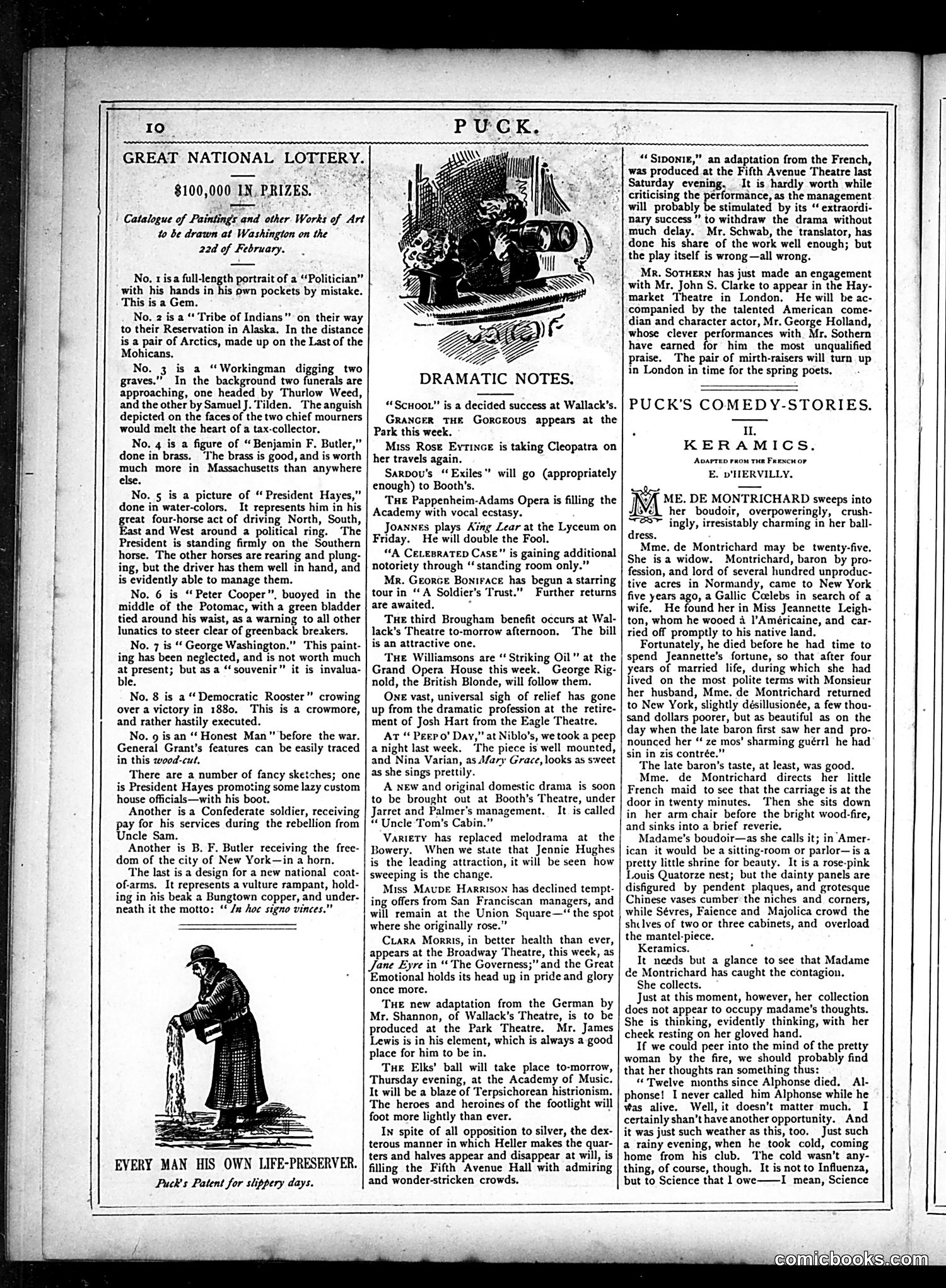
This page contains theatrical reviews and advertisements rather than political cartoons. The main illustrated content shows two figures: 1. **Top illustration**: A dramatic scene depicting what appears to be a theatrical performance or comedic moment with two figures in period dress. 2. **Bottom illustration**: A man in formal attire labeled "EVERY MAN HIS OWN LIFE-PRESERVER" advertising "Puck's Patent for slippery days"—a humorous advertisement, likely for footwear or anti-slip devices, playing on winter weather hazards. The page primarily features "Dramatic Notes" covering New York theater productions of the period, including shows at various theaters and commentary on actors and performances. This is entertainment journalism rather than political satire.
📄 Transcribed text from this page (OCR, searchable)
Machine-transcribed from the original scan — historical spelling and the odd misread are preserved.
190 GREAT NATIONAL LOTTERY. $100,000 IN, PRIZES. | Catalogue of Paintings and other Works of Art to be drawn at Washington on the 22d of February. No, 1 isa full-length portrait of a “Politician” with his hands in his pwn pockets by mistake. This is a Gem. No. 2 is a “ Tribe of Indians” on their way to their Reservation in Alaska. In the distance is a pair of Arctics, made up on the Last of the Mohicans, No. 3 is a ‘“Workingman digging two graves.” In the background two funerals are approaching, one headed by Thurlow Weed, and the other by Samuel J. Tilden. ‘The anguish depicted on the faces of the two chief mourners would melt the heart of a tax-collector. No. 4 is a figure of “Benjamin F. Butler,” done in brass. The brass is good, and is worth much more in Massachusetts than anywhere else. No. 5 is a picture of “ President Hayes,” done in water-colors. It represents him in his great four-horse act of driving North, South, East and West around a political ring. ‘The President is standing firmly on the Southern horse. The other horses are rearing and plung- ing, but the driver has them well in hand, and is evidently able to manage them. No. 6 is ‘Peter Cooper”, buoyed in the middle of the Potomac, with a green bladder tied around his waist, as a warning to all other lunatics to steer clear of greenback breakers. No. 7 is “ George Washington.” ‘This paint- ing has been neglected, and is not worth much a present; but as a “souvenir” it is invalua- le. No. 8 is a “Democratic Rooster” crowing over a victory in 1880. This is a crowmore, and rather hastily executed. No. 9 is an “‘ Honest Man" before the war. General Grant's features can be easily traced in this wood-cut. There are a number of fancy sketches; one is President Hayes promoting some lazy custom house officials—with his boot. Another is a Confederate soldier, receiving pay for his services during the rebellion from Uncle Sam. Another is B. F. Butler receiving the free- dom of the city of New York—in a horn. The last is a design for a new national coat- of-arms. It represents a vulture rampant, hold- ing in his beak a Bungtown copper, and under- neath it the motto: ‘‘ /x hoe signo vinces.” EVERY MAN HIS OWN LIFE-PRESERVER. Puck’s Patent for slippery days. DRAMATIC NOTES, “‘Scuoot” is a decided success at Wallack’s. GRANGER THE GoRGEOUS appears at the Park this week. Miss Rose Evrince is taking Cleopatra on her travels again. Sarvou's “Exiles” will go (appropriately enough) to Booth's. ‘Tue Pappenheim-Adams Opera is filling the Academy with vocal ecstasy. Joannes plays Aing Lear at the Lyceum on Friday. He will double the Fool. “A CeLesrateD Case" is gaining additional notoriety through “ standing room only.” Mr. GeorGe Bonirace has begun a starring tour in ‘A Soldier's Trust.” Further returns are awaited. . Tue third Brougham benefit occurs at Wal- lack’s Theatre to-morrow afternoon, The bill is an attractive one. Tue Williamsons are ‘Striking Oil” at the Grand Opera House this week. George Rig- nold, the British Blonde, will follow them. One vast, universal sigh of relief has gone up from the dramatic profession at the retire- ment of Josh Hart from the Eagle Theatre. At “ Peepo' Day,” at Niblo’s, we took a peep a night last week. ‘he piece is well mounted, and Nina Varian, as Mary Grace, looks as sweet as she sings prettily. A new and original domestic drama is soon to be brought out at Booth’s Theatre, under Jarret and Palmer's management. It is called “ Uncle Tom’s Cabin.” Variety has replaced melodrama at the Bowery. When we state that Jennie Hughes is the leading attraction, it will be seen how sweeping is the change. Miss Mauve Harrison has declined tempt- ing offers from San Franciscan managers, and will remain at the Union Square—‘ the spot where she originally rose.”” Ciara Morais, in better health than ever, appears at the Broadway Theatre, this week, as Jane Eyre in “The Governess;” and the Great ‘Emotional holds its head up in pride and glory once more. ‘THe new adaptation from the German by Mr. Shannon, of Wallack’s Theatre, is to be produced at the Park Theatre. Mr. James Lewis is in his element, which is always a good place for him to be in. Tue Elks’ ball will take place to-morrow, ‘Thursday evening, at the Academy of Music. It will be a blaze of Terpsichorean histrionism. The heroes and heroines of the footlight will foot more lightly than ever. In spite of all opposition to silver, the dex- terous manner in which Heller makes the quar- ters and halves appear and disappear at will, is filling the Fifth Avenue Hall with admiring and wonder-stricken crowds. “* Siponie,” an adaptation from the French, was produced at the Fifth Avenue Theatre last Saturday evening, It is hardly worth while ;| criticising the Petioemaecer ss the management will probably be stimulated by its ‘ extraordi- nary success” to withdraw the drama without much delay. Mr. Schwab, the translator, has done his share of the work well enough; but the play itself is wrong —all wrong. Mr. SoTHERN has just made an engagement with Mr. John S. Clarke to appear in the Hay- market Theatre in London. He will be ac- companied by the talented American come- dian and character actor, Mr. George Holland, whose clever performances with. Mr. Sothern have earned for him the most unqualified praise. The pair of mirth-raisers will turn up in London in time for the spring poets, PUCK’S COMEDY-STORIES. . Il. KERAMICS. Avarren rrom rier Frexcn or E. p'HERVILLY. M ME. DE MONTRICHARD sweeps into [Wel her boudoir, overpoweringly, crush- “S5™ ingly, irresistably charming in her ball- ress. Mme. de Montrichard may be twenty-five. She is a widow. Montrichard, baron by pro- fession, and lord of several hundred unproduc- tive acres in Normandy, came to New York five years ago, a Gallic Corlebs in search of a wife. He found her in Miss Jeannette Leigh- ton, whom he wooed a 1l’Américaine, and car- ried off promptly to his native land. Fortunately, he died before he had time to spend Jeannette’s fortune, so that after four years of married life, during which she had lived on the most polite terms with Monsieur her husband, Mme. de Montrichard returned to New York, slightly désillusionée, a few thou- sand dollars poorer, but as beautiful as on the day when the late baron first saw her and pro- nounced her “ ze mos’ sharming guérrl he had sin in zis contrée.” ‘The late baron’s taste, at least, was good. Mme. de Montrichard directs her little French maid to see that the carriage is at the door in twenty minutes. Then she sits down in her armchair before the bright wood-fire, and sinks into a brief reverie, : Madame’s boudoir—as she calls it; in‘Amer- ican it would be a sitting-room or parlor—is a pretty little shrine for beauty. It is a rose-pink Louis Quatorze nest; but the dainty panels are disfigured by pendent plaques, and grotesque Chinese vases cumber the niches and corners, while Sévres, Faience and Majolica crowd the shelves of two or three cabinets, and overload the mantel-piece. Keramics. It needs but a glance to see that Madame de Montrichard has caught the contagion. She collects. Just at this moment, however, her collection does not appear to occupy madame’s thoughts. She is thinking, evidently thinking, with her cheek resting on her gloved hand. If we could peer into the mind of the pretty woman by the fire, we should probably find that her thoughts ran something thus: “Twelve months since Alphonse died. Al- phonse! I never called him Alphonse while he was alive. Well, it doesn’t matter much. I certainly shan’t have another opportunity. And it was just such weather as this, too. Just such a rainy evening, when he took cold, coming home from his club. The cold wasn’t any- thing, of course, though. It is not to Influenza, but to Science that 1 owe——I mean, Science