
Puck, 1878-02-13 · page 12 of 16
Puck — February 13, 1878 — page 12: what you’re looking at
What you’re looking at
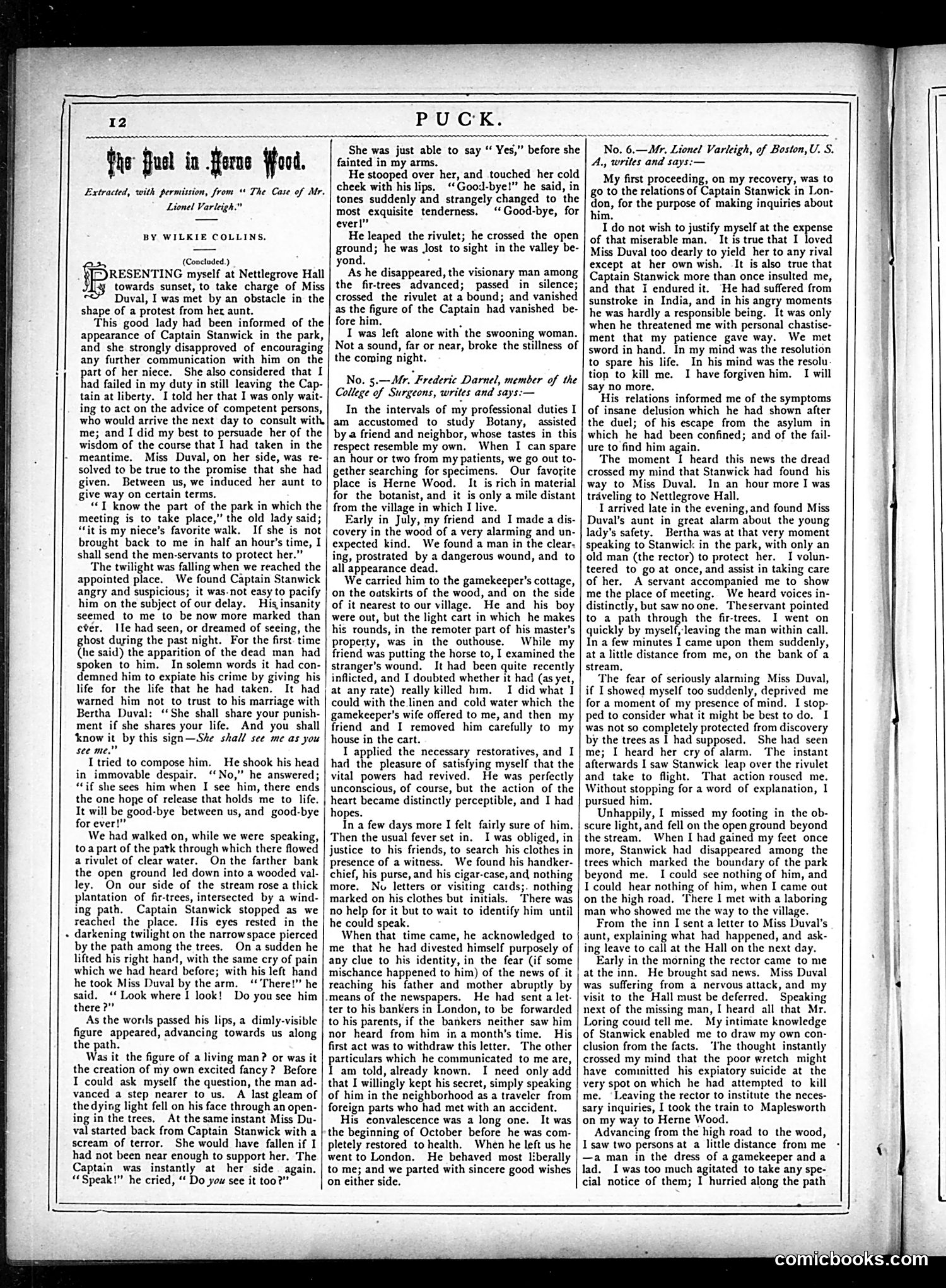
This page contains a serialized story titled "The Duel in Herne Wood," attributed to Wilkie Collins, with the byline "(Concluded.)" The narrative appears to be a Victorian-era romance/mystery tale involving characters named Miss Duval, Captain Stanwick, and various other figures engaged in dramatic personal conflicts. The page is entirely text-based—there are no visible cartoons or satirical illustrations. It functions as a literary installment rather than political satire. The content focuses on romantic entanglement, honor, dueling, and character revelations typical of 19th-century serialized fiction. Without visible cartoon imagery or clear political/social commentary, this page serves as *Puck*'s literary content rather than its signature satirical commentary.
📄 Transcribed text from this page (OCR, searchable)
Machine-transcribed from the original scan — historical spelling and the odd misread are preserved.
12 PUCK. Phe fuel in fore ffi Extracted, with permission, from “ The Case of Mr. Lionel Varleigh.” BY WILKIE COLLINS, (Concluded) RESENTING myself at Nettlegrove Hall y towards sunset, to take charge of Miss Duval, I was met by an obstacle in the shape of a protest from her aunt. This good lady had been informed of the appearance of Captain Stanwick in the park, and she strongly disapproved of encouraging any further communication with him on the art of her niece. She also considered that I ad failed in my duty in still leaving the Cap- tain at liberty. I told her that I was only wait- ing to act on the advice of competent persons, who would arrive the next day to consult with, me; and I did my best to persuade her of the wisdom of the course that I had taken in the meantime. Miss Duval, on her side, was re- solved to be true to the promise that she had given. Between us, we induced her aunt to give way on certain terms. “IT know the part of the park in which the meeting is to take place,” the old lady said; “it is my niece’s favorite walk. If she is not brought back to me in half an hour's time, I shall send the men-servants to protect her.”” ‘The twilight was falling when we reached the appointed place. We found Captain Stanwick angry and suspicious; it was-not easy to pacify him ‘on the subject of our delay. Hig insanity seemed to me to be now more marked than ever. Ie had seen, or dreamed of seeing, the ghost duying the past night. For the first time (he said) the apparition of the dead man had spoken to him. In solemn words it had con- demned him to expiate his crime by giving his life for the life that he had taken. It had warned him not to trust to his marriage with Bertha Duval: “She shall share your punish- ment if she shares your life. And you shall know it by this sign—She shall see me as you see me.” I tried to compose him. He shook his head in immovable despair. “No,” he answered; “if she sees him when I see him, there ends the one hope of release that holds me to life. It will be good-bye between us, and good-bye for ever!” We had walked on, while we were speaking, toa part of the patk through which there flowed a rivulet of clear water. On the farther bank the open ground led down into a wooded val- ley. On our side of the stream rose a thick plantation of fir-trees, intersected by a wind- ing path. Captain Stanwick stopped as we reached the place. His eyes rested in the darkening twilight on the narrow space pierced by the path among the trees. On a sudden he lifted his right hand, with the same cry of pain which we had heard before; with his left hand he took Miss Duval by the arm. “There!” he said. ‘‘ Look where I look! Do you see him there?” As the words passed his lips, a dimly-visible figure appeared, advancing towards us along the path, Was it the figure of a living man? or was it the creation of my own excited fancy ? Before I could ask myself the question, the man ad- vanced a step nearer to us. A last gleam of thedying light fell on his face through an open- ing in the trees. At the same instant Miss Du- val started back from Captain Stanwick with a scream of terror. She would have fallen if I had not been near enough to support her. The Captain was instantly at her side again. -means of the newspapers. She was just able to say “‘ Yes,” before she fainted in my arms. He stooped over her, and touched her cold cheek with his lips. ‘‘ Good-bye!” he said, in tones suddenly and strangely changed to the most exquisite tenderness. ‘‘ Good-bye, for ever!” He leaped the rivulet; he crossed the open ground; he was lost to sight in the valley be- yond. ° As he disappeared, the visionary man among the fir-trees advanced; passed in silence; crossed the rivulet at a bound; and vanished as the figure of the Captain had vanished be- fore him. 2 I was left alone with the swooning woman. Not a sound, far or near, broke the stillness of the coming night. No. 5.—A©r. Frederic Darnel, member of the College of Surgeons, writes and says:— In the intervals of my professional duties I am accustomed to study Botany, assisted by a friend and neighbor, whose tastes in this respect resemble my own. When I can spare an hour or two from my patients, we go out to- gether searching for specimens. Our favorite place is Herne Wood. It is rich in material for the botanist, and it is only a mile distant from the village in which I live. Early in July, my friend and I made a dis- covery in the wood of a very alarming and un- expected kind. We found a man in the clear. ing, prostrated by a dangerous wound, and to all appearance dead. We carried him to the gamekeeper’s cottage, on the oatskirts of the wood, and on the side of it nearest to our village. He and his boy were out, but the light cart in which he makes his rounds, in the remoter part of his master’s property, was in the outhouse. While my friend was putting the horse to, I examined the stranger’s wound. It had been quite recently inflicted, and I doubted whether it had (as yet, at any rate) really killed him. I did what I could with the.linen and cold water which the gamekeeper’s wife offered to me, and then my friend and I removed him carefully to my house in the cart. I applied the necessary restoratives, and I had the pleasure of satisfying myself that the vital powers had revived. He was perfectly unconscious, of course, but the action of the heart became distinctly perceptible, and I had hopes. In a few days more I felt fairly sure of him. Then the usual fever set in. I was obliged, in justice to his friends, to search his clothes in presence of a witness. We found his handker- chief, his purse, and his cigar-case, and nothing more. Nv letters or visiting catds;. nothing marked on his clothes but initials. ‘There was no help for it but to wait to identify him until he could speak. When that time came, he acknowledged to me that he had divested himself purposely of any clue to his identity, in the fear (if some mischance happened to him) of the news of it reaching his father and mother abruptly by He had sent a let- ter to his bankers in London, to be forwarded to his parents, if the bankers neither saw him nor heard from him ina month's time. His first act was to withdraw this letter. The other particulars which he communicated to me are, I am told, already known. I need only add that I willingly kept his secret, simply speaking of him in the neighborhood as a traveler from foreign parts who had met with an accident. His convalescence was a long one. It was the beginning of October before he was com- pletely restored to health. When he left us he went to London. He behaved most liberally to me; and we parted with sincere good wishes “Speak!” he cried, “ Do you see it too?” on either side. No. 6.—AMr. Lionel Varleigh, of Boston, U. S. A, writes and says:— My first proceeding, on my recovery, was to go to the relations of Captain Stanwick in Lon- don, for the purpose of making inquiries about him, 1 do not wish to justify myself at the expense of that miserable man. It is true that I loved Miss Duval too dearly to yield her to any rival except at her own wish. It is also true that Captain Stanwick more than once insulted me, and that I endured it. ‘He had suffered from sunstroke in India, and in his angry moments he was hardly a responsible being. It was only when he threatened me with personal chastise- ment that my patience gave way. We met sword in hand. In my mind was the resolution to spare his life. In his mind was the resolu tion to kill me. I have forgiven him. I will say no more. His relations informed me of the symptoms of insane delusion which he had shown after the duel; of his escape from the asylum in which he had been confined; and of the fail- ure to find him again. The moment I heard this news the dread crossed my mind that Stanwick had found his way to Miss Duval. In an hour more I was traveling to Nettlegrove Hall. I arrived late in the evening, and found Miss Duval’s aunt in great alarm about the young lady's safety. Bertha was at that very moment speaking to Stanwick in the park, with only an old man (the rector) to protect her. I volun- teered to go at once, and assist in taking care of her. A servant accompanied me to show me the place of meeting. We heard voices in- distinctly, but sawnoone. Theservant pointed to a path through the fir-trees. I went on quickly by myself, leaving the man within call. In a few minutes I came upon them suddenly, at a little distance from me, on the bank of a stream, The fear of seriously alarming Miss Duval, if I showed myself too suddenly, deprived me for a moment of my presence of mind. I stop- ped to consider what it might be best todo. I was not so completely protected from discovery by the trees as I had supposed. She had seen me; I heard her cry of alarm. The instant afterwards I saw Stanwick leap over the rivulet and take to flight. That action roused me. Without stopping for a word of explanation, 1 pursued him. Unhappily, I missed my footing in the ob- scure light, and fell on the open ground beyond the stream. When I had gained my feet once more, Stanwick had disappeared among the trees which marked the boundary of the park beyond me. I could see nothing of him, and I could hear nothing of him, when I came out on the high road. There I met with a laboring man who showed me the way to the village. From the inn I sent a letter to Miss Duval's aunt, explaining what had happened, and ask- ing leave to call at the Hall on the next day. Early in the morning the rector came to me at the inn. He brought sad news. Miss Duval was suffering from a nervous attack, and my visit to the Hall must be deferred. Speaking next of the missing man, I heard all that Mr. Loring coutd tell me. My intimate knowledge of Stanwick enabled me to draw my own con- clusion from the facts. ‘I'he thought instantly crossed my mind that the poor wretch might have committed his expiatory suicide at the very spot on which he had attempted to kill me. ‘Leaving the rector to institute the neces- sary inquiries, I took the train to Maplesworth ‘on my way to Herne Wood. Advancing from the high road to the wood, I saw two persons at a little distance from me —a man in the dress of a pamekeeper anda lad. I was too much agitated to take any spe- cial notice of them; I hurried along the path