
Puck, 1878-02-13 · page 7 of 16
Puck — February 13, 1878 — page 7: what you’re looking at
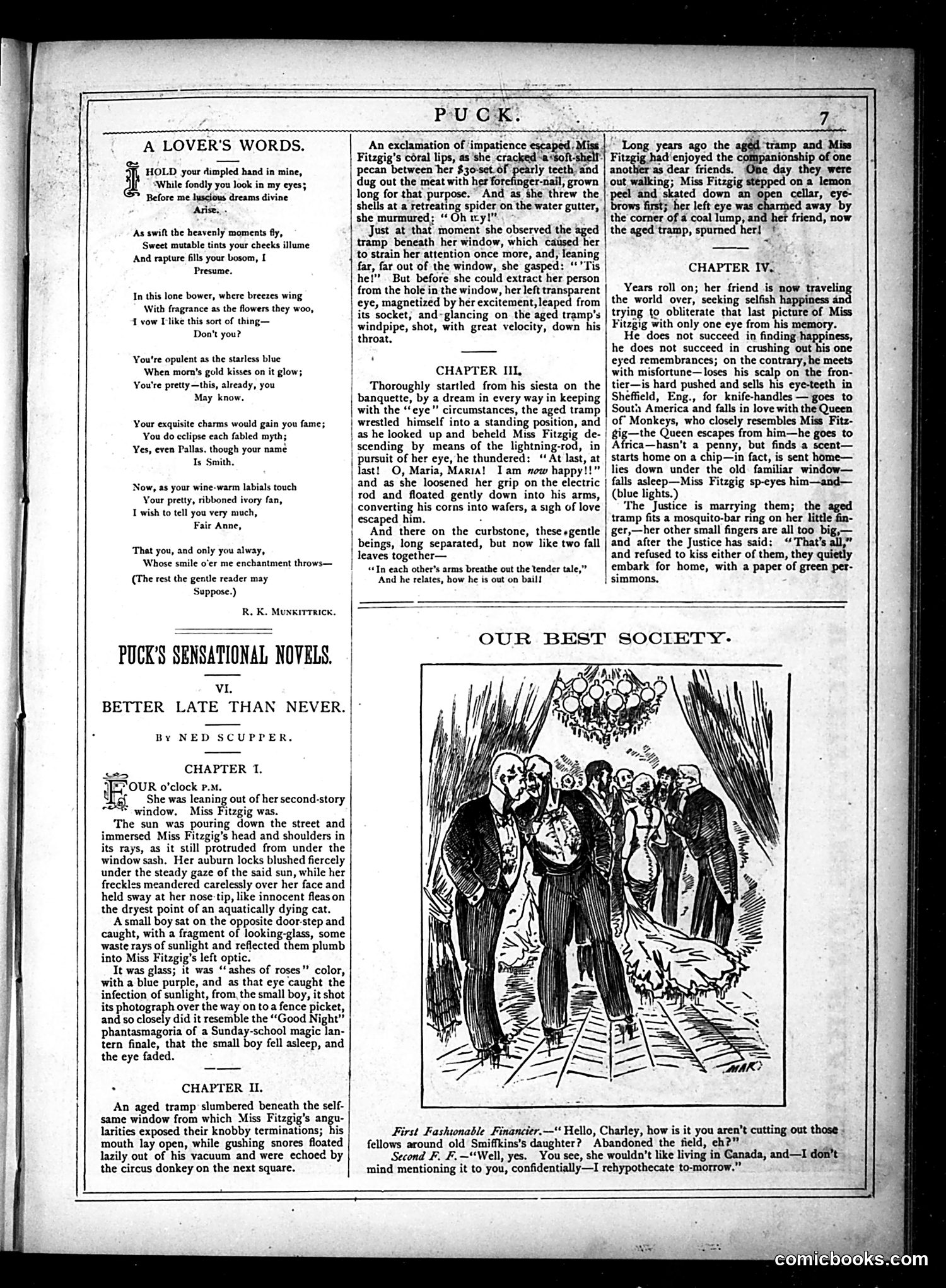
What you’re looking at
This cartoon satirizes upper-class social hypocrisy and pretension. The illustration shows well-dressed figures in an elegant interior (note the chandelier and curtains), but the caption reveals their true nature through dialogue between "First Fashionable Financier" and "Second F.F." The joke hinges on abandoned morality: the first character questions why the second isn't "cutting out those fellows around old Smithkins's daughter," implying seduction or exploitation. The response—claiming he wouldn't risk "living in Canada"—suggests he abandoned such schemes due to legal consequences, not principle. The satire targets wealthy society's facade of respectability masking opportunism, greed, and willingness to exploit others when consequences seem distant. The cartoon mocks both the characters' amorality and their transparent self-interest.
📄 Transcribed text from this page (OCR, searchable)
Machine-transcribed from the original scan — historical spelling and the odd misread are preserved.
PUCK. A LOVER'S WORDS. HOLD your dimpled hand in mine, “While fondly you look in my eyes; Before me luscious dreams divine Arise... d ‘As swift the heavenly moments fly, Sweet mutable tints your cheeks illume And rapture Gills your bosom, [ Presume. In this lone bower, where breezes wing With fragrance as the flowers they woo, I vow Tike this sort of thing— Don't you? You're opulent as the starless blue ‘When morn's gold kisses on it glow; You're pretty—this, already, you May know. Your exquisite charms would gain you fame; You do eclipse each fabled myth; Yes, even Pallas. though your name Is Smith. Now, as your wine-warm labials touch Your pretty, ribboned ivory fan, I wish to tell you very much, Fair Anne, That you, and only you alway, Whose smile o'er me enchantment throws— (The rest the gentle reader may Suppose.) R, K. Munxrrtrick. PUCK’S SENSATIONAL NOVELS. BETTER anes aes NEVER. By NED SCUPPER. CHAPTER 1. fi SOUR o'clock P.at. I She was leaning out of her second-story window. Miss Fitzgig was. ‘The sun was pouring down the street and immersed Miss Fitzgig’s head and shoulders in its rays, as it still protruded from under the window sash. Her auburn locks blushed fiercely under the steady gaze of the said sun, while her freckles meandered carelessly over her face and held sway at her nose-tip, like innocent fleas on the dryest point of an aquatically dying cat. Asmall boy sat on the opposite door-step and caught, with a fragment of looking-glass, some waste rays of sunlight and reflected them plumb into Miss Fitzgig’s left optic. It was glass; it was ‘ashes of roses” color, with a blue purple, and as that eye caught the infection of sunlight, from, the small boy, it shot its photograph over the way on toa fence picket, and so closely did it resemble the “Good Night” phantasmagoria of a Sunday-school magic lan- tern finale, that the small boy fell asleep, and the eye faded. CHAPTER Il. An aged tramp slumbered beneath the self- same window from which Miss Fitzgig’s angu- larities exposed their knobby terminations; his mouth lay open, while gushing snores floated lazily out of his vacuum and were echoed by Se Fitzgig’s coral lips, as ‘she cracked -a‘soft-shel!’ pecan between her $30°set.of" ly teeth. and dug out the meat with her fo: er-nail, grown. long for that purpose.” And as she threw the shells at a retreating spider on the water gutter, she murmured; ‘Oh try!" Just at that moment she observed the aged tramp beneath her window, which caused her to strain her attention once more, and, leaning far, far out of the window, she gasped: “’Tis he!” But before she could extract her person from the hole in the window, her left transparent | eye, magnetized by her excitement, leaped from | its socket, and-glancing on the aged tramp’s | windpipe, shot, with great velocity, down his throat. | CHAPTER IIL, | Thoroughly startled from his siesta on the banquette, by a dream in every way in keeping with the “eye” circumstances, the aged tramp | wrestled himself into a standing position, and | as he looked up and beheld Miss Fitzgig de- | pursuit of her eye, he thundered: “At last, at j last! O, Maria, Maria! Iam now happy!” and as she loosened her grip on the electric rod and floated gently down into his arms, converting his corns into wafers, a sigh of love escaped him. : And there on the curbstone, these «gentle beings, long separated, but now like two fall | leaves together— “«In each other's arms breathe out the tender tale,” | ‘And he relates, how he is out on bail An exclamation of ‘impatience escaped, Miss |. scending by means of the lightning-rod, in | Long years ago the ‘tramp and Miss Fitzgig had‘enjoyed the jionship of one anor dear friends. One day they were out walking; Miss Fitzgig stepped on a lemon peel and skated down an open cellar, eye- brows first; her left eye was charmed away by the corner of 4 coal lump, and her friend, now the aged'tramp, spurned her]? CHAPTER Iv, Years roll on; her friend is now travelin; the world over, seeking selfish happiness trying to obliterate that last picture of Miss Fitzgig with only one eye from his memory. He does not succeed in finding happiness, he does not succeed in crushing out his one eyed remembrances; on the contrary, he meets with misfortune—loses his scalp on the fron- tier—is hard pushed and sells his eye-teeth in Sheffield, Eng., for knife-handles — goes to Sout America and falls in love with the Queen of Monkeys, who closely resembles Miss Fitz- Big the Queen escapes from him—he goes to Africa—hasn’t a penny, but finds a scent— starts home on a chip—in fact, is sent home— lies down under the old familiar window— falls asleep—Miss Fitzgig sp-eyes him—and— (blue lights.) ‘The Justice is marrying them; the aged tramp fits a mosquito-bar ring on her little fin- ger,—her other small fingers are all too big,— and after the Justice has said: “That's all,” and refused to kiss either of them, they quietly embark for home, with a paper of green per- | simmons, the circus donkey on the next square. First Fashionable Financier.—‘ Hello, Charley, how is it you aren’t cutting out those « fellows around old Smiffkins’s daughter? Abandoned the field, ch?” - Second F. F.—“Well, yes. You see, she wouldn’t like living in Ganada, and—I don’t mind mentioning it to you, confidentially—I rehypothecate to-morrow.”