
Puck, 1878-02-13 · page 11 of 16
Puck — February 13, 1878 — page 11: what you’re looking at
What you’re looking at
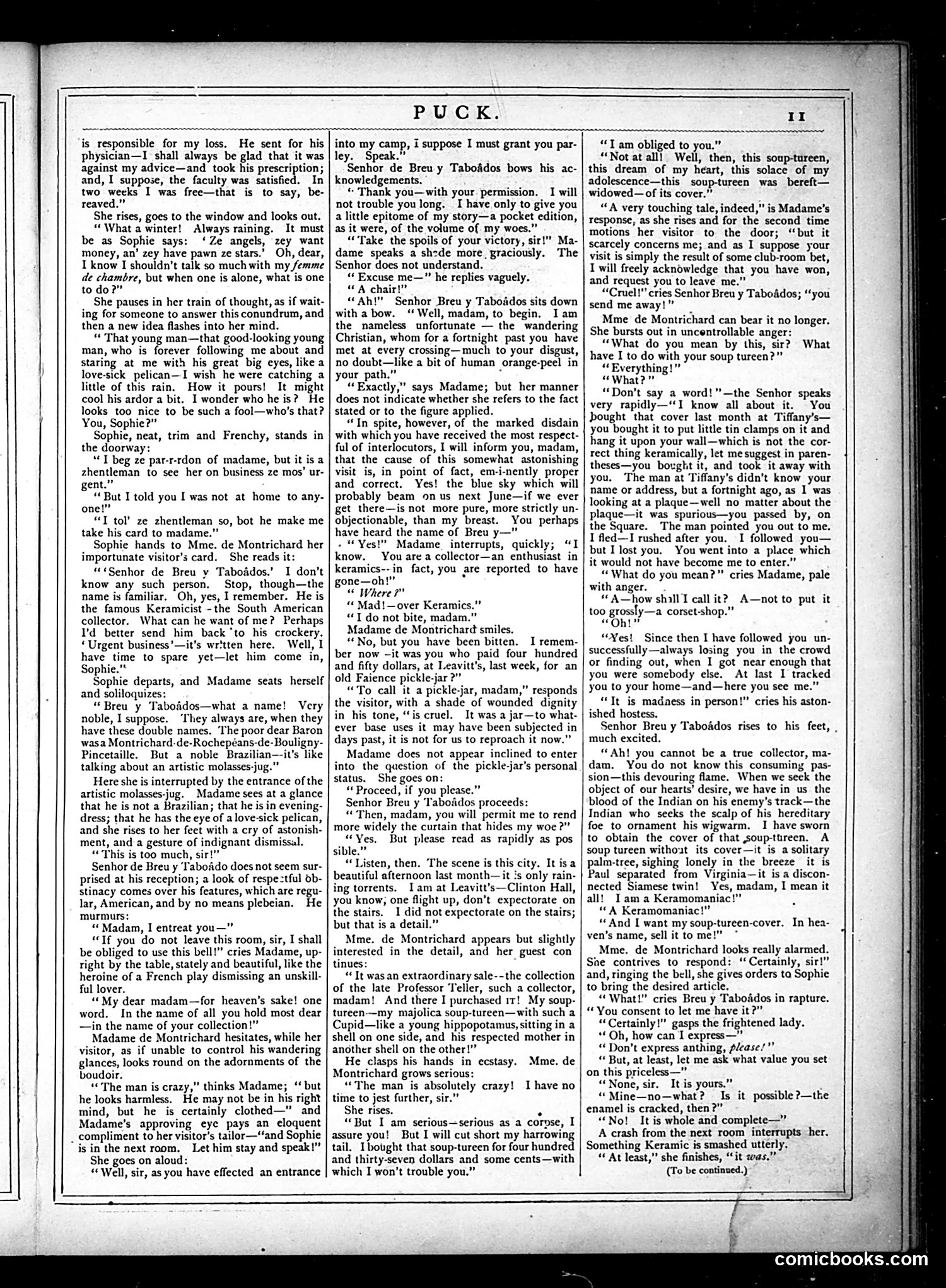
This page contains dialogue from what appears to be a serialized satirical story rather than a political cartoon. The text discusses a character named "Señor Breu y Tabóddos" and involves plot elements about a wandering Christian, a collection of ceramics, a soup tureen, and various interpersonal conflicts over money and social obligations. Without seeing the accompanying illustration clearly, I cannot identify the specific figures or determine what political or social satire is intended. The references to collectors, French characters, and financial disputes suggest social commentary on wealthy American collectors and European art dealings of the period, but the specific targets and point of the satire remain unclear from the text alone. The page appears primarily text-based rather than cartoon-focused.
📄 Transcribed text from this page (OCR, searchable)
Machine-transcribed from the original scan — historical spelling and the odd misread are preserved.
PUCK. is responsible for my loss. He sent for his physician—I shall always be glad that it was against my advice—and took his prescription; and, I suppose, the faculty was satisfied. In two weeks I was free—that is to say, be- reaved.” She rises, goes to the window and looks out. “What a winter! Always raining. It must be as Sophie says: ‘Ze angels, zey want money, an’ zey have pawn ze stars.’ Oh, dear, I know I shouldn’t talk so much with my femme de chambre, but when one is alone, what is one to do?” She pauses in her train of thought, as if wait- ing for someone to answer this conundrum, and then a new idea flashes into her mind. “ That young man—that good-looking young man, who is forever following me about and staring at me with his great big eyes, like a love-sick pelican—I wish he were catching a little of this rain. How it pours! It might cool his ardor a bit. I wonder who he is? He looks too nice to be such a fool—who’s that? You, Sophie?” Sophie, neat, trim and Frenchy, stands in the doorway: “T beg ze par-r-rdon of madame, but it is a zhentleman to see her on business ze mos’ ur- gent.” “But I told you I was not at home to any- one!” “TI tol’ ze zhentleman so, bot he make me take his card to madame.” Sophie hands to Mme. de Montrichard her importunate visitor’s card. She reads it: “¢Senhor de Breu y Taboddos.’ I don’t know any such person. Stop, though—the name is familiar. Oh, yes, I remember. He is the famous Keramicist -the South American collector. What can he want of me? Perhaps I'd better send him back ‘to his crockery. ‘ Urgent business’—it’s written here. Well, I have time to spare yet—let him come in, Sophie." Sophie departs, and Madame seats herself and soliloquizes: “Breu y Taboidos—what a name! Very noble, I suppose. ‘They always are, when they have these double names. ‘The poor dear Baron wasa Montrichard-de-Rochepéans-de-Bouligny- Pincetaille. But a noble Brazilian—it's like talking about an artistic molasses-jug.” Here she is interrupted by the entrance ofthe artistic molasses-jug. Madame sees at a glance that he is not a Brazilian; that he is in evening- dress; that he has the eye of a love-sick pelican, and she rises to her fect with a cry of astonish- ment, and:a gesture of indignant dismissal. “This is too much, sir!" Senhor de Breu y Taboado does not seem sur- prised at his reception; a look of respe:tful ob- stinacy comes over his features, which are regu- lar, American, and by no means plebeian. He murmurs: “Madam, I entreat you—' “If you do not leave this room, sir, I shall be obliged to use this bell!” cries Madame, up- right by the table, stately and beautiful, like the heroine of a French play dismissing an unskill- ful lover. “My dear madam—for heaven's sake! one word. In the name of all you hold most dear —in the name of your collection!” Madame de Montrichard hesitates, while her visitor, as if unable to control his wandering glances, looks round on the adornments of the boudoir. “The man is crazy,” thinks Madame; “but he looks harmless. He may not be in his right mind, but he is certainly clothed—" and Madame’s approving eye pays an eloquent _ compliment to her visitor’s tailor—‘‘and Sophie is in the next room. Let him stay and speak!” She goes on aloud: “Well, sir, as you have effected an entrance 2 ® ¢ into my camp, i suppose I must grant you par- ley. a Senhor de Breu y Tabofdos bows his ac- knowledgements. “ Thank you—with your permission. I will not trouble you long. I have only to give you a little epitome of my story—a pocket edition, as it were, of the volume of my woes.” “Take the spoils of your victory, sir!” Ma- dame speaks a shcde more. graciously. The Senhor does not understand. “ Excuse me—” he replies vaguely. “A chair!” “ Ah!" Senhor Breu y Taboddos sits down with a bow. Well, madam, to begin. I am the nameless unfortunate — the wandering Christian, whom for a fortnight past you have met at every crossing—much to your disgust, no doubt—like a bit of human orange-peel in your path,” : “Exactly,” says Madame; but her manner does not indicate whether she refers to the fact stated or to the figure applied. “In spite, however, of the marked disdain with which you have received the most respect- ful of interlocutors, I will inform you, madam, that the cause of this somewhat astonishing visit is, in point of fact, em-i-nently proper and correct. Yes! the blue sky which will probably beam onus next June—if we ever get there—is not more pure, more strictly un- objectionable, than my breast. You perhaps have heard the name of Breu y—” + Yes!” Madame interrupts, quickly; “I know. You area collector—an enthusiast in keramics--in fact, you are reported to have gone—oh!”” . “© Where?” “« Mad!—over Keramics.”” “T do not bite, madam.” Madame de Montrichard smiles. “No, but you have been bitten. I remem- ber now -it'was you who paid four hundred and fifty dollars, at Leavitt's, last week, for an old Faience pickle-jar ?” “To call it a pickle-jar, madam,” responds the visitor, with a shade of wounded dignity in his tone, “is cruel. It was a jar—to what- ever base uses it may have been subjected in days past, it is not for us to reproach it now.” Madame does not appear inclined to enter into the question of the pickle-jar’s personal status. She goes on: “Proceed, if you please.” Senhor Breu y ‘Taboiidos proceeds: “Then, madam, you will permit me to rend more widely the curtain that hides my woe ?” “Yes, But please read as rapidly as pos sible.” “Listen, then. The scene is this city. It isa beautiful afternoon last month— it 's only rain- ing torrents. 1am at Leavitt’s—Clinton Hall, you know, one flight up, don’t expectorate on the stairs. 1 did not expectorate on the stairs; but that is a detail.” Mme. de Montrichard appears but slightly interested in the detail, and her guest con tinues: “It was an extraordinary sale--the collection of the late Professor Teller, such a collector, madam! And there I purchased iT! My soup: tureen—my majolica soup-tureen—with such a Cupid—tike a young hippopotamus, sitting in a shell on one side, and his respected mother in another shell on the other!” He clasps his hands in ecstasy. Mme. de Montrichard grows serious: “The man is absolutely crazy! time to jest further, sir.” She rises. * “But I am serious—serious as a corpse, I assure you! But I will cut short my harrowing tail. Ibought that soup-tureen for four hundr and thirty-seven dollars and some cents—with T have no which I won't trouble you.” “T am obliged to you.” “Not at all! Well, then, this soup-tureen, this dream of my heart, this solace of my adolescence—this soup-tureen was bereft— widowed—of its cover.” “A very touching tale, indeed,” is Madame’s response, as she rises and for the second time motions her visitor to the door; “but it scarcely concerns me; and as I suppose your visit is simply the result of some club-room bet, I will freely acknowledge that you have won, and request you to leave me.” “Cruel!” cries Senhor Breu y Tabodidos; “you send me away!" Mme de Montrichard can bear it no longer. She bursts out in uncentrollable anger: “What do you mean by this, sir? What have I to do with your soup tureen?” “Everything!” “What?” “Don’t say a word!""—the Senhor speaks very rapidly—"I know all about it. You Dought that cover last month at Tiffany’s— you bought it to put little tin clamps on it and hang it upon your wall—which is not the cor- rect thing keramically, let me suggest in paren- theses—you boxght it, and took it away with you, The man at Tiffany's didn't know your name or address, but a fortnight ago, as 1 was looking at a plaque—well no matter about the plaque—it was spurious—you passed by, on the Square. The man pointed you out to me. I fled—I rushed after you. I followed you— but I lost you. You went into a place which it would not have become me to enter.” “What do you mean?” cries Madame, pale with anger. “ A—how shall I call it? A—not to put it too grossly—a corset-shop.” “Oh!” “Nest Since then I have followed you un- successfully—always losing you in the crowd or finding out, when I got near enough that you were somebody else. At last I tracked you to your home—and—here you see me.” “Tt is madaess in person!” cries his aston- ished hostess. Senhor Breu y Tabo&dos rises to his feet, . much excited. “Ah! you cannot be a true collector, ma- dam. You do not know this consuming’ pas- sion—this devouring flame. When we seek the object of our hearts’ desire, we have in us the blood of the Indian on his enemy's track—the Indian who seeks the scalp of his hereditary foe to ornament his wigwarm. I have sworn to obtain the cover of that soup-tureen, A soup tureen without its cover—it is a solitary palm-tree, sighing lonely in the breeze it is Paul separated from Virginia—it is a discon- nected Siamese twin! Yes, madam, I mean it all! Iam a Keramomaniac!” “A Keramomaniac!” “ And I want my soup-tureen-cover. In hea- ven’s name, sell it to me!” * Mme. de Montrichard looks really alarmed. She contrives to respond: ‘Certainly, sir!” and, ringing the bell, she gives orders ta Sophie to bring the desired article. “What!” cries Breu y Taboddos in rapture. “You consent to let me have it?” “Certainly!” gasps the frightened lady. “Oh, how can I express—” «Don’t express anthing, please! “ But, at least, let me ask what value you set on this priceless—” “None, sir. It is yours.” “ Mine—no—what? _ Is it possible ?—the enamel is cracked, then?” “No! It is whole and complete—” A crash from the next room interrupts her. Something Keramic is smashed utterly. “At least,” she finishes, “it was.” (To be continued.)