
A complete issue · 16 pages · 1878
Puck — January 23, 1878
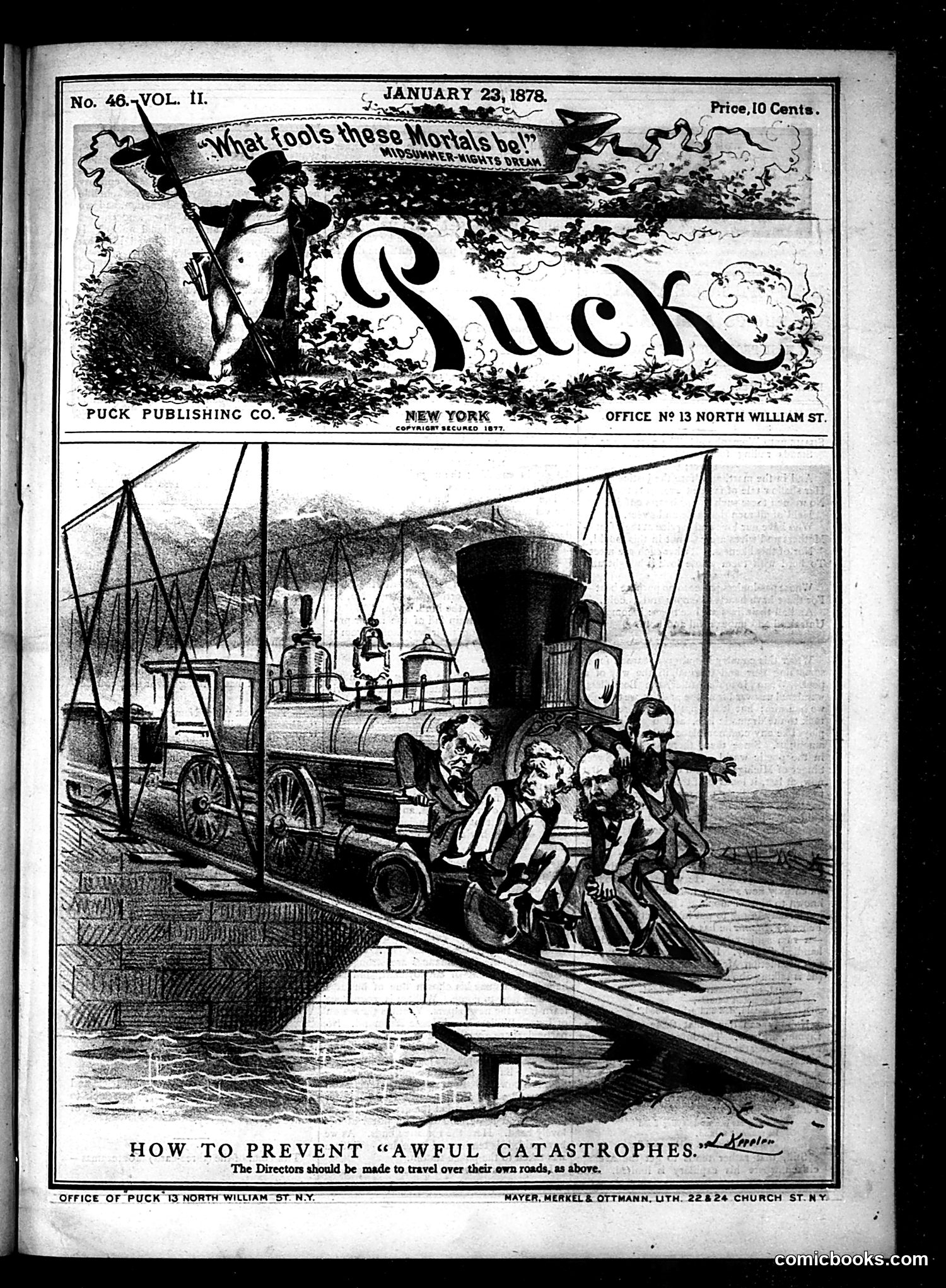
This satirical cartoon criticizes railroad safety practices of the era. The main illustration, titled "How to Prevent 'Awful Catastrophes,'" shows a steamship and locomotive in dangerous proximity near water, with passengers in a small boat appearing to flee or escape. The caption reads: "The Directors should be made to travel over their own roads, as above"—suggesting that railroad company directors ignored safety hazards because they didn't personally experience the risks their passengers faced. This was a common complaint during the railroad boom: wealthy executives profited from dangerous routes and conditions while ordinary travelers bore the consequences of poor maintenance or reckless operation. The satire advocates personal accountability through forced participation in the dangers they created.
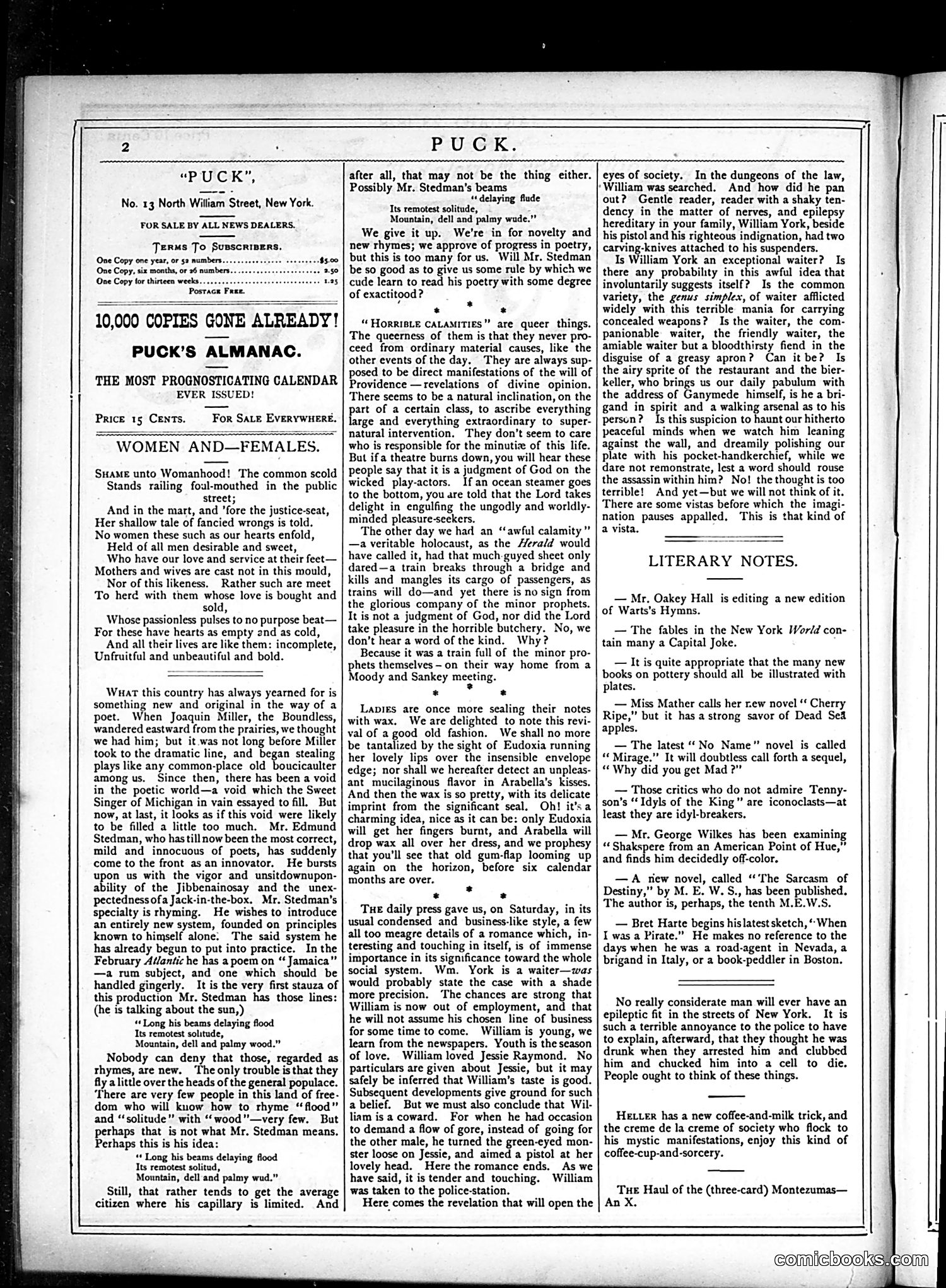
This page is primarily **literary and editorial content** rather than political satire. It contains: **"Women and Females"** — A poem criticizing women who adopt affected mannerisms and pretension, contrasting "real" women with those seeking social status through artifice. **Stedman's Poetry Commentary** — Critical discussion of Will Mr. Stedman's poetry collection, questioning whether his work offers genuine literary merit or merely novelty. **Literary Notes** — Brief book reviews and publishing gossip, including mentions of new novels and American literary criticism. **Minor Satirical Elements** — Light mockery of social pretensions and literary fashions, typical of Puck's cultural commentary. The page lacks prominent political cartoons or caricatures of recognizable public figures. Instead, it targets broad social types and literary trends of the era through written satire.
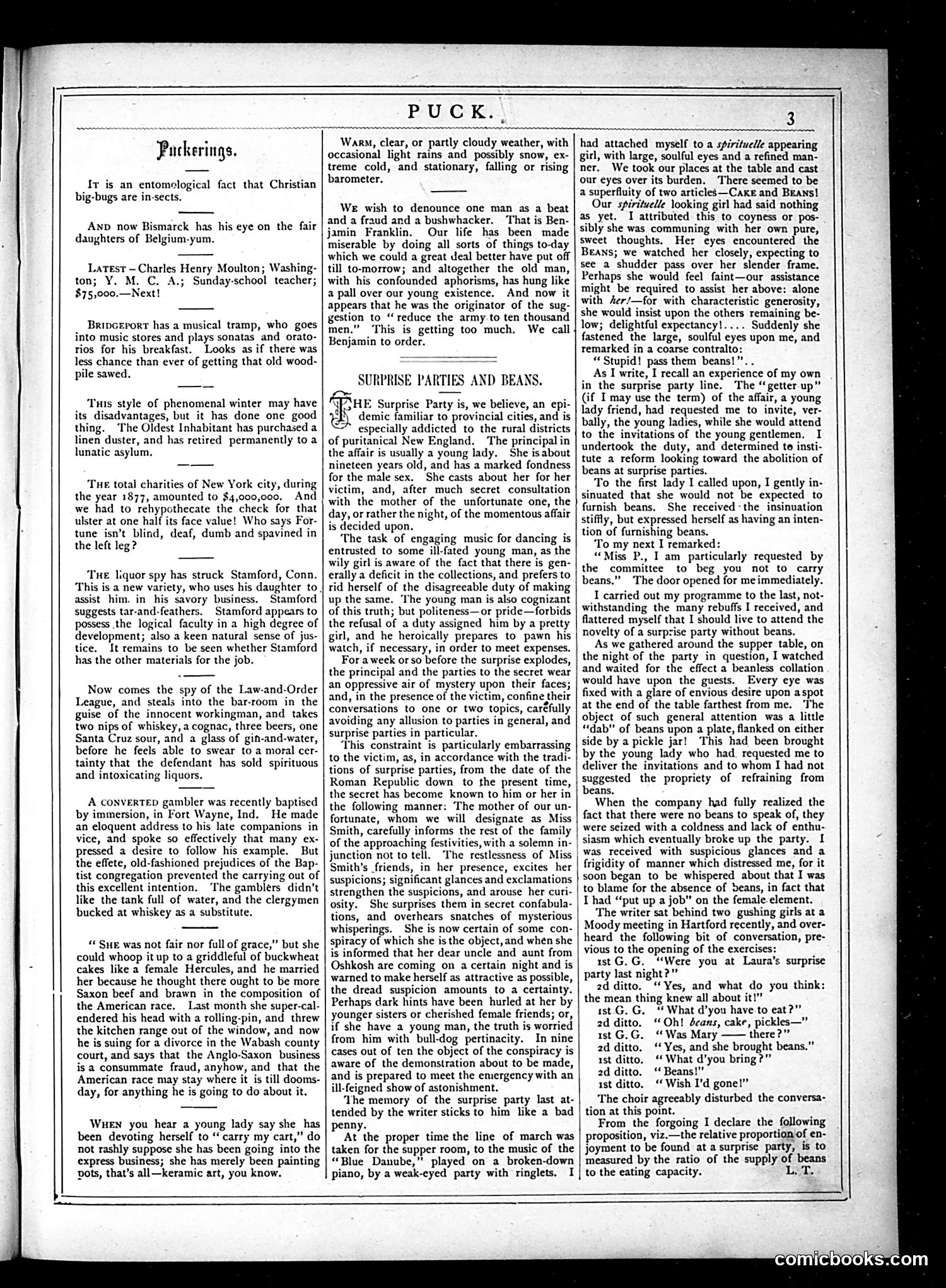
This page contains several satirical short pieces rather than political cartoons. The "Puckerings" section opens with entomological humor about Christian "big-bugs" being insects—likely mocking prominent religious figures. The main content targets **Benjamin Franklin** (referenced as having his "eye on the fair daughters of Belgium"), criticizing his diplomatic compromises and military proposals to reduce army size to ten thousand men—characterized as excessive appeasement. The lengthy "Surprise Parties and Beans" section satirizes the social custom of surprise parties through a humorous anecdote about a young lady hosting one but experiencing embarrassment when the promised beans for supper go missing, leading to comedic misunderstandings among guests about the missing dish. The satire targets both pretentious social conventions and their inevitable comic failures.
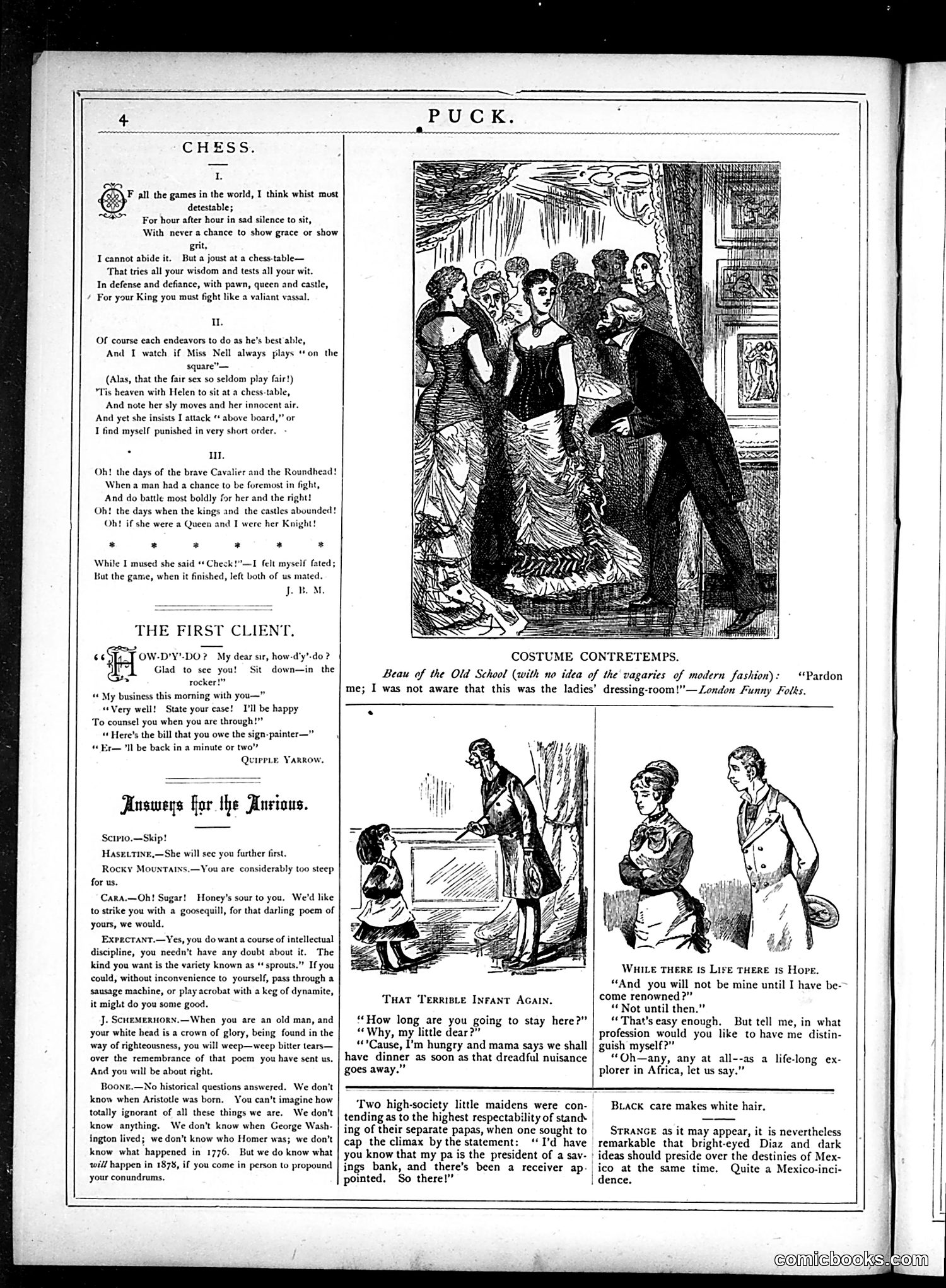
This page contains several satirical pieces rather than a single unified cartoon. "Chess" is a poem mocking social pretense and artifice among the upper classes, using chess metaphors to critique superficial society behavior. "The First Client" appears to be a humorous sketch about a visiting customer. "Costume Contretemps" illustrates a social embarrassment involving ladies' dress—the caption references outdated fashion ("Old School") and includes a joke about confusing ladies' rooms. The lower sections include brief humorous answers to readers' questions and social commentary, including a joke referencing race ("Black care makes white hair") and observations about Mexican life. Overall, the page demonstrates Puck's typical approach: biting social satire targeting Victorian-era pretension, class anxiety, and gender relations through poetry, short sketches, and illustrated vignettes.
This page contains two pieces: a humorous poem about "Brudder Swimble" and an article on "Debts." The poem, written in dialect, satirizes a rural or working-class preacher character who appears comically disheveled and impoverished—arriving at church with an umbrella and carpet-bag, wearing undersized gum-shoes. The humor derives from contrast between his shabby appearance and his moral authority. The "Debts" article (by H.C. Dodge) discusses debt-contracting as a trade, distinguishing between "good" debts (productive investments) and "bad" debts (luxury purchases). It appears to critique both creditors who exploit borrowers and debtors lacking self-discipline, while praising those with integrity in financial dealings. The piece advocates for remembering exact debt amounts and maintaining honorable repayment practices—essentially promoting financial responsibility and moral character.
This page contains two distinct items: **"The Ballad of Wm. Pitts"** — a poem about a tailor named William who played accordion, loved a woman named Emma, and faced hardship when his business failed. This appears to be sentimental fiction rather than political satire. **"Fitznoodle in America" (XLIII)** — a satirical column mocking American political institutions. The cartoonist (shown sitting) criticizes Congress members as drunkards who cause "groans in legislation" and expresses frustration that American government seems dysfunctional and unable to manage basic governance. The piece suggests Congress lacks competence and discipline, using "Jack Carnegie" as an example of broader incompetence among elected officials. The satire targets American democratic governance as ineffective and populated by unsuitable representatives.
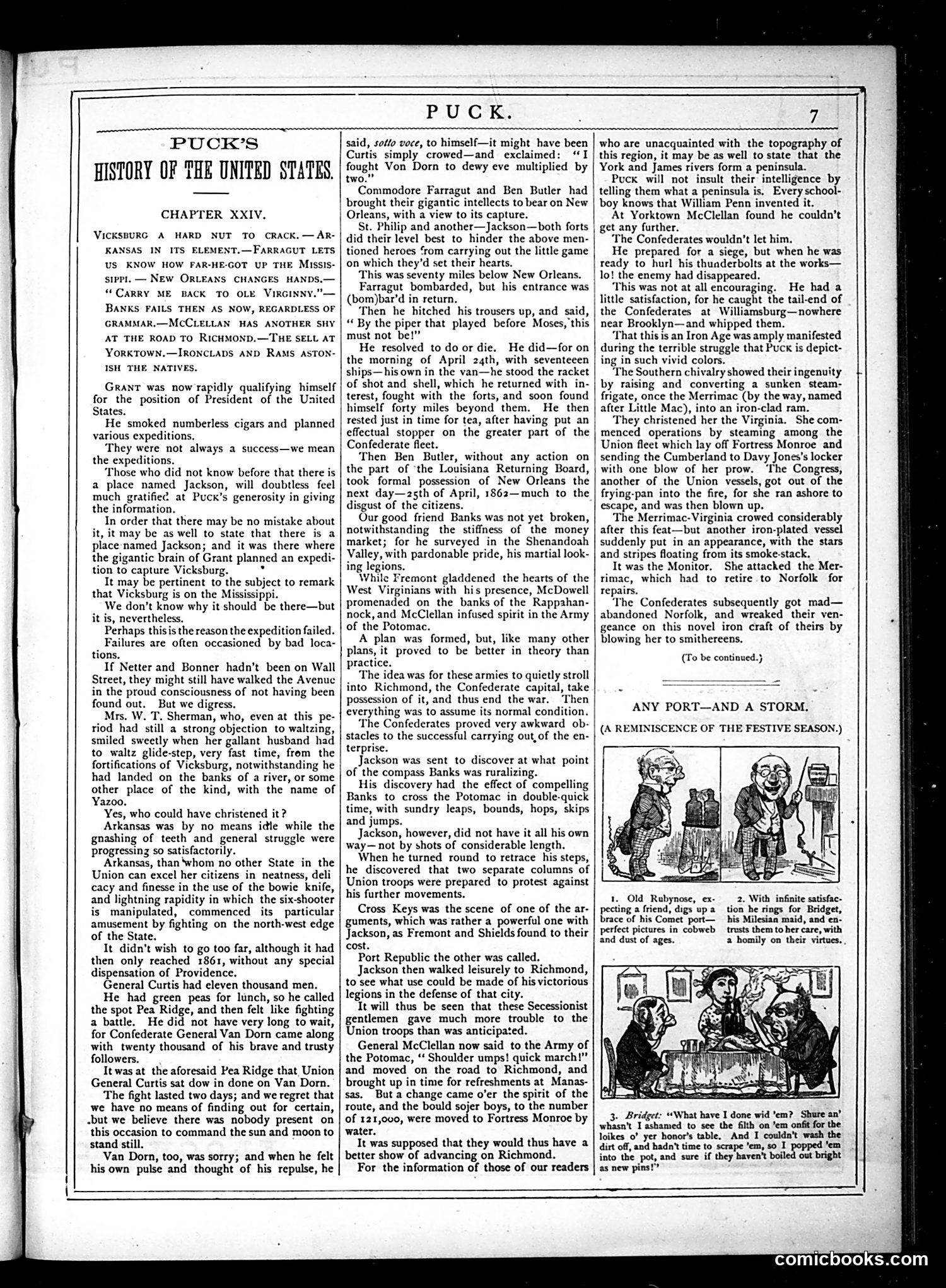
This page contains two distinct elements: **Main Content:** "Puck's History of the United States" - Chapter XXIV discusses Civil War military campaigns, particularly focusing on Vicksburg and New Orleans. The text criticizes Union generals' strategies and praises certain Confederate maneuvers, written from a satirical perspective examining the war's conduct. **Bottom Cartoons:** Two small illustrated vignettes titled "Any Port—and a Storm" (subtitled "A Reminiscence of the Festive Season") appear to depict domestic holiday scenes. The captions reference children and household activities, though the exact satirical point requires clearer visibility of the illustrations. The page primarily functions as historical commentary on Civil War military operations rather than contemporary political satire, mixing serious historical narrative with Puck's characteristic irreverent tone.
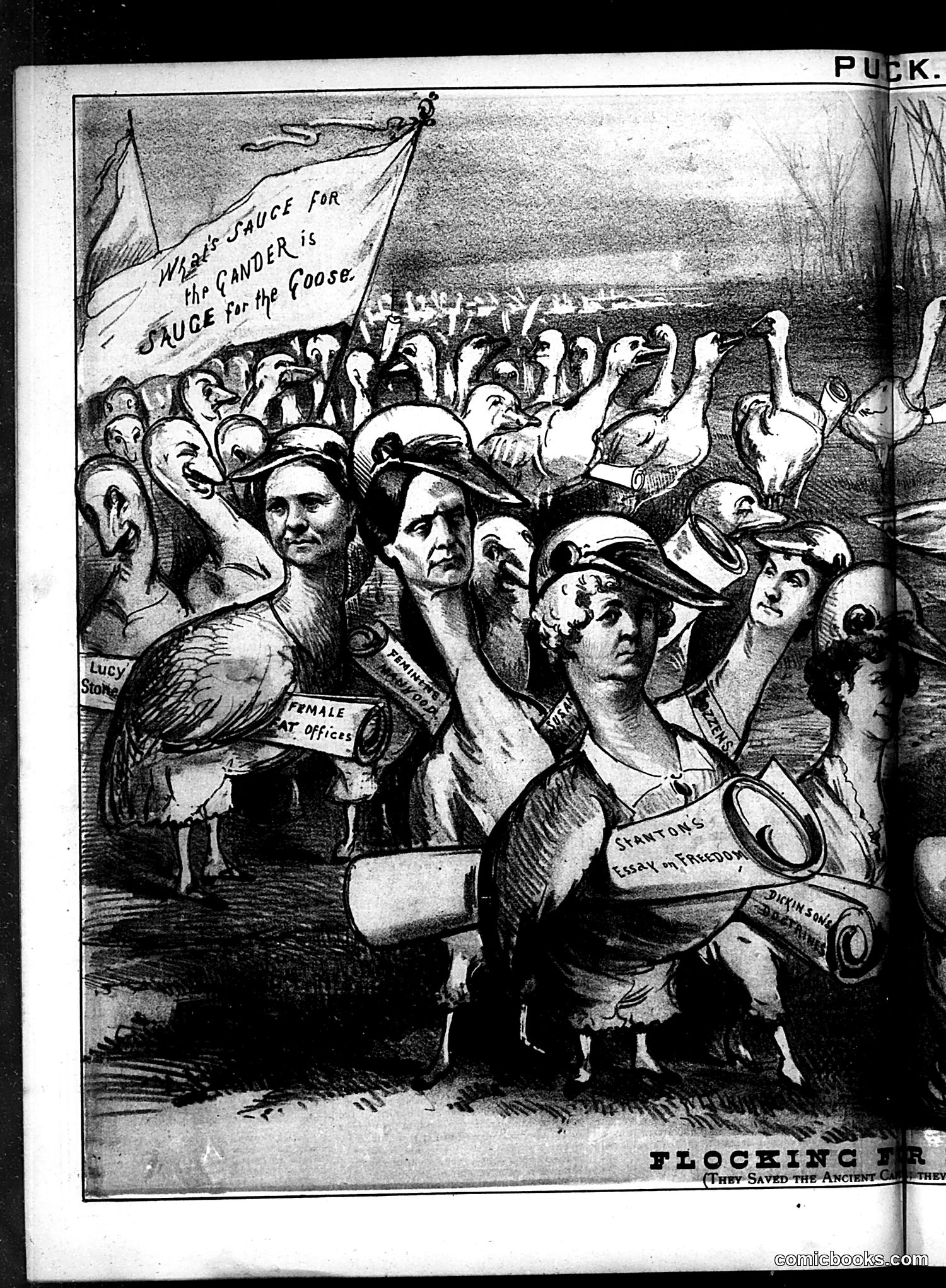
This Puck cartoon satirizes what appears to be a political movement or gathering, showing a crowd of people following geese while holding a banner reading "What's Sauce for the Gander is Sauce for the Goose." The visible labels reference "Female Suffrage," "Lucy Stone" (early suffragist), and various political positions. The geese dominate the composition—a common satirical device suggesting the crowd are mindless followers or "fools." The banner's proverb (meaning equal treatment) likely mocks either women's suffrage advocates or their opponents, depending on Puck's editorial stance. The cartoon appears to criticize political movements as lacking independent thought, with people literally following geese like a flock. The exact historical moment and Puck's position remain somewhat unclear without dating information.
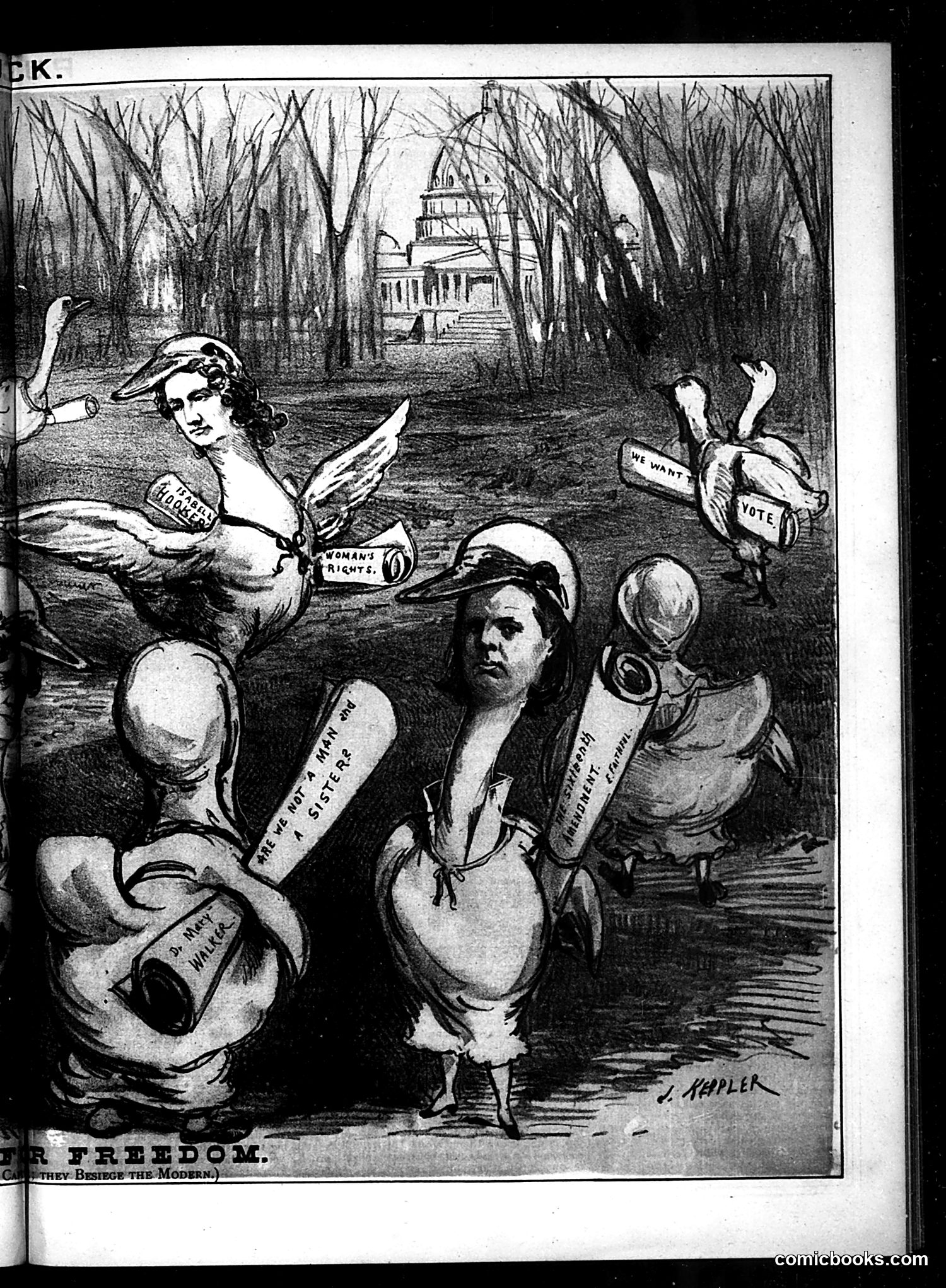
This satirical cartoon depicts female figures representing women's suffrage activism. The central nude or semi-nude women carry banners reading "WOMEN'S RIGHTS," "WE WANT THE VOTE," and "WE DON'T MEAN SISTERLY" — the latter appears to mock suffragists' moral arguments. The Capitol building visible in the background suggests this addresses American politics. The cartoonist (signed "Keppler") uses exaggeration and sexual imagery to ridicule women's voting rights advocates, a common anti-suffrage tactic in early 20th-century Puck magazine. The title "CRY FREEDOM" appears ironic — the cartoon suggests women's demands for political equality are absurd or indecent rather than legitimate civil rights claims. This reflects opposition prevalent before women's suffrage was granted in 1920.
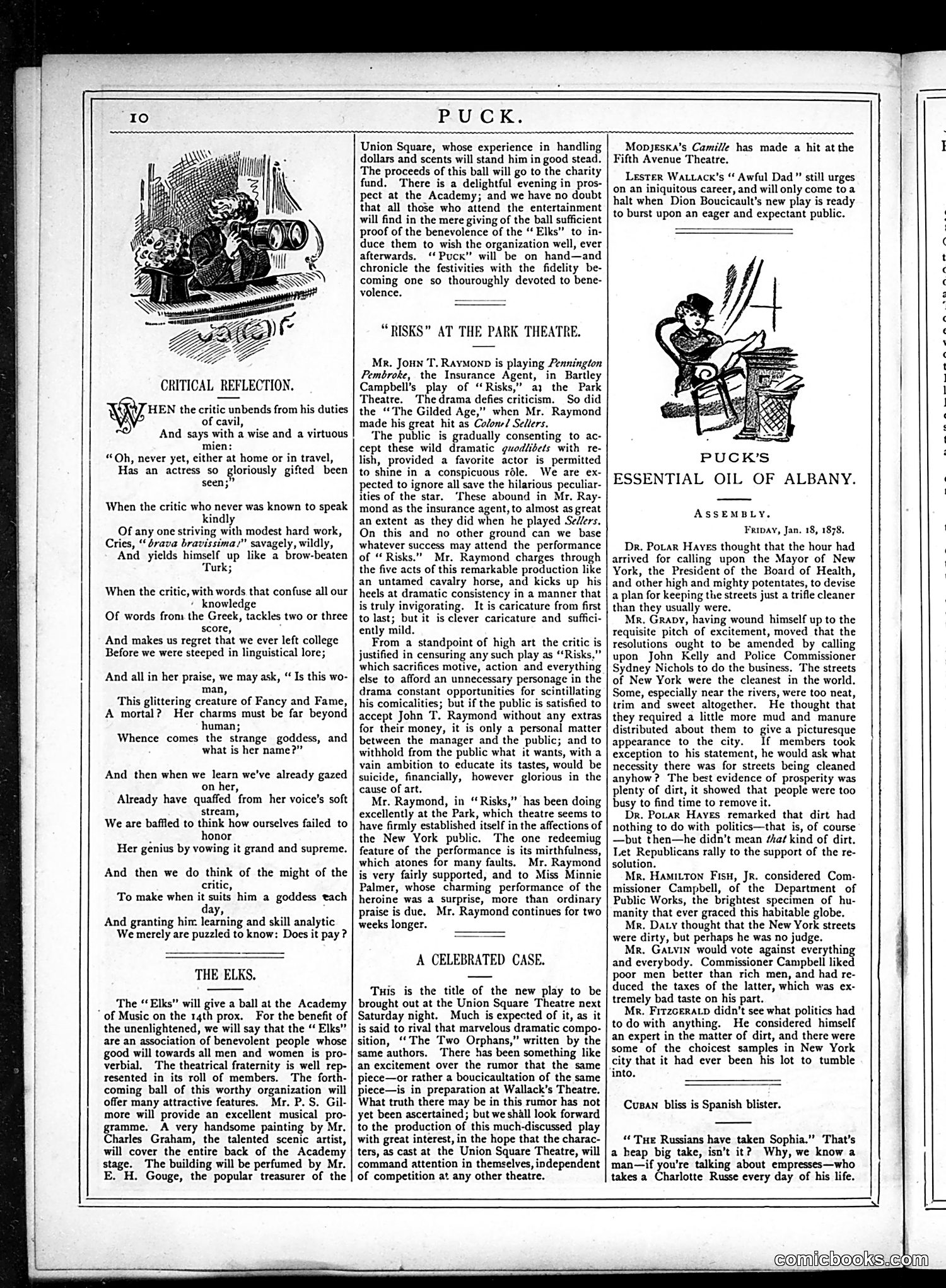
This page contains theater reviews and commentary rather than political cartoons. The main visual element is "Critical Reflection," a decorative illustration showing figures in classical dress, accompanying a poem praising an unnamed actress of "Fancy and Fame." The text discusses several theatrical productions: "Risks" at the Park Theatre (starring Mr. Raymond), "The Elks" ball at the Academy of Music, and an upcoming play titled "The Two Orphans" at Union Square Theatre. The Assembly section reports on civic matters: Dr. Polar Hayes and city officials debating street cleanliness in New York, with discussion of dust and dirt management. Commissioner Campbell appears involved in these municipal debates. The page is primarily entertainment and local governance coverage rather than satirical political commentary.
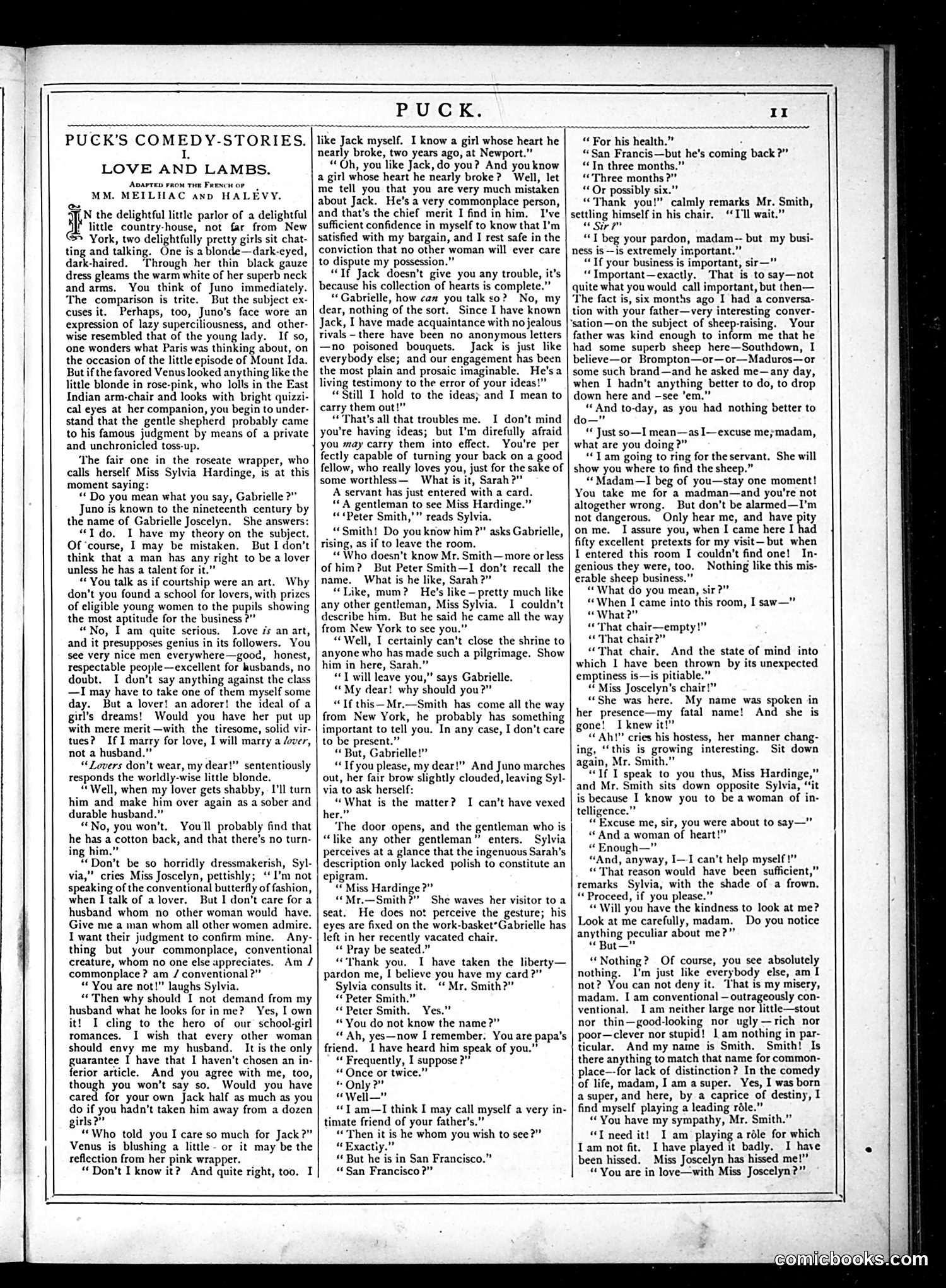
This page from *Puck* magazine contains a story titled "Love and Lambs," attributed to M.M. Methlac and Haley. The OCR'd text shows a romantic narrative about characters named Jack, Juno, Sylvia, Mr. Smith, and Gabrielle, involving romantic misunderstandings and class considerations. However, **I cannot identify specific political figures or satirical targets** from the visible text alone. The story appears to be a conventional romantic comedy rather than political satire—discussing themes like class differences, engagement disputes, and mistaken identities typical of Victorian-era fiction. Without visible illustrations or clearer context indicating which public figures are being caricatured, I cannot reliably explain what specific satire this content represents to modern readers.
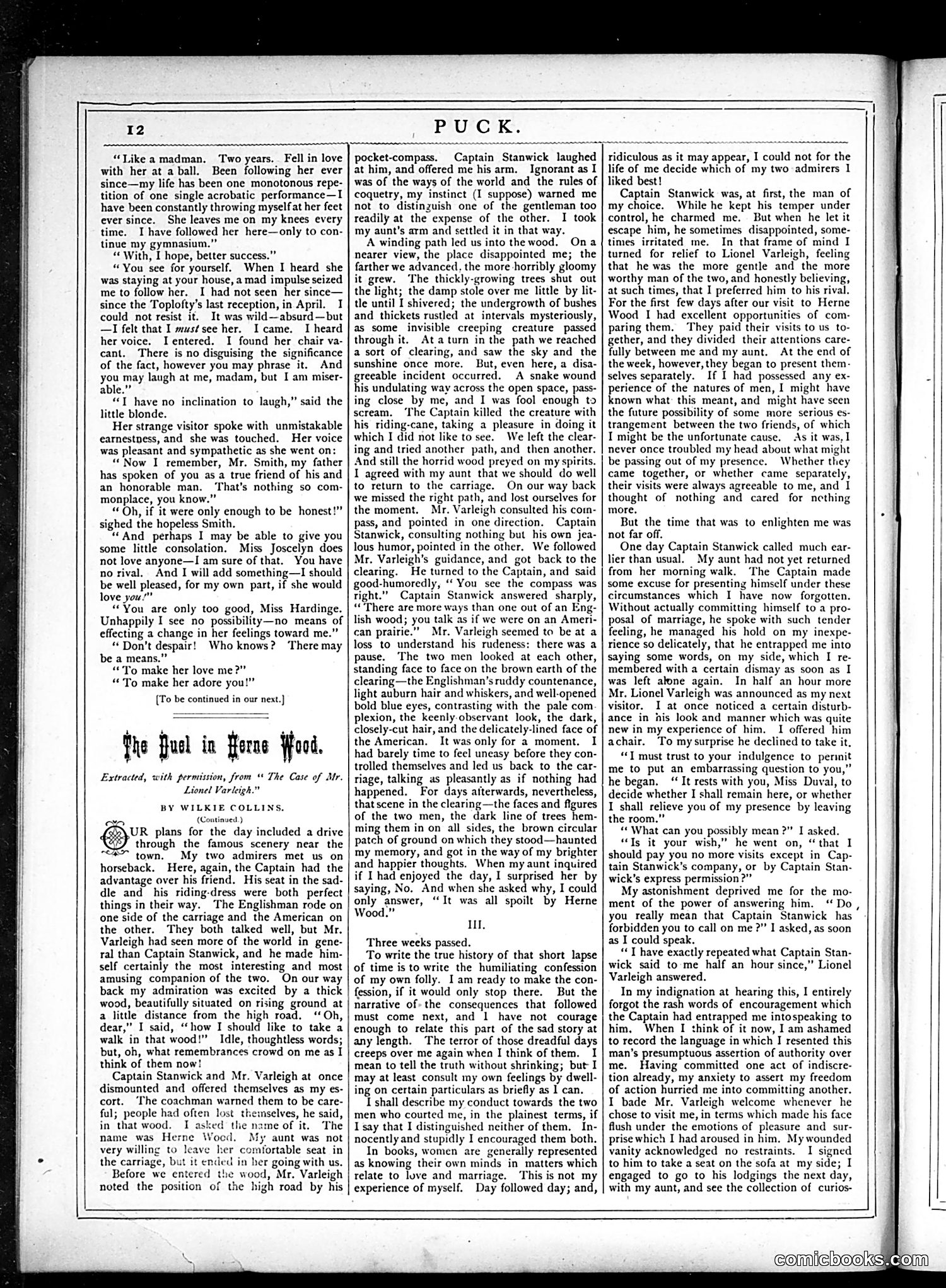
This page from *Puck* contains primarily **text content** rather than a political cartoon. It features "The Duel in Horne Wood," a serialized story "extracted, with permission, from 'The Care of Mr. Lionel Varleigh.'" The narrative appears to be a romantic/dramatic tale involving characters named Captain Stanwick, Mr. Varleigh, and a female character. The excerpt discusses a love triangle and includes dialogue about conflicting romantic interests and social propriety. There is **no visible political cartoon or satire on this page**—it is a literary installment typical of *Puck's* mixed content format, which combined satirical illustrations with fiction and other entertainment. Without seeing the accompanying illustration (if any exists), the political or social commentary, if present, cannot be assessed from this text alone.
This page contains serialized fiction ("Puck's Perhapses") and brief satirical news items rather than political cartoons. The main visual element is a small decorative illustration accompanying the fiction column. The text items mock contemporary topics: Kentucky town governance, opera singers' vocal ranges, Milwaukee residents' citizenship changes, cremation preferences, and various domestic mishaps. One brief note satirizes a man who accidentally shot himself while opening a door with a toothpick—absurdist humor typical of Puck's "humorous observations" format. The cartoon appears to depict people in domestic/social situations, though details are difficult to discern at this resolution. The page functions primarily as entertainment commentary rather than direct political satire.
This page is primarily **advertising and miscellaneous content** rather than political cartoons. The visible advertisements include: - **Gaff, Fleischmann & Co.'s Compressed Yeast** (top right, with decorative trade mark) - **German Printing and Lithographic Inks** - **Otto Stietz's New York Glass Letter Co.** - **Nicoll The Tailor** - **Pachtmann & Moelich** (watches, diamonds, jewelry) - **Aberle's Tivoli Theatre** (theatrical advertisement) The left column contains brief satirical anecdotes and observations typical of *Puck*'s humor—including commentary on German culture, survival theories, and social observations—but **no identifiable political cartoon** appears on this page. The content is primarily filler material between major illustrated pieces.
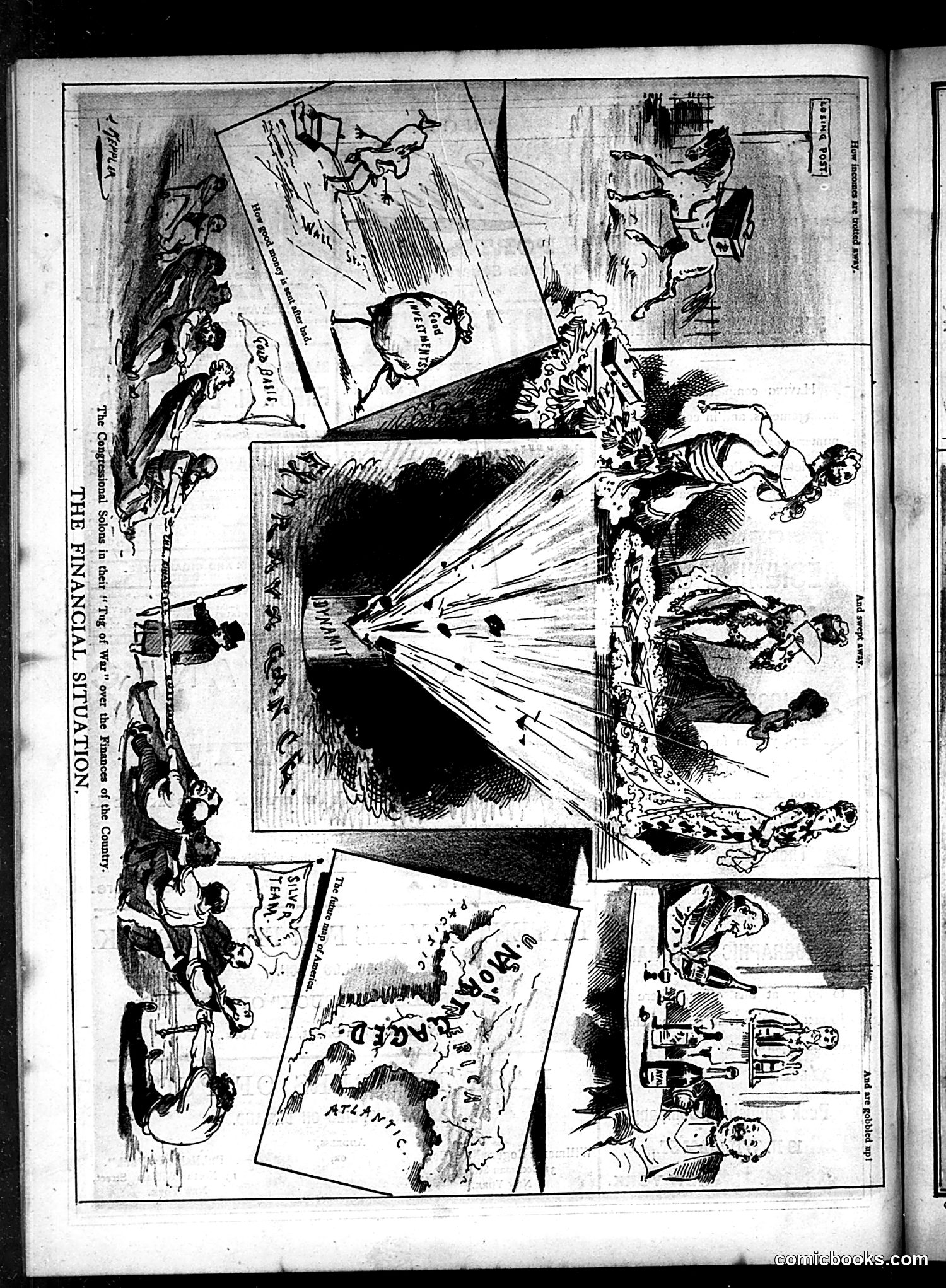
This Puck cartoon satirizes late-19th-century American financial turmoil. The central image depicts a chaotic financial scene with figures appearing to panic or struggle. The surrounding panels show related economic disruptions. The title "The Financial Situation" suggests commentary on a specific crisis—likely the Panic of 1893 or similar economic collapse. The caricatures appear to represent financial speculators, politicians, and ordinary citizens affected by market instability. The satire mocks the confusion and desperation surrounding financial markets, with the dramatic, swirling composition emphasizing chaos. Maps visible in panels suggest geographic scope of the economic problem, possibly referencing national or international financial networks. Without clearer identification of specific figures, the cartoon's precise targets remain somewhat unclear, though it clearly critiques financial mismanagement and its devastating public impact.