
Puck, 1878-01-23 · page 5 of 16
Puck — January 23, 1878 — page 5: what you’re looking at
What you’re looking at
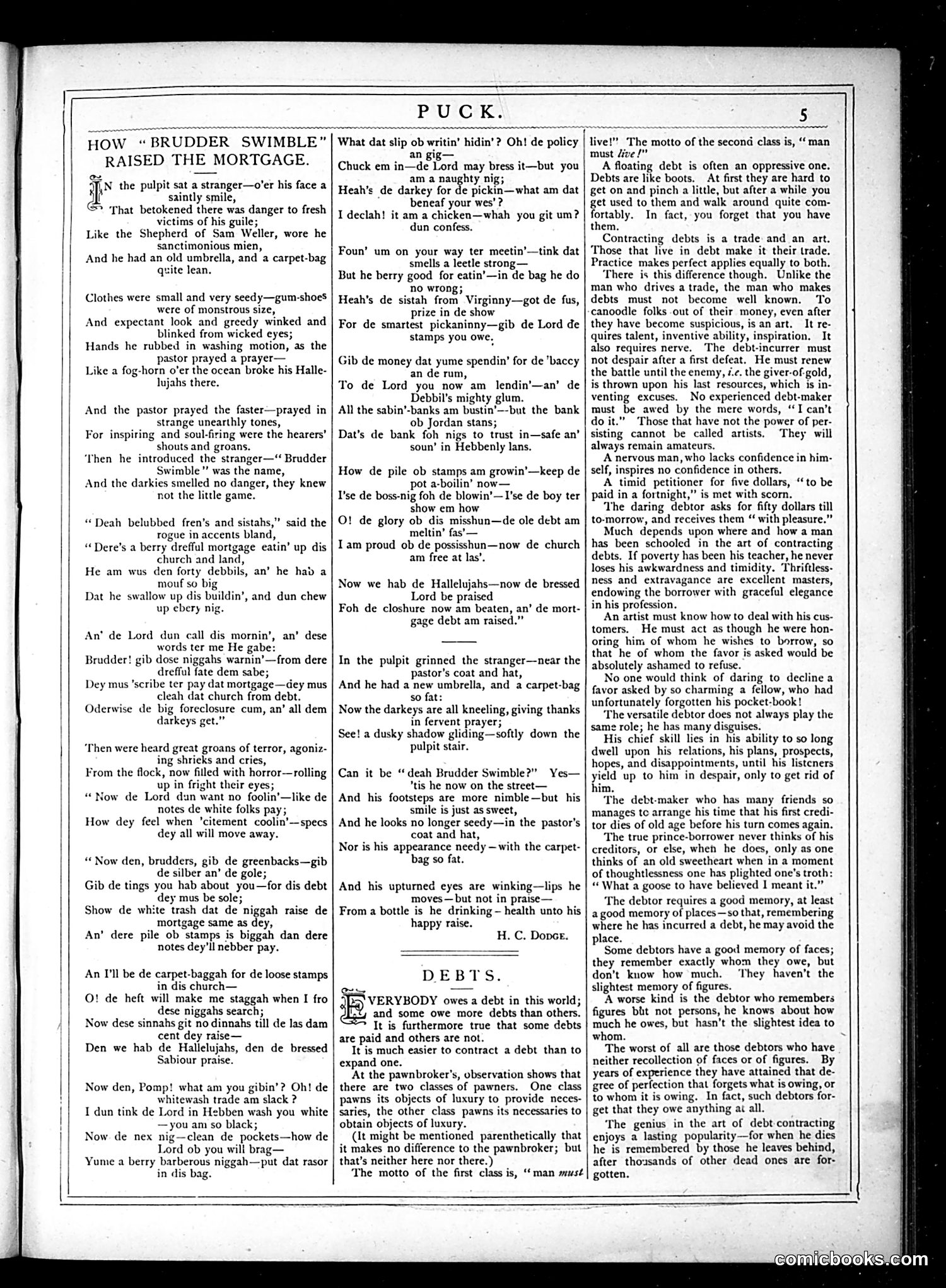
This page contains two pieces: a humorous poem about "Brudder Swimble" and an article on "Debts." The poem, written in dialect, satirizes a rural or working-class preacher character who appears comically disheveled and impoverished—arriving at church with an umbrella and carpet-bag, wearing undersized gum-shoes. The humor derives from contrast between his shabby appearance and his moral authority. The "Debts" article (by H.C. Dodge) discusses debt-contracting as a trade, distinguishing between "good" debts (productive investments) and "bad" debts (luxury purchases). It appears to critique both creditors who exploit borrowers and debtors lacking self-discipline, while praising those with integrity in financial dealings. The piece advocates for remembering exact debt amounts and maintaining honorable repayment practices—essentially promoting financial responsibility and moral character.
📄 Transcribed text from this page (OCR, searchable)
Machine-transcribed from the original scan — historical spelling and the odd misread are preserved.
HO WwW RAISED THE MORTGAGE. co ] MN the pulpit sat a stranger—o’er his face a saintly smile, GS ‘phat betokened there was danger to fresh victims of his guile; Like the Shepherd of Sam Weller, wore he sanctimonious mien, And he had an old umbrella, and’a carpet-bag quite lean, Clothes were small and very seedy—gum-shoes were of monstrous size, And expectant look and greedy winked and blinked from wicked eyes; Hands he rubbed in washing motion, as the pastor prayed a prayer— Like a fog-horn o'er the ocean broke his Halle- lujahs there. And the pastor prayed the faster—prayed in strange unearthly tones, For inspiring and soul-firing were the hearers’ shouts and groans. ‘Then he introduced the stranger—“ Brudder Swimble” was the name, And the darkies smelled no danger, they knew not the little game. “Deah belubbed fren’s and sistahs,” said the rogue in accents bland, “Dere’s a berry drefful mortgage eatin’ up dis church and land, He am wus den forty debbils, an’ he hab a mouf so big Dat he swallow up dis buildin’, and dun chew up ebery nig. An’ de Lord dun call dis mornin’, an’ dese words ter me He gabe: Brudder! gib dose niggahs warnin’—from dere drefful fate dem sabe; Dey mus 'scribe ter pay dat mortgage—dey mus cleah dat church from debt. Oderwise de big foreclosure cum, an’ all dem darkeys get.” ‘Then were heard great groans of terror, agoniz- ing shricks and cries, From the flock, now filled with horror—rolling up in fright their eyes; “Now de Lord dun want no foolin'—like de notes de white folks pay; How dey feel when ‘citement coolin'—specs dey all will move away. “Now den, brudders, gib de greenbacks—gib de silber an’ de gole; Gib de tings you hab about you—for dis debt dey mus be sole; Show de white trash dat de niggah raise de mortgage same as dey, An’ dere pile ob stamps is biggah dan dere notes dey'll nebber pay. An I'll be de carpet-baggah for de loose stamps in dis church— O! de heft will make me staggah when I fro dese niggahs search; Now dese sinnahs git no dinnahs till de las dam cent dey raise— Den we hab de Hallelujahs, den de bressed Sabiour praise. Now den, Pomp! what am you gibin’? Oh! de whitewash trade am slack ? I dun tink de Lord in Hebben wash you white —you am so black; Now de nex nig—clean de pockets—how de Lord ob you will brag— Yume a berry barberous niggah—put dat rasor in dis bag. “ BRUDDER SWIMBLE” PUCK. 7 What dat slip ob writin’ hidin’? Oh! de policy an gig— Chuck em in—de Lord may bress it—but you am a naughty nig; Heah’'s de darkey for de pickin—what am dat beneaf your wes’? I declah! it am a chicken—whah you git um? dun confess. Foun’ um on your way ter meetin’—tink dat smells a leetle strong— But he berry good for eatin’—in de bag he do no wrong; Heah's de sistah from Virginny—got de fus, prize in de show For de smartest pickaninny—gib de Lord de stamps you owe, Gib de money dat yume spendin’ for de 'baccy an de rum, To de Lord you now am lendin’—an’ de Debbil’s mighty glum. All the sabin’-banks am bustin’—-but the bank ob Jordan stans; Dat’s de bank foh nigs to trust in—safe an’ soun’ in Hebbenly lans. How de pile ob stamps am growin’—keep de pot a-boilin’ now— I’se de boss-nig foh de blowin’—I’se de boy ter show em how O! de glory ob dis misshun—de ole debt am meltin’ fas’— Iam proud ob de possisshun—now de church am free at las’. Now we hab de Hallelujahs—now de bressed Lord be praised Foh de closhure now am beaten, an’ de mort- gage debt am raised.” In the pulpit grinned the stranger—near the pastor's coat and hat, And he had a new umbrella, and a carpet-bag so fat: Now the darkeys are all kneeling, giving thanks in fervent prayer; See! a dusky shadow gliding—softly down the pulpit stair. Can it be “deah Brudder Swimble?” ‘tis he now on the street— And his footsteps are more nimble—but his smile is just as sweet, And he looks no longer seedy—in the pastor's coat and hat, Nor is his appearance needy —with the carpet- bag so fat. Yes— And his upturned eyes are winking—lips he moves —but not in praise— From a bottle is he drinking — health unto his happy raise. H. C. Dopce. DEBTS. os — Rp VERYBODY owes a debt in this world; [.% and some owe more debts than others. It is furthermore true that some debts are paid and others are not. It is much easier to contract a debt than to expand one. At the pawnbroker’s, observation shows that there are two classes of pawners. One class pawns its objects of luxury to provide neces- saries, the other class pawns its necessaries to obtain objects of luxury. (It might be mentioned parenthetically that it makes no difference to the pawnbroker; but that’s neither here nor there.) The motto of the first class is, “man must must dive / A floating debt is often an oppressive one. Debts are like boots. At first they are hard to get on and pinch a little, but after a while you get used to them and walk around quite com- fortably. In fact, you forget that you have them. Contracting debts is a trade and an art. Those that live in debt make it their trade. Practice makes perfect applies equally to both. There is this difference though. Unlike the man who drives a trade, the man who makes debts must not become well known. To canoodle folks out of their money, even after they have become suspicious, is an art. It re- quires talent, inventive ability, inspiration. It also requires nerve. The debt-incurrer must not despair after a first defeat. He must renew the battle until the enemy, ée. the giver-of-gold, is thrown upon his last resources, which is in- venting excuses. No experienced debt-maker must be awed by the mere words, ‘I can’t do it.” Those that have not the power of per- sisting cannot be called artists. They will always remain amateurs. A nervous man, who lacks confidence in him- self, inspires no confidence in others. A timid petitioner for five dollars, “to be paid in a fortnight,” is met with scorn. The daring debtor asks for fifty dollars till to-morrow, and receives them “ with pleasure.” Much depends upon where and how a man has been schooled in the art of contracting debts. If poverty has been his teacher, he never loses his awkwardness and timidity. Thriftless- ness and extravagance are excellent masters, endowing the borrower with graceful elegance in his profession. An artist must know how to deal with his cus- tomers. He must act as though he were hon- oring him of whom he wishes to borrow, so that he of whom the favor is asked would be absolutely ashamed to refuse. No one would think of daring to decline a favor asked by so charming a fellow, who had unfortunately forgotten his pocket-book! ‘The versatile debtor does not always play the same role; he has many disguises. His chief skill lies in his ability to so long dwell upon his relations, his plans, prospects, hopes, and disappointments, until his listeners yield up to him in despair, only to get rid of him. ‘The debt-maker who has many friends so manages te arrange his time that his first credi- tor dies of old age before his turn comes again. The true prince-borrower never thinks of his creditors, or else, when he does, only as one thinks of an old sweetheart when in a moment of thoughtlessness one has plighted one’s troth: “What a goose to have believed I meant it.” The debtor requires a good memory, at least a.good memory of places—so that, remembering where he has incurred a debt, he may avoid the place. Some debtors have a good memory of faces; they remember exactly whom they owe, but don’t know how much. ‘They haven't the slightest memory of figures. A worse kind is the debtor who remembers figures bit not persons, he knows about how much he owes, but hasn't the slightest idea to whom. The worst of all are those debtors who have neither recollection of faces or of figures. By years of experience they have attained that de- gree of perfection that forgets what is owing, or to whom it is owing. In fact, such debtors for- get that they owe anything at all. ‘The genius in the art of debt contracting enjoys a lasting popularity—for when he dies he is remembered by those he leaves behind, after thousands of other dead ones are for- gotten.