
Puck, 1878-01-23 · page 6 of 16
Puck — January 23, 1878 — page 6: what you’re looking at
What you’re looking at
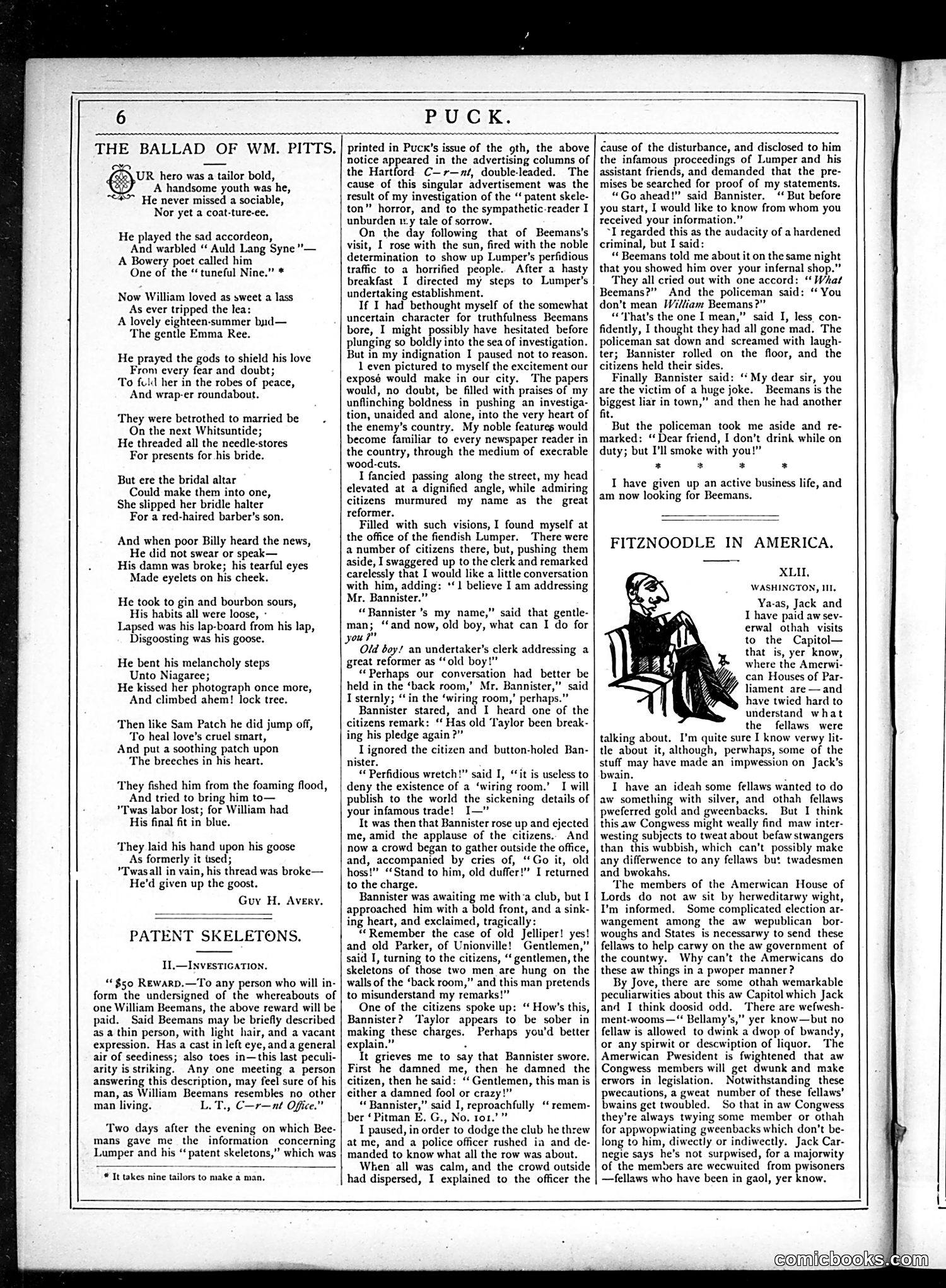
This page contains two distinct items: **"The Ballad of Wm. Pitts"** — a poem about a tailor named William who played accordion, loved a woman named Emma, and faced hardship when his business failed. This appears to be sentimental fiction rather than political satire. **"Fitznoodle in America" (XLIII)** — a satirical column mocking American political institutions. The cartoonist (shown sitting) criticizes Congress members as drunkards who cause "groans in legislation" and expresses frustration that American government seems dysfunctional and unable to manage basic governance. The piece suggests Congress lacks competence and discipline, using "Jack Carnegie" as an example of broader incompetence among elected officials. The satire targets American democratic governance as ineffective and populated by unsuitable representatives.
📄 Transcribed text from this page (OCR, searchable)
Machine-transcribed from the original scan — historical spelling and the odd misread are preserved.
6 PUCK. THE BALLAD OF WM. PITTS. UR hero was a tailor bold, ‘A handsome youth was he, 4°" He never missed a sociable, Nor yet a coat-ture-ee. He played the sad accordeon, And warbled “ Auld Lang Syne ”— A Bowery poet called him One of the “tuneful Nine.” * Now William loved as sweet a lass As ever tripped the lea: A lovely eighteen-summer bud— The gentle Emma Ree. He prayed the gods to shield his love From every fear and doubt; To ful her in the robes of peace, ‘And wrap-er roundabout. They were betrothed to married be On the next Whitsuntide; He threaded all the needle-stores For presents for his bride. But ere the bridal altar Could make them into one, She slipped her bridle halter For a red-haired barber's son. And when poor Billy heard the news, He did not swear or speak— His damn was broke; his tearful eyes Made eyelets on his cheek. He took to gin and bourbon sours, His habits all were loose, - Lapsed was his lap-board from his lap, Disgoosting was his goose. He bent his melancholy steps Unto Niagaree; He kissed her photograph once more, And climbed ahem! lock tree. Then like Sam Patch he did jump off, To heal love’s cruel smart, And put a soothing patch upon The breeches in his heart. ‘They fished him from the foaming flood, And tried to bring him to— "Twas labor lost; for William had His final fit in blue. ‘They laid his hand upon his goose As formerly it used; ’Twas all in vain, his thread was broke— He'd given up the goost. Guy H, Avery, PATENT SKELETONS. IL.—InvesTIGATION. “ $50 Rewarp.—To any person who will in- form the undersigned of the whereabouts of one William Beemans, the above reward will be paid. Said Beemans may be briefly described as a thin person, with light hair, and a vacant expression. Has a cast in left eye, anda general air of seediness; also toes in—this last peculi- arity is striking. Any one meeting a person answering this description, may feel sure of his man, as William Beemans resembles no other man living. L. T., C—r—nt Office.” Two days after the evening on which Bee- mans gave me the information concerning Lumper and his “ patent skeletons,” which was * It takes nine tailors to make a man. printed in Puck’s issue of the gth, the above notice sppented in the advertising columns of the Hartford C—r—nt, double-leaded. The cause of this singular advertisement was the result of my investigation of the “ patent skele- ton” horror, and to the sympathetic-reader I unburden ty tale of sorrow. On the day following that of Beemans’s visit, I rose with the sun, fired with the noble determination to show up Lumper's perfidious traffic to a horrified people. After a hasty breakfast I directed my steps to Lumper’s undertaking establishment. If I had bethought myself of the somewhat uncertain character for truthfulness Beemans bore, I might possibly have hesitated before plunging so boldly into the sea of investigation. But in my indignation I paused not to reason. 1 even pictured to myself the excitement our exposé would make in our city. ‘The papers would, no doubt, be filled with praises of my unflinching boldness in pushing an investiga- tion, unaided and alone, into the very heart of the enemy’s country. My noble features would become familiar to every newspaper reader in the country, through the medium of execrable wood-cuts. I fancied passing along the street, my head elevated at a dignified angle, while admiring citizens murmured my name as the great reformer. Filled with such visions, I found myself at the office of the fiendish Lumper. There were a number of citizens there, but, pushing them aside, I swaggered up to the clerk and remarked carelessly that I would like a little conversation with him, adding: *‘1 believe I am addressing Mr. Bannister.” “Bannister 's my name,” said that gentle- man; “and now, old boy, what can I do for you? Old boy! an undertaker’s clerk addressing a great reformer as “‘old boy!” “Perhaps our conversation had better be held in the ‘back room,’ Mr. Bannister,” said I sternly; “in the ‘wiring room,’ perhaps.” Bannister stared, and I heard one of the citizens remark: “ Has old ‘Taylor been break- ing his pledge again?” l ignored the citizen and button-holed Ban- nister. “ Perfidious wretch!” said I, ‘it is useless to deny the existence of a ‘wiring room.’ I will publish to the world the sickening details of your infamous trade! I—” It was then that Bannister rose up and ejected me, amid the applause of the citizens. And now a crowd began to gather outside the office, and, accompanied by cries of, “Go it, old hoss!” ‘Stand to him, old duffer!” I returned to the charge. Bannister was awaiting me witha club, but I approached him with a bold front, and a sink- ing heart, and exclaimed, tragically: “Remember the case of old Jelliper! yes! and old Parker, of Unionville! Gentlemen,” said I, turning to the citizens, “gentlemen, the skeletons of those two men are hung on the walls of the ‘back room,” and this man pretends to misunderstand my remarks!” One of the citizens spoke up: “ How's this, Bannister? ‘Taylor appears to be sober in making these charges. Perhaps you'd better explain.” . It grieves me to say that Bannister swore, First he damned me, then he damned the citizen, then he said: ‘ Gentlemen, this man is either a damned fool or crazy!” “Bannister,” said I, reproachfully “ remem- ber ‘ Pitman E. G., No. ror.’ I paused, in order to dodge the club he threw at me, and a police officer rushed ia and de- manded to know what all the row was about. When all was calm, and the crowd outside had dispersed, I explained to the officer the cause of the disturbance, and disclosed to him the infamous proceedings of Lumper and his assistant friends, and demanded that the pre- mises be searched for proof of my statements. “Go ahead!” said Bannister. “ But before you start, I would like to know from whom you received your information.” “I regarded this as the audacity of a hardened criminal, but I said: “ Beemans told me about it on the same night that you showed him over your infernal shop.” They all cried out with one accord: “ What Beemans?” And the policeman said: ‘ You don’t mean William Beemans?” “hat’s the one I mean,” said I, less. con- fidently, I thought they had all gone mad. The policeman sat down and screamed with laugh- ter; Bannister rolled on the floor, and the ns held their sides. Finally Bannister said: “ My dear sir, you are the victim of a huge joke. Beemans is the biggest liar in town,” and then he had another fit. But the policeman took me aside and re- marked: “Dear friend, I don’t drink while on duty; but I'll smoke with you!” * * * * I have given up an active business life, and am now looking for Beemans. FITZNOODLE IN AMERICA. XLII. WASHINGTON, III, Ya-as, Jack and I have paid aw sev- erwal othah visits to the Capitol— that is, yer know, where the Amerwi- can Houses of Par- liament are — and have twied hard to understand what the fellaws were talking about. I’m quite sure I know verwy lit- tle about it, although, perwhaps, some of the stuff may have made an impwession on Jack’s bwain. I have an ideah some fellaws wanted to do aw something with silver, and othah fellaws pweferred gold and gweenbacks. But I think this aw Congwess might weally find maw inter- westing subjects to tweat about befaw stwangers than this wubbish, which can’t possibly make any differwence to any fellaws but twadesmen and bwokahs. ‘The members of the Amerwican House of Lords do not aw sit by herweditarwy wight, I'm informed. Some complicated election ar- wangement among the aw wepublican bor- woughs and States is necessarwy to send these fellaws to help carwy on the aw government of the countwy. Why can’t the Amerwicans do these aw things in a pwoper manner? By Jove, there are some othah wemarkable peculiarwities about this aw Capitol which Jack and I think doosid odd. There are wefwesh- ment-wooms—“ Bellamy’s,” yer know—but no fellaw is allowed to dwink a dwop of bwandy, or any spirwit or descwiption of liquor. The Amerwican Pwesident is fwightened that aw Congwess members will get dwunk and make erwors in legislation. Notwithstanding these pwecautions, a gweat number of these fellaws’ bwains get twoubled. So that in aw Congwess they’re always twying some member or othah for appwopwiating gweenbacks which don’t be- long to him, diwectly or indiweetly. Jack Car- negie says he’s not surpwised, for a majorwity of the members are wecwuited from pwisoners —fellaws who have been in gaol, yer know.