
Puck, 1878-01-23 · page 3 of 16
Puck — January 23, 1878 — page 3: what you’re looking at
What you’re looking at
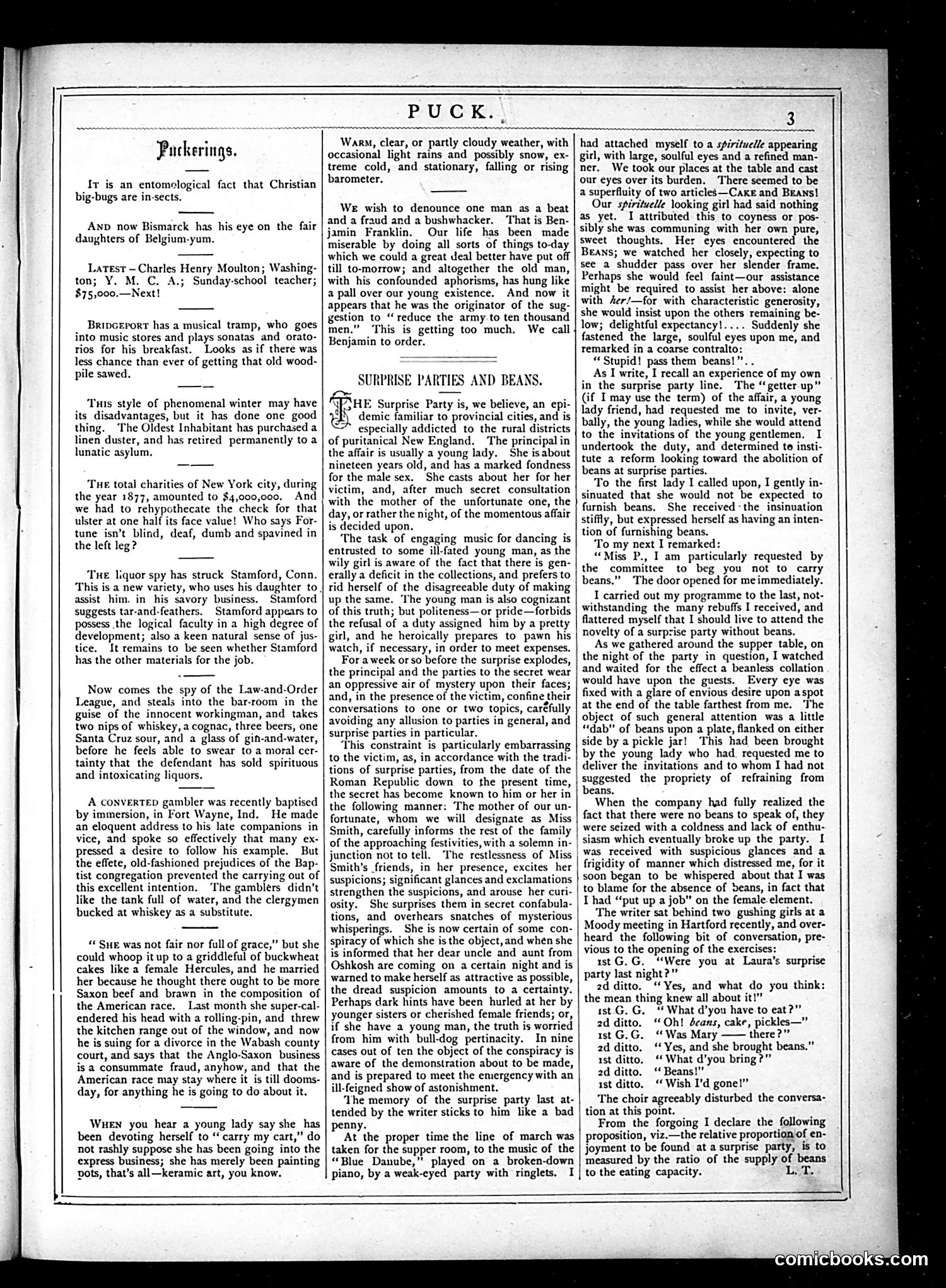
This page contains several satirical short pieces rather than political cartoons. The "Puckerings" section opens with entomological humor about Christian "big-bugs" being insects—likely mocking prominent religious figures. The main content targets **Benjamin Franklin** (referenced as having his "eye on the fair daughters of Belgium"), criticizing his diplomatic compromises and military proposals to reduce army size to ten thousand men—characterized as excessive appeasement. The lengthy "Surprise Parties and Beans" section satirizes the social custom of surprise parties through a humorous anecdote about a young lady hosting one but experiencing embarrassment when the promised beans for supper go missing, leading to comedic misunderstandings among guests about the missing dish. The satire targets both pretentious social conventions and their inevitable comic failures.
📄 Transcribed text from this page (OCR, searchable)
Machine-transcribed from the original scan — historical spelling and the odd misread are preserved.
Packerings. Ir is an entomological fact that Christian big-bugs are in-sects. AND now Bismarck has his eye on the fair daughters of Belgium-yum. Latest — Charles Henry Moulton; Washing- ton; Y. M. C. A.; Sunday-school teacher; $75,000.—Next! Brinceport has a musical tramp, who goes into music stores and plays sonatas and orato- trios for his breakfast. Looks as if there was less chance than ever of getting that old wood- pile sawed. Tis style of phenomenal winter may have its disadvantages, but it has done one good thing. The Oldest Inhabitant has purchased a linen duster, and has retired permanently toa lunatic asylum. Tue total charities of New York city, during the year 1877, amounted to $4,000,000. And we had to rehypothecate the check for that ulster at one half its face value! Who says For- tune isn’t blind, deaf, dumb and spavined in the left leg? ‘Tue liquor spy has struck Stamford, Conn. This is a new variety, who uses his daughter to | assist him. in his savory business. Stamford suggests tar-and-feathers. Stamford appears to possess the logical faculty in a high degree of development; also a keen natural sense of jus- tice, It remains to be seen whether Stamford has the other materials for the job. Now comes the spy of the Law-and-Order League, and steals into the bar-room in the guise of the innocent workingman, and takes two nips of whiskey, a cognac, three beers, one Santa Cruz sour, and a glass of gin-and-water, before he feels able to swear to a moral cer- tainty that the defendant has sold spirituous and intoxicating liquors. A CONVERTED gambler was recently baptised by immersion, in Fort Wayne, Ind. He made an eloquent address to his late companions in vice, and spoke so effectively that many ex- pressed a desire to follow his example. But the effete, old-fashioned prejudices of the Bap- tist congregation prevented the carrying out of this excellent intention. The gamblers didn’t like the tank full of water, and the clergymen bucked at whiskey as a substitute. “ Sue was not fair nor full of grace,” but she could whoop it up to a griddleful of buckwheat cakes like a female Hercules, and he married her because he thought there ought to be more Saxon beef and brawn in the composition of the American race, Last month she super-cal- endered his head with a rolling-pin, and threw the kitchen range out of the window, and now he is suing for a divorce in the Wabash county court, and says that the Anglo-Saxon business is a consummate fraud, anyhow, and that the American race may stay where it is till dooms- day, for anything he is going to do about it. Wuen you hear a young lady say she has been devoting herself to ‘carry my cart,” do not rashly suppose she has been going into the express business; she has merely been painting pots, that’s all—keramic art, you know. PUCK.. : 3 Wana, clear, or partly cloudy weather, with occasional light rains and possibly snow, ex- treme cold, and stationary, falling or rising barometer. We wish to denounce one man as a beat and a fraud and a bushwhacker. That is Ben- jamin Franklin, Our life has been made miserable by doing all sorts of things to-day which we could a great deal better have put off till to-morrow; and altogether the old man, with his confounded aphorisms, has hung like a pall over our young existence. And now it appears that he was the originator of the sug- gestion to “ reduce the army to ten thousand men.” This is getting too much, We call Benjamin to order. SURPRISE PARTIES AND BEANS. PSHE Surprise Party is, we believe, an epi- eo demic familiar to provincial cities, and is especially addicted to the rural districts of puritanical New England. ‘The principal in the affair is usually a young lady. She is about nineteen years old, and has a marked fondness for the male sex, She casts about her for her victim, and, after much secret consultation with the mother of the unfortunate one, the day, or rather the night, of the momentous affair is decided upon. ‘The task of engaging music for dancing is entrusted to some ill-fated young man, as the wily girl is aware of the fact that there is gen- erally a deficit in the collections, and prefers to rid herself of the disagreeable duty of making up the same. ‘The young man is also cognizant of this truth; but politeness—or pride—forbids the refusal of a duty assigned him by a pretty girl, and he heroically prepares to pawn his watch, if necessary, in order to meet expenses. For aweck or so before the surprise explodes, the principal and the parties to the secret wea an oppressive air of mystery upon their faces; and, in the presence of the victim, confine their conversations to one or two topics, carefully avoiding any allusion to parties in general, and surprise parties in particular. This constraint is particularly embarrassing to the victim, as, in accordance with the tradi- tions of surprise parties, from the date of the Roman Republic down to the present time, the secret has become known to him or her in the following manner: The mother of our un- fortunate, whom we will designate as Miss Smith, carefully informs the rest of the family | of the approaching festivities, with a solemn in- | junction not to tell. The restlessness of Miss Smith’s friends, in her presence, excites her suspicions; significant glances and exclamations strengthen the suspicions, and arouse her curi- | osity. She surprises them in secret confabula- tions, and overhears snatches of mysterious whisperings. She is now certain of some con- spiracy of which she is the object, and when she is informed that her dear uncle and aunt from Oshkosh are coming on a certain night and is warned to make herself as attractive as possible, the dread suspicion amounts to a certainty. Perhaps dark hints have been hurled at her by younger sisters or cherished female friends; or, if she have a young man, the truth is worried from him with’ bull-dog pertinacity. In nine cases out of ten the object of the conspiracy is aware of the demonstration about to be made, and is prepared to meet the emergency with an ill-feigned show of astonishment. ‘The memory of the surprise party last at- tended by the writer sticks to him like a bad penny. At the proper time the line of march was taken for the supper room, to the music of the “Blue Danube,” played on a broken-down piano, by a weak-eyed party with ringlets. I had attached myself to a spirituelle appearing girl, with large, soulful eyes and a refined man- ner. We took our places at the table and cast our eyes over its burden. There seemed to be a superfluity of two articles—Caxe and Beans! Our spirituelle looking girl had said nothing as yet. I attributed this to coyness or pos- sibly she was communing with her own pure, sweet thoughts. Her eyes encountered the Beans; we watched her closely, expecting to see a shudder pass over her slender frame. Perhaps she would feel faint—our assistance might be required to assist her above: alone with her/—for with characteristic generosity, she would insist upon the others remaining be- low; delightful expectancy!.... Suddenly she fastened the large, soulful eyes upon me, and remarked in a coarse contralto: «Stupid! pass them beans!”’. . As I write, I recall an experience of my own in the surprise party line. The “getter up” (if I may use the term) of the affair, a young lady friend, had requested me to invite, ver- bally, the young ladies, while she would attend to the invitations of the young gentlemen. I undertook the duty, and determined to insti- tute a reform looking toward the abolition of beans at surprise parties. To the first lady I called upon, I gently in- sinuated that she would not be expected to furnish beans. She received -the insinuation stiffly, but expressed herself as having an inten- tion of furnishing beans. To my next I remarked: “Miss P., I am particularly requested by the committee to beg you not to carry beans.” The door opened for me immediately. I carried out my programme to the last, not- withstanding the many rebuffs I received, and flattered myself that I should live to attend the novelty of a surpzise party without beans. As we gathered around the supper table, on the night of the party in question, I watched and waited for the effect a beanless collation would have upon the guests. Every eye was fixed with a glare of envious desire upon aspot at the end of the table farthest from me. The object of such general attention was a little “dab” of beans upon a plate, flanked on either side by a pickle jar! This had been brought by the young lady who had. requested me to deliver the invitations and to whom I had not suggested the propriety of refraining from beans. When the company had fully realized the fact that there were no beans to speak of, they were seized with a coldness and lack of enthu- siasm which eventually broke up the party. I | was received with suspicious glances and a frigidity of manner which distressed me, for it soon began to be whispered about that I was to blame for the absence of Deans, in fact that Thad “put up a job” on the female element. ‘The writer sat behind two gushing girls at a Moody meeting in Hartford recently, and over- heard the following bit of conversation, pre- vious to the opening of the exercises: istG.G. ‘Were you at Laura’s surprise party last night?” 2d ditto. ‘Yes, and what do you think: the mean thing knew all about it!” tst.G. G, ‘* What d’you have.to eat?” 2d ditto. “Oh! deans, cake, pickles—” istG.G. ‘Was Mary there?” 2d ditto. ‘Yes, and she brought beans.”” ist ditto. What d’you bring?” 2d ditto. ‘‘ Beans!" ist ditto. “‘ Wish I'd gone!” The choir agreeably disturbed the conversa- tion at this point. 3 From the forgoing I declare the following proposition, viz.—the relative proportion of en- joyment to be found at a surprise party, is to measured by the ratio of the supply of beans to the eating capacity. L.T.