
Puck, 1878-01-23 · page 12 of 16
Puck — January 23, 1878 — page 12: what you’re looking at
What you’re looking at
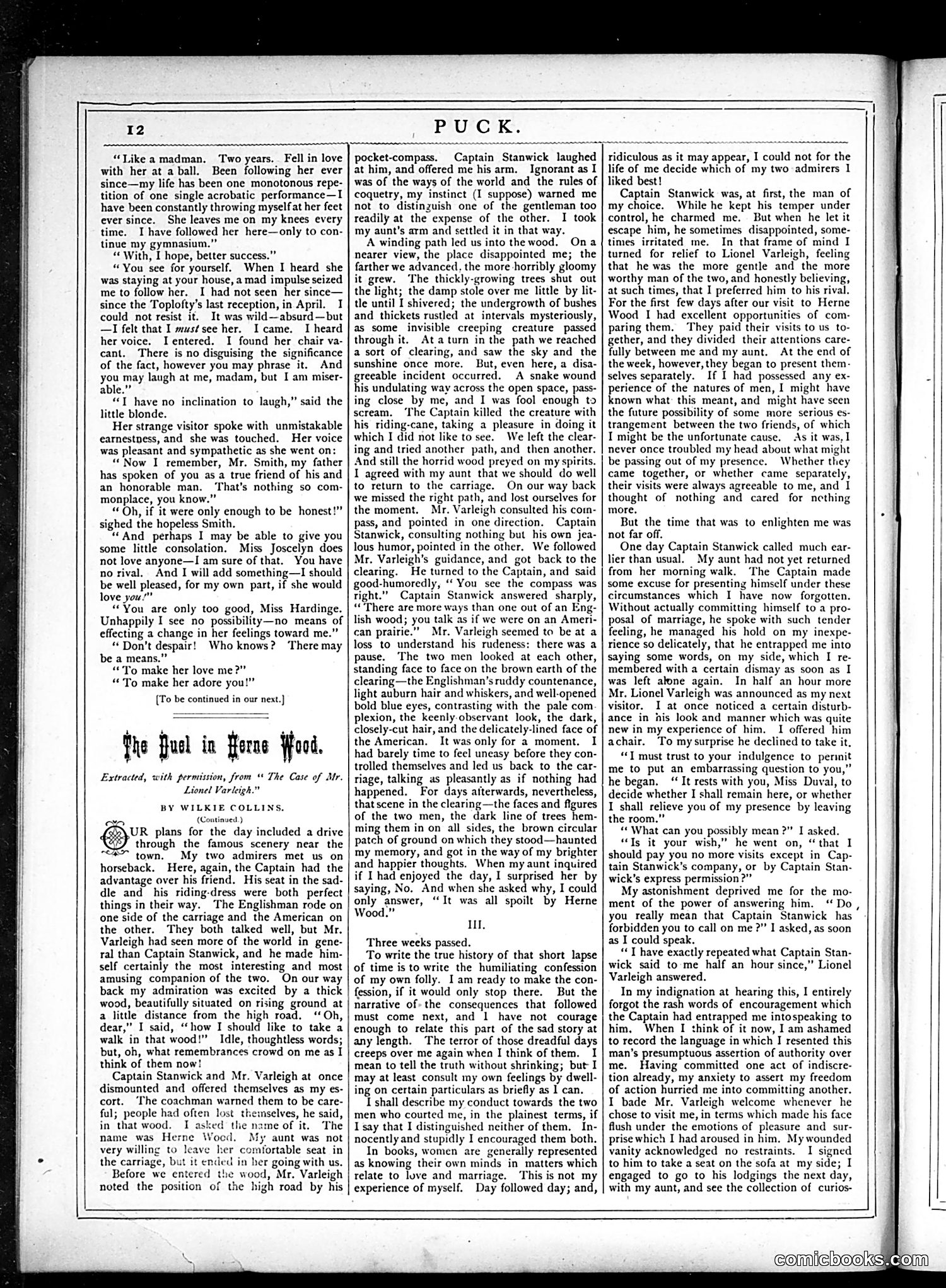
This page from *Puck* contains primarily **text content** rather than a political cartoon. It features "The Duel in Horne Wood," a serialized story "extracted, with permission, from 'The Care of Mr. Lionel Varleigh.'" The narrative appears to be a romantic/dramatic tale involving characters named Captain Stanwick, Mr. Varleigh, and a female character. The excerpt discusses a love triangle and includes dialogue about conflicting romantic interests and social propriety. There is **no visible political cartoon or satire on this page**—it is a literary installment typical of *Puck's* mixed content format, which combined satirical illustrations with fiction and other entertainment. Without seeing the accompanying illustration (if any exists), the political or social commentary, if present, cannot be assessed from this text alone.
📄 Transcribed text from this page (OCR, searchable)
Machine-transcribed from the original scan — historical spelling and the odd misread are preserved.
12 “Like a madman, Two years. Fell in love with her at a ball. Been following her ever since—my life has been one monotonous repe- tition of one single acrobatic performance—I have been constantly throwing myself at her feet ever since. She leaves me on my knees every time. I have followed her here—only to con- tinue my gymnasium.” “With, I hope, better success.” “You see for yourself. When I heard she was staying at your house, a mad impulse seized me to follow her. I had not seen her since— since the Toplofty’s last reception, in April. I could not resist it. It was wild—absurd—but —I felt that I must see her. Icame. I heard her voice. Ientered. I found her chair va- cant. There is no disguising the significance of the fact, however you may phrase it. And you may laugh at me, madam, but I am miser- able.” “I have no inclination to laugh,” said the little blonde. Her strange visitor spoke with unmistakable earnestness, and she was touched. Her voice was pleasant and sympathetic as she went on: “Now I remember, Mr. Smith, my father has spoken of you as a true friend of his and an honorable man. ‘That's nothing so com- monplace, you know.” “Oh, if it were only enough to be honest!” sighed the hopeless Smith. “And perhaps I may be able to give you some little consolation. Miss Joscelyn does not love anyone—I am sure of that. You have no rival. And I will add something—I should be well pleased, for my own part, if she would love you!" “You are only too good, Miss Hardinge. Unhappily I see no possibility—no means of effecting a change in her feelings toward me.” “Don't despair! Who knows? ‘There may be a means.” “To make her love me?” “To make her adore you [To be continued in our next.] Phe fuel in Horns Pood, Extracted, with permission, from “ The Case of Mr. Lionel Varleigh.” BY WILKIE COLLINS. oo (Continued) UR plans for the day included a drive through the famous scenery near the town. My two admirers met us on horseback. Here, again, the Captain had the advantage over his friend. His seat in the sad- dle and his riding-dress were both perfect things in their way. The Englishman rode on ‘one side of the carriage and the American on the other. They both talked well, but Mr. Varleigh had seen more of the world in gene- ral than Captain Stanwick, and he made him- self certainly the most interesting and most amusing companion of the two. On our way back my admiration was excited by a thick wood, beautifully situated on rising ground at a little distance from the high road. ‘Oh, dear,” I said, ‘how I should like to take a walk in that wood!” Idle, thoughtless words; but, oh, what remembrances crowd on me as I think of them now! Captain Stanwick and Mr. Varleigh at once dismounted and offered themselves as my es- cort. The coachman warned them to be care- ful; people had often lost themselves, he said, in that wood. I asked the name of it. The name was Herne Wood, My aunt was not very willing to comfortable seat in the carriage, but it en her going with us. Before we entered the wood, Mr. Varleigh noted the position of the high road by his Ponca} pocket-compass. Captain Stanwick laughed at him, and offered me his arm. Ignorant as I was of the ways of the world and the rules of coquetry, my instinct (I suppose) warned me not to distinguish one of the gentleman too readily at the expense of the other. I took my aunt's arm and settled it in that way. ‘A winding path led us into the wood, Ona nearer view, the place disappointed me; the farther we advanced, the more horribly gloomy it grew. The thickly-growing trees shut out the light; the damp stole over me little by lit- tle until I shivered; the undergrowth of bushes and thickets rustled at intervals mysteriously, as some invisible creeping creature passed through it. Ata turn in the path we reached a sort of clearing, and saw the sky and the sunshine once more. But, even here, a disa- greeable incident occurred. A snake wound his undulating way across the open space, pass- ing close by me, and I was fool enough to scream. ‘The Captain killed the creature with is riding-cane, taking a pleasure in doing it which I did not like to see. We left the clear- ing and tried another path, and then another. And still the horrid wood preyed on my spirits. I agreed with my aunt that we should do well to return to the carriage. On our way back we missed the right path, and lost ourselves for the moment. Mr. Varleigh consulted his coin- pass, and pointed in one direction. Captain Stanwick, consulting nothing but his own jea- lous humor, pointed in the other. We followed Mr. Varleigh’s guidance, and got back to the clearing. He turned to the Captain, and said good-humoredly, “You sce the compass was right.” Captain Stanwick answered sharply, “There are more ways than one out of an Eng- lish wood; you talk as if we were on an Ameri- can prairie.” Mr. Varleigh seemed to be at a loss to understand his rudeness: there was a pause. The two men looked at each other, standing face to face on the brown earth of the clearing—the Englishman’s ruddy countenance, light auburn hair and whiskers, and well-opened bold blue eyes, contrasting with the pale com plexion, the keenly-observant look, the dark, closely-cut hair, and the delicately-lined face of the American. It was only for a moment. I had barely time to feel uneasy before they con- trolled themselves and led us back to the car- riage, talking as pleasantly as if nothing had happened. For days afterwards, nevertheless, that scene in the clearing—the faces and figures of the two men, the dark line of trees hem- ming them in on all sides, the brown circular patch of ground on which they stood—haunted my memory, and got in the way of my brighter and happier thoughts. When my aunt inquired if I had enjoyed the day, 1 surprised her by saying, No. And when she asked why, I could only answer, “It was all spoilt by Herne Wood.” Ill. ‘Three weeks passed. To write the true history of that short lapse of time is to write the humiliating confession of my own folly. I am ready to make the con- fession, if it would only stop there. But the narrative of- the consequences that followed must come next, and 1 have not courage enough to relate this part of the sad story at any length. The terror of those dreadful days creeps over me again when I think of them. I mean to tell the truth without shrinking; but I may at least consult my own feelings by dwell- ing on certain particulars as briefly as I can. I shall describe my conduct towards the two men who courted me, in the plainest terms, if I say that I distinguished neither of them, In- nocently and stupidly I encouraged them both, In books, women are generally represented as knowing their own minds in matters which relate to love and marriage. ‘This is not my experience of myself. Day followed day; and, ridiculous as it may appear, I could not for the life of me decide which of my two admirers 1 liked best! Captain Stanwick was, at first, the man of my choice. While he kept his temper under control, he charmed me. But when he let it escape him, he sometimes disappointed, some- times irritated me. In that frame of mind I turned for relief to Lionel Varleigh, feeling that he was the more gentle and the more worthy man of the two, and honestly believing, at such times, that I preferred him to his rival. For the first few days after our visit to Herne Wood I had excellent opportunities of com- paring them. ‘They paid their visits to us to- gether, and they divided their attentions care- fully between me and my aunt. At the end of the week, however, they began to present them- selves separately. If I had possessed any ex- perience of the natures of men, I might have known what this meant, and might have seen the future possibility of some more serious ¢s- trangement between the two friends, of which I might be the unfortunate cause. As it was, I never once troubled my head about what might be passing out of my presence. Whether they came together, or whether came separately, their visits were always agreeable to me, and I thought of nothing and cared for nothing more. But the time that was to enlighten me was not far off. One day Captain Stanwick called much ear- lier than usual. My aunt had not yet returned from her morning walk. The Captain made some excuse for presenting himself under these circumstances which I have now forgotten. Without actually committing himself to a pro- posal of marriage, he spoke with such tender feeling, he managed his hold on my inexpe- rience so delicately, that he entrapped me into saying some words, on my side, which I re- membered with a certain dismay as soon as I was left alone again. In half an hour more Mr. Lionel Varleigh was announced as my next visitor. I at once noticed a certain disturb- ance in his look and manner which was quite new in my experience of him. I offered him achair. To my surprise he declined to take it. “«] must trust to your indulgence to permit me to put an embarrassing question to you,” he began. “It rests with you, Miss Duval, to decide whether I shall remain here, or whether I shall relieve you of my presence by leaving the room.” “What can you possibly mean ?” I asked. “Ts it your wish,” he went on, “that I should pay you no more visits except in Cap- tain Stanwick’s company, or by Captain Stan- wick’s express permission 2” My astonishment deprived me for the mo- ment of the power of answering him. “Do, you really mean that Captain Stanwick has forbidden you to call on me ?” J asked, as soon as I could speak. “T have exactly repeated what Captain Stan- wick said to me half an hour since,” Lionel Varleigh answered. In my indignation at hearing this, I entirely forgot the rash words of encouragement which the Captain had entrapped me intospeaking to him, When I think of it now, I am ashamed to record the language in which I resented this man’s presumptuous assertion of authority over me. Having committed one act of indiscre- tion already, my anxiety to assert my freedom of action hurried me into committing another. I bade Mr. Varleigh welcome whenever he chose to visit me, in terms which made his face flush under the emotions of pleasure and sur- prise which I had aroused in him, My wounded vanity acknowledged no restraints. I signed to him to take a seat on the sofa at my side; I engaged to go to his lodgings the next day, with my aunt, and see the collection of curios-