
Puck, 1878-01-23 · page 2 of 16
Puck — January 23, 1878 — page 2: what you’re looking at
What you’re looking at
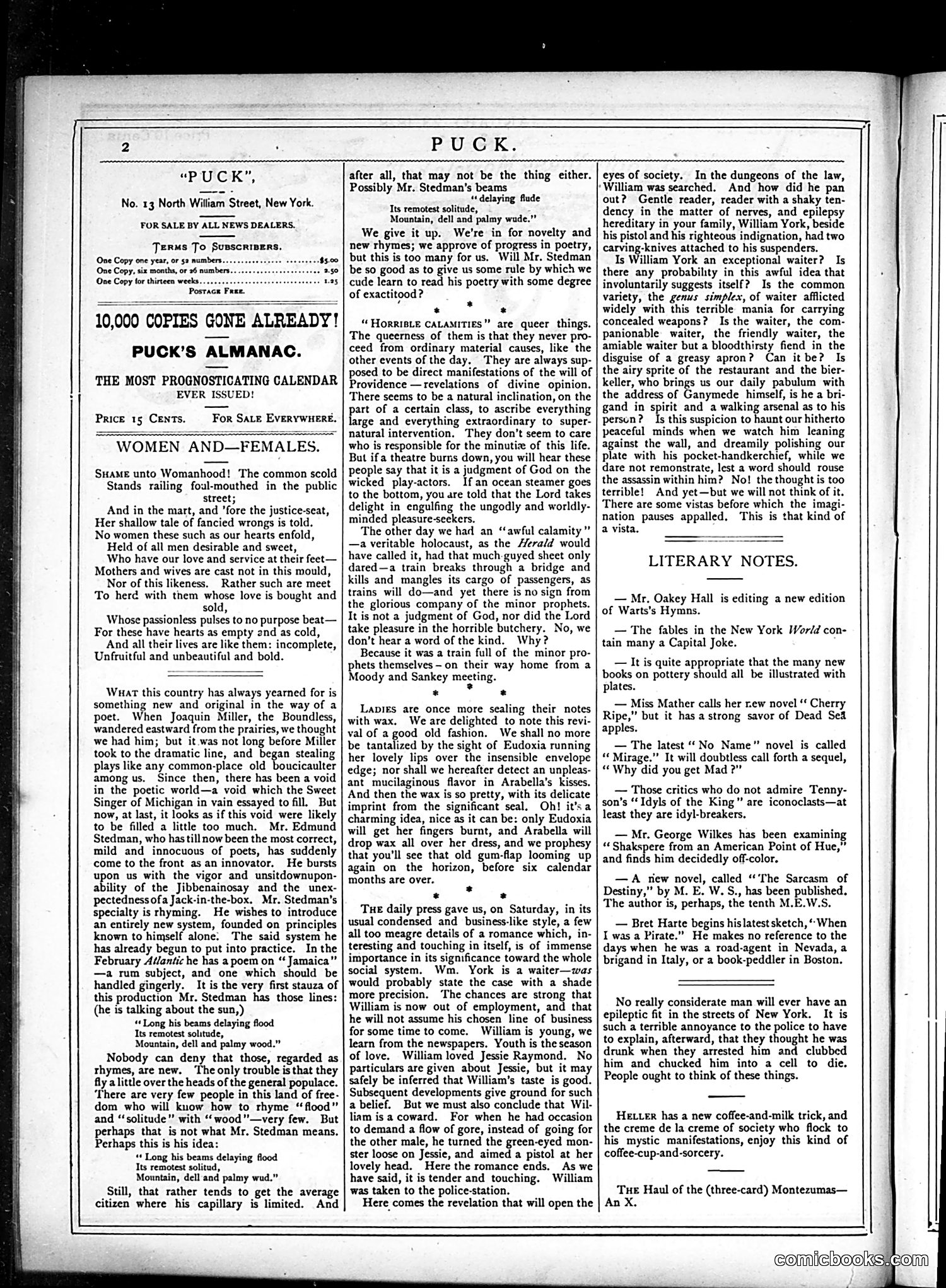
This page is primarily **literary and editorial content** rather than political satire. It contains: **"Women and Females"** — A poem criticizing women who adopt affected mannerisms and pretension, contrasting "real" women with those seeking social status through artifice. **Stedman's Poetry Commentary** — Critical discussion of Will Mr. Stedman's poetry collection, questioning whether his work offers genuine literary merit or merely novelty. **Literary Notes** — Brief book reviews and publishing gossip, including mentions of new novels and American literary criticism. **Minor Satirical Elements** — Light mockery of social pretensions and literary fashions, typical of Puck's cultural commentary. The page lacks prominent political cartoons or caricatures of recognizable public figures. Instead, it targets broad social types and literary trends of the era through written satire.
📄 Transcribed text from this page (OCR, searchable)
Machine-transcribed from the original scan — historical spelling and the odd misread are preserved.
PUCK. “PUCK”, No. 13 North Willan FOR SALE BY ALL NEWS DEALERS. m Street, New York. Terms To Suascripers. ‘One Copy one year, or $2 numbers. One Copy, six months, or 26 numbers One Copy for thirteen weeks. Posra 10,000 COPIES GONE ALREADY! PUCK’S ALMANAC. THE MOST PROGNOSTICATING CALENDAR EVER ISSUED! For Sate EVERYWHERE. Price 15 Cents. WOMEN AND— . Suame unto Womanhood! The common scold Stands railing foul-mouthed in the public street; And in the mart, and 'fore the justice-seat, Her shallow tale of fancied wrongs is told. No women these such as our hearts enfold, Held of all men desirable and sweet, Who have our love and service at their feet— Mothers and wives are cast not in this mould, Nor of this likeness. Rather such are meet To herd with them whose love is bought and sold, Whose passionless pulses to no purpose beat— For these have hearts as empty and as cold, And all their lives are like them: incomplete, Unfruitful and unbeautiful and bold. Wuar this country has always yearned for is something new and original in the way of a poet. When Joaquin Miller, the Boundless, wandered eastward from the prairies, we thought we had him; but it was not long before Miller took to the dramatic line, and began stealing plays like any common-place old boucicaulter among us. Since then, there has been a void in the poetic world—a void which the Sweet Singer of Michigan in vain essayed to fill. But now, at last, it looks as if this void were likely to be filled a little too much. Mr. Edmund Stedman, who has till now been the most correct, mild and innocuous of poets, has suddenly come to the front as an innovator. He bursts upon us with the vigor and unsitdownupon- ability of the Jibbenainosay and the unex- pectedness ofa Jack-in-the-box, Mr. Stedman's specialty is rhyming. He wishes to introduce an entirely new system, founded on principles known to himself alone. The said system he has already begun to put into practice. Inthe February Aé/antic he has a poem on “Jamaica” —a rum subject, and one which should be handled gingerly. It is the very first stauza of this production Mr. Stedman has those lines: (he is talking about the sun,) «Long his beams delaying flood Its remotest solitude, Mountain, dell and palmy wood.” Nobody can deny that those, regarded as rhymes, are new. The only trouble is that they fly a little over the heads of the general populace. ‘There are very few people in this land of free- dom who will kuow how to rhyme “flood” and “solitude” with “‘wood"—very few. But perhaps that is not what Mr. Stedman means. Perhaps this is his idea: «+ Long his beams delaying flood Its remotest solitud, Mountain, dell and palmy wud.” Still, that rather tends to get the average citizen where his capillary is limited. And after all, that may not be the thing either. Possibly Mr. Stedman's beams «delaying flude Its remotest solitude, Mountain, dell and palmy wade.” We give it up. We're in for novelty and new rhymes; we approve of progress in poetry, but this is too many for us. Will Mr. Stedman be so good as to give us some rule by which we cude learn to read his poetry with some degree of exactitood? “ HORRIBLE CALAMITIES” are queer things. The queerness of them is that they never pro- ceed from ordinary material causes, like the other events of the day, They are always sup- posed to be direct manifestations of the will of Providence —revelations of divine opinion. There seems to be a natural inclination, on the art of a certain class, to ascribe everything large and everything extraordinary to super- natural intervention. They don’t seem to care who is responsible for the minutize of this life. But ifa theatre burns down, you will hear these people say that it is a judgment of God on the wicked play-actors. Ifan ocean steamer goes to the bottom, you are told that the Lord takes delight in engulfing the ungodly and worldly- minded pleasure-seekers. ‘The other day we had an “awful calamity ” —a veritable holocaust, as the Hera/d would have called it, had that much-guyed sheet only dared—a train breaks through a bridge and kills and mangles its cargo of passengers, as trains will do—and yet there is no sign from the glorious company of the minor prophets. It is not a judgment of God, nor did the Lord take pleasure in the horrible butchery. No, we don’t hear a word of the kind. Why? Because it was a train full of the minor pro- phets themselves—on their way home from a Moody and Sankey meeting. * . * Lapis are once more sealing their notes with wax. We are delighted to note this revi- val of a good old fashion. We shall no more be tantalized by the sight of Eudoxia running her lovely lips over the insensible envelope edge; nor shall we hereafter detect an unpleas- ant mucilaginous flavor in Arabella’s kisses. And then the wax is so pretty, with its delicate imprint from the significant seal. Oh! it’s a charming idea, nice as it can be: only Eudoxia will get her fingers burnt, and Arabella will drop wax all over her dress, and we prophesy that you'll see that old gum-flap looming up again on the horizon, before six calendar months are over. *« * * Tue daily press gave us, on Saturday, in its usual condensed and business-like style, a few all too meagre details of a romance which, teresting and touching in itself, is of immense importance in its significance toward the whole social system. Wm. York is a waiter—was would probably state the case with a shade more precision. ‘The chances are strong that William is now out of employment, and that he will not assume his chosen line of business for some time to come. William is young, we learn from the newspapers. Youth is the season of love. William loved Jessie Raymond. No particulars are given about Jessie, but it may safely be inferred that William's taste is good. Subsequent developments give ground for such a belief. But we must also conclude that Wil- liam is a coward. For when he had occasion to demand a flow of gore, instead of going for the other male, he turned the green-eyed mon- ster loose on Jessie, and aimed a pistol at her lovely head. Here the romance ends, As we have said, it is tender and touching. William was taken to the police-station. Here comes the revelation that will open the } William was searched. eyes of society. In the dungeons of the law, And how did he pan out? Gentle reader, reader with a shaky ten- dency in the matter of nerves, and epilepsy hereditary in your family, William York, beside his pistol and his righteous indignation, had two carving-knives attached to his suspenders. Is William York an exceptional waiter? Is there any probability in this awful idea that involuntarily suggests itself? Is the common variety, the genus simplex, of waiter afflicted widely ‘with this terrible. mania for carrying concealed weapons? Is the waiter, the com- panionable waiter, the friendly waiter, the amiable waiter but a bloodthirsty fiend in the disguise of a greasy apron? Can it be? Is the airy sprite of the restaurant and the bier- keller, who brings us our daily pabulum with the address of Ganymede himself, is he a bri- gand in spirit and a walking arsenal as to his persun? Is this suspicion to haunt our hitherto peaceful minds when we watch him leaning against the wall, and dreamily polishing our plate with his pocket-handkerchief, while we dare not remonstrate, lest a word should rouse the assassin within him? No! the thought is too terrible!’ And yet—but we will not think of it. There are some vistas before which the imagi- nation pauses appalled, This is that kind of a vista. LITERARY NOTES. — Mr. Oakey Hall is editing a new edition of Warts's Hymns. —The fables in the New York World con- tain many a Capital Joke. — It is quite appropriate that the many new books on pottery should all be illustrated with plates. — Miss Mather calls her rew novel ‘ Cherry Ripe,” but it has a strong savor of Dead Sea apples. — The latest “No Name” novel is called « Mirage.” It will doubtless call forth a sequel, “Why did you get Mad ?” — Those critics who do not admire Tenny- son’s “Idyls of the King” are iconoclasts—at least they are idyl-breakers. — Mr. George Wilkes has been examining “ Shakspere from an American Point of Hue,” and finds him decidedly off-color. —A new novel, called “The Sarcasm of Destiny,” by M. E. W. S., has been published. The author is, perhaps, the tenth M.E.W.S. — Bret Harte begins hislatest sketch, “When I was a Pirate.” He makes no reference to the days when he was a road-agent in Nevada, a brigand in Italy, or a book-peddler in Boston. No really considerate man will ever have an epileptic fit in the streets of New York. It is such a terrible annoyance to the police to have to explain, afterward, that they thought he was drunk when they arrested him and clubbed him and chucked him into a cell to die. People ought to think of these things. HeLter has a new coffee-and-milk trick, and the creme de la creme of society who flock to his mystic manifestations, enjoy this kind of coffee-cup-and-sorcery. ‘Tue Haul of the (three-card) Montezumas— An X. comichooksxeom