
Puck, 1878-01-23 · page 7 of 16
Puck — January 23, 1878 — page 7: what you’re looking at
What you’re looking at
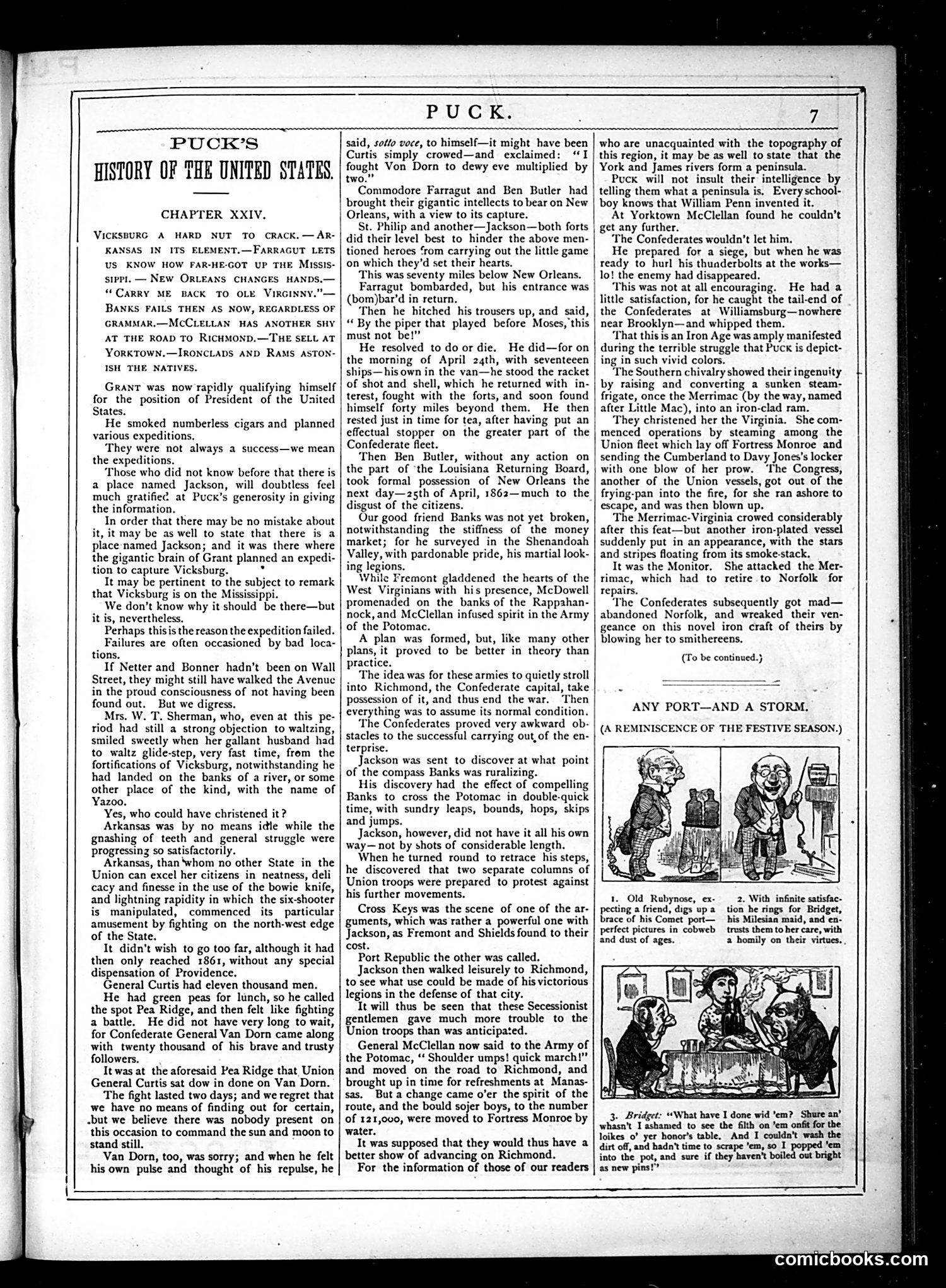
This page contains two distinct elements: **Main Content:** "Puck's History of the United States" - Chapter XXIV discusses Civil War military campaigns, particularly focusing on Vicksburg and New Orleans. The text criticizes Union generals' strategies and praises certain Confederate maneuvers, written from a satirical perspective examining the war's conduct. **Bottom Cartoons:** Two small illustrated vignettes titled "Any Port—and a Storm" (subtitled "A Reminiscence of the Festive Season") appear to depict domestic holiday scenes. The captions reference children and household activities, though the exact satirical point requires clearer visibility of the illustrations. The page primarily functions as historical commentary on Civil War military operations rather than contemporary political satire, mixing serious historical narrative with Puck's characteristic irreverent tone.
📄 Transcribed text from this page (OCR, searchable)
Machine-transcribed from the original scan — historical spelling and the odd misread are preserved.
PUCK. PUCK’S HISTORY OF THE UNITED STATES. CHAPTER XXIV. VICKSBURG A HARD NUT TO CRACK. — AR- KANSAS IN ITS ELEMENT.—FARRAGUT LETS US KNOW HOW FAR-HE-GOT UP THE Missis- sippl. — NEw ORLEANS CHANGES HANDS.— “CARRY ME BACK TO OLE ViIRGINNY.”— BANKS FAILS THEN AS NOW, REGARDLESS OF GRAMMAR.—MCCLELLAN HAS ANOTHER SHY AT THE ROAD TO RICHMOND.—THE SELL AT Yorktown.—IRONCLADS AND RaMs ASTON- ISH THE NATIVES. Grant was now rapidly qualifying himself for the position of President of the United States. He smoked numberless cigars and planned various expeditions, They were not always a success—we mean the expeditions. ‘Those who did not know before that there is a place named Jackson, will doubtless feel much gratifiee at Puck’s generosity in giving the information. In order that there may be no mistake about it, it may be as well to state that there is a place named Jackson; and it was there where the gigantic brain of Grant planned an expedi- tion to capture Vicksburg. . It may be pertinent to the subject to remark that Vicksburg is on the Mississippi. We don’t know why it should be there—but it is, nevertheless. Perhaps thisis the reason the expedition failed. Failures are often occasioned by bad loca- tions. If Netter and Bonner hadn’t been on Wall Street, they might still have walked the Avenue in the proud consciousness of not having been found out. But we digress. Mrs. W. T. Sherman, who, even at this pe- riod had still a strong objection to waltzing, smiled sweetly when her gallant husband had to waltz glide-step, very fast time, frem the fortifications of Vicksburg, notwithstanding he had landed on the banks of a river, or some other place of the kind, with the name of Yazoo. Yes, who could have christened it? Arkansas was by no means idle while the gnashing of teeth and general struggle were progressing so satisfactorily. Arkansas, than‘whom no other State in the Union can excel her citizens in neatness, deli cacy and finesse in the use of the bowie knife, and lightning rapidity in which the six-shooter is manipulated, commenced its particular amusement by fighting on the north-west edge of the State, It didn’t wish to go too far, although it had then only reached 1861, without any special dispensation of Providence. General Curtis had eleven thousand men. He had green peas for lunch, so he called the spot Pea Ridge, and then felt ‘like fighting a battle. He did not have very long to wait, for Confederate General Van Dorn came along with twenty thousand of his brave and trusty followers, Itwas at the aforesaid Pea Ridge that, Union General Curtis sat dow in done on Van Dorn. The fight lasted two days; and we regret that we have no means of finding out for certain, but we believe there was nobody present on this occasion to command the sun and moon to stand still. Van Dorn, too, was sorry; and when he felt his own pulse and thought of his repulse, he said, sotfo voce, to himself—it might have been Curtis simply crowed—and exclaimed: “I fought Von Dorn to dewy eve multiplied by two.” Commodore Farragut and Ben Butler had brought their gigantic intellects to bear on New Orleans, with a view to its capture. St. Philip and another—Jackson—both forts did their level best to hinder the above men- tioned heroes ‘rom carrying out the little game on which they'd set their hearts. This was seventy miles below New Orleans. Farragut bombarded, but his entrance was (bom)bar’d in return. Then he hitched his trousers up, and said, “« By the piper that played before Moses, this must not be!” He resolved to do or die. He did—for on the morning of April 24th, with seventeeen ships—his own in the van—he stood the racket of shot and shell, which he returned with in- terest, fought with the forts, and soon found himself forty miles beyond them. He then rested just in time for tea, after having put an effectual stopper on the greater part of the Confederate fleet. Then Ben Butler, without any action on the part of ‘the Louisiana Returning Board, took formal possession of New Orleans the next day—2sth of April, 1862—much to the disgust of the citizens. Our good friend Banks was not yet broken, notwithstanding the stiffness of the money market; for he surveyed in the Shenandoah Valley, with pardonable pride, his martial look- ing legions. While Fremont gladdened the hearts of the West Virginians with his presence, McDowell promenaded on the banks of the Rappahan- nock, and McClellan infused spirit in the Army of the Potomac. A plan was formed, but, like many other plans, it proved to be better in theory than practice. The idea was for these armies to quietly stroll into Richmond, the Confederate capital, take possession of it, and thus end the war. Then everything was to assume its normal condition. ‘The Confederates proved very awkward ob- stacles to the successful carrying out,of the en- terprise. Jackson was sent to discover at what point of the compass Banks was ruralizing. His discovery had the effect of compelling Banks to cross the Potomac in double-quick time, with sundry leaps, bounds, hops, skips and jumps. Jackson, however, did not have it all his own way—not by shots of considerable length. When he turned round to retrace his steps, he discovered that two separate columns of Union troops were prepared to protest against his further movements. Cross Keys was the scene of one of the ar- guments, which was rather a powerful one with Jackson, as Fremont and Shields found to their cost. Port Republic the other was called. Jackson then walked leisurely to Richmond, to see what use could be made of his victorious legions in the defense of that city. It will thus be seen that these Secessionist gentlemen gave much more trouble to the Union troops than was anticipated. General McClellan now said to the Army of the Potomac, ‘ Shoulder umps! quick march!” and moved on the road to Richmond, and brought up in time for refreshments at Manas- sas. But a change came o’er the spirit of the route, and the bould sojer boys, to the number of 121,000, were moved to Fortress Monroe by water. It was supposed that they would thus have a better show of advancing on Richmond. For the information of those of our readers | little satisfaction, for he caug! who are unacquainted with the topography of this region, it may be as well to state that the York and James rivers form a peninsula. Puck will not insult their intelligence by telling them what a peninsula is. Every school- boy knows that William Penn invented it. At Yorktown McClellan found he couldn’t get any further, ‘The Confederates wouldn't let him. He prepared for a siege, but when he was ready to hurl his thuaderbolts at the works— | lo! the enemy had disappeared. ‘This was not at all encouraging. He had a bt the tail-end of the Confederates at Williamsburg—nowhere near Brooklyn—and whipped them. ‘That this is an Iron Age was amply manifested during the terrible struggle that Puck is depict- ing in such vivid colors. ‘The Southern chivalry showed their ingenuity by raising and converting a sunken steam- frigate, once the Merrimac (by the way, named after Little Mac), into an iron-clad ram. They christened her the Virginia. She com- menced operations by steaming among the Union fleet which lay off Fortress Monroe and sending the Cumberland to Davy Jones's locker with one blow of her prow. ‘The Congress, another of the Union vessels, got out of the frying-pan into the fire, for she ran ashore to escape, and was then blown up. The Merrimac-Virginia crowed considerably after this feat—but another iron-plated vessel suddenly put in an appearance, with the stars and stripes floating from its smoke-stack. It was the Monitor. She attacked the Mer- rimac, which had to retire to Norfolk for repairs. The Confederates subsequently got mad— abandoned Norfolk, and wreaked their ven- geance on this novel iron craft of theirs by blowing her to smithereens. (To be continued.) ANY PORT—AND A STORM. (A REMINISCENCE OF THE FESTIVE SEASON.) 2. With infinite satisfac- tion he rings for Bridget, his Milesian maid, and en- trusts them to her care, with a homily on their virtues. . 1, Old Rubynose, ex- pecting a friend, digs up a brace of his Comet port— perfect pictures in cobweb and dust of ages. 3. Bridget: “What have I done wid 'em? Shure an’ whasn'’t I ashamed to see the filth on ‘em onfit for the loikes 0” yer honor’s table. And I couldn't wash the dirt off, and hadn’t time to scrape 'em, so I tem into the pot, and sure if they haven’t boiled out as new pins!” comicbooks.com