
Puck, 1878-01-23 · page 10 of 16
Puck — January 23, 1878 — page 10: what you’re looking at
What you’re looking at
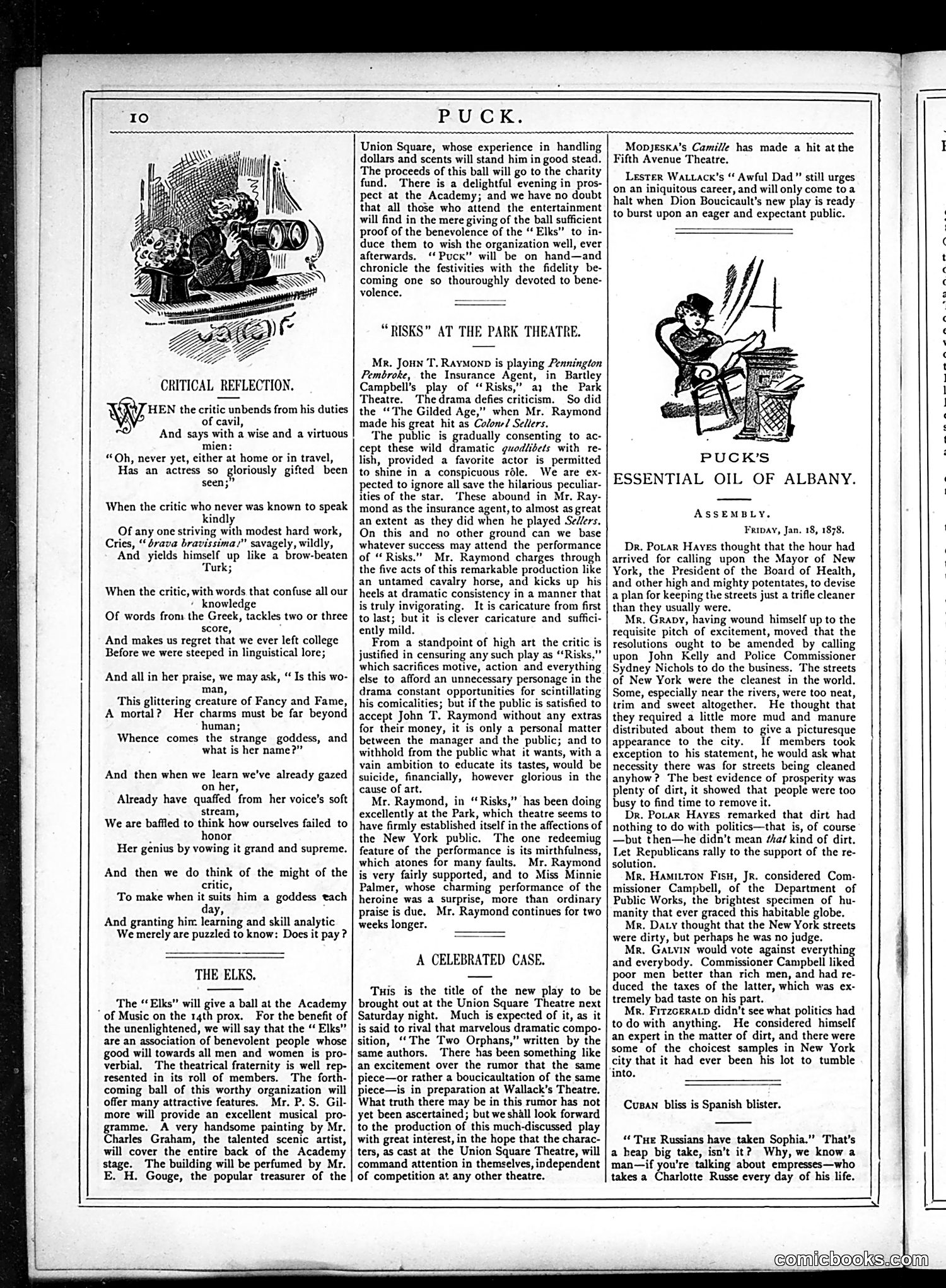
This page contains theater reviews and commentary rather than political cartoons. The main visual element is "Critical Reflection," a decorative illustration showing figures in classical dress, accompanying a poem praising an unnamed actress of "Fancy and Fame." The text discusses several theatrical productions: "Risks" at the Park Theatre (starring Mr. Raymond), "The Elks" ball at the Academy of Music, and an upcoming play titled "The Two Orphans" at Union Square Theatre. The Assembly section reports on civic matters: Dr. Polar Hayes and city officials debating street cleanliness in New York, with discussion of dust and dirt management. Commissioner Campbell appears involved in these municipal debates. The page is primarily entertainment and local governance coverage rather than satirical political commentary.
📄 Transcribed text from this page (OCR, searchable)
Machine-transcribed from the original scan — historical spelling and the odd misread are preserved.
—} fe) PUCK. CRITICAL REFLECTION. (\7 HEN the critic unbends from his duties of cavil, And says with a wise and a virtuous mien: “Oh, never yet, cither at home or in travel, Has an actress so gloriously gifted been a seen; When the critic who never was known to speak kindly Of any one striving with modest hard work, Cries, “brava bravissima!” savagely, wildly, And yields himself up like a brow-beaten Turk; When the critic, with words that confuse all our + knowledge Of words from the Greek, tackles two or three score, And makes us regret that we ever left college Before we were steeped in linguistical lore; And all in her praise, we may ask, “ Is this wo- man, This glittering creature of Fancy and Fame, A mortal? Her charms must be far beyond human; Whence comes the strange goddess, and what is her name?” And then when we learn we've already gazed on her, Already have quaffed from her voice’s soft stream, We are baffled to think how ourselves failed to = honor Her genius by vowing it grand and supreme. And then we do think of the might of the critic, To make when it suits him a goddess tach day And granting hin: learning and skill analytic We merely are puzzled to know: Does it pay? THE ELKS, The “Elks” will give a ball at the Academy “of Music on the 14th prox. For the benefit of the unenlightened, we will say that the ‘“ Elks” are an association of benevolent people whose good will towards all men and women is pro- verbial. The theatrical fraternity is well rep- resented in its roll of members. The forth- coming ball of this worthy organization will offer many attractive features. Mr. P. S. Gil- more will provide an excellent musical pro- imme. A very handsome painting by Mr. harles Graham, the talented scenic artist, will cover the entire back of the Academy stage. The building will be perfumed by Mr. E. H. Gouge, the popular treasurer of the Union Square, whose experience in handling dollars and scents will stand him in good stead. The proceeds of this ball will go to the charity fund, There is a delightful evening in pros- pect at the Academy; and we have no doubt that all those who attend the entertainment will find in the mere giving of the ball sufficient proof of the benevolence of the “‘ Elks” to in- duce them to wish the organization well, ever afterwards. ‘ Puck” will be on hand—and chronicle the festivities with the fidelity be- coming one so thouroughly devoted to bene- volence. “RISKS” AT THE PARK THEATRE. Mr. Joun T. Raymonn is playing Pennington Pembroke, the Insurance Agent, in Bartley Campbell’s play of “Risks,” ay the Park Theatre. The drama defies criticism. So did the “The Gilded Age,” when Mr. Raymond made his great hit as Colone/ Sellers. ‘The public is gradually consenting to ac- cept these wild dramatic guodlibels with re- lish, provided a favorite actor is permitted to shine in a conspicuous réle. We are ex- cted to ignore all save the hilarious peculiar- ities of the star. ‘These abound in Mr. Ray- mond as the insurance agent, to almost as great an extent as they did when he played Sedlers, On this and no other ground can we base whatever success may attend the performance of “Risks.” Mr. Raymond charges through the five acts of this remarkable production like an untamed cavalry horse, and kicks up his heels at dramatic consistency in a manner that is truly invigorating. It is caricature from first to last; but it is clever caricature and suffici- ently mild. From a standpoint of high art the critic is justified in censuring any such play as “Risks,” which sacrifices motive, action and everything else to afford an unnecessary personage in the drama constant opportunities for scintillating his comicalities; but if the public is satisfied to accept John T. Raymond without any extras for their money, it is only a personal matter between the manager and the public; and to withhold from the public what it wants, with a vain ambition to educate its tastes, would be suicide, financially, however glorious in the cause of art. Mr. Raymond, in “ Risks,” has been doing excellently at the Park, which theatre seems to have firmly established itself in the affections of the New York public. The one redeemiug feature of the performance is its mirthfulness, which atones for many faults. Mr. Raymond is very fairly supported, and to Miss Minnie Palmer, whose charming performance of the heroine was a surprise, more than ordinary praise is due. Mr. Raymond continues for two weeks longer. A CELEBRATED CASE. Tuis is the title of the new play to be brought out at the Union Square Theatre next Saturday night. Much is expected of it, as it is said to rival that marvelous dramatic compo- sition, “The Two Orphans,” written by the same authors. There has been something like an excitement over the rumor that the same piece—or rather a boucicaultation of the same piece—is in preparation at Wallack’s Theatre. What truth there may be in this rumor has not yet been ascertained; but we shall look forward to the production of this much-discussed play with great interest, in the hope that the charac- ters, as cast at the Union Square Theatre, will command attention in themselves, independent of competition at any other theatre. Mopjesxa's Camille has made a hit at the Fifth Avenue Theatre. Lester Wattack's “ Awful Dad” still urges on an iniquitous career, and will only come toa halt when Dion Boucicault’s new play is ready to burst upon an eager and expectant public. PUCK’S ESSENTIAL OIL OF ALBANY. ASSEMBLY. Frivay, Jan. 18, 1878, Dr. Potar Haves thought that the hour had arrived for calling upon the Mayor of New York, the President of the Board of Health, and other high and mighty potentates, to devise a plan for keeping the streets just a trifle cleaner than they usually were. Mr. Gray, having wound himself up to the requisite pitch of excitement, moved that the resolutions ought to be amended by calling upon John Kelly and Police Commissioner Sydney Nichols to do the business. The streets of New York were the cleanest in the world. Some, especially near the rivers, were too neat, trim and sweet altogether. He thought that they required a little more mud and manure distributed about them to give a picturesque appearance to the city. If members took exception to his statement, he would ask what necessity there was for streets being cleaned anyhow? The best evidence of prosperity was plenty of dirt, it showed that people were too busy to find time to remove it. Dr. Poar Hayes remarked that dirt had nothing to do with politics—that is, of course —but then—he didn’t mean hat kind of dirt. Let Republicans rally to the support of the re- solution. Mr. Hamitton Fis, JR. considered Com- missioner Campbell, of the Department of Public Works, the brightest specimen of hu- manity that ever graced this habitable globe. Mr. Daty thought that the New York streets were dirty, but perhaps he was no judge. Mr. Gatvin would vote against everythin; and everybody. Commissioner Campbell liked poor men better than rich men, and had re- duced the taxes of the latter, which was ex- tremely bad taste on his part. Mr. Fitzceratp didn't see what politics had todo with anything. He considered himself an expert in the matter of dirt, and there were some of the choicest samples in New York city that it had ever been his lot to tumble into. Cusan bliss is Spanish blister. “Te Russians have taken Sophia.” That's a heap big take, isn’t it? Why, we know a man—if you're talking about empresses—who takes a Charlotte Russe every day of his life. ¢ t « « a