
A complete issue · 16 pages · 1878
Puck — January 2, 1878
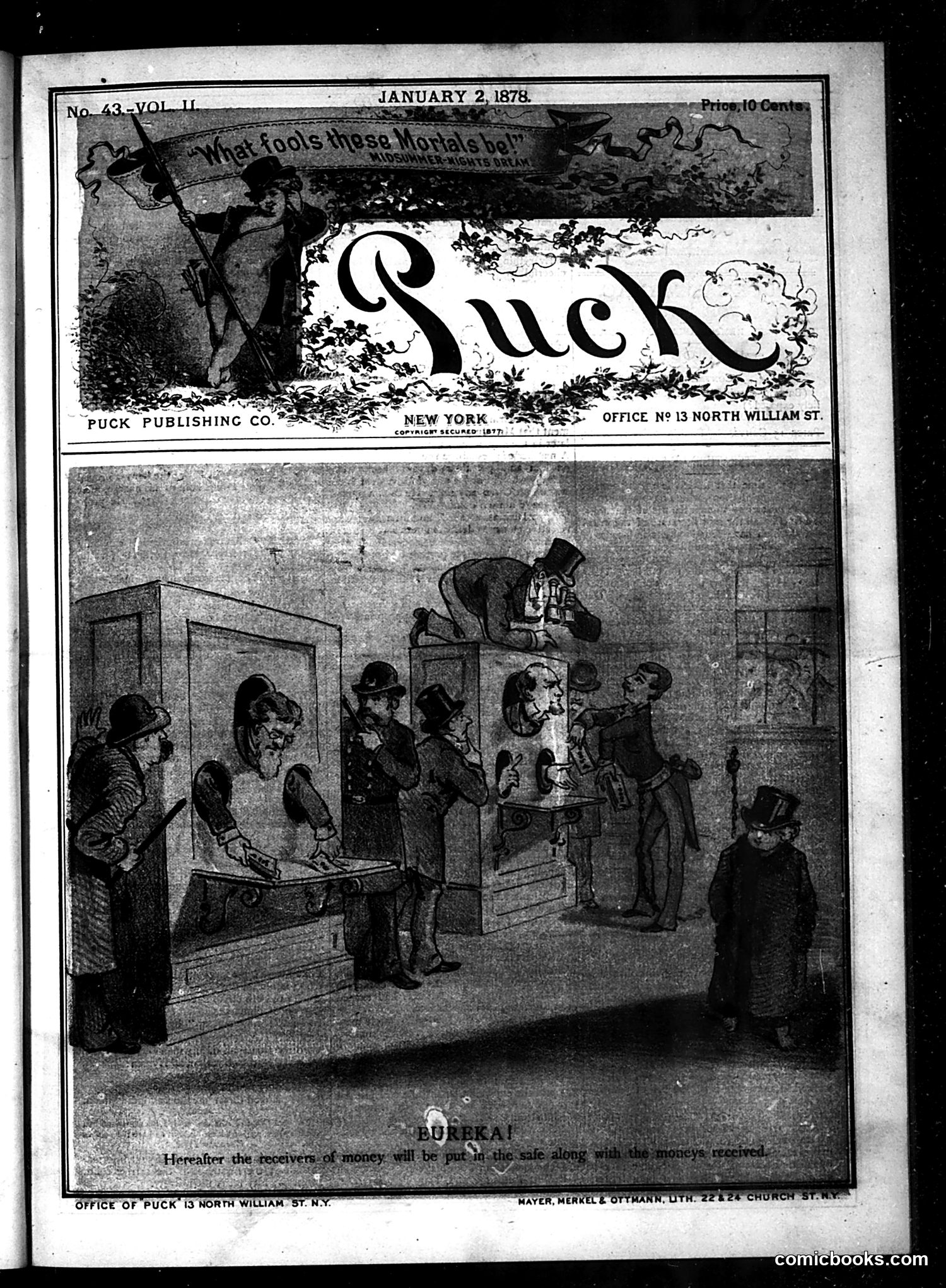
This page features a satirical cartoon titled "Eureka!" depicting a bank or money-changing establishment. The scene shows well-dressed men (likely bankers or financial operators) gathered around what appears to be a safe or vault, with one figure positioned on top of it. The caption reads: "Hereafter the receivers of money will be put in the safe along with the moneys received." This is political satire targeting financial corruption or embezzlement. The joke suggests that bank officials who mishandle or steal deposited funds should themselves be locked in safes—implying that contemporary bankers cannot be trusted with public money. The cartoon mocks 1870s concerns about financial fraud and the dishonesty of financial institutions during the Gilded Age.
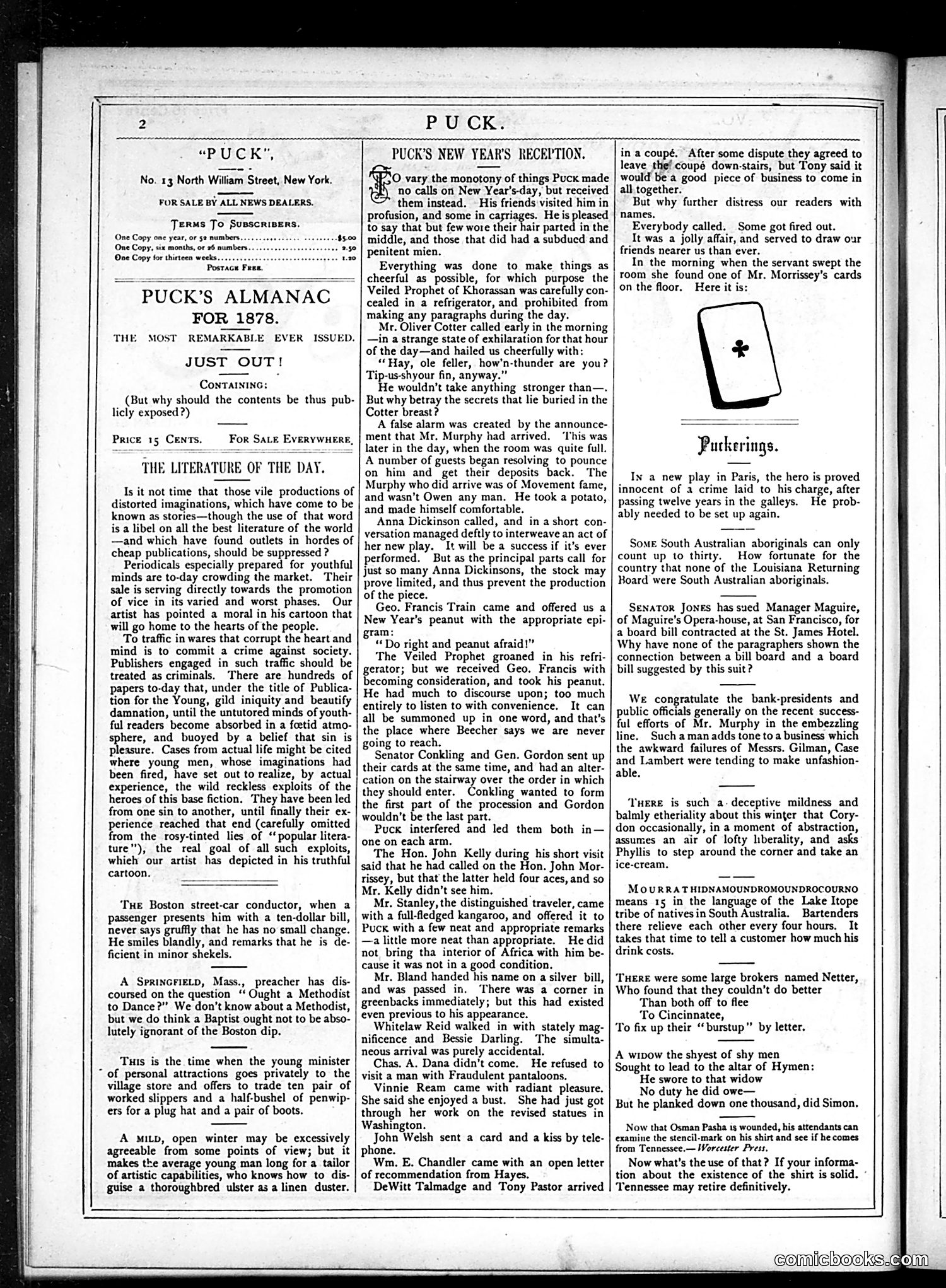
This page is primarily **editorial and advertising content** rather than political cartoons. The masthead announces "Puck's New Year's Reception" — a humorous narrative account of the magazine's New Year's Day gathering. The single visible cartoon shows a **playing card (club suit)** labeled "Puckerings," accompanying brief satirical notes about theater and politics. The main text mocks the chaos of Puck's New Year's party, describing various guests' arrival and behavior. It satirizes contemporary figures mentioned casually (Mr. Murphy, Senator Jones, Mr. Beecher), but without the visual caricature we'd expect from Puck's famous cartoons. The remaining content consists of **social commentary, theater criticism, and advertising** for Puck's Almanac. This appears a lighter, more literary issue than Puck's typical satirical cartoon-focused format.
This page contains three distinct sections: 1. **"Fitznoodle in America"** (left column): A humorous travel narrative where the narrator describes New Year's celebrations in New York, contrasting American customs with European ones. The satire mocks American social pretensions and nouveau-riche behavior—particularly wealthy Americans' awkward attempts at sophistication and their tendency toward excessive drinking and questionable etiquette. 2. **"The Voices of the Night"** (center): A poem featuring nighttime urban sounds, likely satirizing industrial American city life. 3. **"Cambridge Cads"** and **"British Enlightenment"** (right): Social commentary on Cambridge University undergraduates and a brief note about advertisements for children's products, mocking British upper-class youth behavior. The overall tone is satirical critique of both American and British social classes.
This page contains literary and humor content rather than political cartoons. The main pieces include: **"A Fable for Rulers"** — A French fable about a king and his courtiers hunting, emphasizing themes of power and flattery among rulers. **"Puck's History of the United States, Chapter XXII"** — A satirical historical narrative focusing on Lincoln-era politics, particularly tensions between Lincoln and Southern secessionists over military appropriations and the status of Fort Sumter. The satire critiques both Northern and Southern political positions during the Civil War period. **"Evarts's Fun"** — A brief anecdote about wit at a New England dinner, likely referencing William Maxwell Evarts, a prominent 19th-century lawyer and politician. **"Answers for the Curious"** — An advice column addressing various reader questions. The page demonstrates Puck's blend of political satire, historical commentary, and humor content typical of the era.
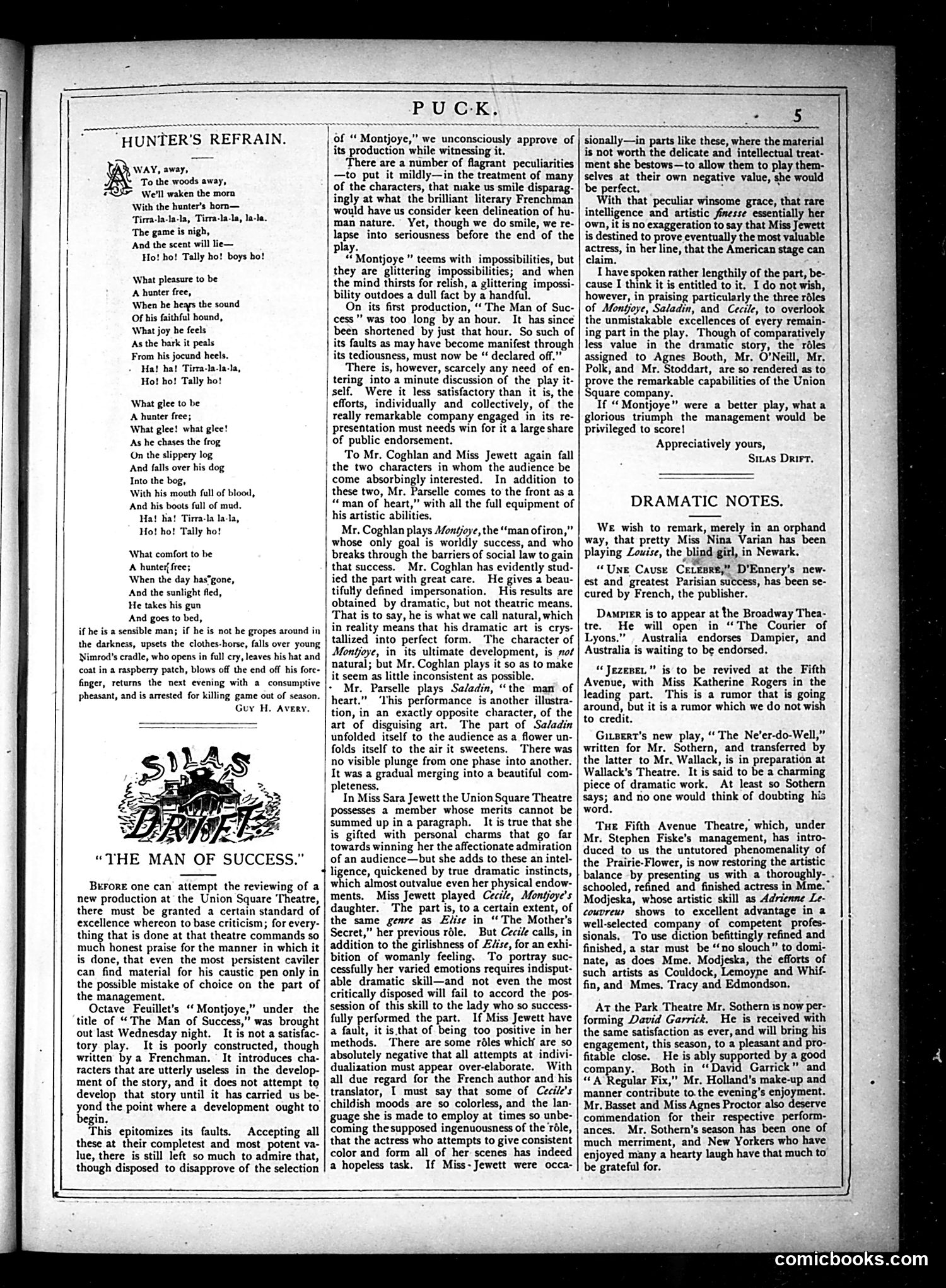
This page contains theater criticism rather than political cartoons. The main content discusses productions at the Union Square Theatre, including reviews of "Montjoye" and "The Man of Success." The critic (Silas Drifft) praises certain performances while critiquing the plays themselves as poorly constructed. He commends actors like Mr. Coghlan and Miss Jewett for their skill in elevating weak material. The "Dramatic Notes" section briefly mentions various theatrical productions and personnel changes at different theaters around New York. The only illustration visible is a small decorative emblem labeled "SILAS DRIFTS" at the bottom—likely the critic's signature mark rather than a political cartoon. This represents Puck's arts criticism rather than its satirical commentary on current events or politics.
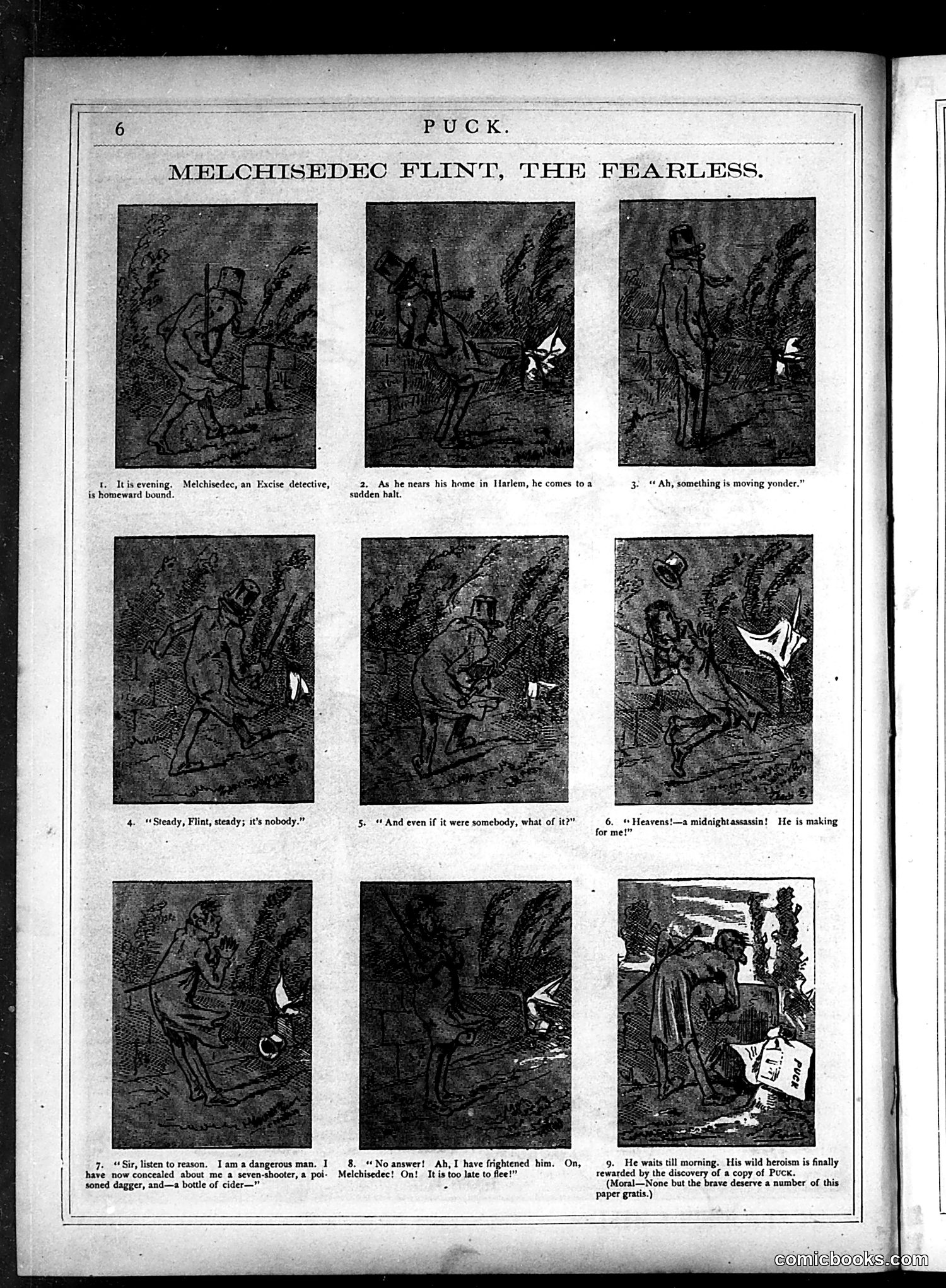
This nine-panel narrative follows Melchisedec Flint, apparently an excise detective, returning home to Harlem one evening. He encounters a mysterious midnight assassin but fearlessly confronts the danger. The story culminates with Flint's wife discovering his body the next morning—he has been killed by a seven-shooter pistol and poisoned dagger. The moral appended reads: "None but the brave deserve a number of this paper grats [sic]." This appears to be a serialized adventure story rather than political satire. It emphasizes courage in the face of urban criminal violence, using melodramatic violence and moral instruction typical of Puck's mixed content during this era.
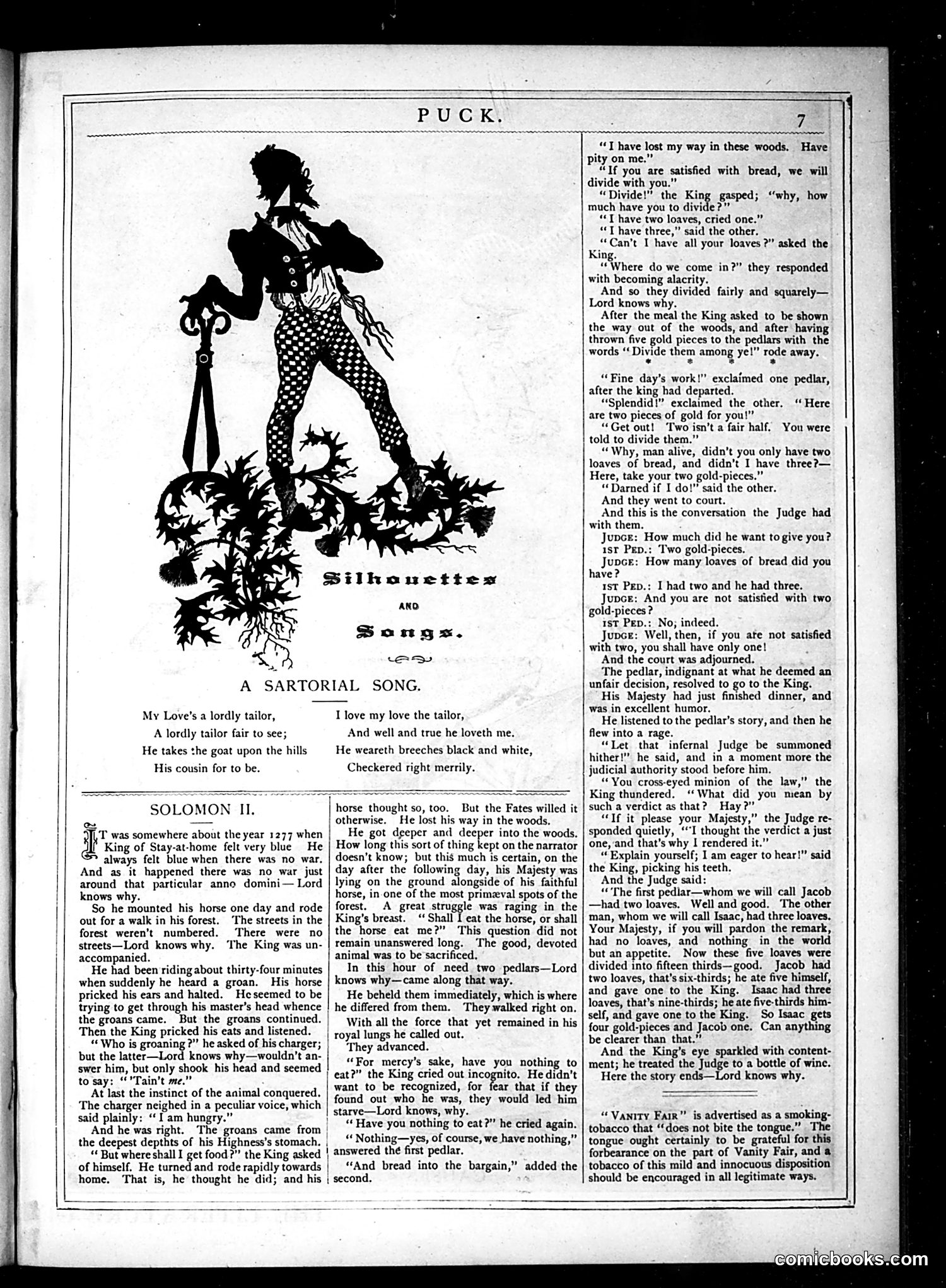
This page contains a silhouette illustration labeled "Silhouettes and Songs" featuring a jester or fool figure, followed by a sartorial song about a tailor, and a story titled "Solomon II." The main narrative concerns a king whose horse goes missing in the woods. The king and his accompanying pedlars become lost searching for it. When they emerge, the king asks them to divide bread fairly as payment. A dispute erupts—one pedlar claims two loaves, another claims three. A judge arbitrates, ultimately ruling the complaining pedlar receives only one loaf, finding his argument logically flawed. The satire appears to mock judicial reasoning and the vagaries of fairness, though the specific historical or political reference remains unclear from the text alone. The story's tone suggests gentle ridicule of legal proceedings rather than pointed political commentary.
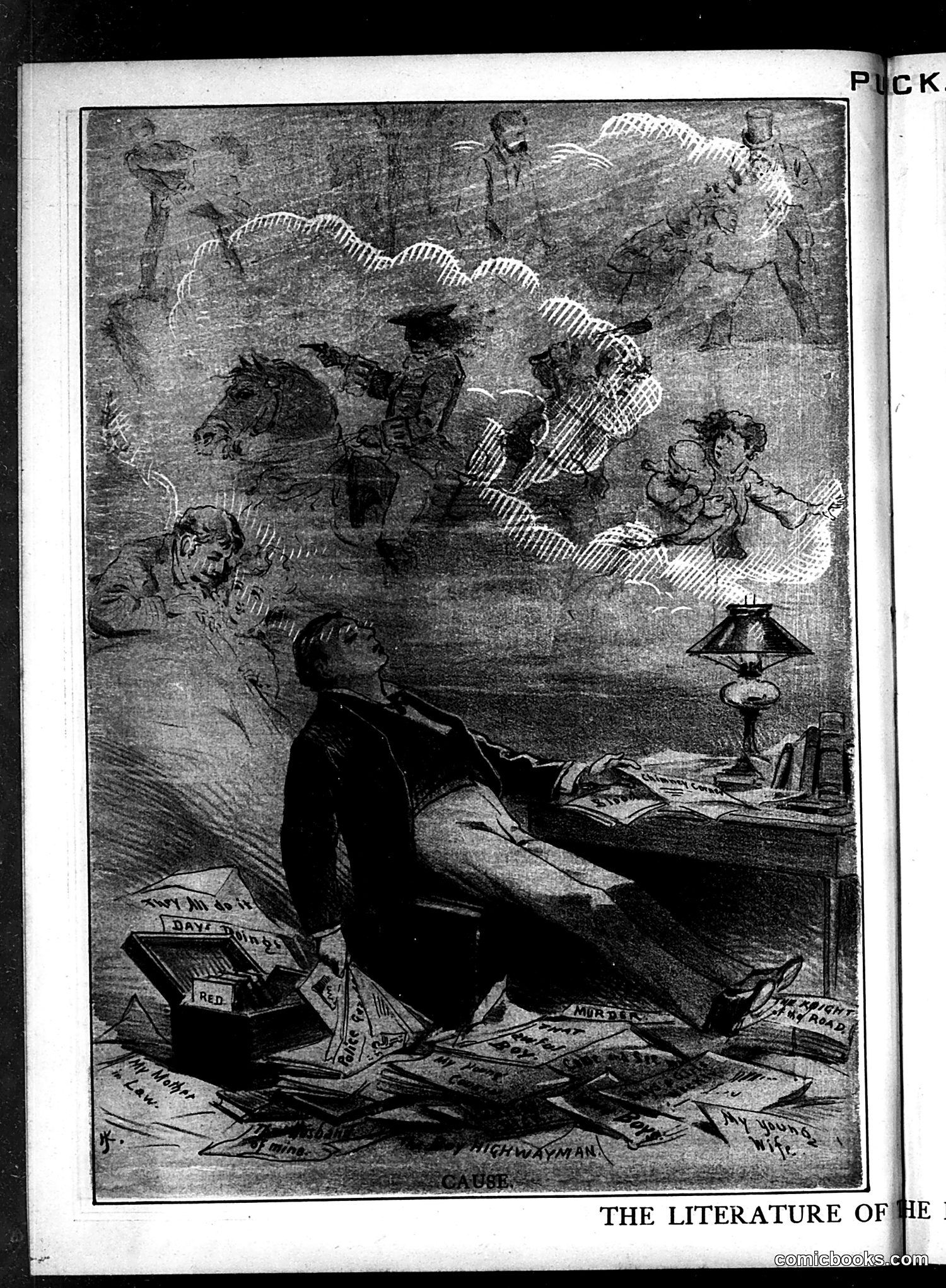
This appears to be a satirical illustration showing a man at a desk dreaming or fantasizing about figures in the clouds above. The sleeping figure is surrounded by scattered papers labeled with what appear to be literary or publication titles (text is difficult to read precisely in this reproduction). The caption reads "THE LITERATURE OF" (text cuts off), suggesting this is commentary on contemporary literature or publishing. The dreaming man seems to be a literary figure or critic, while the ethereal figures above likely represent either idealized literary characters or perhaps muses. The satire appears to critique either the gap between literary aspirations and reality, or perhaps the fantastical nature of contemporary literary trends. Without clearer text legibility, the specific targets and precise satirical point remain somewhat unclear from this reproduction.
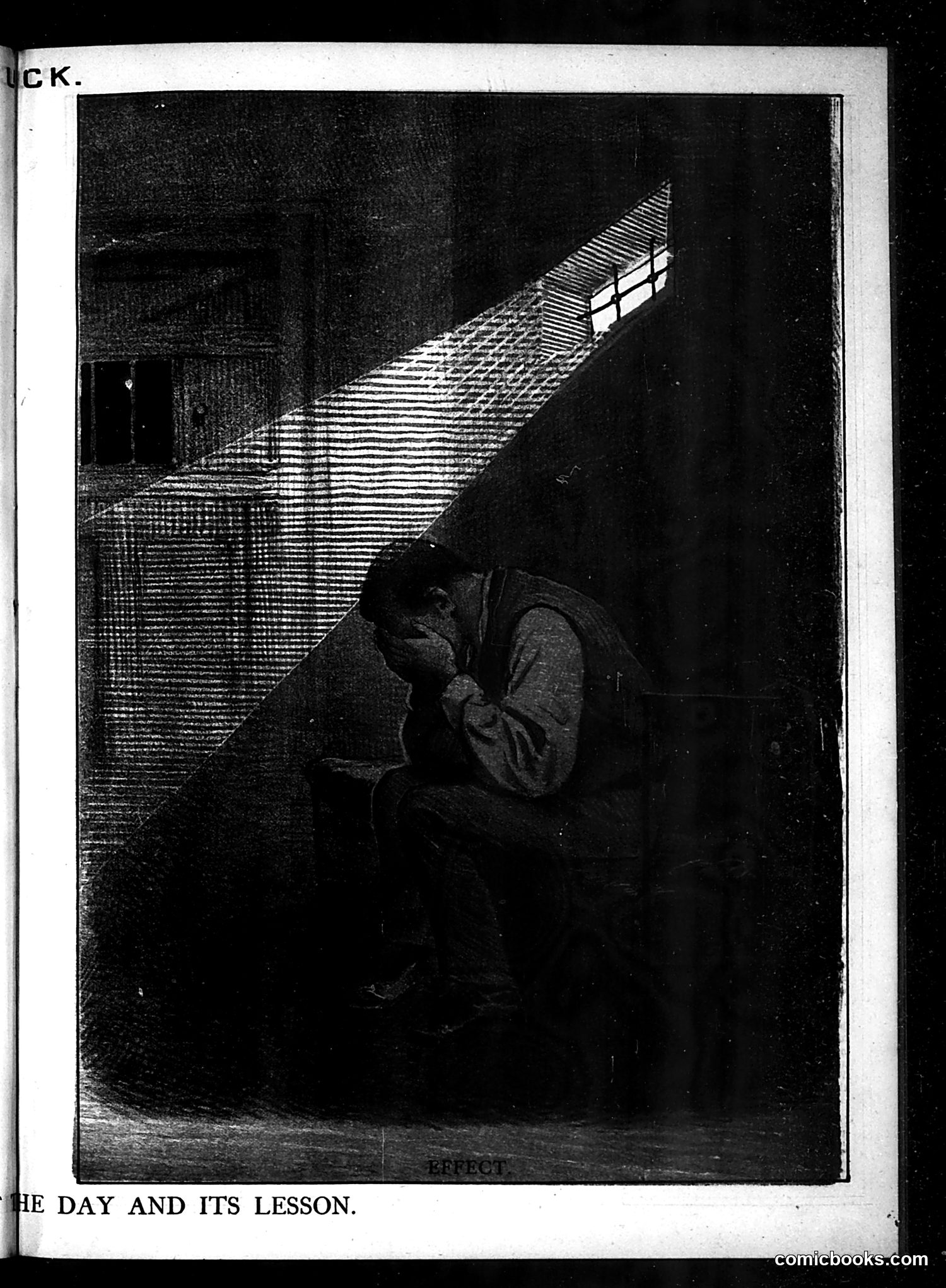
This political cartoon appears to depict a figure in dark clothing standing in a prison cell or confined space, with dramatic light streaming through barred windows above, creating a striking chiaroscuro effect. The caption "THE DAY AND ITS LESSON" suggests commentary on consequences or imprisonment resulting from some contemporary event or behavior. The image's dramatic lighting and the figure's posture convey a mood of confinement and reckoning. Without additional context from the magazine's date or surrounding articles, the specific identity of the figure and the exact political situation referenced remain unclear. However, the composition clearly intends to illustrate moral or political judgment through the visual metaphor of imprisonment.
This page satirizes New York City's financial crisis through a meeting where prominent citizens debate how to pay off municipal debt. The cartoon depicts **real political figures** including Mayor Hall, City Controller Murphy, and various wealthy New Yorkers arguing about contributions. The satire mocks their reluctance to donate: wealthy figures like Ex-Mayor Tweed initially refuse, then grudgingly offer minimal amounts. Rev. Beecher eventually shames them into giving more. The joke targets **wealthy elites' hypocrisy**—they claim patriotism while protecting their money, requiring moral pressure to contribute to public coffers. The other sections ("Puckerings," "Mr. and Mrs. Murphy," "Welsh Art") are separate short satirical pieces about fashion, domestic life, and cultural topics.
This page contains two distinct articles rather than political cartoons. The left column features "Wanted—A Holocaust," a satirical piece (attributed to the N.Y. Times) criticizing the alarming increase in small boys in cities. It sardonically proposes solutions like ice-cream, candy, and skating ponds to reduce their numbers—essentially mocking concerns about urban youth overpopulation and vagrancy. The right column begins "Two Knaves and a Queen," a fictional story by Frank Barrett. The visible excerpt describes theatrical intrigue involving characters De Galliffontaine, Mr. Fox, and the Trichsman in what appears to be a backstage drama involving theft or deception. Both pieces use humor to address social issues and entertainment, typical of Puck's satirical approach to contemporary concerns.
This page contains the conclusion of a serialized story titled "John Smith" (a fictional account), along with a section called "Puck's Exchanges"—a humor column featuring brief satirical quips about contemporary figures and events. The main narrative describes a dramatic escape scene involving fire and danger, told in melodramatic Victorian style. The "Exchanges" section offers witty one-liners mocking various public figures and social types—politicians, celebrities, and social figures whose names appear to be recognizable to the magazine's period readership. Without clearer image resolution of the cartoon illustrations or more identifiable names in the Exchanges section, the specific targets of satire remain unclear, though the format typifies Puck's approach to topical humor.
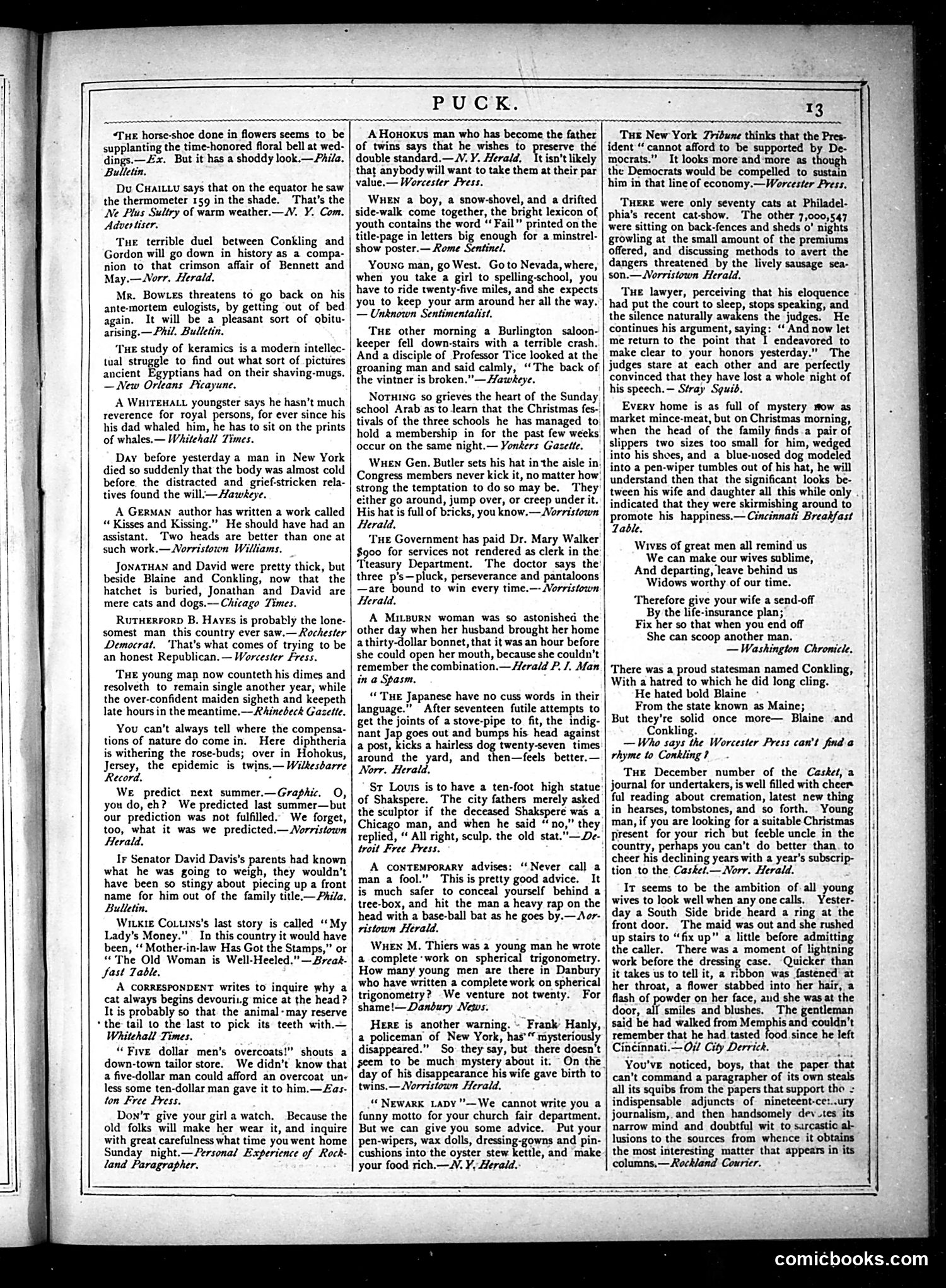
This page is primarily **text-based humor and anecdotes** rather than political cartoons. The content consists of short, satirical commentary pieces and jokes organized under the masthead "PUCK." The items mock various social situations: a woman's persistence in riding horseback despite injury, a man's invention of useless spherical trigonometry, disputes over Christmas cat casualties, and marital advice columns. There are references to contemporary institutions (Treasury Department, Burlington railroad, New York Herald) but these appear in humorous anecdotes rather than as targets of political satire. **No identifiable political figures or major cartoon imagery are visible** on this page. Instead, Puck employs its typical format of brief, witty observations about everyday American life—domestic mishaps, professional pretensions, and social absurdities—aimed at general middle-class readership rather than specific political commentary.
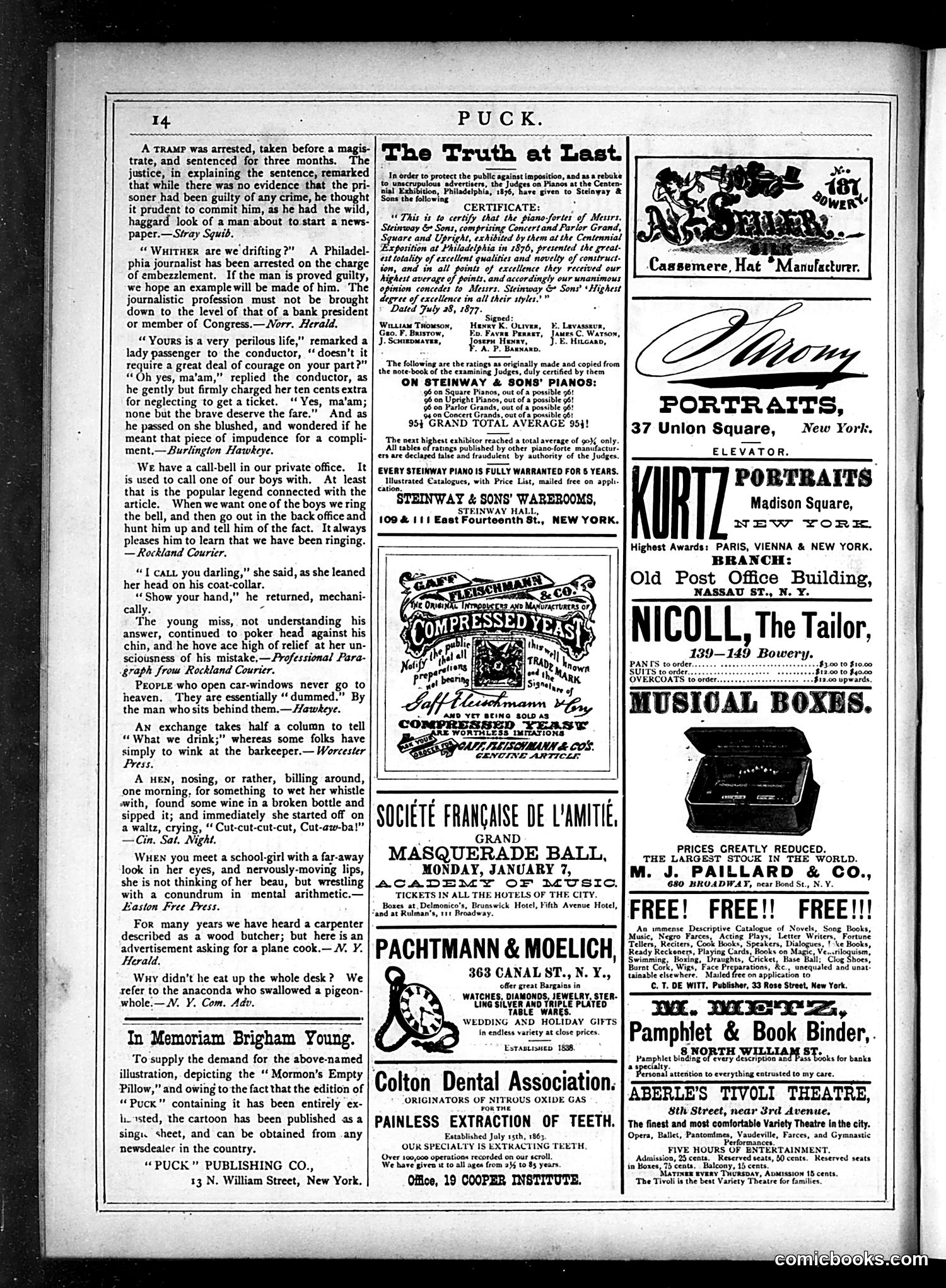
This page is primarily **advertisements and notices** rather than political cartoons. The visible content includes: **Main features:** - "The Truth at Last" - appears to be a satirical certificate regarding piano manufacturers (Steinway & Sons), though the specific satire is unclear from this reproduction - Multiple commercial ads for portraits, tailors, musical boxes, dental services, and theatrical venues - An "In Memoriam Brigham Young" notice referencing Mormon leadership and the LDS church - Various New York business advertisements **Notable detail:** The Brigham Young memorial references the "Mormon's Empty Pockets" cartoon from Puck, suggesting anti-Mormon satire was part of the magazine's content during this period. The page reflects Puck's business model: satirical content mixed with substantial advertising revenue.
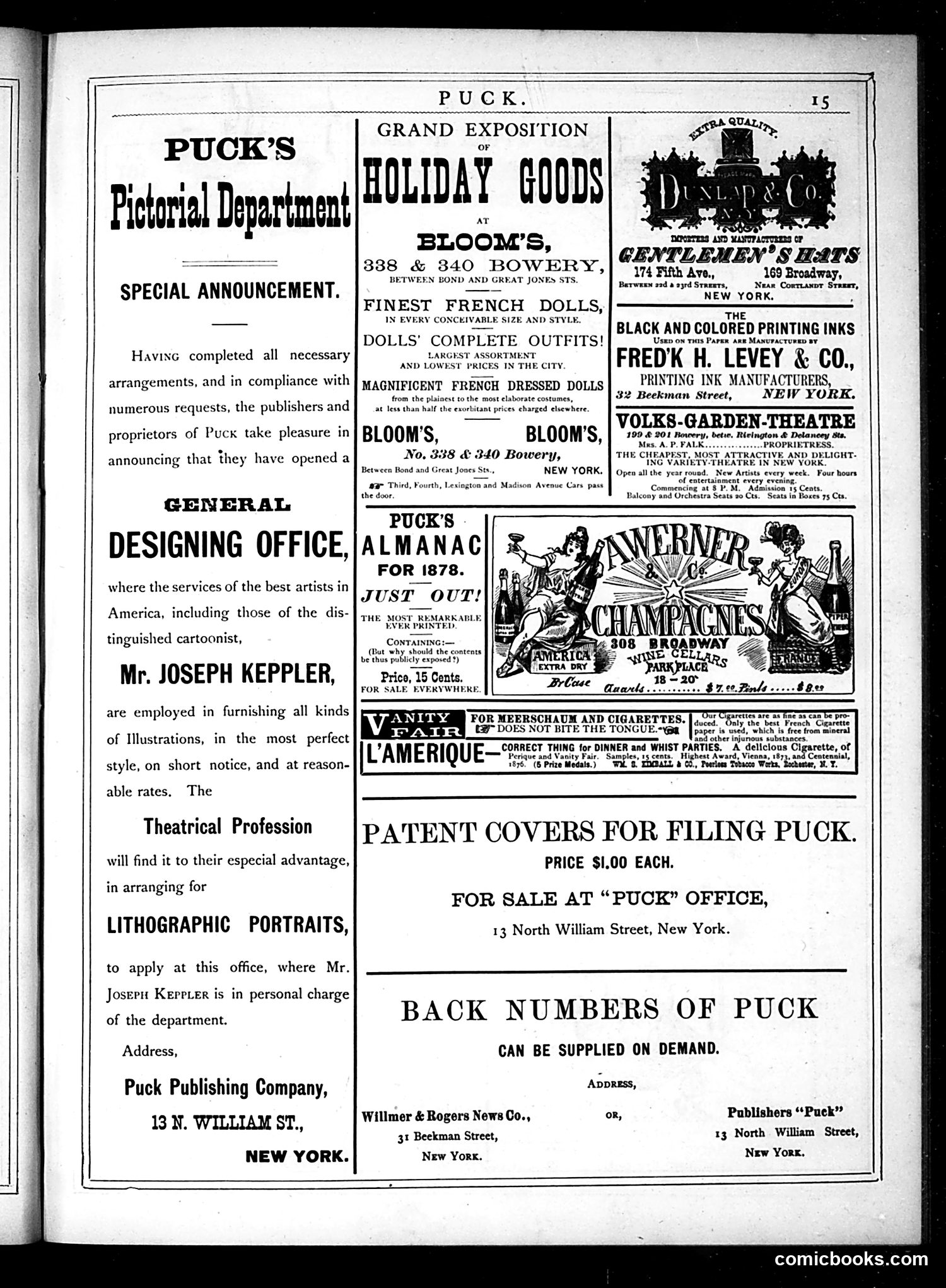
This is primarily an advertising and announcement page from Puck magazine (page 15) rather than a satirical cartoon page. The main content announces Puck's new "General Designing Office" employing cartoonist Joseph Keppler, offering illustration services to the theatrical profession and others. The page includes advertisements for various products: Bloom's holiday goods and French dolls, D. Nelin & Co. gentlemen's hats, French Ikey & Co. printing inks, and Volks-Garden-Theatre. There's also an ad for A. Werner & Co. champagnes and a patent cover offer for filing Puck issues. The only illustration visible is an ornate champagne advertisement showing classical figures. This is a business/administrative page with minimal satirical content.
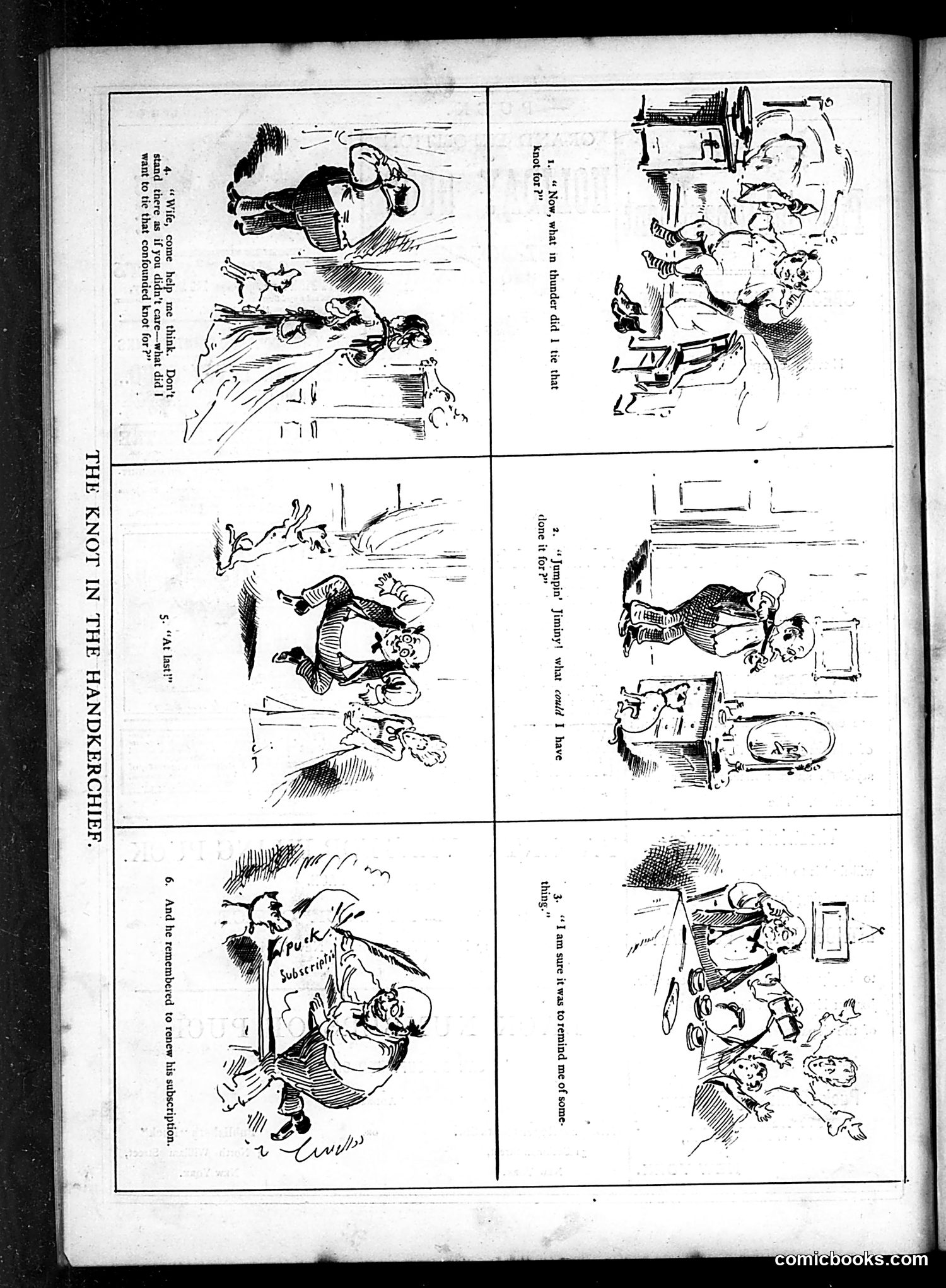
This Puck page presents six sequential cartoon panels depicting a narrative about memory aids. The title references the folk practice of tying knots in handkerchiefs to remember important tasks. Each panel shows a character (appears to be the same man) attempting to recall what the knot was meant to remind him of. The sequence humorously illustrates the futility of this memory method—the knot itself becomes forgotten or its purpose lost. The caricatured figure grows increasingly frustrated or bewildered across the panels. The satire mocks the ineffectiveness of makeshift memory devices and, more broadly, the disconnect between intention and outcome in everyday life. This was a relatable theme for Puck's audience, playing on universal frustrations with forgetfulness.