
Puck, 1878-01-02 · page 4 of 16
Puck — January 2, 1878 — page 4: what you’re looking at
What you’re looking at
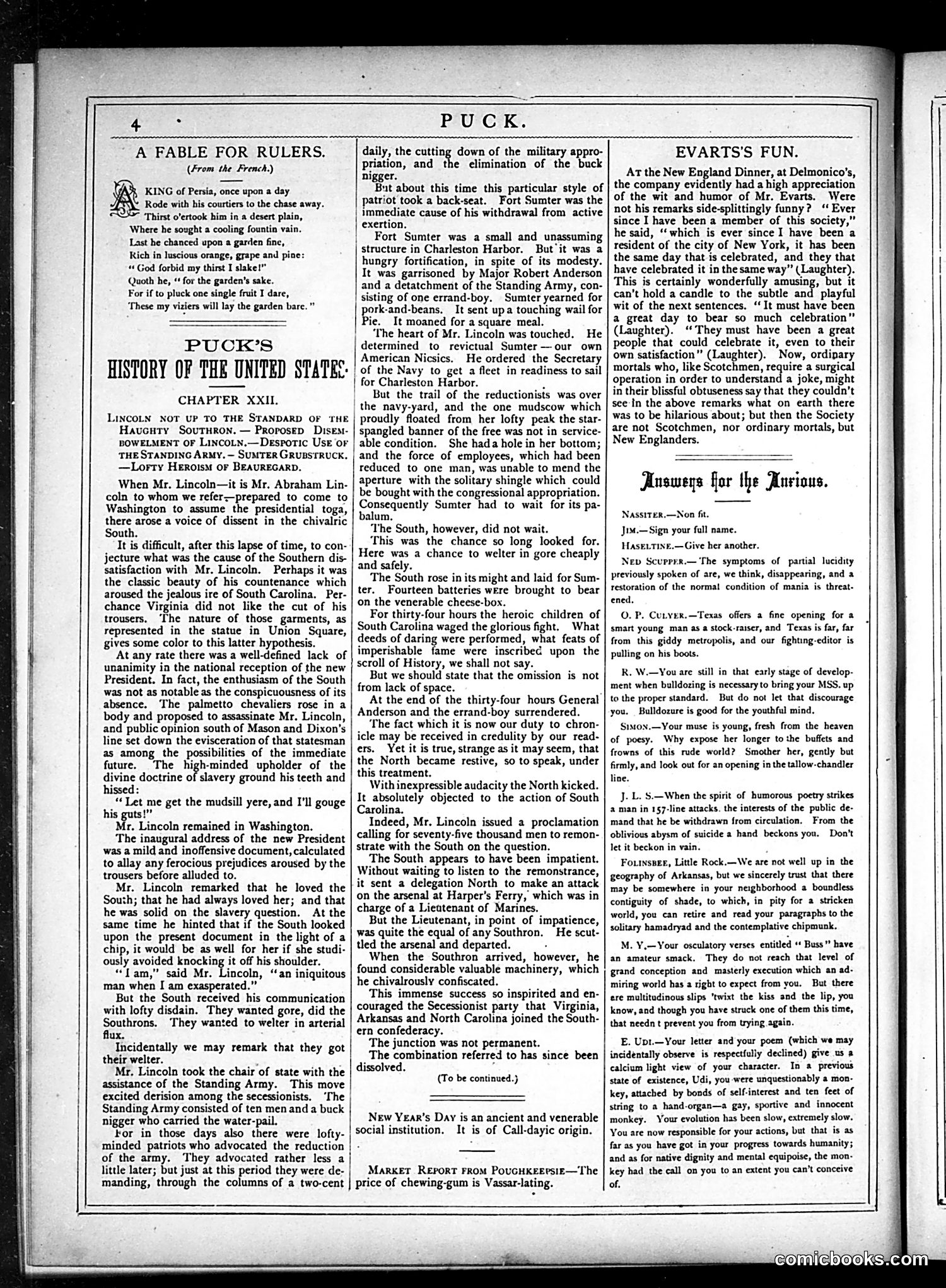
This page contains literary and humor content rather than political cartoons. The main pieces include: **"A Fable for Rulers"** — A French fable about a king and his courtiers hunting, emphasizing themes of power and flattery among rulers. **"Puck's History of the United States, Chapter XXII"** — A satirical historical narrative focusing on Lincoln-era politics, particularly tensions between Lincoln and Southern secessionists over military appropriations and the status of Fort Sumter. The satire critiques both Northern and Southern political positions during the Civil War period. **"Evarts's Fun"** — A brief anecdote about wit at a New England dinner, likely referencing William Maxwell Evarts, a prominent 19th-century lawyer and politician. **"Answers for the Curious"** — An advice column addressing various reader questions. The page demonstrates Puck's blend of political satire, historical commentary, and humor content typical of the era.
📄 Transcribed text from this page (OCR, searchable)
Machine-transcribed from the original scan — historical spelling and the odd misread are preserved.
PUCK. KING of Persia, once upon a day A FABLE FOR RULERS. (From the French.) R Rode with his courtiers to the chase away. ‘Thirst o’ertook him in a desert plain, Where he sought a cooling fountin vain. Last he chanced upon a garden fine, Rich in luscious orange, grape and pine: «God forbid my thirst I slake!” Quoth he, «for the garden’s sake. For if to pluck one single fruit I dare, “These my viziers will lay the garden bare.” " PUCK'S HISTORY OF THE UNITED STATES: CHAPTER XXII. LINCOLN NOT UP TO THE STANDARD OF Havucuty SourHron. — Proposed Disem- BOWELMENT OF Linco.n.—Desporic Use or THE STANDING ARMY. — SUMTER GRUBSTRUCK. —Lorty HeroisM oF BEAUREGARD. When Mr. Lincoln—it is Mr. Abraham Lin- coln to whom we refer—prepared to come to Washington to assume the presidential toga, there arose a voice of dissent in the chivalric South. It is difficult, after this lapse of time, to con- jecture what was the cause of the Southern dis- satisfaction with Mr. Lincoln. Perhaps it was the classic beauty of his countenance which aroused the jealous ire of South Carolina. Per- chance Virginia did not like the cut of his trousers. ‘The nature of those garments, as represented in the statue in Union Square, gives some color to this latter hypothesis. At any rate there was a well-defined lack of unanimity in the national reception of the new President. In fact, the enthusiasm of the South was not as notable as the conspicuousness of its absence. The palmetto chevaliers rose in a body and proposed to assassinate Mr. Lincoln, and public opinion south of Mason and Dixon's line set down the evisceration of that statesman as among the possibilities of the immediate future. The high-minded upholder of the divine doctrine of slavery ground his teeth and hissed: “Let me get the mudsill yere, and I'll gouge his guts!”” Mr. Lincoln remained in Washington. The inaugural address of the new President was a mild and inoffensive document, calculated to allay any ferocious prejudices aroused by the trousers before alluded to. Mr. Lincoln remarked that he loved the South; that he had always loved her; and that he was solid on the slavery question. At the same time he hinted that if the South looked upon the present document in the light of a chip, it would be as well for her if she studi- ously avoided Baoeking it off his shoulder. “fam,” said Mr. Lincoln, “an iniquitous man when I am exasperated.” But the South received his communication with lofty disdain. They wanted gore, did the Southrons. They wanted to welter in arterial flux. Incidentally we may remark that they got their welter. : Mr. Lincoln took the chair of state with the assistance of the Standing Army. This move excited derision among the secessionists. ‘The Standing Army consisted of ten men and a buck nigger who carried the water-pail. kor in those days also there were lofty- minded patriots who advocated the reduction of the army. They advocated rather less a little later; but just at this period they were de- | manding, through the columns of a two-cent THE | daily, the cutting down of the military appro- priation, and the elimination of the buck nigger. But about this time this particular style of patriot took a back-seat. Fort Sumter was the | immediate cause of his withdrawal from active exertion. | Fort Sumter was a small and unassuming structure in Charleston Harbor. But ‘it was a hungry fortification, in spite of its modesty. It was garrisoned by Major Robert Anderson and a detatchment of the Standing Army, con- sisting of one errand-boy. Sumter yearned for ork-and-beans. It sent upa touching wail for ie. It moaned for a square meal. ‘The heart of Mr. Lincoln was touched. He determined to revictual Sumter —our own American Nicsics. He ordered the Secretary of the Navy to get a fleet in readiness to sail | for Charleston Harbor. % | But the trail of the reductionists was over the navy-yard, and the one mudscow which proudly floated from her lofty peak the star- spangled banner of the free was not in service- able condition. She hada hole in her bottom; and the force of employees, which had been reduced to one man, was unable to mend the aperture with the solitary shingle which could be bought with the congressional appropriation. Consequently Sumter had to wait for its pa- lum, ‘The South, however, did not wait. ‘This was the chance so long looked for. Here was a chance to welter in gore cheaply and safely. The South rose in its might and laid for Sum- ter. Fourteen batteries were brought to bear on the venerable cheese-box. For thirty-four hours the heroic children of South Carolina waged the glorious fight. What deeds of Serine were performed, what feats of imperishable fame were inscribed upon the scroll of History, we shall not say. But we should state that the omission is not from lack of space. At the end of the thirty-four hours General Anderson and the errand-boy surrendered. ‘The fact which it is now our duty to chron- icle may be received in credulity by our read- ers. Yet it is true, strange as it may seem, that the North became restive, so to speak, under this treatment. With inexpressible audacity the North kicked. It absolutely objected to the action of South Carolina. Indeed, Mr. Lincoln issued a proclamation calling for seventy-five thousand men to remon- strate with the South on the question. The South appears to have been impatient. Without waiting to listen to the remonstrance, it sent a delegation North to make an attack on the arsenal at Harper's Ferry, which was in charge of a Lieutenant of Marines. But the Lieutenant, in point of impatience, was quite the equal of any Southron. He scut- tled the arsenal and departed. When the Southron arrived, however, he found considerable valuable machinery, which he chivalrously confiscated. This immense success so inspirited and en- couraged the Secessionist party that Virginia, Arkansas and North Carolina joined the South- ern confederacy. The junction was not permanent. The combination referred to has since been dissolved. (To be continued.) New Year's Day is an ancient and venerable social institution. It is of Call-dayic origin. Marker Report From PouGHKEEPsIE—The price of chewing-gum is Vassar-lating. EVARTS'S FUN. Art the New England Dinner, at Delmonico’s, the company evidently had a high appreciation of the wit and humor of Mr. Evarts. Were not his remarks side-splittingly funny? ‘ Ever since I have been a member of this society,” he said, “which is ever since I have been a resident of the city of New York, it has been the same day that is celebrated, and they that have celebrated it in the same way” (Laughter). This is certainly wonderfully arousing) but it can't hold a candle to the subtle playful wit of the next sentences. “It must have been a great day to bear so much celebration” (Laughter). “They must have been a great people that could celebrate it, even to their own satisfaction” Case). Now, ordipary mortals who, like Scotchmen zeire a surgical operation in order to understand a joke, might in their blissful obtuseness say that they couldn’t sce'In the above remarks what on earth there was to be hilarious about; but then the Society are not Scotchmen, nor ordinary mortals, but New Englanders. Answeys for the Aurious. NassiTeR.—Non fit. J. Hasetine.—Give her another. Nev Scurrrr.— ‘The symptoms of partial lucidity previously spoken of are, we think, disappearing, and a restoration of the normal condition of mania is threat. ened. O. P, Cunyer.—Texas offers a fine opening for a smart young man as @ stock-raiser, and Texas is far, far from this giddy metropolis, and our fighting-editor is pulling on his boots. R. W.—You are still in that early stage of develop- ment when bulldozing is necessary to bring your MSS. up to the proper standard. But do not let that discourage you. Bulldozure is good for the youthful mind. SiMoN.—Your muse is young, fresh from the heaven of poesy. Why expose her longer tothe buffets and frowns of this rude world? Smother her, gently but firmly, and look out for an opening in the tallow-chandler line. J. L. S.—When the spirit of humorous poetry strikes a man in 157-line attacks. the interests of the public de- mand that he be withdrawn from circulation, From the oblivious abysm of suicide a hand beckons you. Don't let it beckon in vain. Foutnspee, Little Rock.—We are not well up in the geography of Arkansas, but we sincerely trust that there may be somewhere in your neighborhood a boundless contiguity of shade, to which, in pity for a stricken world, you can retire and read your paragraphs to the solitary hamadryad and the contemplative chipmunk. M. Y.—Your osculatory verses entitled “ Buss” have an amateur smack. They do not reach that level of grand conception and masterly execution which an ad- miring world has a right to expect from you. But there ere multitudinous slips ’twixt the kiss and the lip, you know, and though you have struck one of them this time, that needn t prevent you from trying again. E. Upt.—Your letter and your poem (which we may incidentally observe is respectfully declined) give us a calcium light view of your character. In a previous state of existence, Udi, you-were unquestionably a mon- key, attached by bonds of self-interest and ten feet of string to a hand-organ—a gay, sportive and innocent monkey. Your evolution has been slow, extremely slow. You are now responsible for your actions, but that is as far as you have got in your progress towards humanity; and as for native dignity and mental equipoise, the mon- key had the call on you to an extent you can’t conceive of. Sign your full name.