
Puck, 1878-01-02 · page 5 of 16
Puck — January 2, 1878 — page 5: what you’re looking at
What you’re looking at
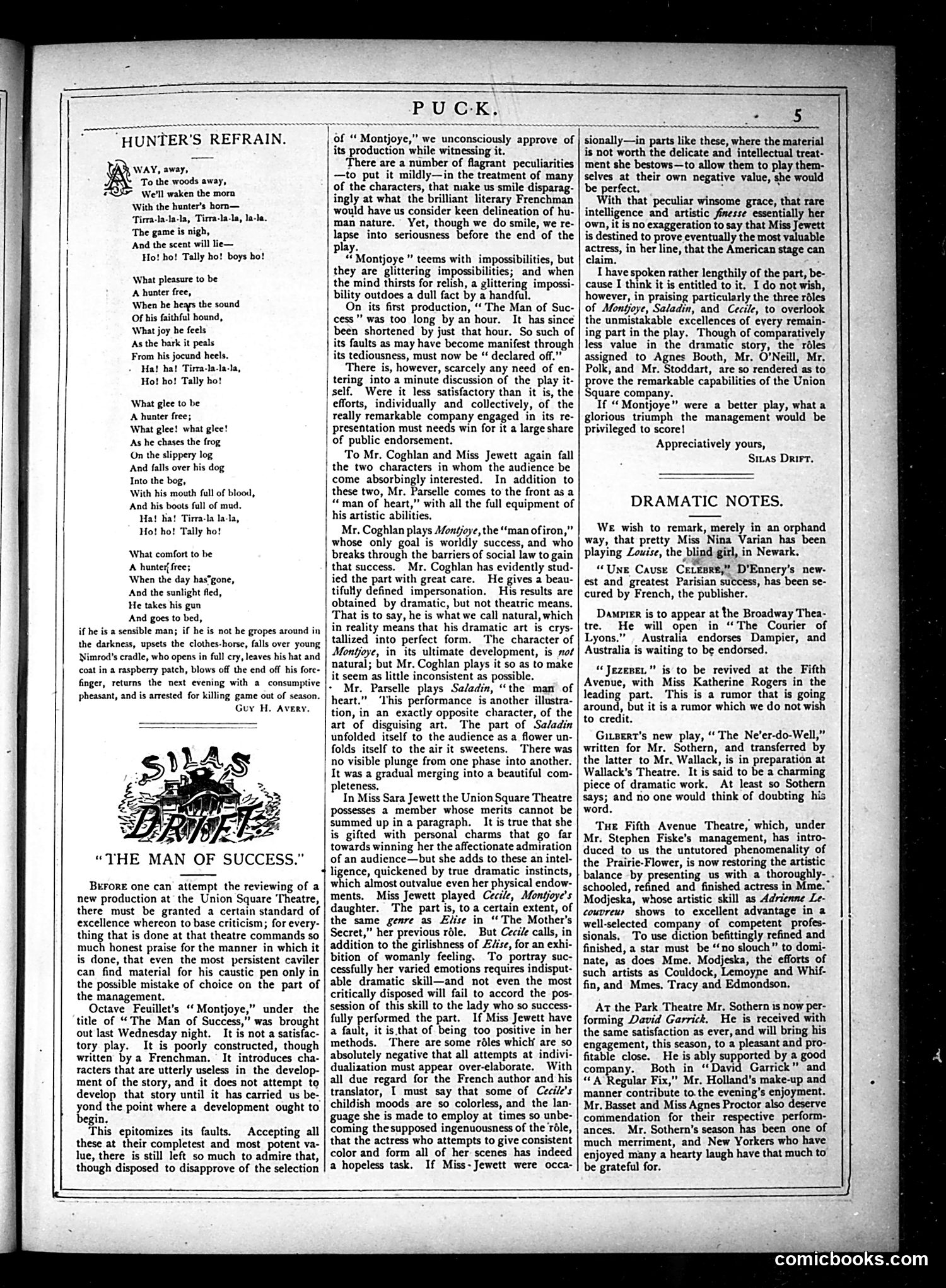
This page contains theater criticism rather than political cartoons. The main content discusses productions at the Union Square Theatre, including reviews of "Montjoye" and "The Man of Success." The critic (Silas Drifft) praises certain performances while critiquing the plays themselves as poorly constructed. He commends actors like Mr. Coghlan and Miss Jewett for their skill in elevating weak material. The "Dramatic Notes" section briefly mentions various theatrical productions and personnel changes at different theaters around New York. The only illustration visible is a small decorative emblem labeled "SILAS DRIFTS" at the bottom—likely the critic's signature mark rather than a political cartoon. This represents Puck's arts criticism rather than its satirical commentary on current events or politics.
📄 Transcribed text from this page (OCR, searchable)
Machine-transcribed from the original scan — historical spelling and the odd misread are preserved.
“HUNTER’S REFRAIN. WAY, away, To the woods away, G We'll waken the morn With the hunter’s horn— Tirra-la-la-la, Tirra-la-la, la-la. The game is nigh, And the scent will lie— Ho! ho! Tally ho! boys ho! What pleasure to be A hunter free, When he hes the sound Of his faithful hound, ‘What joy he feels As the bark it peals From his jocund heels. Ha! ha! Tirra-la-la Ho! ho! Tally hot ‘What glee to be A hunter free; What glee! what glee! As he chases the frog On the slippery log And falls over his dog Into the bog, With his mouth full of blood, And his boots full of mud. Ha! Ka! Tirra-la lala, Ho! ho! Tally ho! What comfort to be A hunter free; When the day has"gone, And the sunlight fled, He takes his gun ‘And goes to bed, if he is a sensible man; if he is not he gropes around in the darkness, upsets the clothes-horse, falls over young Nimrod’s cradle, who opens in full cry, leaves his hat and coat in a raspberry patch, blows off the end off his fore- finger, returns the next evening with a consumptive pheasant, and is arrested for killing game out of season. Guy H. Avery. LL; “THE MAN OF SUCCESS.” Brrore one can attempt the reviewing of a new production at the Union Square Theatre, there must be granted a certain standard of excellence whereon to base criticism; for every- thing that is done at that theatre commands so much honest praise for the manner in which it is done, that even the most persistent caviler can find material for his caustic pen only in the possible mistake of choice on the part of the management. Octave Feuillet's ‘‘Montjoye,” under the title of “The Man of Success,” was brought out last Wednesday night. It is not a satisfac- tory play. It is poorly constructed, though written by a Frenchman. | It introduces cha- racters that are utterly useless in the develop- ment of the story, and it does not attempt to develop that story until it has carried us be- yond the point where a development ought to begin. ‘This epitomizes its faults, Accepting all these at their completest and most potent va- lue, there is still left so much to admire that, though disposed to disapprove of the selection | of “ Montjoye,” we unconsciously approve of | its production while witnessing it. There are a number of flagrant peculiarities —to put it mildly—in the treatment of many of the characters, that make us smile disparag- ingly at what the brilliant literary Frenchman would have us consider keen delineation of hu- man nature. Yet, though we do smile, we re- lapse into seriousness before the end of the play. |" Montjoye ” teems with impossibilities, but | they are glittering impossibilities; and when | the mind thirsts for relish, a glittering impossi- bility outdoes a dull fact by a handful. On its first production, ‘The Man of Suc- cess" was too long by an hour. It has since | been shortened by just that hour. So such of its faults as may have become manifest through | its tediousness, must now be “ declared off.”” | There is, however, scarcely any need of en- tering into a minute discussion of the play it- self. Were it less satisfactory than it is, the | efforts, individually and collectively, of the really remarkable company engaged in its re- presentation must needs win for it a large share of public endorsement. | To Mr. Coghlan and Miss Jewett again fall | the two characters in whom the audience be come absorbingly interested. In addition to these two, Mr. Parselle comes to the front as a “man of heart,” with all the full equipment of his artistic abilities, Mr. Coghlan plays Montjoye, the ‘man ofiron,” whose only goal is worldly success, and who breaks through the barriers of social law to gain that success. Mr. Coghlan has evidently stud- ied the part with great care. He gives a beau- | tifully defined impersonation. His results are | obtained by dramatic, but not theatric means, | That is to say, he is what we call natural, which in reality means that his dramatic art is crys- tallized into perfect form. The character of Montjoye, in its ultimate development, is not natural; but Mr. Coghlan plays it so as to make it seem as little inconsistent as possible. + Mr. Parselle plays Sa/adin, “the man of heart.” ‘Ihis performance is another illustra- tion, in an exactly opposite character, of the art of disguising art. The part of Saladin unfolded itself to the audience as a flower un- folds itself to the air it sweetens. There was no visible plunge from one phase into another. | It was a gradual merging into a beautiful com- pleteness. In Miss Sara Jewett the Union Square Theatre possesses a member whose merits cannot be summed up in a paragraph. It is true that she is gifted with personal charms that go far towards winning her the affectionate admiration of an audience—but she adds to these an intel- 4 ligence, quickened by true dramatic instincts, which almost outvalue even her physical endow- ments, Miss Jewett played Cecile, Monsjoye's daughter. The part is, to a certain extent, of the same genre as Elise in “The Mother's Secret,” her previous réle. But Cecile calls, in addition to the girlishness of Z/ise, for an exhi- bition of womanly feeling. To portray suc- cessfully her varied emotions requires indisput- able dramatic skill—and not even the most critically disposed will fail to accord the pos- session of this skill to the lady who so success- fully performed the part. If Miss Jewett have a fault, it is that of being too positive in her methods. ‘here are some réles which are so absolutely negative that all attempts at indivi- dualization must appear over-elaborate. With all due regard for the French author and his translator, I must say that some of Cecile's childish moods are so colorless, and the lan- guage she is made to employ at times so unbe- coming thesupposed ingenuousness of the réle, that the actress who attempts to give consistent color and form all of her scenes has indeed a hopeless task. If Miss-Jewett were occa- sionally—in parts like these, where the material is not worth the delicate and intellectual treat- ment she bestows—to allow them to play them- selves at their own negative value, she would be perfect. S Y With that peculiar winsome grace, that rare intelligence and artistic finesse essentially her own, it is no exaggeration to say that Miss Jewett is destined to prove eventually the most valuable actress, in her line, that the American stage can claim, I have spoken rather lengthily of the part, be- cause I think it is entitled to ri Ido es wish, however, in praising particularly the three réles of Montoye, Saladin, and Cecile, to overlook the unmistakable excellences of every remain- ing part in the play. ‘Though of comparatively less value in the dramatic story, the réles assigned to Agnes Bovth, Mr. O'Neill, Mr. Polk, and Mr. Stoddart, are so rendered as to prove the remarkable capabilities of the Union Square company. If “ Montjoye” were a better play, what a glorious triumph the management would be privileged to score! Appreciatively yours, Sttas Drier. DRAMATIC NOTES. WE wish to remark, merely in an orphand way, that pretty Miss Nina Varian has been playing Louise, the blind girl, in Newark. “Une Cause CeLesre,” D'Ennery's new- est and greatest Parisian success, has been se- cured by French, the publisher. Dampier is to appear at the Broadway Thea- tre. He will open in ‘The Courier of Lyon: Australia endorses Dampier, and Australia is waiting to be endorsed. « Jezepel to be revived at the Fifth Avenue, with Miss Katherine Rogers in the leading part. This is a rumor that is going around, but it is a rumor which we do not wish to credit. Girpert’s new play, ‘‘ The Ne’er-do-Well,” written for Mr. Sothern, and transferred by the latter to Mr. Wallack, is in preparation at Wallack’s Theatre. It is said to be a charming piece of dramatic work. At least so Sothern says} and no one would think of doubting his word. Tue Fifth Avenue Theatre, which, under Mr. Stephen Fiske’s management, has intro- duced to us the untutored phenomenality of the Prairie-Flower, is now restoring the artistic balance by presenting us with a thoroughly- . schooled, refined and finished actress in Mme. Modjeska, whose artistic skill as Adrienne Le- couvreur shows to excellent advantage in a well-selected company of competent profes- sionals, To use diction befittingly refined and finished, a star must be “no slouch” to domi- nate, as does Mme. Modjeska, the efforts of such artists as Couldock, Lemoyne and Whif- fin, and Mmes, Tracy and Edmondson. At the Park Theatre Mr. Sothern 1s now per- forming David Garrick. He is received with the same satisfaction as ever, and will bring his engagement, this season, to a pleasant and pro- fitable close. He is ably eapported by a good company. Both in “David Garrick” and “A Regular Fix,” Mr. Holland’s make-up and manner contribute to. the evening’s enjoyment. Mr. Basset and Miss Agnes Proctor also deserve commendation for their respective perform- ances. Mr. Sothern’s season has been one of much merriment, and New Yorkers who have enjoyed many a hearty laugh have that much to be grateful for. comicbooks.com