
Puck, 1878-01-02 · page 11 of 16
Puck — January 2, 1878 — page 11: what you’re looking at
What you’re looking at
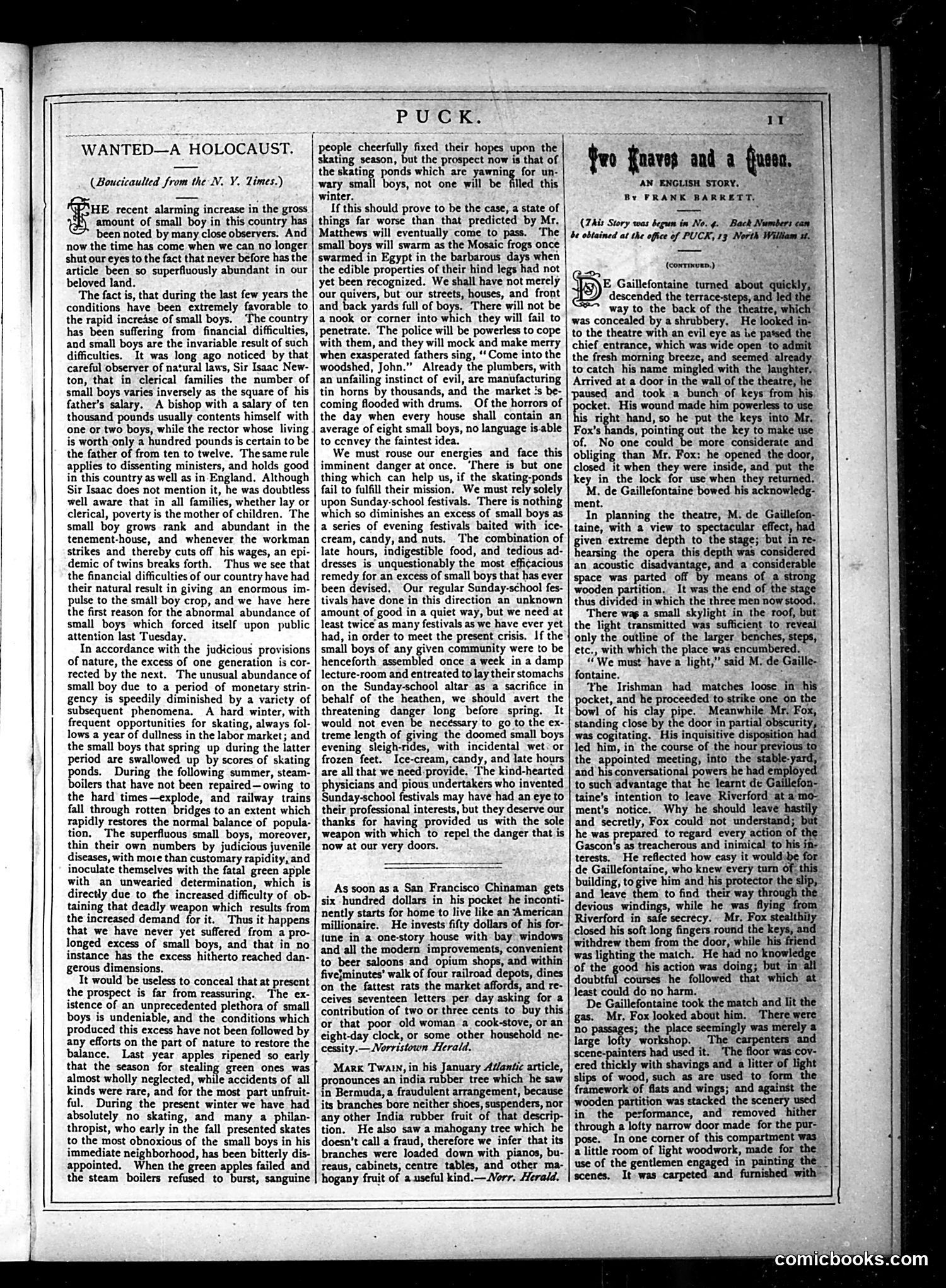
This page contains two distinct articles rather than political cartoons. The left column features "Wanted—A Holocaust," a satirical piece (attributed to the N.Y. Times) criticizing the alarming increase in small boys in cities. It sardonically proposes solutions like ice-cream, candy, and skating ponds to reduce their numbers—essentially mocking concerns about urban youth overpopulation and vagrancy. The right column begins "Two Knaves and a Queen," a fictional story by Frank Barrett. The visible excerpt describes theatrical intrigue involving characters De Galliffontaine, Mr. Fox, and the Trichsman in what appears to be a backstage drama involving theft or deception. Both pieces use humor to address social issues and entertainment, typical of Puck's satirical approach to contemporary concerns.
📄 Transcribed text from this page (OCR, searchable)
Machine-transcribed from the original scan — historical spelling and the odd misread are preserved.
~ WANTED—A HOLOCAUST. (Boucicaulted from the-N. Y. Limes.) HE recent alarming increase in the gross. amount of small boy in this country has been noted by many close observers. And now the time has come when we can no longer shut our eyes to the fact that never before has the article been so superfluously abundant in our beloved land. ‘The fact is, that during the last few years the conditions have been extremely favorable to the rapid increase of small boys. ‘The country has been suffering from financial difficulties, and small boys are the invariable result of such difficulties. It was long ago noticed by that careful observer of natural laws, Sir Isaac New- ton, that in clerical families the number of small boys varies inversely as the square of his father’s salary. A bishop with a salary of ten thousand pounds usually contents himself with one or two boys, while the rector whose living is worth only a hundred pounds is certain to be the father of from ten to twelve. The same rule applies to dissenting ministers, and holds good in this country as well as in-England. Although Sir Isaac does not mention it, he was doubtless well aware that in all families, whether lay or clerical, poverty is the mother of children. The small boy grows rank and abundant in the tenement-house, and whenever the workman strikes and thereby cuts off his wages, an epi- demic of twins breaks forth. Thus we see that the financial difficulties of our country have had their natural result in giving an enormous im- pulse to the small boy crop, and we have here the first reason for the abnormal abundance of small boys which forced itself upon public attention last Tuesday. In accordance with the judicious provisions of nature, the excess of one generation is cor- rected by the next. The unusual abundance of small boy due to a period of monetary strin- gency is speedily diminished by a varicty of subsequent phenomena. A hard winter, with frequent opportunities for skating, always fol- lows a year of dullness in the labor market; and the small boys that spring up during the latter period are swallowed up by scores of skating ponds. During the following summer, steam- boilers that have not been repaired—owing to the hard times—explode, and railway trains fall through rotten bridges to an extent which rapidly restores the normal balance of popula- tion. The superfluous small boys, moreover, thin their own numbers by judicious juvenile diseases, with more than customary rapidity, and inoculate themselves with the fatal green apple with an unwearied determination, which is directly due to the increased difficulty of ob- taining that deadly weapon which results from the increased demand for it. ‘Thus it happens that we have never yet suffered from a pro- longed excess of small boys, and that in no instance has the excess hitherto reached dan- gerous dimensions. It would be useless to conceal that at present the prospect is far from reassuring. The ex- istence of an unprecedented plethora of small boys is undeniable, and the conditions which produced this excess have not been followed by any efforts on the part of nature to restore the balance. Last year apples ripened so early that the season for stealing green ones was almost wholly neglected, while accidents of all kinds were rare, and for the most part unfruit- ful. During the present winter we have had absolutely no skating, and many a philan- thropist, who early in the fall presented skates to the most obnoxious of the small boys in his immediate neighborhood, has been bitterly dis- appointed. When the green apples failed and the steam boilers refused to burst, sanguine PUCK. people cheerfully fixed their hopes upon the skating season, but the prospect now is that of the skating ponds which are yawning for un- wary small boys, not one will be filed this winter. If this should prove to be the case, a state of things far worse than that predicted by Mr, Matthews will eventually come to pass. The small boys will swarm as the Mosaic frogs once swarmed in Egypt in the barbarous days when the edible properties of their hind legs had not yet been recognized. We shall have not merely our quivers, but our streets, houses, and front and back yards full of boys. There will not be a nook or corner into which they will fail to penetrate. The police will be powerless to cope with them, and they will mock and make merry when exasperated fathers sing, ‘Come into the woodshed, John.” Already the plumbers, with an unfailing instinct of evil, are manufacturing tin horns by thousands, and the market :s be- coming flooded with drums. Of the horrors of the day when every house shall contain an average of eight small boys, no language is.able to cenvey the faintest idea. We must rouse our energies and face this imminent danger at once. ‘There is but one thing which can help us, if the skating-ponds fail to fulfill their mission. We must rely solely upon Sunday-school festivals. There is nothing which so diminishes an excess of small boys as a series of evening festivals baited with ice- cream, candy, and nuts. The combination of late hours, indigestible food, and tedious ad- dresses is unquestionably the most efficacious remedy for an excess of small boys that has ever been devised, Our regular Sunday-school fes- tivals have done in this direction an unknown amount of good in a quiet way, but we need at least twice’ as many festivals as we have ever yet had, in order to meet the present crisis. If the small boys of any given community were to be henceforth assembled once a week in a damp lecture-room and entreated to lay their stomachs on the Sunday-school altar as a sacrifice in behalf of the heathen, we should avert the threatening danger long before spring. It would not even be necéssary to go to the ex- treme length of giving the doomed small boys evening sleigh-rides, with incidental wet: or frozen feet. Ice-cream, candy, and late hours are all that we need provide. The kind-hearted AN ENGLISH STORY. | By FRANK BARRETT, * (This Story was begun in No. 4. Back Numberi be obtained at the office of PUCK, 13 North William (conrmven.) E Gaillefontaine turned about quickly, descended the terrace-steps, and Jed the way to the back of the theatre, which” was concealed by a shrubbery, He: n= to the theatre with an evil eye as Le passed the chief entrance, which was wide open to admit the fresh morning breeze, and seemed already to catch his name mingled with the laughter, Arrived at a door in the wall of the theatre, he paused and took a bunch of keys from his. pees His wound made him powerless to tse is right hand, so he put the keys into Mr. Fox’s hands, pointing out the key to make use ‘of. No one could more considerate and obliging than Mr. Fox: he opened the door, closed it when they were inside, and put the key in the lock for use when they returned- M., de Gaillefontaine bowed his acknowledg- ment. In planning the theatre, M. de Gaillefon- taine, with a view to spectacular effect, had given extreme depth to the stage; but in re- hearsing the opera this depth was considered an acoustic disadvantage, and a considerable space was parted off means of a strong wooden partition, It was the end of the stage thus divided in which the three men now stood, ‘There wag a small skylight in the roof, but the light transmitted was sufficient to reveal only the outline of the larger benches, steps, etc., with which the place was encumbered. “We must have a light,” said M. de Gaille- fontaine. Hea ‘The Irishman had matches loose in~his pocket, and he proceeded to strike one on the bowl of his clay pipe: Meanwhile Mr. Fox, standing close by the door in partial obscurity, » was cogitating. His inquisitive disposition had © led him, in’ the course of the hour previous to” the appointed meeting, into the stable- 5 and his conversational powers he had em physicians and pious undertakers who invented Sunday-school festivals may have had an eye to their professional interests, but they deserve our thanks for having provided us with the sole weapon with which to repel the danger that is now at our very doors. As soon as a San Francisco Chinaman gets six hundred dollars in his pocket he inconti- nently starts for home to live like an American millionaire. He invests fifty dollars of his for- tune in a one-story house with bay! windows and all the modern improvements, convenient to beer saloons and opium shops, and within five}minutes’ walk of four railroad depots, dines on the fattest rats the market affords, and re- ceives seventeen letters per day asking for a contribution of two or three cents to buy this or that poor old woman a cook-stove, or an eight-day clock, or some other household ne- cessity.—Vorristown Herald. Marx Twann, in his January AWantic article, ronounces an india rubber tree which he saw in Bermuda, a fraudulent arrangement, because its branches bore neither shoes, st ders, nor any other India rubber fruit of that descrip- tion. He also saw a mahogany tree which he doesn’t call a fraud, therefore we infer that its branches were loaded down with pianos, bu- reaus, cabinets, centre tables, and other ma- hogany fruit of a useful kind.— Morr. Herald. to such advantage that he learnt de Gaile taine’s intention to leave Riverford at amo- ment’s notice. Why he should leave hastily and secretly, Fox could not und he was prepared to regard every action Gascon’s as treacherous and inimical to his in-_ terests.. He reflected how easy it would:be for: de Gaillefontaine, who knew every turn of. this. building, to give him and his protector the ay and leave them to find their way through the devious windings, while he was flying from Riverford in safe secrecy. Mr. Fox stealthil closed his soft long fingers round the keys, and » withdrew them from the door, while his friend was lighting the match. He had no teow 4 ‘of the good his action was doing; but in’ all” doubtful courses he followed that which at least could do no harm. eae De Gaillefontaine took the match and lit the gas. Mr. Fox looked about him. There were lige igen eure Beh e ‘wor! . 3. carpenters: pais inters had 2) it: ‘The floor was cov- ered thickly with shavings and a litter of light slips of wood, such as are used to form the framework of flats and wings; and against the wooden partition was stacked the scenery used in the performance, and removed hither through a lofty narrow door made for the pur= < pose. In one comer of this compartment was, a little room of light woodwork, made for the use of the gentlemen ei in painting the scenes. It was and furnished with