
Puck, 1878-01-02 · page 7 of 16
Puck — January 2, 1878 — page 7: what you’re looking at
What you’re looking at
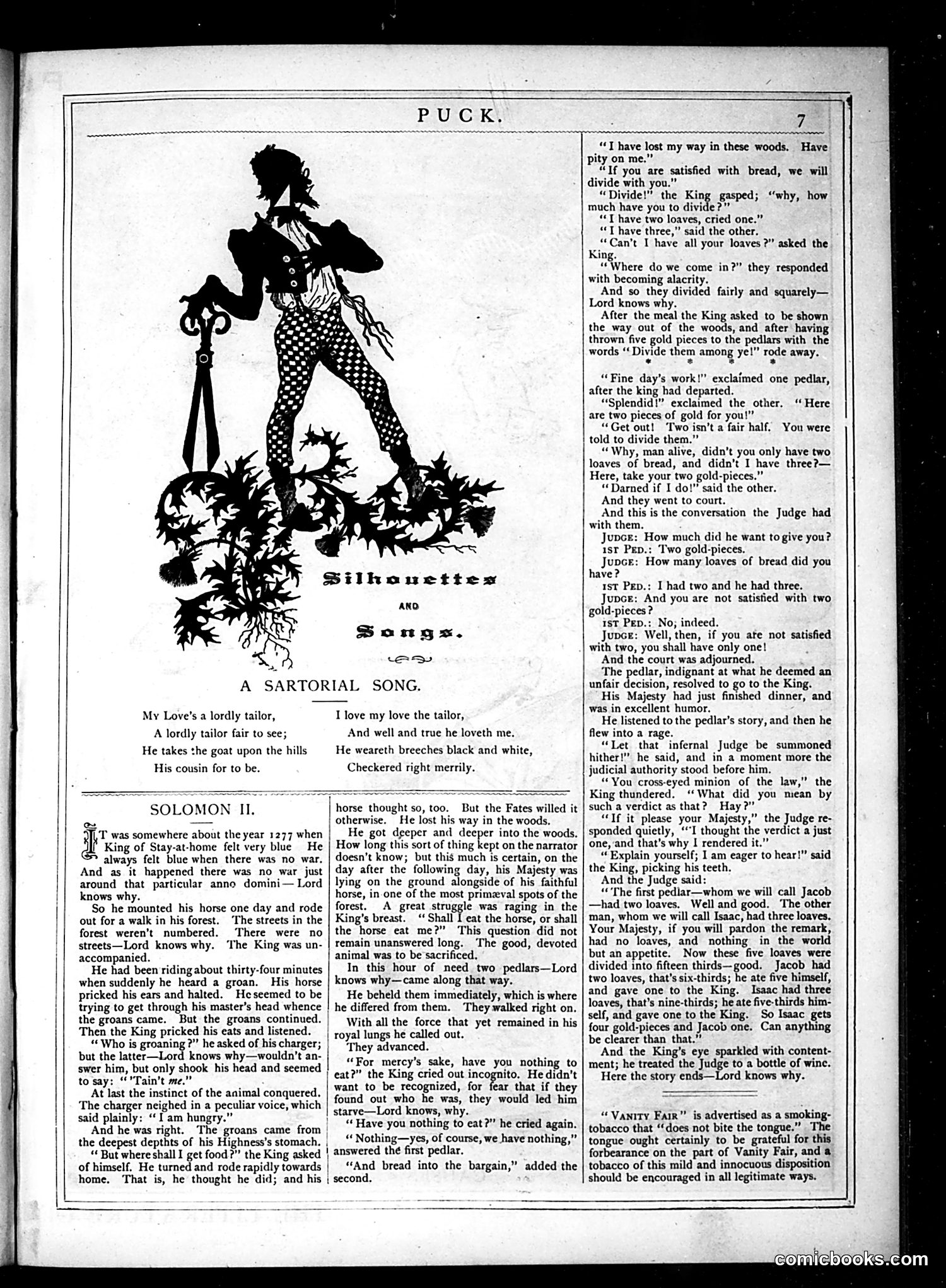
This page contains a silhouette illustration labeled "Silhouettes and Songs" featuring a jester or fool figure, followed by a sartorial song about a tailor, and a story titled "Solomon II." The main narrative concerns a king whose horse goes missing in the woods. The king and his accompanying pedlars become lost searching for it. When they emerge, the king asks them to divide bread fairly as payment. A dispute erupts—one pedlar claims two loaves, another claims three. A judge arbitrates, ultimately ruling the complaining pedlar receives only one loaf, finding his argument logically flawed. The satire appears to mock judicial reasoning and the vagaries of fairness, though the specific historical or political reference remains unclear from the text alone. The story's tone suggests gentle ridicule of legal proceedings rather than pointed political commentary.
📄 Transcribed text from this page (OCR, searchable)
Machine-transcribed from the original scan — historical spelling and the odd misread are preserved.
My Love's a lordly tailor, A lordly tailor fair to see; He takes the goat upon the hills His cousin for to be. A SARTORIAL Sithauvettews ANO Songs. te > SONG. I love my love the tailor, And well and true he loveth me. He weareth breeches black and white, Checkered right merrily. SOLOMON II. was somewhere about the year 1277 when King of Stay-at-home felt very blue He always felt blue when there was no war. j And as it happened there was no war just around that particular anno domini— Lord knows why. So he mounted his horse one day and rode ‘The streets in the There were no ‘The King was un- out for a walk in his forest. forest weren't numbered. streets—Lord knows why. accompanied. He had been riding about thirty-four minutes when suddenly he heard a groan. His horse pricked his ears and halted. Heseemed to be trying to get through his master’s head whence the groans came. But the groans continued. ‘Then the King pricked his eats and listened. “Who is groaning ?” he asked of his charger; | but the latter—Lord knows why—wouldn’t an- swer him, but only shook his head and seemed to say: “’Tain’t me.” At last the instinct of the animal conquered, | eat?” the King cried out inc horse thought so, too. But the Fates willed it | otherwise. He lost his way in the woods, He got deeper and deeper into the woods. How long this sort of thing kept on the narrator doesn’t know; but this much is certain, on the day after the following day, his Majesty was lying on the ground alongside of his faithful horse, in one of the most primzval spots of the forest. A great struggle was raging in the King’s breast.“ Shall I eat the horse, or shall the horse eat me?” This question did not remain unanswered long. The good, devoted animal was to be'sacrificed, In this hour of need two pedlars—Lord knows why—came along that way. He beheld them immediately, which is where he differed from them. They walked right on. With all the force that yet remained in his royal lungs he called out. ‘They advanced. “For mercy’s sake, have you nothing to ito. He didn't want to be recognized, for fear that if they found out who he was, they would led him ‘The charger neighed in a peculiar voice, which said plainly: “Iam hungry.” | And he was right. The groans came from the deepest depthts of his Highness’s stomach. , “ But where shall I get food?” the King asked | of himself, He turned and rode rapidly towards | home. That is, he thought he did; and his ; starve—Lord knows, why. “Have you nothing to eat?” he cried again. “ Nothing—yes, of course, we have nothing,” answered thé first pedlar. “And bread into the bargain,” added the second. 7 “T have lost my way in these woods. Have pity on me.” “If you are satisfied with bread, we will divide with you.” “Divide!” the King gasped; “why, how much have you to divide?” “T have two loaves, cried one.” “T have three,” said the other. “Can't I have all your loaves ?” asked the King. “Where do we come in?” they responded with becoming alacrity. And so they divided fairly and squarely— Lord knows why. After the meal the King asked to be shown the way out of the woods, and after having thrown five gold pieces to the pedlars with the words ‘‘ Divide them among ye!” rode away. . * * * “Fine day's work!” exclaimed one pedlar, after the king had departed. “Splendid!” exclaimed the other. are two pieces of gold for you!” “Get out! ‘Two isn’t a fair half. You were told to divide them.” “Why, man alive, didn’t you only have two loaves of bread, and didn’t I have three?— Here, take your two gold-pieces.” “‘Darned if I do!” said the other. And they went to court. And this is the conversation the Judge had with them. Jupcr: How much did he want to give you? ist Pep.: ‘Two gold-pieces. Jupcr: How many loaves of bread did you have? 1st Pep.: I had two and he had three. Jupce: And you are not satistied with two gold-pieces ? 1st Pep.: No; indeed. Jupce: Well, then, if you ate not satisfied with two, you shall have only one! And the court was adjourned. The pedlar, indignant at what he deemed an unfair decision, resolved to go to the King. His Majesty had just finished dinner, and was in excellent humor. He listened to the pedlar’s story, and then he flew into a rage. “Let that infernal Judge be summoned hither!” he said, and in a moment more the judicial authority stood before him. “You cross-eyed minion of the law,” the King thundered. ‘What did you mean by such a verdict as that? Hay?” “If it please your Majesty,” the Judge re- sponded quietly, ‘I thought the verdict a just one, ‘and that’s why I rendered it.” “Explain yourself; 1 am eager to hear!” said the King, picking his teeth. And the Judge said: “The first pedlar—whom we will call Jacob —had two loaves. Well and good. The other man, whom we will call Isaac, had three loaves. Your Majesty, if you will pardon the remark, had no loaves, and nothing in the world but an appetite. Now these five loaves were divided into fifteen thirds—good. Jacob had two loaves, that’s six-thirds; he ate five himself, and gave one to the King. Isaac had three loaves, that’s nine-thirds; he ate five-thirds him- self, and gave one to the King. So Isaac gets four gold-pieces and Jacob one. Can anything be clearer than that.” And the King’s eye sparkled with content- ment; he treated the Judge to a bottle of winc. Here the story ends—Lord knows why. “Here “Vanity Fair” is advertised as a smoking- tobacco that “does not bite the tongue.” The tongue ought certainly to be grateful for this forbearance on the part of Vanity Fair, and a tobacco of this mild and innocuous disposition should be encouraged in all legitimate ways.