
Puck, 1878-01-02 · page 2 of 16
Puck — January 2, 1878 — page 2: what you’re looking at
What you’re looking at
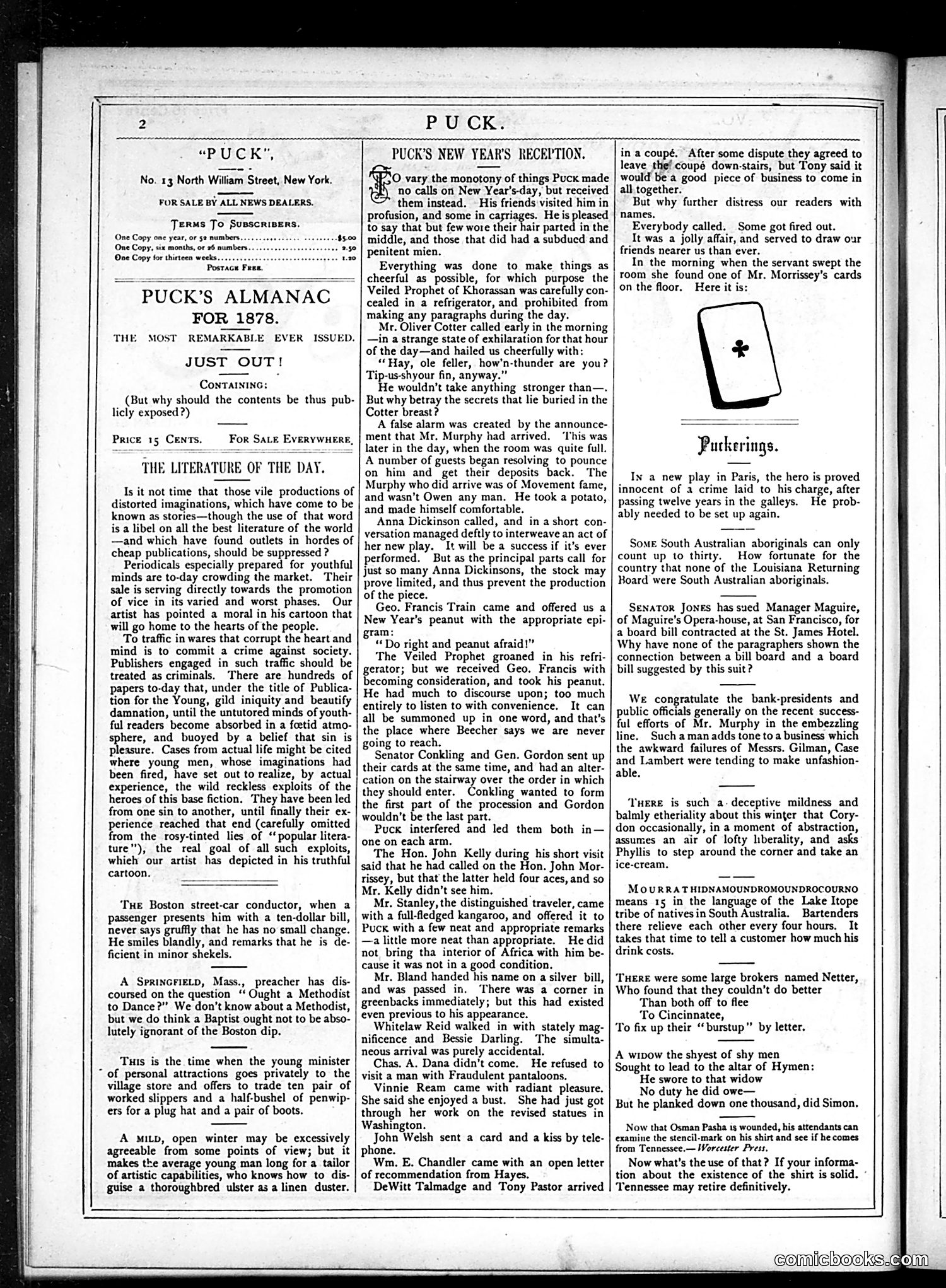
This page is primarily **editorial and advertising content** rather than political cartoons. The masthead announces "Puck's New Year's Reception" — a humorous narrative account of the magazine's New Year's Day gathering. The single visible cartoon shows a **playing card (club suit)** labeled "Puckerings," accompanying brief satirical notes about theater and politics. The main text mocks the chaos of Puck's New Year's party, describing various guests' arrival and behavior. It satirizes contemporary figures mentioned casually (Mr. Murphy, Senator Jones, Mr. Beecher), but without the visual caricature we'd expect from Puck's famous cartoons. The remaining content consists of **social commentary, theater criticism, and advertising** for Puck's Almanac. This appears a lighter, more literary issue than Puck's typical satirical cartoon-focused format.
📄 Transcribed text from this page (OCR, searchable)
Machine-transcribed from the original scan — historical spelling and the odd misread are preserved.
PUCK. “PUCK’", No. 13 North Wiliam Street, New York. FOR SALE BY ALL NEWS DEALERS. Terms To Sunscrivers. One Copy one year, or 52 numbers One Copy, six months, or 26 sum Ove Copy for thirteen weeks. PUCK’S ALMANAC FOR 1878. THE MOST REMARKABLE EVER ISSUED. JUST OUT! ConTAINING: (But why should the contents be thus pub- licly exposed?) Price 15 Cents. THE LITERATURE OF THE DAY. Is it not time that those vile productions of distorted imaginations, which have come to be known as stories—though the use of that word is a libel on all the best literature of the world ~—and which have found outlets in hordes of cheap publications, should be suppressed ? Periodicals especially prepared for youthful minds are to-day crowding the market. Their sale is serving directly towards the promotion of vice in its varied and worst phases. Our artist has pointed a moral in his cartoon that will go home to the hearts of the people. To traffic in wares that corrupt the heart and mind is to commit a crime against society. Publishers engaged in such traffic should be treated as criminals. There are hundreds of papers to-day that, under the title of Publica- tion for the Young, gild iniquity and beautify damnation, until the untutored minds of youth- ful readers become absorbed in a fcetid atmo- sphere, and buoyed by a belief that sin is pleasure. Cases from actual life might be cited where young men, whose imaginations had been fired, have set out to realize, by actual experience, the wild reckless exploits of the heroes of this base fiction, They have been led from one sin to another, until finally their ex- perience reached that end (carefully omitted from the rosy-tinted lies of “popular litera- ture”), the real goal of all such exploits, whieh our artist has depicted in his truthful cartoon. For Sate Everywiere, ‘THe Boston street-car conductor, when a passenger presents him with a ten-dollar bill, never says gruffly that he has no small change. He smiles blandly, and remarks that he is de- ficient in minor shekels. A Sprincrietp, Mass., preacher has dis- coursed on the question ‘“ Ought a Methodist to Dance?” We don’t know about a Methodist, but we do think a Baptist ought not to be abso- lutely ignorant of the Boston dip. Tuts is the time when the young minister of personal attractions goes privately to the village store and offers to trade ten pair of worked slippers and a half-bushel of penwip- ers for a plug hat and a pair of boots. A MiLD, open winter may be excessively agreeable from some points of view; but it makes the average young man long for a tailor of artistic capabilities, who knows how to dis- guise a thoroughbred ulster a3 a linen duster. PUCK’S NEW YEAR'S RECEPTION. ‘O vary the monotony of things Puck made no calls on New Year’s-day, but received them instead. — His friends visited him in profusion, and some in casriages. He is pleased to say that but few wore their hair parted in the middle, and those that did had a subdued and penitent mien. Everything was done to make things as cheerful as possible, for which purpose the Veiled Prophet of Khorassan was carefully con- cealed in a refrigerator, and prohibited from making any paragraphs during the day. Mr. Oliver Cotter called early in the morning —in a strange state of exhilaration for that hour of the day—and hailed us cheerfully with: “Hay, ole feller, how'n-thunder are you? Tip-us-shyour fin, anyway.” He wouldn’t take anything stronger than—. But why betray the secrets that lie buried in the Cotter breast? ‘A false alarm was created by the announce- ment that Mr. Murphy had arrived. ‘T'his was later in the day, when the room was quite full. A number of guests began resolving to pounce on him and get their deposits back. The Murphy who did arrive was of Movement fame, and wasn’t Owen any man. He took a potato, and made himself comfortable. Anna Dickinson called, and in a short con- versation managed deftly to interweave an act of her new play. It will be a success if it’s ever performed. But as the principal parts call for just so many Anna Dickinsons, the stock may prove limited, and thus prevent the production of the piece. Geo. Francis Train came and offered us a New Year’s peanut with the appropriate epi- ram : “Do right and peanut afraid!” The Veiled Prophet groaned in his refri- gerator; but we received Geo. Francis with becoming consideration, and took his peanut. He had much to discourse upon; too much entirely to listen to with convenience. It can all be summoned up in one word, and that’s the place where Beecher says we are never going to reach, Senator Conkling and Gen. Gordon sent up their cards at the same time, and had an alter- cation on the stairway over the order in which they should enter. Conkling wanted to form the first part of the procession and Gordon wouldn't be the last part. Puck interfered and led them both in— one on each arm. The Hon. John Kelly during his short visit said that he had called on the Hon. John Mor- rissey, but that the latter held four aces, and so Mr. Kelly didn’t see him. : Mr. Stanley, the distinguished traveler, came with a full-fledged kangaroo, and offered it to Puck with a few neat and appropriate remarks —a little more neat than appropriate. He did not bring tha interior of Africa with him be- cause it was not in a good condition. Mr. Bland handed his name on a silver bill, and was passed in. There was a corner in greenbacks immediately; but this had existed even previous to his appearance. Whitelaw Reid walked in with stately mag- nificence and Bessie Darling. The simulta- neous arrival was purely accidental. Chas. A. Dana didn’t come. He refused to visit a man with Fraudulent pantaloons. Vinnie Ream came with radiant pleasure. She said she enjoyed a bust. She had just got through her work on the revised statues in Washington. John Welsh sent a card and a kiss by tele- phone. Wm. E. Chandler came with an open letter of recommendation from Hayes. DeWitt Talmadge and Tony Pastor arrived in a coupé. After some dispute they agreed to leave the! coupé down-stairs, but Tony said it would be a good piece of business to come in all together. But why further distress our readers with names. Everybody called. Some got fired out. It was a jolly affair, and served to draw our friends nearer us than ever. In the morning when the servant swept the room she found one of Mr. Morrissey’s cards on the floor. Here it is: Purkerings. Iw a new play in Paris, the hero is proved innocent of 4 crime laid to. his charge, after passing twelve years in the galleys. He ‘prob- ably needed to be set up again. Some South Australian aboriginals can only count up to thirty. How fortunate for the country that none of the Louisiana Returning Board were South Australian aboriginals. Senator Jones has sued Manager Maguire, of Maguire’s Opera-house, at San Francisco, for a board bill contracted at the St. James Hotel. Why have none of the paragraphers shown the connection between a bill board and a board bill suggested by this suit? We congratulate the bank-presidents and public officials generally on the recent success- ful efforts of Mr. Murphy in the embezzling line, Such aman adds tone toa business which the awkward failures of Messrs. Gilman, Case and Lambert were tending to make unfashion- able. ‘THere is such a- deceptive mildness and balmly etheriality about this winter that Cory- don occasionally, in a moment of abstraction, assumes an air of lofty liberality, and Phyllis to step around the corner and take an ice-cream. MOURRATHIDNAMOUNDROMOUNDROCOURNO means 15 in the language of the Lake Itope tribe of nativesin South Australia, Bartenders there relieve each other every four hours. It takes that time to tell a customer how much his drink costs. ‘THERE were some large brokers named Netter, Who found that they couldn’t do better Than both off to flee To Cincinnatee, To fix up their “burstup” by letter. A wipow the shyest of shy men Sought to lead to the altar of Hymen: He swore to that widow No duty he did owe— But he planked down one thousand, did Simon. Now that Osman Pasha 1s wounded, his attendants can examine the stencil-mark on his shirt and see if he comes from Tennessee.— Worcester Press. Now what's the use of that? If your informa- tion about the existence of the shirt is solid. ‘Tennessee may retire definitively. comichooks, com