
Puck, 1878-01-02 · page 10 of 16
Puck — January 2, 1878 — page 10: what you’re looking at
What you’re looking at
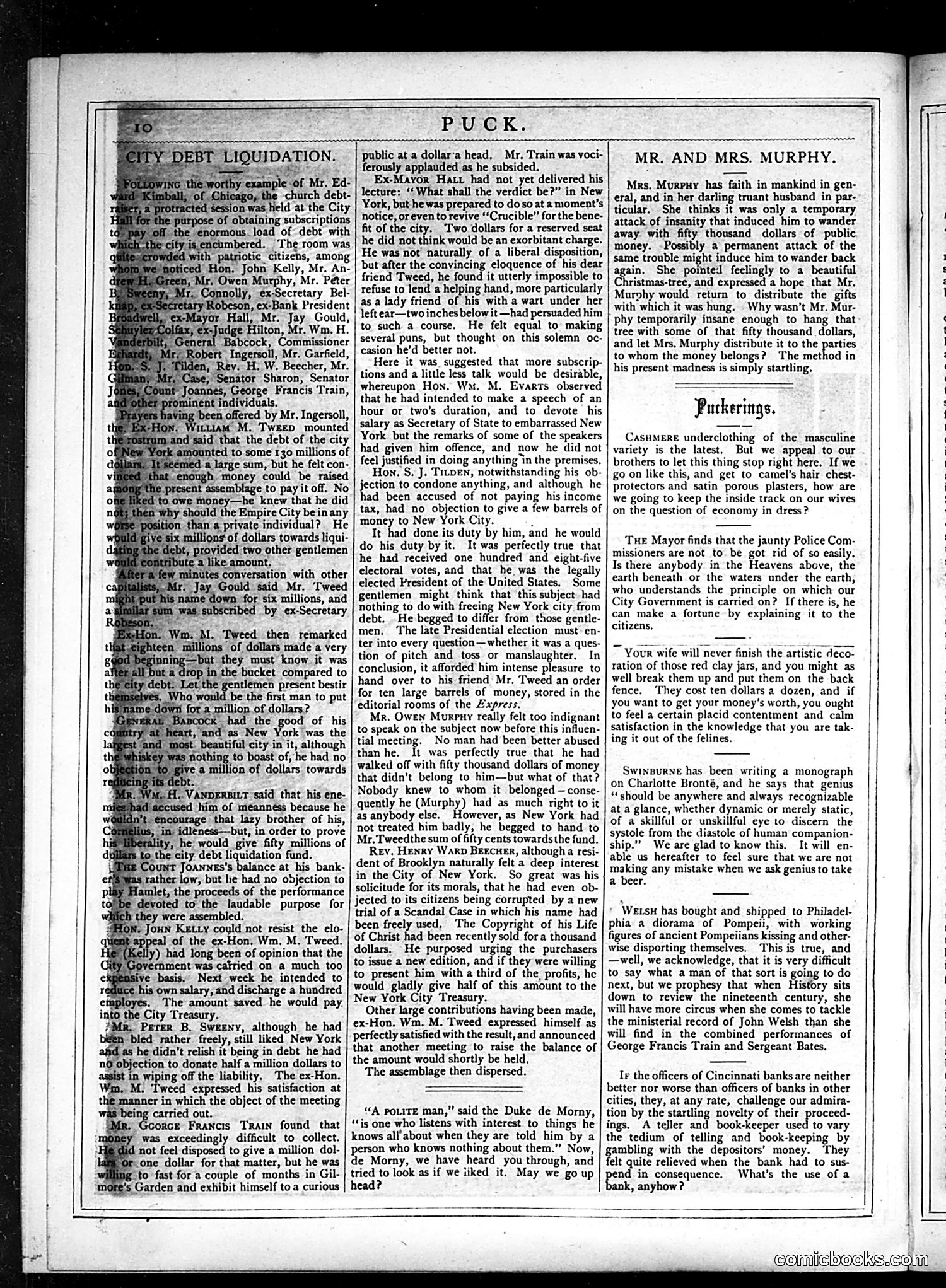
This page satirizes New York City's financial crisis through a meeting where prominent citizens debate how to pay off municipal debt. The cartoon depicts **real political figures** including Mayor Hall, City Controller Murphy, and various wealthy New Yorkers arguing about contributions. The satire mocks their reluctance to donate: wealthy figures like Ex-Mayor Tweed initially refuse, then grudgingly offer minimal amounts. Rev. Beecher eventually shames them into giving more. The joke targets **wealthy elites' hypocrisy**—they claim patriotism while protecting their money, requiring moral pressure to contribute to public coffers. The other sections ("Puckerings," "Mr. and Mrs. Murphy," "Welsh Art") are separate short satirical pieces about fashion, domestic life, and cultural topics.
📄 Transcribed text from this page (OCR, searchable)
Machine-transcribed from the original scan — historical spelling and the odd misread are preserved.
a app le into the Ci “bled as he Win, M: § bei gto teen ddlllass to, the city debe li i Count Joannes’s rather low, but lie had no objection to his own salary, and discharge a hundred ~Gcorce Francis Train found that was exceeding): sone dollar for that matter, but he was PUCK. LIQUIDATION. example of Mr. Ed- igo, the church debt- td session was held at the City Of obtaining subscriptions enormous. load of debt with cumbered._ ‘The room was ith: patriotic citizens, among Hon. John Kelly, Mr. An- , Owen Murphy, Mr. Peter mnolly, <€x-Secretary Bel- , ex-Bank President Mayor. Hall, Mr. iy Gould, Sodee Hilton, Mr. Wm. H. Babcock, Commissioner “Ingersoll, Mr. Garfield, Rey. H. W. Beecher, Mr. “Senator Sharon, Senator Joannes, George Francis Train, inent individuals, ‘been offered by Mr. Ingersoll, VittiaM M. Tweep mounted ‘said that the debt of the city amounted to some 130 millions of eda large sum, but he felt con- enough. Boe, could be raed present assemblage to pay it off. No Pee taba —he een that he did /why should the Empire City beinany n than a private individual? He ix millions of dollars towards liqui- t, provided two other gentlemen ike amount. miniites conversation with other "Jay Gould said. Mr. ‘Tweed his name down ‘for six millions, and ‘was subscribed by ex-Secretary “of dollars made a very 3 they. must know it was rop in the bucket compared to debt: Let the gentlemen present bestir gives. Who would be ae be ea to put m “million. of dol ERAscoee had the good of his ‘heart, “and as New York was the beautiful city in it, although | Rothing to boast of, he had no sto give a million of dollars. towards ANDERBILT said that his ene- him of meannéss because he courage that lazy brother of his, ‘in, idleness—but, in order to prove y, he) would give fifty millions of uidation fund. ince at his bank- it, the proceeds of the performance ‘devoted to the laudable purpose for } they were assembled. IN. JOKN Ketry coyld not resist the elo- of the ex-Hon. Wm. M. Tweed. ly) had long been of opinion that the nment was cafried on a much too basis. Next week he intended to The amount saved he would pay. ‘ity Treasury. . Perer B. Sweeny, although he had rather freely, still liked New York didn’t relish it being in debt he had ‘objection to donate half a million dollars to wiping off the liability. The ex-Hon. weed expressed his satisfaction at the manner in which the object of the meeting carried out. ifficult to collect. not feel dis; to give a million dol- fast fora couple of months in Gil- iblic ata dollar’a head. Mr. Train was voci- ferously applauded as he subsided. Ex-Mayor Hatt had not yet delivered his lecture: ‘What shall the verdict be?” in New York, but he was prepared to do so ata moment's notice, or even to revive “Crucible” for the bene- fit of the city. Two dollars for a reserved seat he did not think would be an exorbitant charge. He was not’ naturally of a liberal disposition, but after the convincing eloquence of his dear friend Tweed, he found it utterly impossible to refuse to lend a helping hand, more particularly as a lady friend of his with a wart under her left ear—two inches below it —had persuaded him to such a course. He felt equal to making several puns, but thought on this solemn oc- casion he'd better not. Here it was suggested that more subscrip- tions and a little less talk would be desirable, whereupon Hon. Ws. M. Evarts observed that he had intended to make a speech of an hour or two’s duration, and to devote his salary as Secretary of State to embarrassed New York but the remarks of some of the speakers had given him offence, and now he did not feel justified in doing anything in the premises. Hon. S. J. Tien, notwithstanding his ob- jection to condone anything, and although he had been accused of not paying his income tax, had no objection to give a few barrels of money to New York City. . It had done its duty by him, and he would do his duty by it. It was perfectly true that he had received one hundred and eight-five electoral votes, and that he was the legally elected President of the United States, Some gentlemen might think that this subject had nothing to do with freeing New York city from debt. . He begged to differ from those gentle- men. ‘he late Presidential election must en- ter into every question—whether it was a ques- tion of pitch and toss or manslaughter. In conclusion, it afforded him intense pleasure to hand over to his friend Mr. Tweed an order for ten large barrels of money, stored in the editorial rooms of the Express. Mr. Owen Murpny really felt too indignant to speak on the subject now before this influen- tial mecting: No man had been better abused than he. It was perfectly true that he had walked off with fifty thousand dollars of money that didn’t belong to him—but what of that? Nobody knew to whom it belonged —conse- quently he (Murphy) had as much right to it as anybody else. However, as New York had not treated him badly, he begged to hand to Mr. Tweedthe sum of fifty cents towards the fund. Rev, Henry Warp BEECHER, although a resi- dent of Brooklyn naturally felt a deep interest in the City of New York. So great was his solicitude for its morals, that he had even ob- jected to its citizens being corrupted by a new trial of a Scandal Case in which his name had been freely used, The Copyright of his Life of Christ had been recently sold fora thousand dollars. He purposed urging the purchasers to issue a new edition, and if they were willing to present him with a third of the, profits, he would gladly give half of this amount to the New York City Treasury. Other large contributions having been made, ex-Hon. Wm. M. Tweed expressed himself as perfectly satisfied with the result, and announced that another meeting to raise the balance of the amount would shortly be held. The assemblage then dispersed. “A POLITE man,” said the Duke de Morny, is one who listens with interest to things he knows all'about when they are told him by a person who knows nothing about them.” Now, de Morny, we have heard you through, and tried to look as if we iiked it. May we go up ’s Garden and exhibit himself toa curious head? MR. AND MRS. MURPHY. Mrs. Murpuy has faith in mankind in gen- eral, and in her darling truant husband in par- ticular. She thinks it was only a temporary attack of insanity that induced him to wander away. with fifty thousand dollars of public money. Possibly a permanent attack of the same trouble might induce him to wander back again. She pointed feelingly to a beautiful Christmas-tree, and expressed a hope that Mr. Murphy would return to distribute the gifts with which it was hung. Why wasn’t Mr. Mur- phy temporarily insane enough to hang that tree with some of that fifty thousand dollars, and let Mrs. Murphy distribute it to the parties to whom the money belongs? The method in his present madness is simply startling. Puckerings. CasuMere underclothing of the masculine variety is the latest. But we appeal to our brothers to let this thing stop right here. If we go on like this, and get to camel’s hair chest- protectors and satin porous plasters, how are we going to keep the inside track on our wives on the question of economy in dress? ‘THE Mayor finds that the jaunty Police Com- missioners are not to be got rid of so easily. Is there anybody in the Heavens above, the earth beneath or the waters under the earth, who understands the principle on which our City Government is carried on? If there is, he can make a fortune by explaining it to the citizens. Your wife will never finish the artistic deco- ration of those red clay jars, and you might as well break them up and put them on the back fence. ‘They cost ten dollars a dozen, and if you want to get your money’s worth, you ought to feel a certain placid contentment and calm satisfaction in the knowledge that you are tak- ing it out of the felines. Swinburne has been writing a monograph on Charlotte Bronté, and he says that genius “should be anywhere and always recognizable at a glance, whether dynamic or merely static, of a skillful or unskillful eye to discern the systole from the diastole of human companion- ship.” We are glad to know this. It will en- able us hereafter to feel sure that we are not making any mistake when we ask geniusto take a beer. We su has bought and shipped to Philadel- phia a diorama of Pompeii, with working figures of ancient Pompeiians kissing and other- wise disporting themselves. This is true, and —well, we acknowledge, that it is very difficult to say what a man of that sort is going to do next, but we prophesy that when History sits down to review the nineteenth century, she will have more circus when she comes to tackle the ministerial record of John Welsh than she will find in the combined performances of George Francis Train and Sergeant Bates. Ir the officers of Cincinnati banks are neither better nor worse than officers of banks in other cities, they, at any rate, challenge our admira- tion by the startling novelty of their proceed- ings. A teller and book-keeper used to vary the tedium of telling and book-keeping by gambling with the depositors’ money. ‘They felt quite relieved when the bank had to sus- end in consequence. What’s the use of a ik, anyhow ? { comichooks.com