
A complete issue · 16 pages · 1877
Puck — November 28, 1877
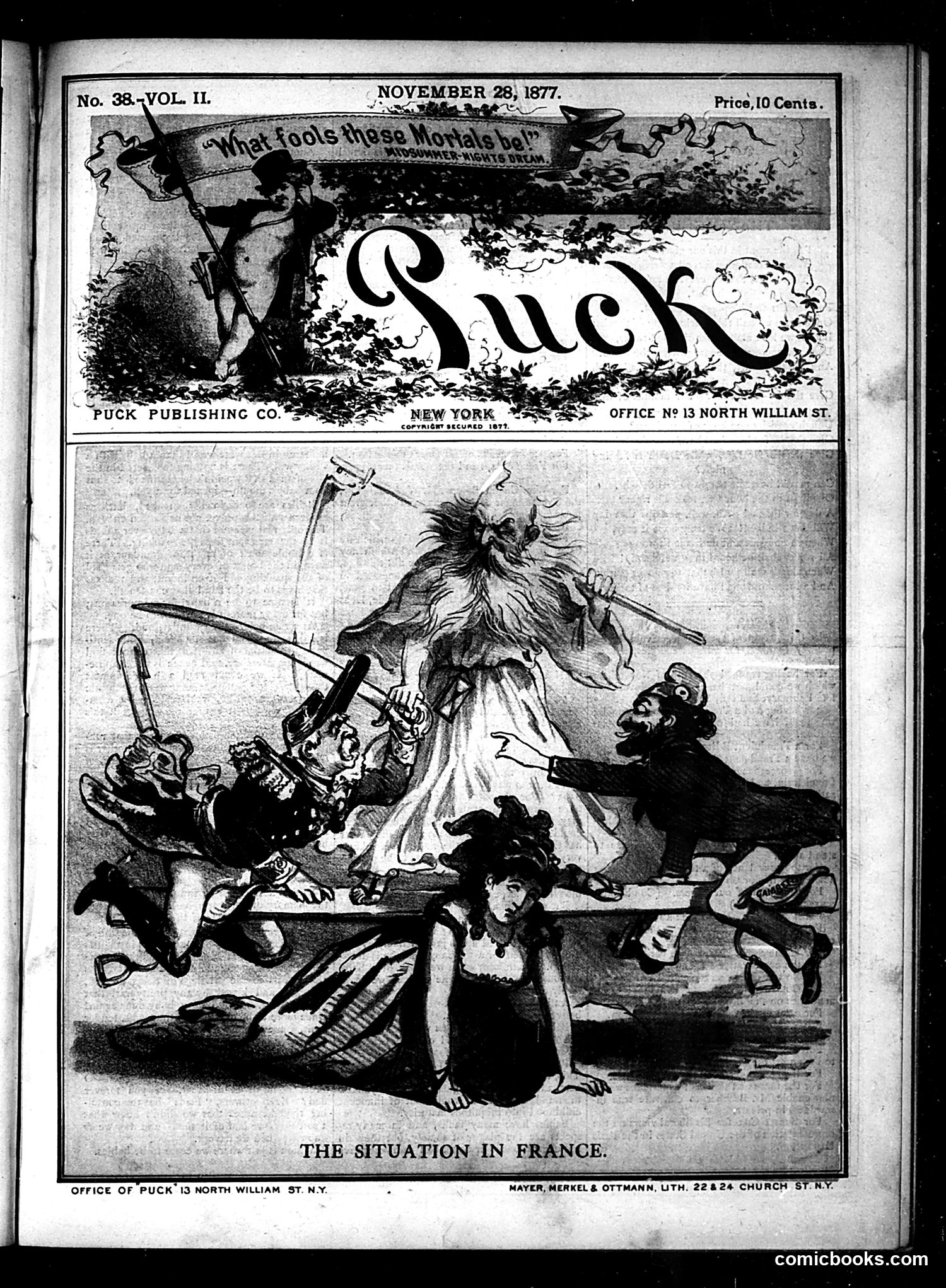
This satirical cartoon depicts chaos in France following recent political turmoil. A demonic or skeletal figure labeled as representing French instability towers over smaller figures engaged in violent conflict—likely depicting different political factions battling for control. The central female figure (possibly representing France itself or the French Republic) sits amid the chaos in a vulnerable position, surrounded by armed combatants. The imagery suggests France was fractured and threatened by internal discord during this period. This likely references the constitutional crisis of 1877, when President MacMahon attempted to dissolve parliament, triggering political instability. The cartoon satirizes how competing political forces were tearing the nation apart rather than governing effectively.
This page contains two main sections: advertisements for Puck magazine at the top, and editorial content below featuring a "Thanksgiving" poem and an article titled "Babies." The Thanksgiving poem is satirical verse listing things to be grateful for, including references to contemporary political figures and situations (mentions of "November," "President," "Fraudulent Editor," and "Judge Hilton"). These appear to be topical jabs at 1880s politics and journalism, though specific identities are unclear without additional context. The "Babies" article is a humorous essay about infants' characteristics and behavior—their lack of manners, their tyrannical nature, and their demands. It's written in a comic, affectionate tone typical of Puck's social satire, poking fun at how babies dominate households despite their complete helplessness. No political cartoon is visible on this particular page.
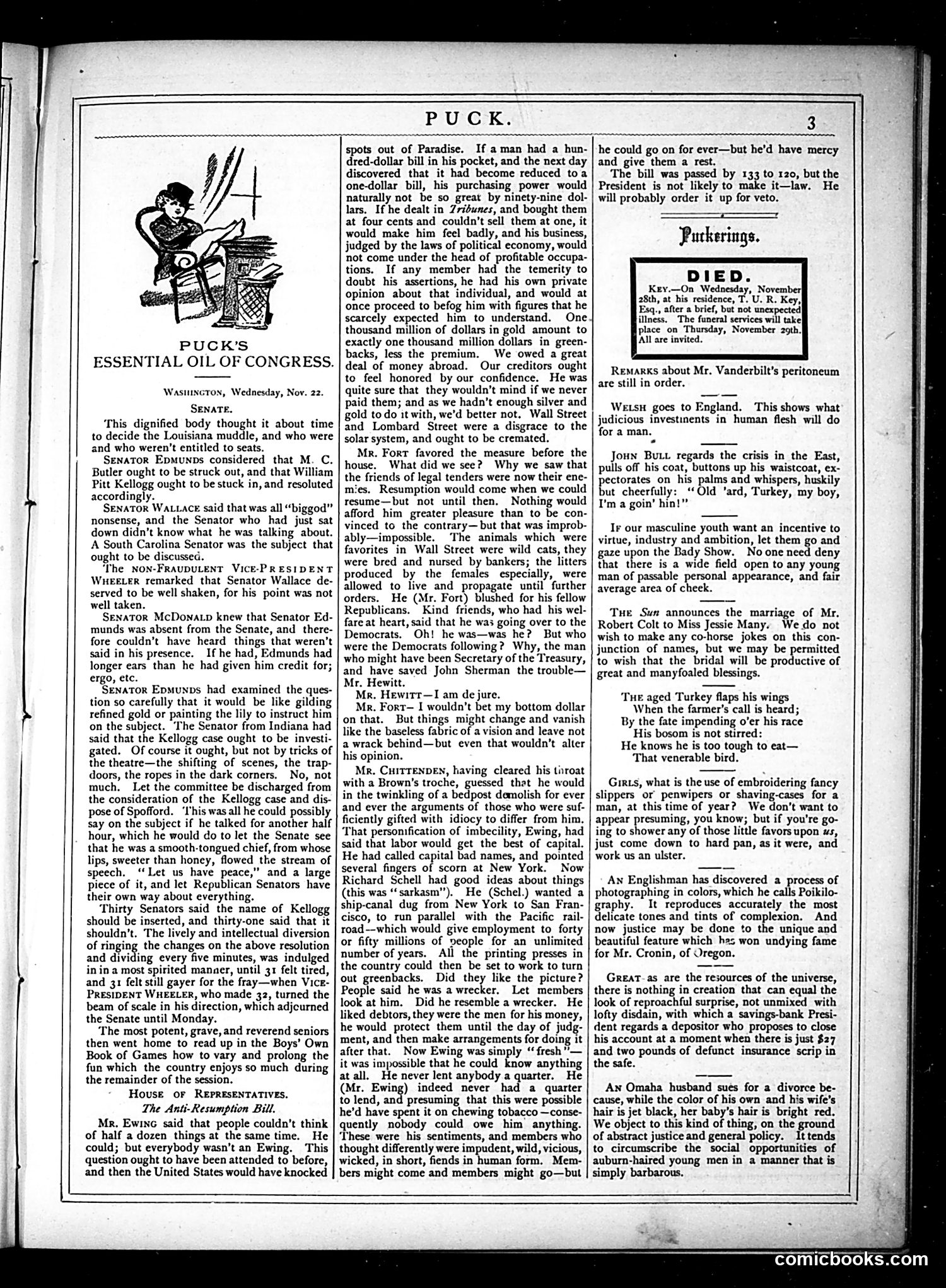
The cartoon depicts a figure (appearing to be a senator or congressman) distilling "essential oil of congress"—a satirical commentary on legislative ineffectiveness. The accompanying text records Senate debate over Louisiana's admission and currency/financial policy, with senators discussing (often nonsensically) various proposals about money supply and banking reform. The satire targets Congress's tendency to produce only vaporous rhetoric from lengthy deliberations. By framing legislative output as an "oil" to be extracted, Puck mocks how little substantive policy results from extensive congressional debate. The cartoon suggests that after all the talking, senators and representatives yield minimal tangible results—just empty distillations of hot air, suitable only for trivial uses.
This page contains three distinct sections satirizing American public figures and culture: **"Cox as a Humorist"** critiques Samuel Cox, a congressman, as an unintentional comedian whose incompetence makes him ridiculous rather than genuinely funny. The piece questions whether his humor serves patriotic purposes. **"Fitznoodle in America"** features an illustrated character observing American life, particularly New York society. The narrative mocks American pretensions and social hierarchies through a visitor's perspective, comparing American customs unfavorably to British standards. **"Puck's Dream-Book"** offers humorous "dream interpretations"—if you dream of various animals or scenarios, what does it supposedly mean? This is lighthearted entertainment rather than serious satire. The page blends political commentary with social observation and whimsical humor typical of Puck's editorial approach.
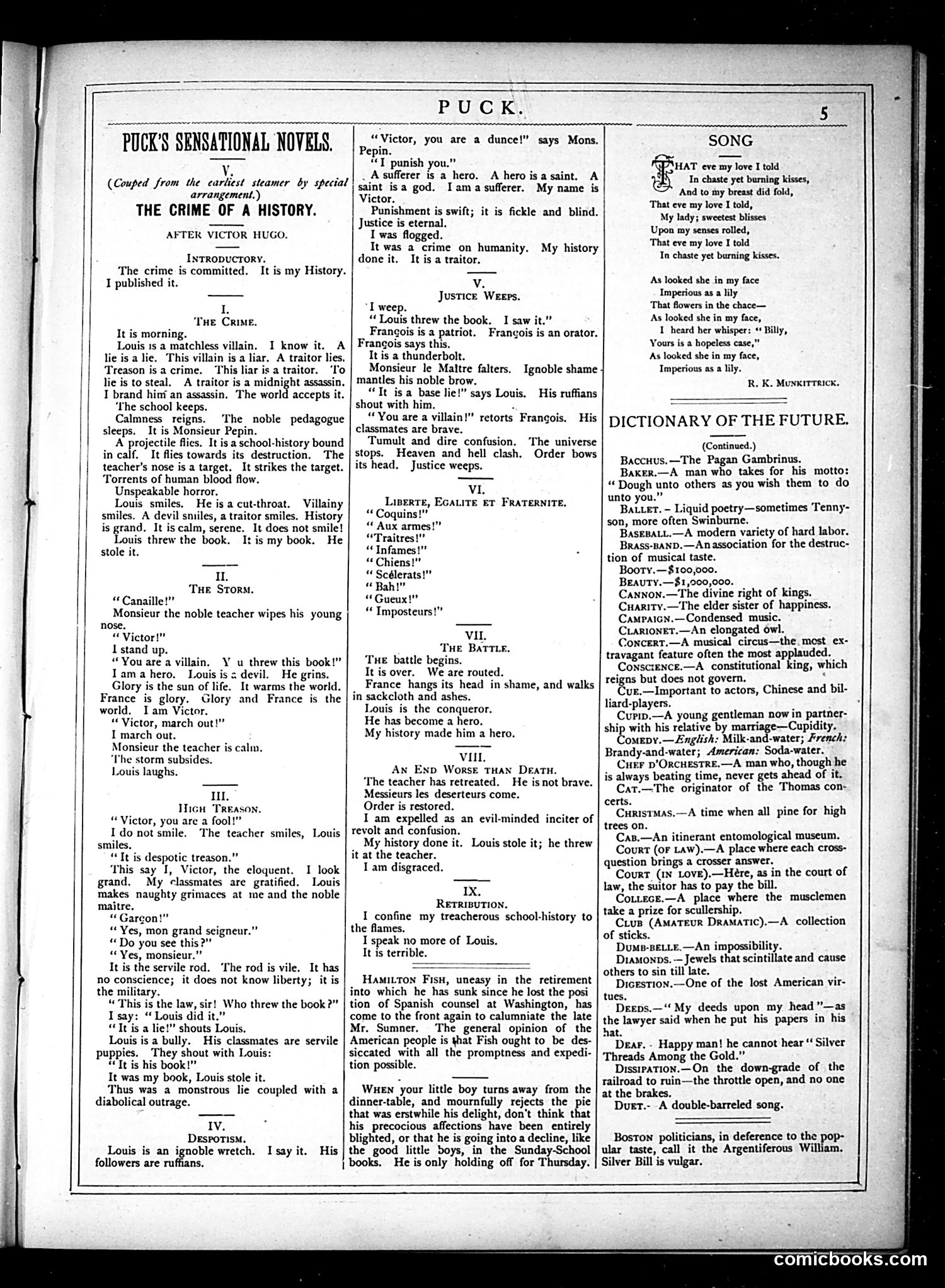
This page contains **"The Crime of a History,"** a satirical piece mocking Victor Hugo's novel *Les Misérables*. The satire presents a schoolmaster's brutal interpretation where Louis (the protagonist) is simply a villain and traitor deserving punishment, stripping away Hugo's humanitarian themes about justice and redemption. The satire critiques rigid, authoritarian pedagogy—the "noble teacher" who teaches obedience over moral complexity. By reducing Hugo's nuanced social commentary to simplistic condemnation, Puck mocks both educational institutions that suppress critical thinking and conservative social attitudes that reject compassion for the poor and downtrodden. The page also includes a song, dictionary entries, and miscellaneous humor typical of Puck's format, but the main content satirizes institutional resistance to progressive ideas about human dignity.
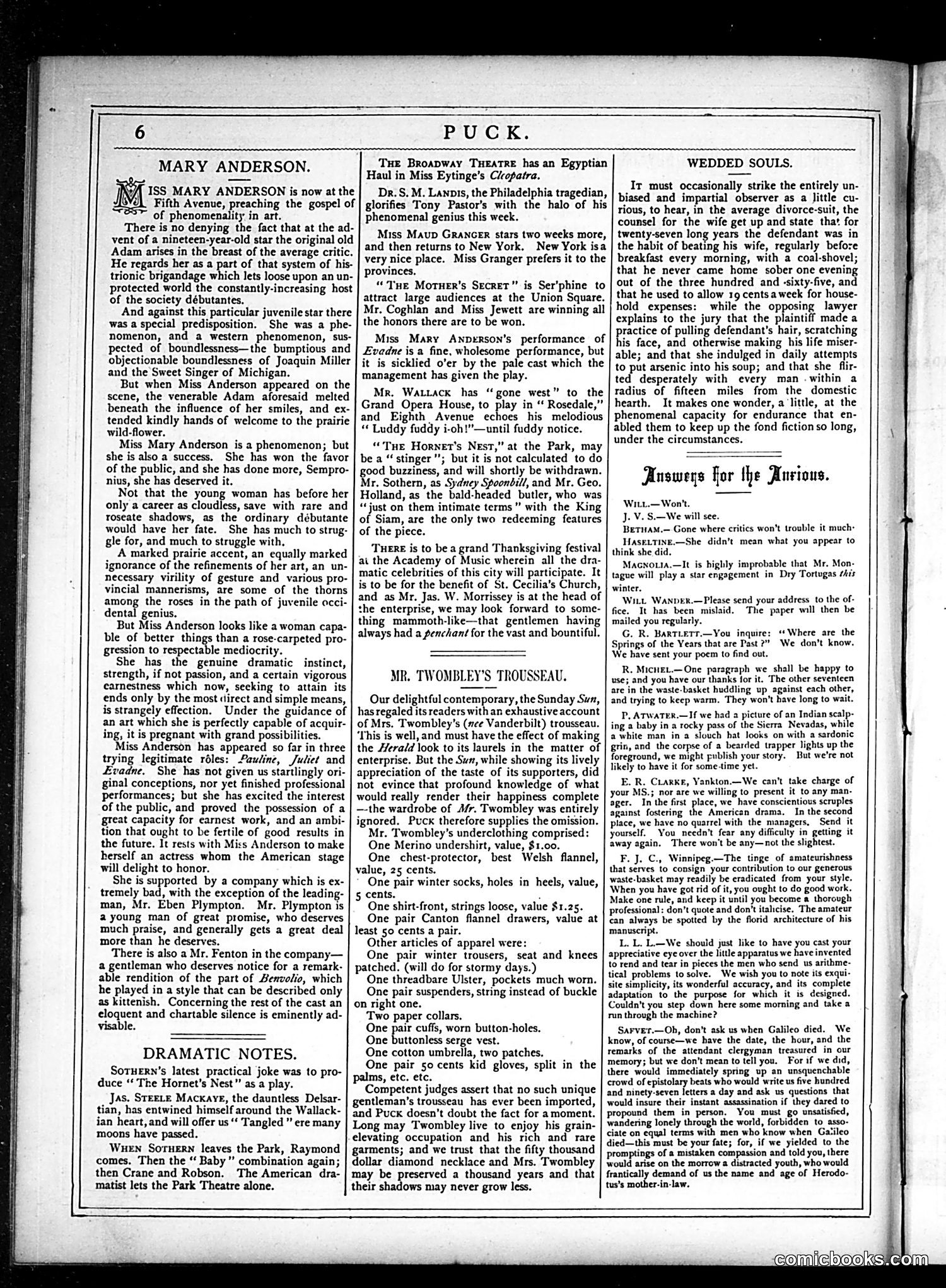
This Puck page is primarily **theatrical criticism and drama notes**, not political satire. The main content discusses: **Mary Anderson** - A celebrated actress reviewed favorably for her "phenomenal" talent and career trajectory, praised for performances in legitimate roles like *Juliet* and *Evadne*. **Mr. Twombley's Trousseau** - A theatrical review of a play featuring actors Mr. Sothern and Mr. Geo. Holland, critiquing both the production's quality and its social commentary about wealth and materialism. **Dramatic Notes** - Brief gossipy items about theater figures and productions. The page contains no visible political cartoons. It's essentially **entertainment journalism** — typical of Puck's theatrical coverage mixed with advertisements for clothing and accessories. The satire, if present, operates at the level of theater criticism rather than political commentary.
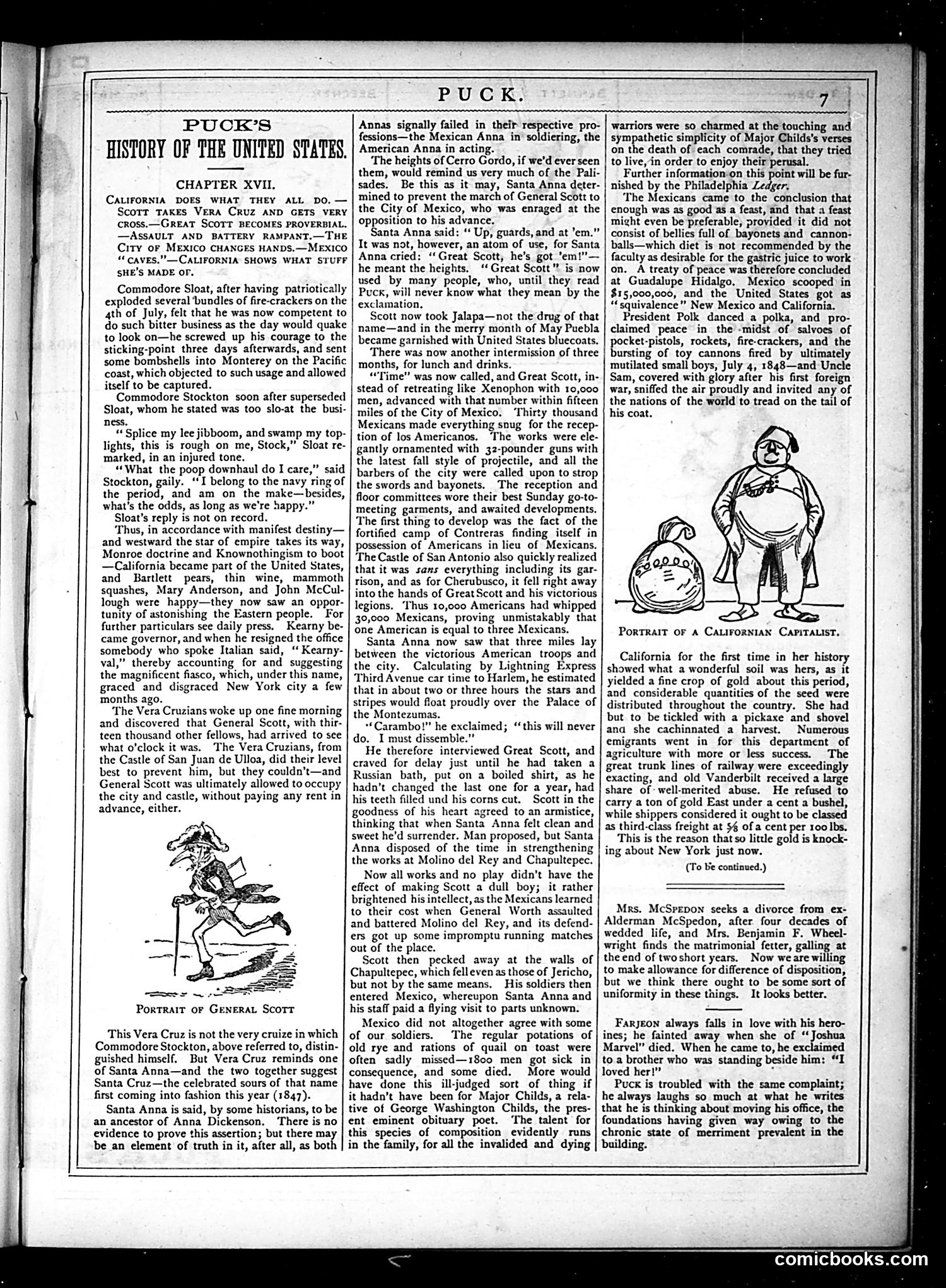
This page from Puck contains two illustrations accompanying an article titled "PUCK'S HISTORY OF THE UNITED STATES," specifically Chapter XVII about California during the Mexican-American War era. The two portraits shown are labeled "PORTRAIT OF A CALIFORNIAN CAPITALIST" and "PORTRAIT OF GENERAL SCOTT." These appear to be historical illustrations supporting a satirical narrative about American military conquest in California and the acquisition of wealth and property during westward expansion. The text discusses General Scott's military campaigns, Mexican resistance, and the ultimate American victory, presenting events with Puck's characteristic irreverent tone. The "Californian Capitalist" portrait likely represents newly wealthy American settlers profiting from the territorial acquisition—a common Puck subject satirizing rapid wealth accumulation during American expansion.
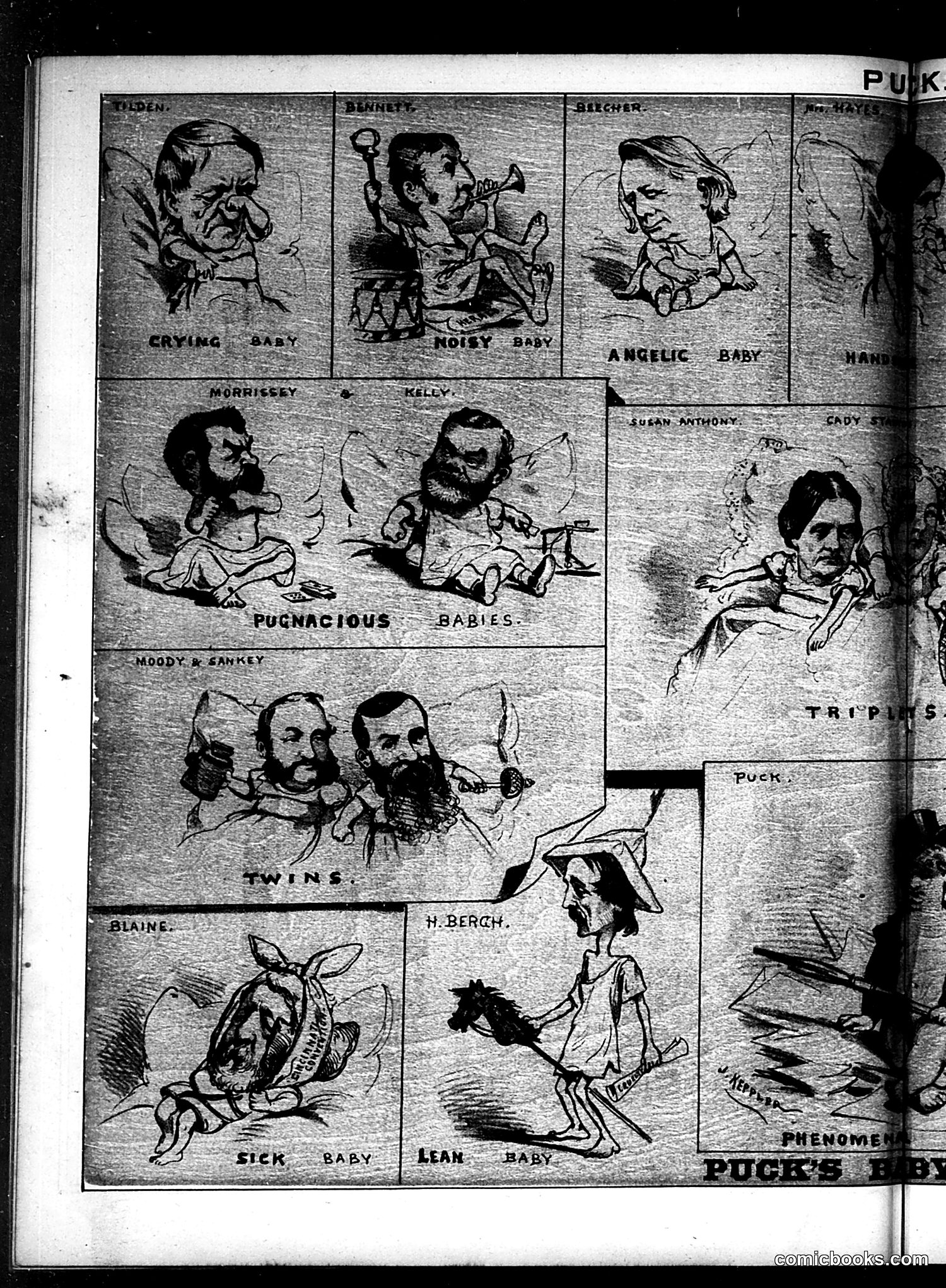
This page presents caricatured "babies" representing prominent political and public figures of the era. Each panel labels a figure with a characteristic trait or nickname—"Crying Baby" (Holden), "Noisy Baby" (Stanhope), "Angelic Baby" (Slicjgem), and others including "Pugnacious Babies" (Morrissey and Kelley), "Twins" (Moody and Sankey), and additional panels showing "Sick Baby" (Blaine) and "Lean Baby" (H. Bergh). The satire infantilizes these public figures, suggesting they behave childishly or immaturely in their political roles. The exaggerated facial features in the caricatures mock their appearances while the "baby" conceit implies incompetence or petulance. Without specific dates visible, the exact political context remains unclear, but the format was typical of Puck's editorial commentary on contemporary politicians and celebrities.
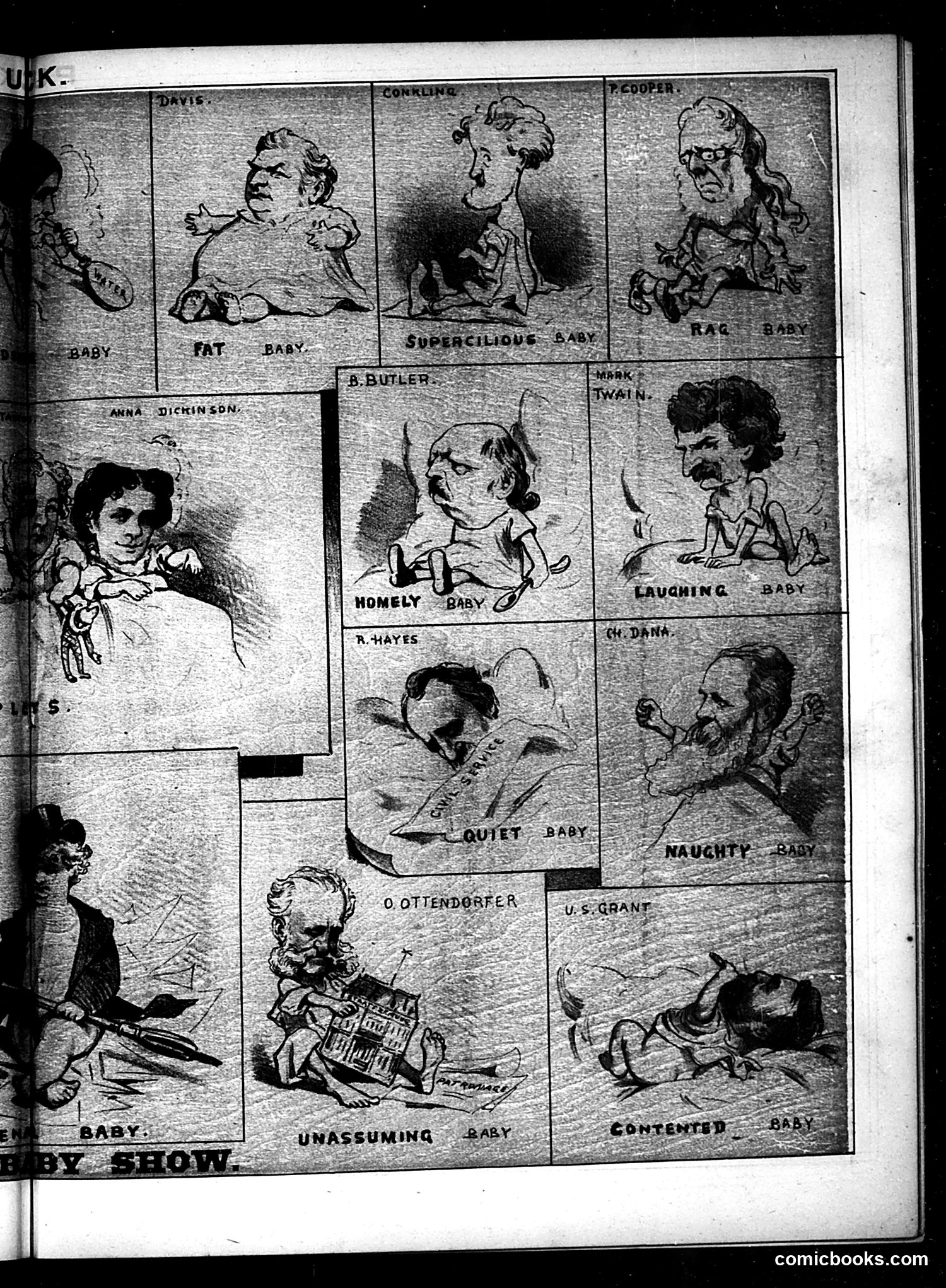
This satirical cartoon depicts famous 19th-century figures as exaggerated babies, each labeled with a characteristic trait. The caricatures include Davis ("Fat Baby"), Conkling ("Supercilious Baby"), J. Cooper ("Baby"), Anna Dickinson, A. Butler ("Homely Baby"), Mark Twain ("Laughing Baby"), R. Hayes ("Quiet Baby"), Ch. Dana ("Naughty Baby"), O. Ottendorfer ("Unassuming Baby"), and U.S. Grant ("Contested Baby"). The satire mocks prominent politicians, writers, and public figures by reducing them to infantile versions, emphasizing their perceived flaws or personality quirks. This "baby show" format was a common Puck trope used to ridicule public figures through exaggeration and diminishment, suggesting their foolish or childish behavior despite their prominence.
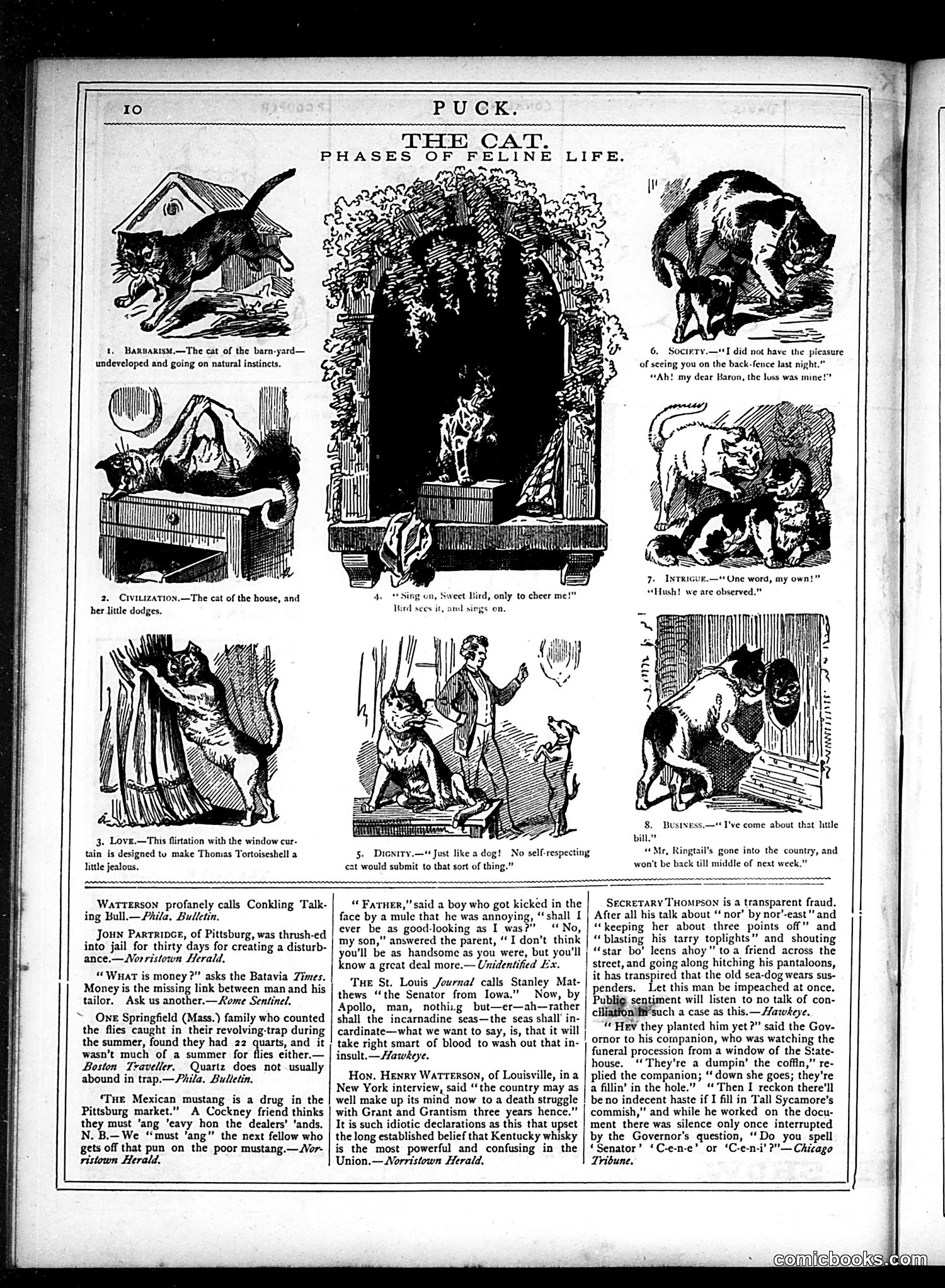
This is a humorous illustrated essay showing eight stages of a cat's life, from wild barn kitten to dignified house pet to romantic entanglement to elderly mouser. Each panel includes satirical captions mimicking human social progression. The satire works by anthropomorphizing cats—treating them as if they progress through "civilization" stages parallel to human society. Panel 2 ("Civilization") shows a pampered house cat; Panel 3 ("Love") depicts romantic entanglement; Panel 5 ("Dignity") shows a cat rejecting dog-like behavior. The final panels suggest aging and decline. The humor relies on Victorian-era assumptions about social refinement and propriety, applying these concepts absurdly to animal behavior. This was typical Puck magazine fare: gentle, family-friendly satire about everyday life rather than direct political commentary.
This page contains the continuation of a serialized English story by Frank Barrett, not a political cartoon. The narrative concerns theatrical intrigue involving characters named René, Raffaelli, and Beatrice, with plot elements including: - A masquerade ball and identity deception through costume - Romantic/social maneuvering among aristocratic characters - Theater company business and disguises The story focuses on interpersonal drama rather than political satire. It appears to be serialized fiction entertainment typical of Puck magazine's content alongside its better-known political cartoons. No identifiable historical figures or current political references are evident on this page.
This page features Puck magazine's regular humor column containing brief satirical quips and observations about contemporary society. The cartoon at the top shows cherubs or cupids, likely introducing romantic or relationship-themed jokes below. The column satirizes various American social issues: disparities between rich and poor, emerging technologies (mentions of "New York" dispatches), military concerns (references to Colorado), theatrical life, gender roles (jokes about wives and husbands), Indian affairs, and political matters (mentions of Congress and "ex-Senators Logan"). The humor targets pretension, hypocritical behavior, social climbing, and absurdities of modern life. Without specific dated references visible, the exact historical context remains unclear, though the content appears to reflect late 19th-century American social concerns through Puck's characteristically irreverent satirical lens.
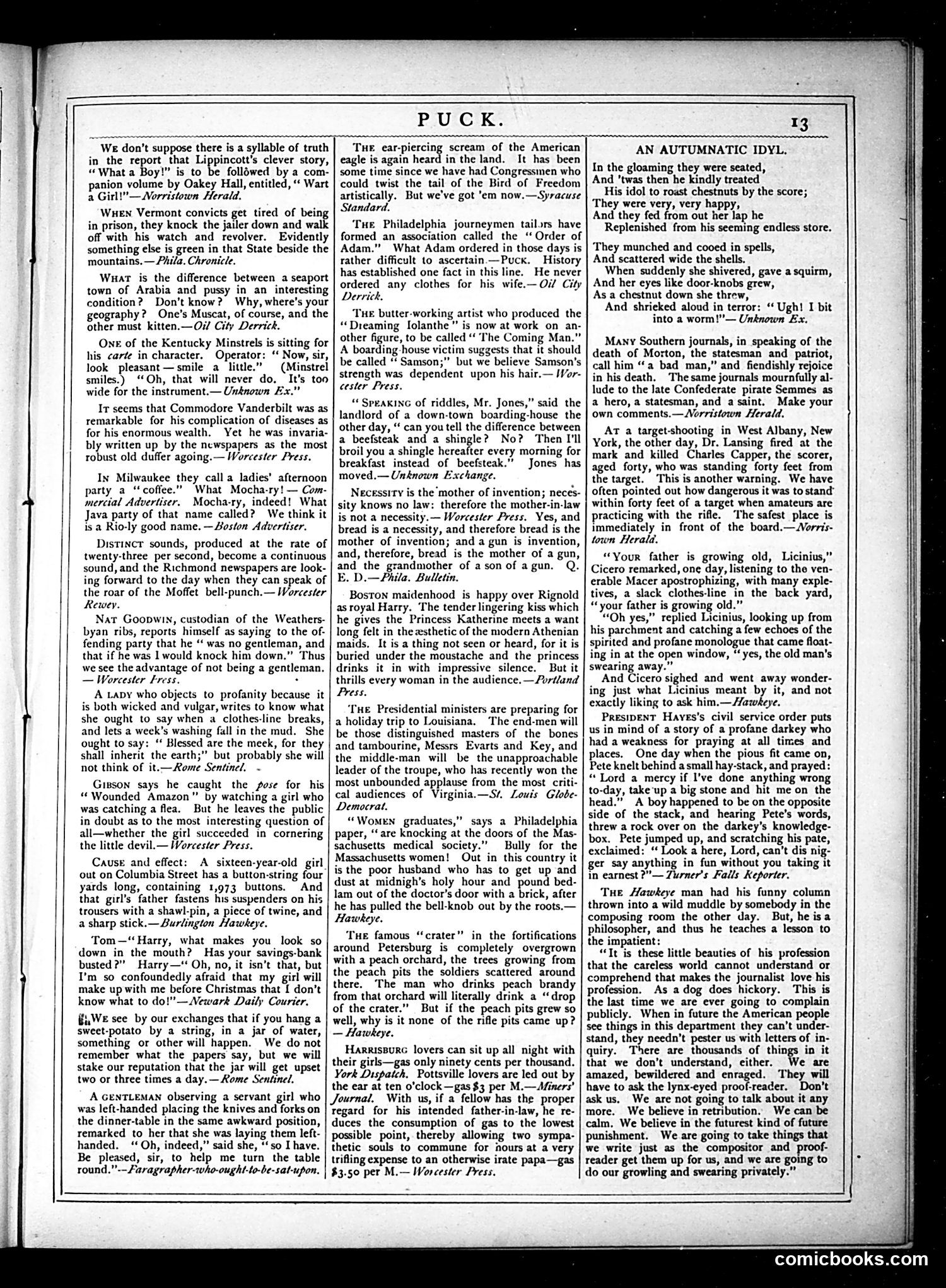
This page consists primarily of **humorous anecdotes and social commentary** rather than illustrated political cartoons. The content includes brief satirical items about contemporary American life: - Mockery of politicians and Congressmen, particularly regarding the "Bird of Freedom" (the eagle/national symbol) - Jabs at Philadelphia journeymen and their organizations - Commentary on boarding house life and domestic situations - Criticism of professional pretension (doctors, inventors, philosophers) - Social observations about gender relations and courtship The pieces target **American institutions, social pretense, and everyday domestic absurdities** rather than specific named political figures. The satire relies on wordplay and situational humor rather than visual caricature. Without illustrations on this particular page, the comedy depends entirely on witty, often cynical written observations about American society.
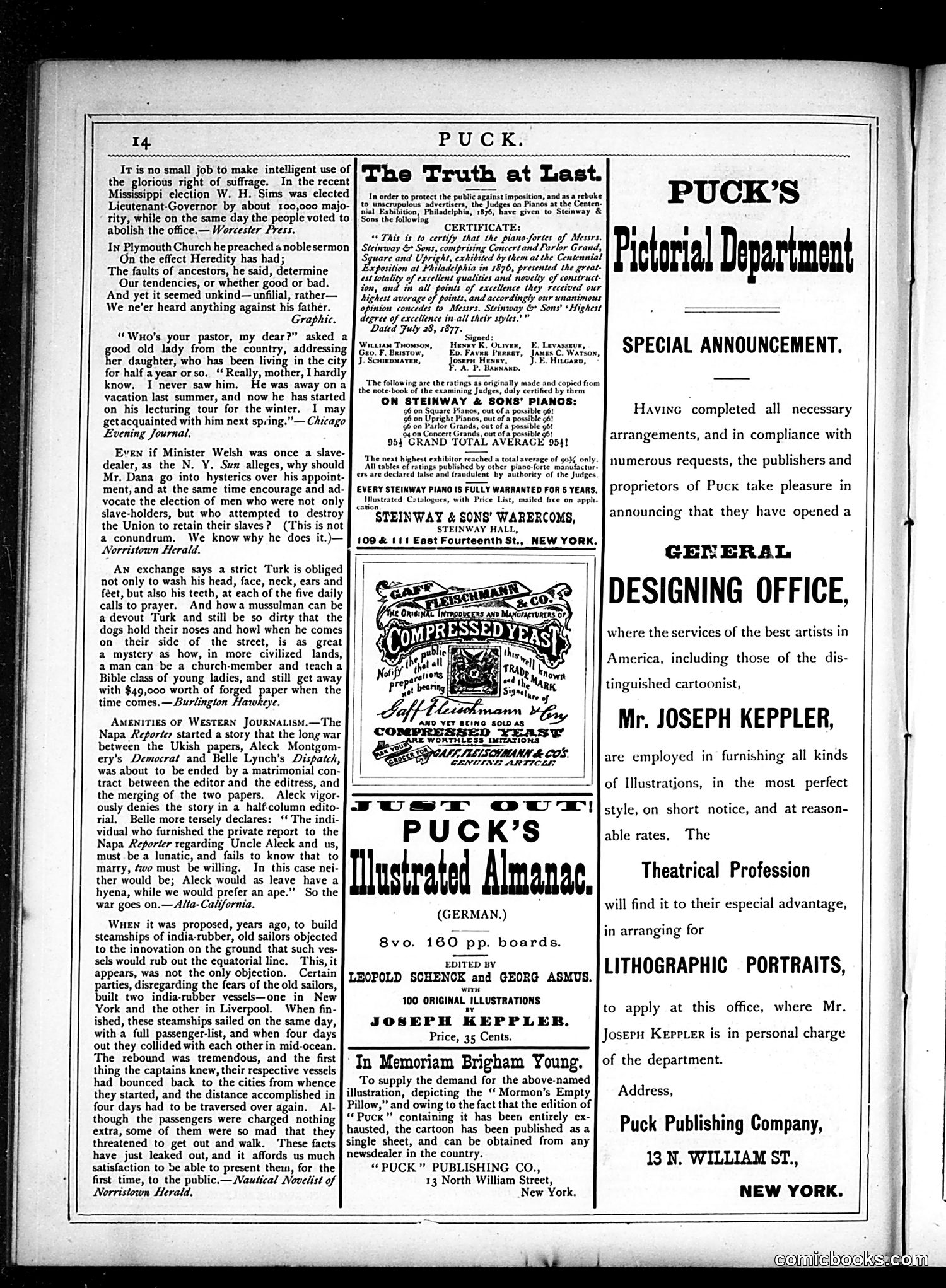
This is primarily an **advertising and announcement page** rather than a satirical cartoon page. The main content includes: 1. **Puck's Pictorial Department announcement** — advertising their newly opened "General Designing Office" featuring cartoonist **Joseph Keppler**, offering illustration services 2. **Multiple advertisements** for pianos (Steinway & Sons), compressed yeast (Gaff, Fleischmann & Co.), and Puck's own **Illustrated Almanac** (German edition) 3. **In Memoriam notice** for Brigham Young, offering a cartoon depicting "The Mormon's Empty Fellow" The page functions as **self-promotion and commercial advertising** rather than political satire. While Keppler was a renowned cartoonist, this particular page showcases Puck's business operations and product offerings to readers rather than delivering satirical commentary on contemporary politics or society.
This is primarily an **advertising page** from Puck magazine, not a satirical cartoon page. It features commercial advertisements for New York City businesses circa the 1870s-1880s, including: - Holiday goods at Bloom's department store - Portrait studios (Whitman, Kurtz) - Hats (Dunlap & Co.) - Hotels and champagne - Carpet and furniture warehouses (D. Kelly's) - Hungarian wines - A tailor (Nicoll) The only potentially humorous element is a decorative label for "Damayer Hungarian Wines" featuring what appears to be a figure in folk costume, but this is a product advertisement rather than political satire. The page demonstrates how 19th-century magazines subsidized content through advertising rather than subscriptions alone.
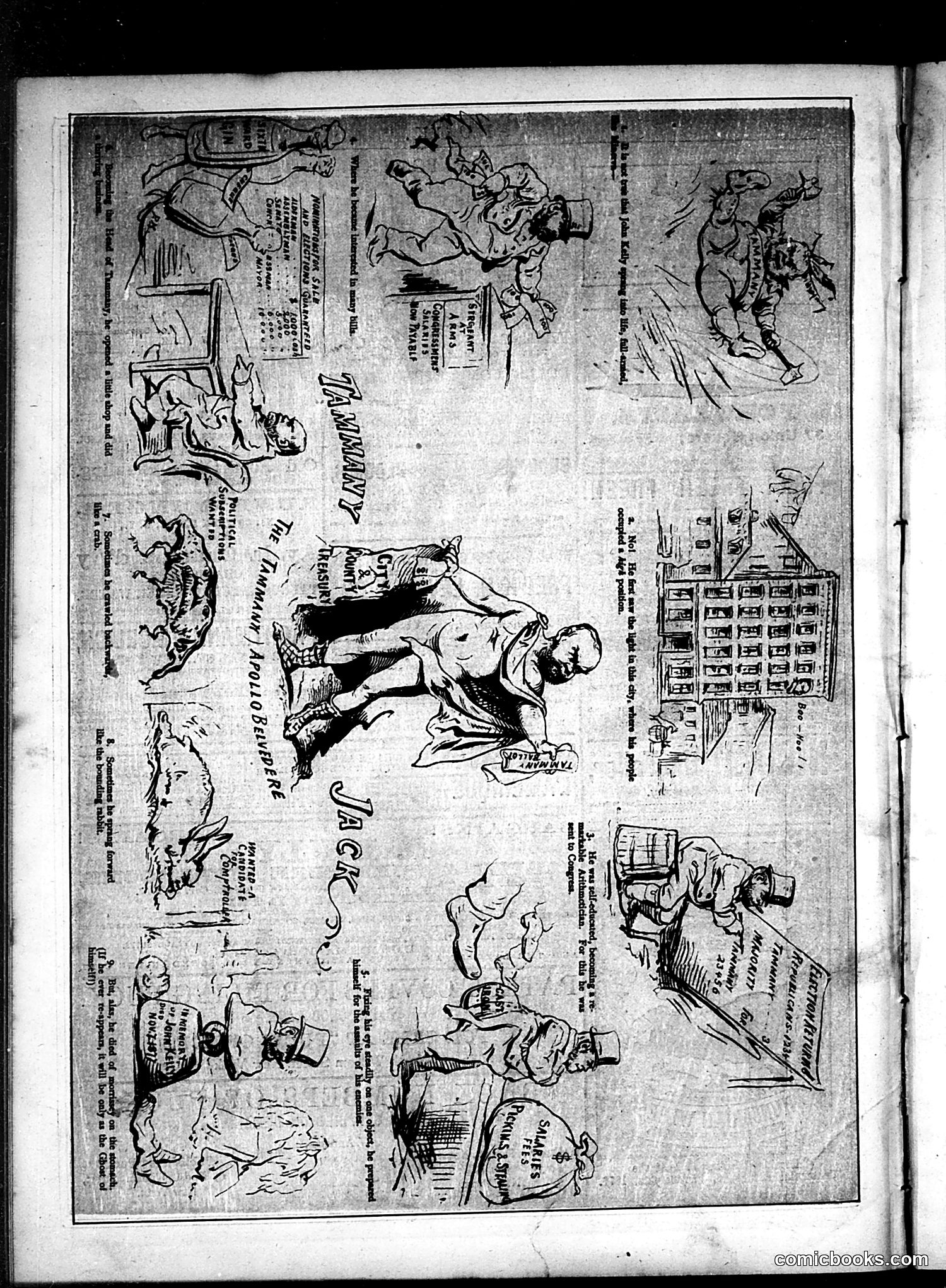
I can see this is a Puck magazine page featuring multiple comic panels arranged around a central figure, but the image quality makes it difficult to read the OCR text clearly or identify specific figures with certainty. The layout appears to show satirical scenes depicting various social situations or political commentary, with the style typical of late 19th or early 20th-century American humor. There's a prominent central illustration of what appears to be a reclining figure, surrounded by smaller vignettes showing different characters and scenarios. Without being able to reliably read the text captions or identify the specific public figures being caricatured, I cannot accurately explain the particular political or social references the cartoons are meant to satirize. To provide accurate analysis meeting your standards, I would need clearer image quality or legible OCR text.