
Puck, 1877-11-28 · page 11 of 16
Puck — November 28, 1877 — page 11: what you’re looking at
What you’re looking at
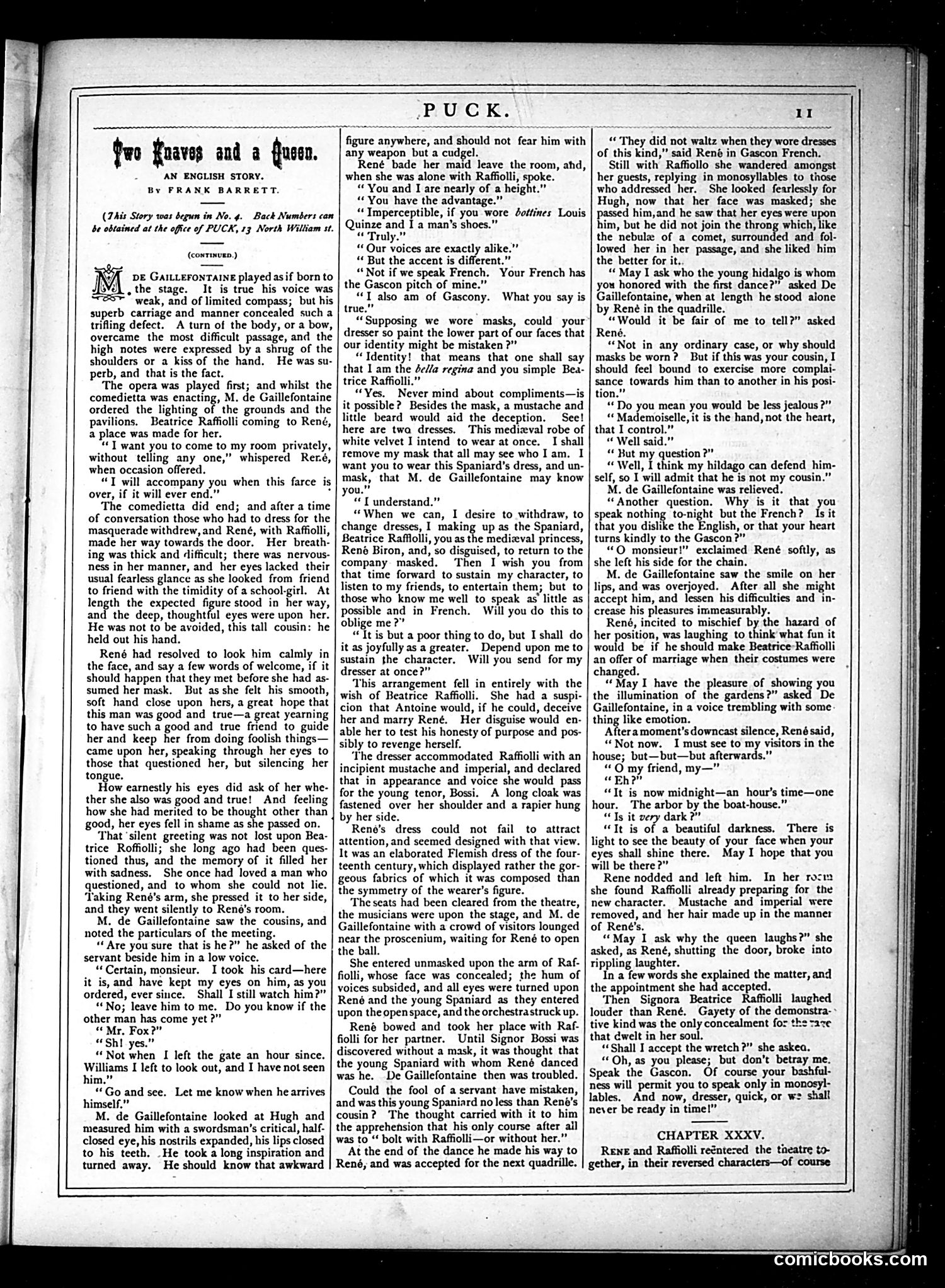
This page contains the continuation of a serialized English story by Frank Barrett, not a political cartoon. The narrative concerns theatrical intrigue involving characters named René, Raffaelli, and Beatrice, with plot elements including: - A masquerade ball and identity deception through costume - Romantic/social maneuvering among aristocratic characters - Theater company business and disguises The story focuses on interpersonal drama rather than political satire. It appears to be serialized fiction entertainment typical of Puck magazine's content alongside its better-known political cartoons. No identifiable historical figures or current political references are evident on this page.
📄 Transcribed text from this page (OCR, searchable)
Machine-transcribed from the original scan — historical spelling and the odd misread are preserved.
feo ffnaves and a fuse. AN ENGLISH STORY. By FRANK BARRETT. (This Story was begun in No.4. Back Numbers can be obtained at the office of PUCK, 13 North William st. (continven.) ny DE GAILLEFONTAINE played asif born to Vel, the stage. It is true his voice was a weak, and of limited compass; but his superb carriage and manner concealed such a trifling defect. A turn of the body, or a bow, overcame the most difficult passage, and the high notes were expressed by a shrug of the shoulders or a kiss of the hand. He was su- perb, and that is the fact. The opera was played first; and whilst the comedietta was enacting, M. de Gaillefontaine ordered the lighting of the grounds and the pavilions, Beatrice Raffiolli coming to René, a place was made for her. ‘«] want you to come to my room privately, without telling any one,” whispered René, when occasion offered. “T will accompany you when this farce is over, if it will ever end.” . The comedietta did end; and after a time of conversation those who had to dress for the masquerade withdrew, and René, with Raffiolli, made her way towards the door. Her breath- ing was thick and difficult; there was nervous- ness in her manner, and her eyes lacked their usual fearless glance as she looked from friend to friend with the timidity of a school-girl. At length the expected figure stood in her way, and the deep, thoughtful eyes were upon her. He was not to be avoided, this tall cousin: he held out his hand. René had resolved to look him calmly in the face, and say a few words of welcome, if it should happen that they met before she had as- sumed her mask. But as she felt his smooth, soft hand close upon hers, a great hope that this man was good and true—a great yearning to have such a good and true friend to guide her and keep her from doing foolish things— came upon her, speaking through her eyes to those that questioned her, but silencing her tongue. low earnestly his eyes did ask of her whe- ther she also was good and true! And feeling how she had merited to be thought other than good, her eyes fell in shame as she passed on. That 'silent greeting was not lost upon Bea- trice Roffiolli; she long ago had been ques- tioned thus, and the memory of it filled her with sadness. She once had loved a man who questioned, and to whom she could not lie. ‘Taking René’s arm, she pressed it to her side, and they went silently to René’s room. M. de Gaillefontaine saw the cousins, and noted the particulars of the meeting. “ Are you sure that is he ?” he asked of the servant beside him in a low voice. “Certain, monsieur. I took his card—here it is, and have kept my eyes on him, as you ordered, ever since. Shall I still watch him?” **No; leave him to me. Do you know if the other man has come yet ?” “Mr, Fox?” “Sh! yes.” Not when I left the gate an hour since. Williams I left to look out, and I have not seen him.” “Go and see. Let me know when he arrives himself.” M. de Gaillefontaine looked at Hugh and measured him with a swordsman’s critical, half- closed eye, his nostrils expanded, his lips closed to his teeth. -He took a long inspiration and turned away. He should know that awkward PUCK. figure anywhere, and should not fear him with any weapon but a cudgel. René bade her maid leave the room, ahd, when she was alone with Raffolli, spoke. “You and I are nearly of a height.” “‘ You have the advantage.” “Imperceptible, if you wore dottines Louis Quinze and I a man’s shoes.” “Truly.” “Our voices are exactly alike.” “ But the accent is different.” “‘Not if we speak French. Your French has the Gascon pitch of mine.” “T also am of Gascony. true."” “Supposing we wore masks, could your dresser so paint the lower part of our faces that our identity might be mistaken ?” “Identity! that means that one shall say that I am the della regina and you simple Bea- trice Raffiolli.” “Yes, Never mind about compliments—is it possible? Besides the mask, a mustache and little beard would aid the deception. See! here are twa dresses. This medizeval robe of white velvet I intend to wear at once. I shall remove my mask that all may see who I am. 1 want you to wear this Spaniard’s dress, and un- mask, that M. de Gaillefontaine may know you.” “ T understand.” “When we can, I desire to withdraw, to change dresses, I making up as the Spaniard, Beatrice Raflolli, you as the medizval princess, René Biron, and, so disguised, to return to the company masked. Then I wish you from that time forward to sustain my character, to listen to my friends, to entertain them; but to those who know me well to speak as’ little as possible and in French. Will you do this to oblige me ?” “It is but a poor thing to do, but I shall do it as joyfully as a greater. Depend upon me to sustain the character. Will you send for my dresser at once?” This arrangement fell in entirely with the wish of Beatrice Raffiolli. She had a suspi- cion that Antoine would, if he could, deceive her and marry René. Her disguise would en- able her to test his honesty of purpose and pos- sibly to revenge herself. ‘The dresser accommodated Raffiolli with an incipient mustache and imperial, and declared that in appearance and voice she would pass for the young tenor, Bossi. A long cloak was fastened: afer Her chonldenand/e rapier hung by her side. Rene’s dress could not fail to attract attention, and seemed designed with that view. It was an elaborated Flemish dress of the four- teenth century, which displayed rather the gor- geous fabrics of which it was composed than the symmetry of the wearer’s figure. ‘The seats had been cleared from the theatre, the musicians were upon the stage, and M. de Gaillefontaine with a crowd of visitors lounged near the proscenium, waiting for René to open the ball. She entered unmasked upon the arm of Raf- fiolli, whose face was concealed; the hum of voices subsided, and all eyes were turned upon René and the young Spaniard as they entered upon the openspace, and the orchestrastruck up. René bowed and took her place with Raf- fiolli for her partner. Until Signor Bossi was discovered without a mask, it was thought that the young Spaniard with whom René danced was he. De Gaillefontaine then was troubled. Could the fool of a servant have mistaken, and was this young Spaniard no less than René’s cousin? The thought carried with it to him the apprehension that his only course after all was to “ bolt with Raffiolli—or without her.” At the end of the dance he made his way to What you say is not waltz when they wore dresses |," said René in Gascon French. Still with Raffiollo she wandered amongst her guests, replying in monosyllables to those who addressed her. She looked fearlessly for Hugh, now that her face was masked; she passed him, and he saw that her eyes were upon him, but he did not join the throng which, like the nebule of a comet, surrounded and fol- lowed her in her passage, and she liked him the better for it. “ May I ask who the young hidalgo is whom you honored with the first dance?” asked De Gaillefontaine, when at length he stood alone by René in the quadrille. “Would it be fair of me to tell?” asked René. “Not in any ordinary case, or why should masks be worn? But if this was your cousin, I should feel bound to exercise more complai- sance towards him than to another in his posi- tion.” “Do you mean you would be less jealous ?” “ Mademoiselle, it is the hand, not the heart, that I control.” “Well said.” “ But my question ?” “Well, I think my hildago can defend him- self, so I will admit that he is not my cousin.” M. de Gaillefontaine was relieved. “Another question. Why is it that you speak sea to-night but the French? Is it that you dislike the English, or that your heart turns kindly to the Gascon?” “O monsieur!” exclaimed René softly, as she left his side for the chain. M. de Gaillefontaine saw the smile on her lips, and was overjoyed. After all she might accept him, and lessen his difficulties and in- crease his pleasures immeasurably. René, incited to mischief by the hazard of her position, was laughing to think’ what fun it would be if he should make Beatrice-Raffiolli an offer of marriage when their costumes were changed. “May I have the pleasure of showing you the illumination of the gardens?” asked De Gaillefontaine, in a voice trembling with some thing like emotion. Afteramoment’s downcast silence, René said, “Not now. I must see to my visitors in the house; but—but—but afterwards.” “O my friend, my—” “Eh? “Tt is now midnight—an hour’s time—one hour. The arbor by the boat-house.”” “Ts it very dark ?” “Tt is of a beautiful darkness. There is light to see the beauty of your face when your eyes shall shine there. May I hope that you will be there?” Rene nodded and left him. In her roc she found Raffiolli already preparing for the new character. Mustache and imperial were removed, and her hair made up in the manner of René’s. “May I ask why the queen laughs?” she asked, as René, shutting the door, broke into rippling laughter. In a few words she explained the matter, and the appointment she had accepted. Then Signora Beatrice Raffiolli laughed louder than René. Gayety of the demonstra-> tive kind was the only concealment for the sare that dwelt in her soul. “Shall I accept the wretch ?” she askea. “Oh, as you please; but don’t betray me. Speak the Gascon. Of course your bashful- ness will permit you to speak only in monosyl- lables. And now, dresser, quick, or w= shall never be ready in time!” CHAPTER XXXV. Rene and Raffiolli reéntezed the theatre to- René, and was accepted for the next quadrille. gether, in their reversed characters—of course Comicbooks.com