
Puck, 1877-11-28 · page 4 of 16
Puck — November 28, 1877 — page 4: what you’re looking at
What you’re looking at
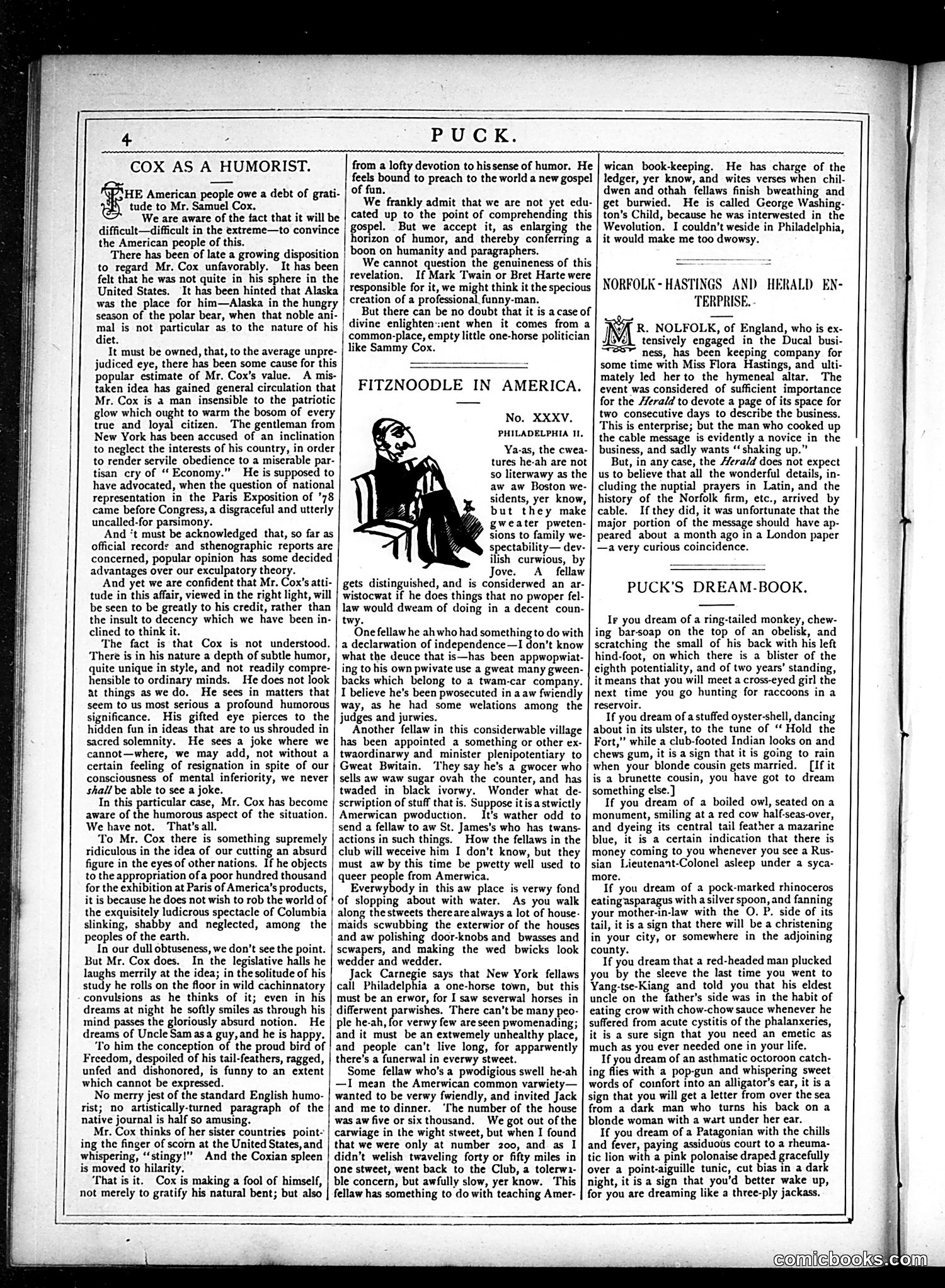
This page contains three distinct sections satirizing American public figures and culture: **"Cox as a Humorist"** critiques Samuel Cox, a congressman, as an unintentional comedian whose incompetence makes him ridiculous rather than genuinely funny. The piece questions whether his humor serves patriotic purposes. **"Fitznoodle in America"** features an illustrated character observing American life, particularly New York society. The narrative mocks American pretensions and social hierarchies through a visitor's perspective, comparing American customs unfavorably to British standards. **"Puck's Dream-Book"** offers humorous "dream interpretations"—if you dream of various animals or scenarios, what does it supposedly mean? This is lighthearted entertainment rather than serious satire. The page blends political commentary with social observation and whimsical humor typical of Puck's editorial approach.
📄 Transcribed text from this page (OCR, searchable)
Machine-transcribed from the original scan — historical spelling and the odd misread are preserved.
4 , PUCK. COX AS A HUMORIST. HE American people owe a debt of grati- tude to Mr, Samuel Cox. We are aware of the fact that it will be difficult—difficult in the extreme—to convince the American people of this. There has been of late a growing disposition to regard Mr. Cox unfavorably. It has been felt that he was not quite in his sphere in the United States. It has been hinted that Alaska was the place for him—Alaska in the hungry season of the polar bear, when that noble ani- | mal is not particular as to the nature of his diet. It must be owned, that, to the average unpre- judiced eye, there has been some cause for this popular estimate of Mr. Cox's value. A mis- taken idea has gained general circulation that Mr. Cox is a man insensible to the patriotic glow which ought to warm the bosom of every true and loyal citizen. The gentleman from New York has been accused of an inclination to neglect the interests of his country, in order to render servile obedience to a miserable par- tisan cry of “Economy.” He is supposed to have advocated, when the question of national representation in the Paris Exposition of ’78 came before Congress, a disgraceful and utterly uncalled-for parsimony. And ‘t must be acknowledged that, so far as official record: and sthenographic reports are concerned, popular opinion has some decided advantages over our exculpatory theory. And yet we are confident that Mr. Cox's atti- tude in this affair, viewed in the right light, will be seen to be greatly to his credit, rather than the insult to decency which we have been in- clined to think it. ‘The fact is that Cox is not understood. There is in his nature a depth of subtle humor, quite unique in style, and not readily compre- hensible to ordinary minds. He does not look at things as we do. He sees in matters that seem to us most serious a profound humorous significance. His gifted eye pierces to the hidden fun in ideas that are to us shrouded in sacred solemnity. He sees a joke where we cannot—where, we may add, not without a certain feeling of resignation in spite of our consciousness of mental inferiority, we never shall be able to see a joke. In this particular case, Mr. Cox has become aware of ch We have not. That's all. To Mr. Cox there is something supremely ridiculous in the idea of our cutting an absurd figure in the eyes of other nations. If he objects to the appropriation of a poor hundred thousand for the exhibition at Paris of America’s products, it is because he does not wish to rob the world of the exquisitely ludicrous spectacle of Columbia slinking, shabby and neglected, among the peoples of the earth. In our dull obtuseness, we don't see the point. But Mr. Cox does. In the legislative halls he laughs merrily at the idea; in the solitude of his study he rolls on the floor in wild cachinnatory convulsions as he thinks of it; even in his dreams at night he softly smiles as through his mind passes the gloriously absurd notion. He dreams of Uncle Sam asa guy, and he is happy. To him the conception of the proud bird of Freedom, despoiled of his tail-feathers, ragged, unfed and dishonored, is funny to an extent which cannot be expressed. No merry jest of the standard English humo- rist; no artistically-turned paragraph of the native journal is half so amusing. Mr. Cox thinks of her sister countries point- ing the finger of scorn at the United States, and whispering, “stingy!” And the Coxian spleen is moved to hilarity. ‘That is it. Cox is making a fool of himself, not merely to gratify his natural bent; but also | gospel. ¢ humorous aspect of the situation. | from a lofty devotion to his sense of humor. He feels bound to preach to the world a new gospel of fun. We frankly admit that we are not yet edu- cated up to the point of comprehending this But we accept it, as enlarging the ‘orizon of humor, and thereby conferring a boon on humanity and paragraphers. We cannot question the genuineness of this revelation. If Mark Twain or Bret Harte were responsible for it, we might think it the specious creation of a professional funny-man. But there can be no doubt that it is a case of divine enlighten:::ent when it comes from a common-place, empty little one-horse politician like Sammy Cox. FITZNOODLE IN AMERICA. No. XXXV. PHILADELPHIA II, Ya-as, the cwea- tures he-ah are not so literwawy as the aw aw Boston we- sidents, yer know, but they make gweater pweten- sions to family we- spectability— dev- ilish curwious, by Jove. A fellaw gets distinguished, and is considerwed an ar- wistocwat if he does things that no pwoper fel- law would dweam of doing in a decent coun- twy. One fellaw he ah who had something to do with a declarwation of independence—I don’t know what the deuce that is—has been appwopwiat- ing to his own pwivate use a gweat many gween- backs which belong to a twam-car company. I believe he's been pwosecuted in a aw fwiendly way, as he had some welations among the judges and jurwies. Another fellaw in this considerwable village has been appointed a something or other ex- twaordinarwy and minister plenipotentiary to Gweat Bwitain. ‘They say he’s a gwocer who sells aw waw sugar ovah the counter, and has twaded in black ivorwy. Wonder what de- scrwiption of stuff that is. Suppose itis a stwictly Amerwican pwoduction. It’s wather odd to send a fellaw to aw St. James's who has twans- actions in such things. How the fellaws in the club will weceive him I don’t know, but they must aw by this time be pwetty well used to queer people from Amerwica. Everwybody in this aw place is verwy fond of slopping about with water. As you walk along thestweets thereare always a lot of house- maids scwubbing the exterwior of the houses and aw polishing door-knobs and bwasses and scrapes and making the wed bwicks look wedder and wedder. Jack Carnegie says that New York fellaws call Philadelphia a one-horse town, but this must be an erwor, for I saw severwal horses in differwent parwishes. There can’t be many peo- ple he-ah, for verwy few are seen pwomenading; and it must be an extwemely unhealthy place, and people can’t live long, for apparwently there’s a funerwal in everwy stweet. Some fellaw who's a pwodigious swell he-ah —I mean the Amerwican common varwiety— wanted to be verwy fwiendly, and invited Jack and me to dinner. ‘The number of the house was aw five or six thousand. We got out of the carwiage in the wight stweet, but when I found that we were only at number 200, and as I didn’t welish twaveling forty or fifty miles in one stweet, went back to the Club, a tolerwa- ble concern, but awfully slow, yer know. This wican book-keeping. He has charge of the ledger, yer know, and wites verses when chil- dwen and othah fellaws finish bweathing and get burwied. He is called George Washing- ton’s Child, because he was interwested in the Wevolution. I couldn't weside in Philadelphia, it would make me too dwowsy. NORFOLK-HASTINGS AND HERALD EN- TERPRISE. M R. NOLFOLK, of England, who is ex- [Mal tensively engaged in the Ducal busi- 25> ness, has been keeping company for some time with Miss Flora Hastings, and ulti- mately led herto the hymeneal altar. The event was considered of sufficient importance for the Herald to devote a page of its space for two consecutive days to describe the business. This is enterprise; but the man who cooked up the cable message is evidently a novice in the business, and sadly wants “shaking up.” But, in any case, the Hera/d does not expect us to believe that all the wonderful details, in- cluding the nuptial prayers in Latin, and the history of the Norfolk firm, etc., arrived by cable. If they did, it was unfortunate that the major portion of the message should have ap- peared about a month ago in a London paper —a very curious coincidence. PUCK’S DREAM-BOOK. Ir you dream of a ring-tailed monkey, chew- ing bar-soap on the top of an obelisk, and scratching the small of his back with his left hind-foot, on which there is a blister of the eighth potentiality, and of two years’ standing, it means that you will meet a cross-eyed girl the next time you go hunting for raccoons in a reservoir. If you dream of astuffed oyster-shell, dancing about in its ulster, to the tune of ‘“ Hold the Fort,” while a club-footed Indian looks on and chews gum, it is a sign that it is going to rain when your blonde cousin gets married. [If it is a brunette cousin, you have got to dream something else.] If you dream of a boiled owl, seated on a monument, smiling at a red cow half-seas-over, and dyeing its central tail feather a mazarine blue, it is a certain indication that there is money coming to you whenever you see a Rus- sian Lieutenant-Colonel asleep under a syca- more. If you dream of a pock-marked rhinoceros eating asparagus with a silver spoon, and fanning your mother-in-law with the O. P. side of its tail, it is a sign that there will be a christening in your city, or somewhere in the adjoining county. If you dream that a red-headed man plucked you by the sleeve the last time you went to Yang-tse-Kiang and told you that his eldest uncle on the father’s side was in the habit of eating crow with chow-chow sauce whenever he suffered from acute cystitis of the phalanxeries, it is a sure sign that you need an emetic as much as you ever needed one in your life. If you dream of an asthmatic octoroon catch- ing flies with a pop-gun and whispering sweet words of coinfort into an alligator’s ear, it is a sign that you will get a letter from over the sea from a dark man who turns his back on a blonde woman with a wart under her ear. If you dream of a Patagonian with the chills and fever, paying assiduois court to a rheuma- tic lion with a pink polonaise draped gracefully over a point-aiguille tunic, cut bias in a dark night, it is a sign that you’d better wake up, fellaw has something to do with teaching Amer- | for you are dreaming like a three-ply jackass. comichoo!