
Puck, 1877-11-28 · page 6 of 16
Puck — November 28, 1877 — page 6: what you’re looking at
What you’re looking at
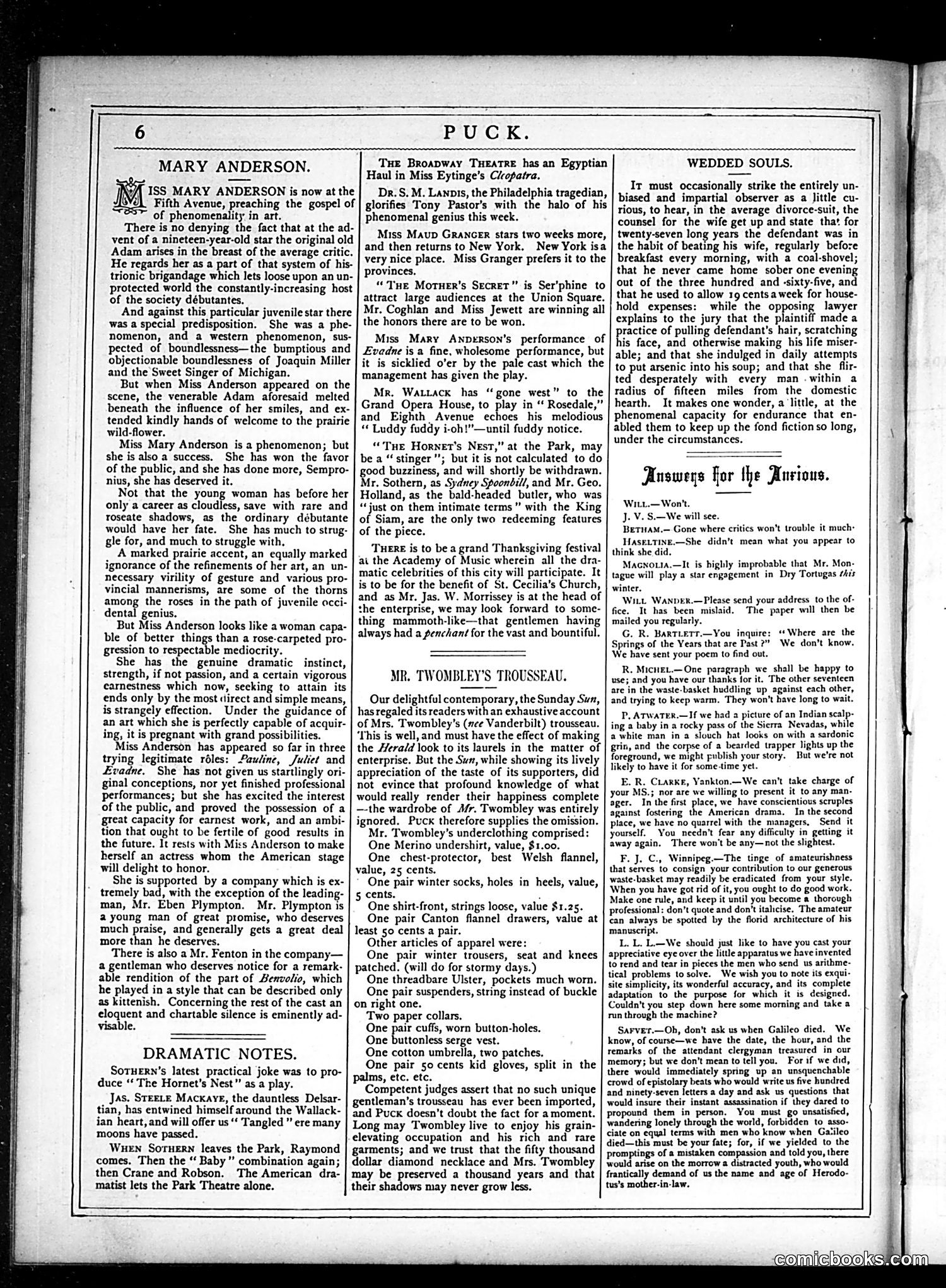
This Puck page is primarily **theatrical criticism and drama notes**, not political satire. The main content discusses: **Mary Anderson** - A celebrated actress reviewed favorably for her "phenomenal" talent and career trajectory, praised for performances in legitimate roles like *Juliet* and *Evadne*. **Mr. Twombley's Trousseau** - A theatrical review of a play featuring actors Mr. Sothern and Mr. Geo. Holland, critiquing both the production's quality and its social commentary about wealth and materialism. **Dramatic Notes** - Brief gossipy items about theater figures and productions. The page contains no visible political cartoons. It's essentially **entertainment journalism** — typical of Puck's theatrical coverage mixed with advertisements for clothing and accessories. The satire, if present, operates at the level of theater criticism rather than political commentary.
📄 Transcribed text from this page (OCR, searchable)
Machine-transcribed from the original scan — historical spelling and the odd misread are preserved.
L PUCK. || MARY ANDERSON. I ISS MARY ANDERSON is now at the x Fifth Avenue, preaching the gospel of of phenomenality in art. There is no denying the fact that at the ad- vent of a nineteen-year-old star the original old Adam arises in the breast of the average critic. He regards her as a part of that system of his- trionic brigandage which lets loose upon an un- protected world the constantly-increasing host of the society débutantes. And against this particular juvenile star there was a special predisposition. She was a phe- nomenon, and a western phenomenon, sus- pected of boundlessness—the bumptious and objectionable boundlessness of Joaquin Miller and the Sweet Singer of Michigan. But when Miss Anderson appeared on the scene, the venerable Adam aforesaid melted beneath the influence of her smiles, and ex- tended kindly hands of welcome to the prairie wild-flower. Miss Mary Anderson is a phenomenon; but she is also a success. She has won the favor of the public, and she has done more, Sempro- nius, she has deserved it. Not that the young woman has before her only a career as cloudless, save with rare and toseate shadows, as the ordinary débutante would have her fate. She has much to strug- gle for, and much to struggle with, A marked prairie accent, an equally marked ignorance of the refinements of her art, an un- necessary virility of gesture and various pro- vincial mannerisms, are some of the thorns among the roses in the path of juvenile occi- dental genius. But Miss Anderson looks like a woman capa- ble of better things than a rose-carpeted pro- gression to respectable mediocrity. She has the genuine dramatic instinct, strength, if not passion, and a certain vigorous earnestness which now, secking to attain its ends only by the most direct and simple means, is strangely effection. Under the guidance of an art which she is perfectly capable of acquir- ing, it is pregnant with grand possibilities. Miss Anderson has appeared so far in three trying legitimate réles: Pauline, Juliet and Evadne. She has not given us startlingly ori- ginal conceptions, nor yet finished professional performances; but she has excited the interest of the public, and proved the possession of a great capacity for earnest work, and an ambi- tion that ought to be fertile of good results in the future. It rests with Miss Anderson to make herself an actress whom the American stage will delight to honor. She is supported by a company which is ex- tremely bad, with the exception of the leading- man, Mr. Eben Plympton. Mr. Plympton is a young man of great promise, who deserves much praise, and generally gets a great deal more t he deserves. There is also a Mr. Fenton in the company— a gentleman who deserves notice for a remark- able rendition of the part of Benvolio, which he played in a style that can be described only as kittenish. Concerning the rest of the cast an eloquent and chartable silence is eminently ad- visable. DRAMATIC NOTES. SoTuHERn’s latest practical joke was to pro- duce “ The Hornet's Nest” as‘a play. Jas. STEELE Mackayé, the dauntless Delsar- tian, has entwined himself around the Wallack- ian heart, and will offer us ‘‘ ‘Tangled ere many moons have passed. Wuen Soruern leaves the Park, Raymond comes. Then the “ Baby” combination again; then Crane and Robson. The American dra- matist lets the Park Theatre alone. Tue Broapway THEATRE has an Egyptian Haul in Miss Eytinge’s C/opatra. Dr. S. M. Lanois, the Philadelphia tragedian, glorifies Tony Pastor’s with the halo of his phenomenal genius this week. Miss Maup GRANGER stars two weeks more, and then returns to New York. New York isa very nice place. Miss Granger prefers it to the provinces, “©THE MoTHER’s SECRET” is Ser'phine to attract large audiences at the Union Square. Mr. Coghlan and Miss Jewett are winning all the honors there are to be won. Miss Mary AnpeErson’s performance of Evadne is a fine, wholesome performance, but it is sicklied o’er by the pale cast which the management has given the play. Mr. Wattack has “gone west” to the Grand Opera House, to play in ‘“ Rosedale,” and Eighth Avenue echoes his melodious “Luddy fuddy i-oh!"”—until fuddy notice. “THe Hornet's Nest,” at the Park, may be a ‘stinger’; but it is not calculated to do good buzziness, and will shortly be withdrawn. Mr. Sothern, as Sydney Spoonbill, and Mr. Geo. Holland, as the bald-headed butler, who was “just on them intimate terms” with the King of Siam, are the only two redeeming features of the piece. Tuere is to be a grand Thanksgiving festival ‘at the Academy of Music wherein all the dra- matic celebrities of this city will participate. It is to be for the benefit of St. Cecilia's Church, and as Mr. Jas. W. Morrissey is at the head of the enterprise, we may look forward to some- thing mammoth-like—that gentlemen having always had a penchant for the vast and bountiful. MR. TWOMBLEY’S TROUSSEAU. Our delightful contemporary, the Sunday Sun, has regaled its readers with an exhaustive account of Mrs. Twombley’s (nee Vanderbilt) trousseau. ‘This is well, and must have the effect of making the Hera/d look to its laurels in the matter of enterprise. But the Sur, while showing its lively appreciation of the taste of its supporters, did not evince that profound knowledge of what would really render their happiness complete —the wardrobe of Afr. Twombley was entirely ignored. Puck therefore supplies the omission. Mr. Twombley’s underclothing comprised: One Merino undershirt, value, $1.00. One chest-protector, best Welsh flannel, value, 25 cents. One pair winter socks, holes in heels, value, 5 cents. ; One shirt-front, strings loose, value $1.25. One pair Canton flannel drawers, value at least 50 cents a pair. Other articles of apparel were: One pair winter trousers, seat and knees patched. (will do for stormy days.) One threadbare Ulster, pockets much worn. One pair suspenders, string instead of buckle on right one. Two paper collars, One et cuffs, worn button-holes. One buttonless serge vest. One cotton umbrella, two patches. One pair 50 cents kid gloves, split in the palms, etc. etc. Competent judges assert that no such unique gentleman's trousseau has ever been imported, and Puck doesn’t doubt the fact for amoment. Long may Twombley live to enjoy his grain- elevating occupation and his rich and rare garments; and we trust that the fifty thousand dollar diamond necklace and Mrs. Twombley may be preserved a thousand years and that their shadows may never grow less. WEDDED SOULS. It must occasionally strike the entirely un- biased and impartial observer as a Jittle cu- rious, to hear, in the average divorce-suit, the counsel for the wife get up and state that for twenty-seven long years the defendant was in the habit of beating his wife, regularly before breakfast every morning, with a coal-shovel; that he never came home sober one evening out of the three hundred and -sixty-five, and that he used to allow 19 cents aweek for house- hold expenses: while the opposing lawyer explains to the jury that the plaintiff made a ractice of pulling defendant's hair, scratching Fis face, and otherwise making his life miser- able; and that she indulged in daily attempts to put arsenic into his soup; and that she _flir- ted desperately with every man within a radius of fifteen miles from the domestic hearth. It makes one wonder, a little, at the phenomenal capacity for endurance that en- abled them to keep up the fond fiction so long, under the circumstances. Fnswers for the Anrious. Betiam.— Gone where critics won't trouble it much: Mase She didn’t mean what you appear to think she did. MacNouta.—It is highly improbable that Mr. Mon- tague will playa star engagement in Dry Tortugas ¢his winter. Wit. Wanper.—Please send your address to the of- fice. It has been mislaid. The paper will then be mailed you regularly. G. R. BaRTLETT.—You inquire Springs of the Years that are Past We have sent your poem to find out. R. MicueL.—One paragraph we shall be happy to use; and you have our thanks for it. ‘The other seventeen are in the waste-basket huddling up against each other, and trying to keep warm, They won't have long to wait. P. ATwaren.—If we had a picture of an Indian scalp- ing a baby in a rocky pass of the Sierra Nevadas, while awhite man ina slouch hat looks on with a sardonic grin, and the corpse of a bearded trapper lights up the foreground, we might publish your story. But we're not likely to have it for sometime yet. E. R. CLarke, Yankton.—We can’t take charge of your MS.; nor are we willing to present it to any man- ager. In the first place, we have conscientious scruples against fostering the American drama. In the second place, we have no quarrel with the managers. Send it yourself. You needn't fear any difficulty in getting it away again, ‘There won't be any—not the slightest. F. J. C., Winnipeg.—The tinge of amateurishness that serves to consign your contribution to our generous waste-basket may readily be eradicated from your style. When you have got rid of it, you ought to do good work. Make one rule, and keep it until you become a thorough professional: don’t quote and don’t itahicise. The amateur can always be spotted by the florid architecture of his manuscript. L. L. L.—We should just like to have you cast your appreciative eye over the little apparatus we have invented to rend and tear in pieces the men who send us arithme- tical problems to solve. We wish you to note its exqui- site simplicity, its wonderful accuracy, and its complete adaptation to the purpose for which it is designed. Couldn’t you step down here some morning and take a run through the machine? Sarvet.—Oh, don’t ask us when Galileo died. We know, of course—we have the date, the hour, and the remarks of the attendant clergyman treasured in our memory; but we don’t mean to tell you. For if we did, there would immediately spring up an unsquenchable crowd of epistolary beats who would write us five hundred and ninety-seven letters a day and ask us questions that would insure their instant assassination if they dared to propound them in person. You must go unsatisfied, wandering lonely through the world, forbidden to asso- ciate on equal terms with men who know when Gatileo died—this must be your fate; for, if we yielded to the promptings of a mistaken compassion and told you, there would arise on the morrow a distracted youth, who would frantically demand of us the name and age of Herodo- tus’s mother-in-law. “Where are the We don’t know.