
Puck, 1877-11-28 · page 2 of 16
Puck — November 28, 1877 — page 2: what you’re looking at
What you’re looking at
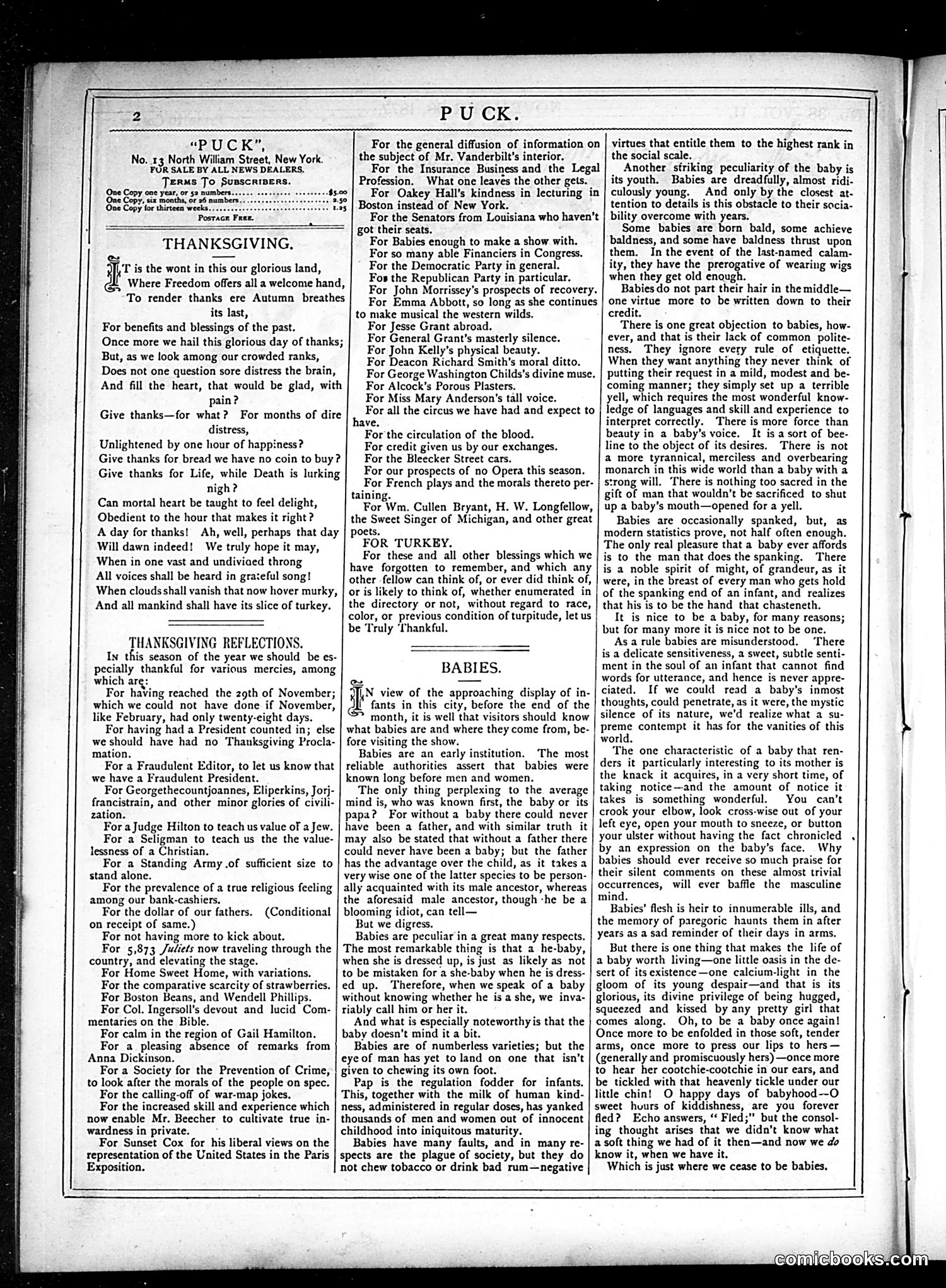
This page contains two main sections: advertisements for Puck magazine at the top, and editorial content below featuring a "Thanksgiving" poem and an article titled "Babies." The Thanksgiving poem is satirical verse listing things to be grateful for, including references to contemporary political figures and situations (mentions of "November," "President," "Fraudulent Editor," and "Judge Hilton"). These appear to be topical jabs at 1880s politics and journalism, though specific identities are unclear without additional context. The "Babies" article is a humorous essay about infants' characteristics and behavior—their lack of manners, their tyrannical nature, and their demands. It's written in a comic, affectionate tone typical of Puck's social satire, poking fun at how babies dominate households despite their complete helplessness. No political cartoon is visible on this particular page.
📄 Transcribed text from this page (OCR, searchable)
Machine-transcribed from the original scan — historical spelling and the odd misread are preserved.
PUCK. “PUCK”, No. 13 North William Street, New York. FOR SALE BY ALL NEWS DEALERS, Terms To Susscriners. Que Copy te bers. One Copy, ax montha, or 36 a One Copy for thirteen weeks... Postrace Free. THANKSGIVING. Ie is the wont in this our glorious land, Where Freedom offers all a welcome hand, To render thanks ere Autumn breathes its last, For benefits and blessings of the past. Once more we hail this glorious day of thanks; But, as we look among our crowded ranks, Does not one question sore distress the brain, And fill the heart, that would be glad, with pain? Give thanks—for what? For months of dire distress, Unlightened by one hour of happiness? Give thanks for bread we have no coin to buy? Give thanks for Life, while Death is lurking nigh? Can mortal heart be taught to feel delight, Obedient to the hour that makes it right? A day for thanks! Ah, well, perhaps that day Will dawn indeed! We truly hope it may, When in one vast and undiviaed throng All voices shall be heard in grateful song! When clouds shall vanish that now hover murky, And all mankind shall have its slice of turkey. THANKSGIVING REFLECTIONS. In this season of the year we should be es- pecially thankful for various mercies, among which are: For having reached the 29th of November; which we could not have done if November, like February, had only twenty-eight days. For having had a President counted in; else we should have had no Thanksgiving Procla- mation. For a Fraudulent Editor, to let us know that we have a Fraudulent President. For Georgethecountjoannes, Eliperkins, Jorj- francistrain, and other minor glories of civili- zation. For aJudge Hilton to teach us value of a Jew. For a Seligman to teach us the the value- lessness of a Christian. For a Standing Army.of sufficient size to stand alone. For the prevalence of a true religious feeling among our bank-cashiers, For the dollar of our fathers. on receipt of same.) For not having more to kick about. For 5,873 /u/iets now traveling through the country, and elevating the stage. For Home Sweet Home, with variations. For the comparative scarcity of strawberries. For Boston Beans, and Wendell Phillips. For Col. Ingersoll’s devout and lucid Com- mentaries on the Bible. For calm in the region of Gail Hamilton. For a pleasing absence of remarks from Anna Dickinson. For a Society for the Prevention of Crime, to look after the morals of the people on spec. For the calling-off of war-map jokes. For the increased skill and experience which now enable Mr. Beecher to cultivate true in- wardness in private. For Sunset Cox for his liberal views on the representation of the United States in the Paris Exposition. (Conditional For the general diffusion of information on the subject of Mr. Vanderbilt’s interior. For the Insurance Business and the Legal Profession. What one leaves the other gets. For Oakey Hall’s kindness in lecturing in Boston instead of New York. For the Senators from Louisiana who haven't got their seats. For Babies enough to make a show with. For so many able Financiers in Congress. For the Democratic Party in general. Fos the Republican Party in particular. For John Morrissey’s prospects of recovery. For Emma Abbott, so long as she continues to make musical the western wilds. For Jesse Grant abroad. For General Grant's masterly silence. For John Kelly's physical beauty. For Deacon Richard Smith’s moral ditto. For George Washington Childs’s divine muse, For Alcock’s Porous Plasters. For Miss Mary Anderson's tall voice. For all the circus we have had and expect to have, For the circulation of the blood. For credit given us by our exchanges. For the Bleecker Street cars. For our prospects of no Opera this season. For French plays and the morals thereto per- taining. For Wm. Cullen Bryant, H. W. Longfellow, the Sweet Singer of Michigan, and other great joets. FOR TURKEY. For these and all other blessings which we have forgotten to remember, and which any other fellow can think of, or ever did think of, or is likely to think of, whether enumerated in the directory or not, without regard to race, color, or previous condition of turpitude, let us be Truly ‘Thankful. BABIES. és eoey LN view of the approaching display of in- fants in this city, before the end of the month, it is well that visitors should know what babies are and where they come from, be- fore visiting the show. Babies are an early institution. The most reliable authorities assert that babies were known long before men and women. The only thing perplexing to the average mind is, who was known first, the baby or its papa? For without a baby there could never have been a father, and with similar truth it may also be stated that without a father there could never have been a baby; but the father has the advantage over the child, as it takes a very wise one of the latter species to be person- ally acquainted with its male ancestor, whereas the aforesaid male ancestor, though -he be a blooming idiot, can tell— But we digress. Babies are peculiar in a great many respects. The most remarkable thing is that a he-baby, when she is dressed up, is just as likely as not to be mistaken for a she-baby when he is dress- ed up. ‘Therefore, when we speak of a baby without knowing whether he is a she, we inva- riably call him or her it. And what is especially noteworthy is that the baby doesn’t mind it a bit. Babies are of numberless varieties; but the eye of man has yet to land on one that isn’t given to chewing its own foot. Pap is the regulation fodder for infants. This, together with the milk of human kind- ness, administered in regular doses, has yanked thousands of men and women out of innocent childhood into iniquitous maturity. Babies have many faults, and in many re- spects are the plague of society, but they do not chew tobacco or drink bad rum—negative virtues that entitle them to the highest rank in the social scale. Another sfriking peculiarity of the baby is its youth. Babies are dreadfully, almost ridi- culously young. And only by the closest at- tention to details is this obstacle to their socia- bility overcome with years. Some babies are born bald, some achieve baldness, and some have baldness thrust upon them. In the event of the last-named calam- ity, they have the prerogative of wearing wigs when they get old enough. Babies do not part their hair in the middle— one virtue more to be written down to their credit. There is one great objection to babies, how- ever, and that is their lack of common _polite- ness. They ignore every rule of etiquette. When they want anything they never think of putting their request in a mild, modest and be- coming manner; they simply set up a terrible yell, which requires the most wonderful know- ledge of languages and skill and experience to interpret correctly. There is more force than beauty in a baby’s voice. It is a sort of bee- line to the object of its desires. There is not a more tyrannical, merciless and overbearing monarch in this wide world than a baby with a strong will. ‘There is nothing too sacred in the gift of man that wouldn’t be sacrificed to shut up a baby’s mouth—opened for a yell. Babies are occasionally spanked, but, as modern statistics prove, not half often enough. The only real pleasure that a baby ever affords is to the man that does the spanking. There is a noble spirit of might, of grandeur, as it were, in the breast of every man who gets hold of the spanking end of an infant, and realizes that his is to be the hand that chasteneth. It is nice to be a baby, for many reasons; but for many more it is nice not to be one. Asa rule babies are misunderstood. ‘There is a delicate sensitiveness, a sweet, subtle senti- ment in the soul of an infant that cannot find words for utterance, and hence is never appre- ciated. If we could read a baby’s inmost thoughts, could penetrate, as it were, the mystic silence of its nature, we'd realize what a su- preme contempt it has for the vanities of this world. The one characteristic of a baby that ren- ders it particularly interesting to its mother is the knack it acquires, in a very short time, of taking notice—and the amount of notice it takes is something wonderful. You can’t crook your elbow, look cross-wise out of your left eye, open your mouth to sneeze, or button your ulster without having the fact chronicled by an expression on the baby’s face. Why babies should ever receive so much praise for their silent comments on these almost trivial occurrences, will ever baffle the masculine mind, Babies’ flesh is heir to innumerable ills, and the memory of paregoric haunts them in after years as a sad reminder of their days in arms. But there is one thing that makes the life of a baby worth living—one little oasis in the de- sert of its existence—one calcium-light in the gloom of its young despair—and that is its glorious, its divine privilege of being hugged, squeezed and kissed by any pretty girl that comes along. Oh, to be a baby once again! Once more to be enfolded in those soft, tender arms, once more to press our lips to hers — (generally and promiscuously hers) once more to hear her cootchie-cootchie in our ears, and be tickled with that heavenly tickle under our little chin!’ O happy days of babyhood~O sweet huurs of kiddishness, are you forever fled? Echo answers, “ Fled;” but the consol- ing thought arises that we didn’t know what a soft thing we had of it then—and now we do know it, when we have it, Which is just where we cease to be babies.