
Puck, 1877-11-28 · page 7 of 16
Puck — November 28, 1877 — page 7: what you’re looking at
What you’re looking at
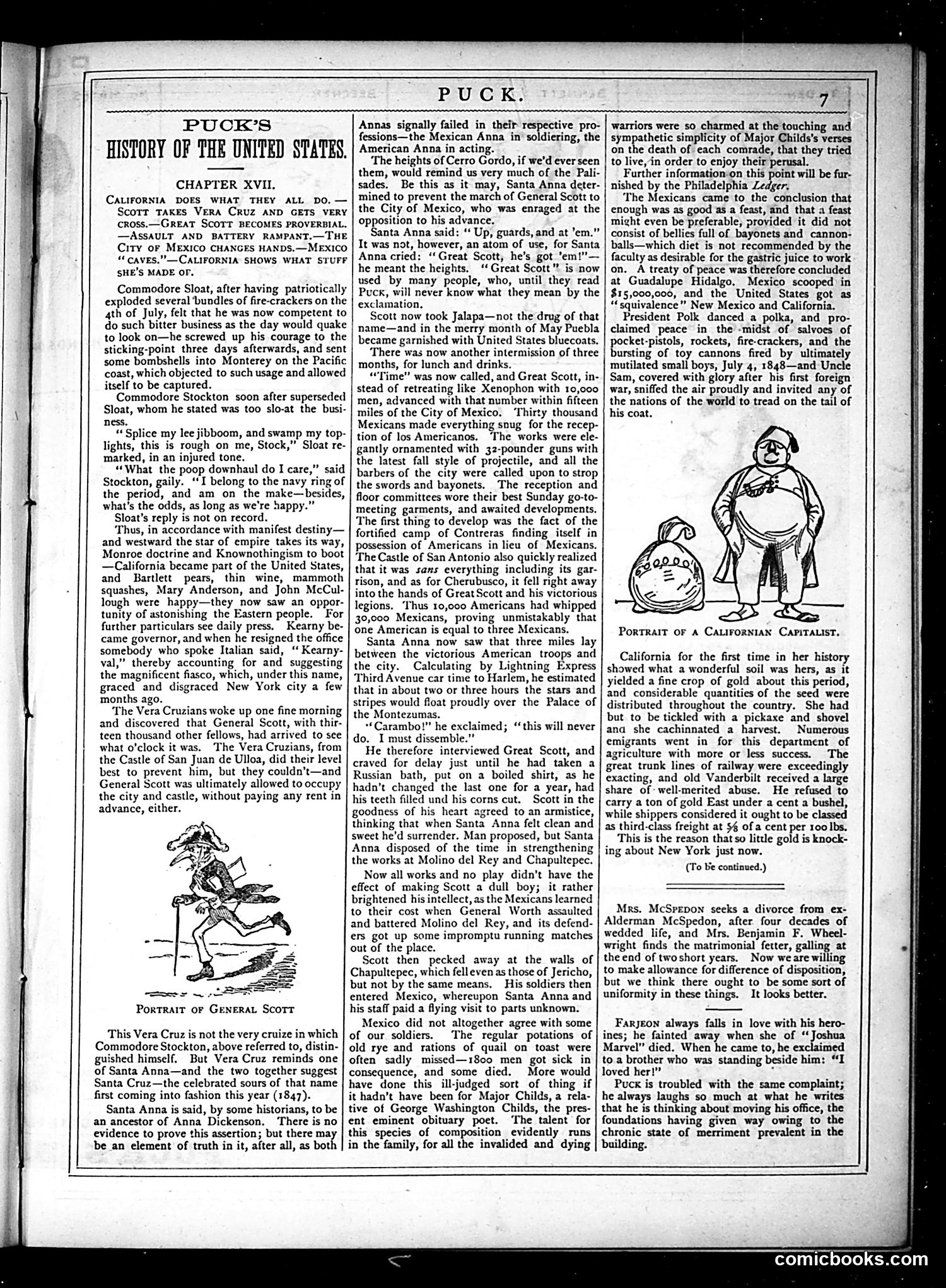
This page from Puck contains two illustrations accompanying an article titled "PUCK'S HISTORY OF THE UNITED STATES," specifically Chapter XVII about California during the Mexican-American War era. The two portraits shown are labeled "PORTRAIT OF A CALIFORNIAN CAPITALIST" and "PORTRAIT OF GENERAL SCOTT." These appear to be historical illustrations supporting a satirical narrative about American military conquest in California and the acquisition of wealth and property during westward expansion. The text discusses General Scott's military campaigns, Mexican resistance, and the ultimate American victory, presenting events with Puck's characteristic irreverent tone. The "Californian Capitalist" portrait likely represents newly wealthy American settlers profiting from the territorial acquisition—a common Puck subject satirizing rapid wealth accumulation during American expansion.
📄 Transcribed text from this page (OCR, searchable)
Machine-transcribed from the original scan — historical spelling and the odd misread are preserved.
PUCK. ; { PUCK’S HISTORY OF THE UNITED STATES. CHAPTER XVII. CALIFORNIA DOES WHAT THEY ALL DO. — Scott TAKES VERA CRUZ AND GETS VERY cross.—GREAT SCOTT BECOMES PROVERBIAL. —ASSAULT AND BATTERY RAMPANT.—THE City oF MEXICO CHANGES HANDS.—MEXICO “CavES.”—CALIFORNIA SHOWS WHAT STUFF SHE'S MADE Or, Commodore Sloat, after having patriotically exploded several ‘bundles of fire-crackers on the 4th of July, felt that he was now competent to do such bitter business as the day would quake to look on—he screwed up his courage to the sticking-point three days afterwards, and sent some bombshells into Monterey on the Pacific coast, which objected to such usage and allowed itself to be captured. Commodore Stockton soon after superseded Sloat, whom he stated was too slo-at the busi- ness. “Splice my lee jibboom, and swamp my top- lights, this is rough on me, Stock,” Sloat re- marked, in an injured tone. “What the poop downhaul do I care,” said Stockton, gaily. ‘I belong to the navy ring of the period, and am on the make—besides, what's the odds, as long as we're happy.” Sloat's reply is not on record. Thus, in accordance with manifest destiny— and westward the star of empire takes its way, Monroe doctrine and Knownothingism to boot —California became part of the United States, and Bartlett pears, thin wine, mammoth squashes, Mary Anderson, and John McCul- lough were happy—they now saw an oppor- tunity of astonishing the Eastern people. For further particulars see daily press. Kearny be- came governor, and when he resigned the office somebody who spoke Italian said, “ Kearny- val,” thereby accounting for and suggesting the magnificent fiasco, which, under this name, graced and disgraced New York city a few months ago. ‘The Vera Cruzians woke up one fine morning and discovered that General Scott, with thir- teen thousand other fellows, had arrived to see what o'clock it was. The Vera Cruzians, from the Castle of San Juan de Ulloa, did their level best to prevent him, but they couldn’t—and General Scott was ultimately allowed to occupy the city and castle, without paying any rent in advance, either. Portrait or GENERAL ScoTT This Vera Cruz is not the very cruize in which Commodore Stockton, above referred to, distin- guished himself, But Vera Cruz reminds one of Santa Anna—and the two together suggest Santa Cruz—the celebrated sours of that name first coming into fashion this year (1847). Santa Anna is said, by some historians, to be an ancestor of Anna Dickenson. There is no evidence to prove this assertion; but there may be an element of truth in it, after all, as both Annas signally failed in their respective pro- fessions—the Mexican Anna in’ soldiering, the American Anna in acting. The heights of Cerro Gordo, if we'd ever seen them, would remind us very much of the Pali- sades. Be this as it may, Santa Anna deter- mined to prevent the march of General Scott to the City of Mexico, who was enraged at the opposition to his advance. Santa Anna said: ‘‘ Up, guards, and at ’em.” It was not, however, an atom of use, for Santa Anna cried: ‘Great Scott, he’s got ’em!”— he meant the heights. ‘Great Scott” is now used by many people, who, until they read Puck, will never know what they mean by the exclamation, Scott now took Jalapa—not the drug of that name—and in the merry month of May Puebla became garnished with United States bluecoats. There was now another intermission of three months, for lunch and drinks. “Time” was now called, and Great Scott, in- stead of retreating like Xenophon with 10,000 men, advanced with that number within fifteen miles of the City of Mexico. ‘Thirty thousand Mexicans made everything snug for the recep- tion of los Americanos. The works were ele- gantly ornamented with 32-pounder guns with the latest fall style of projectile, and all the barbers of the city were called upon to strop the swords and bayonets. The reception and floor committees wore their best Sunday go-to- meeting garments, and awaited developments. The first thing to develop was the fact of the fortified camp of Contreras finding itself in possession of Americans in lieu of Mexicans. The Castle of San Antonio also quickly realized that it was sans everything including its gar- rison, and as for Cherubusco, it fell right away into the hands of Great Scott and his victorious legions. ‘Thus 10,000 Americans had whipped 30,000 Mexicans, proving unmistakably that one American is equal to three Mexicans. Santa Anna now saw that three miles lay between the victorious American troops and the city. Calculating by Lightning Express Third Avenue car time to Harlem, he estimated that in about two or three hours the stars and stripes would float proudly over the Palace of the Montezumas. “Carambo!” he exclaimed; ‘this will never do. I must dissemble.”” He therefore interviewed Great Scott, and craved for delay just until he had taken a Russian bath, put on a boiled shirt, as he hadn't changed the last one for a year, had his teeth filled und his corns cut. Scott in the goodness of his heart agreed to an armistice, thinking that when Santa Anna felt clean and sweet he'd surrender. Man proposed, but Santa Anna disposed of the time in strengthening the works at Molino del Rey and Chapultepec. Now all works and no play didn’t have the effect of making Scott a dull boy; it rather brightened his intellect, as the Mexicans learned to their cost when General Worth assaulted and battered Molino del Rey, and its defend- ers got up some impromptu running matches out of the place. Scott then pecked away at the walls of Chapultepec, which felleven as those of Jericho, but not by the same means. His soldiers then entered Mexico, whereupon Santa Anna and his staff paid a fying visit to parts unknown. Mexico did not altogether agree with some of our soldiers. The regular potations of old rye and rations of quail on toast were often sadly missed—1800 men got sick in consequence, and some died. More would have done this ill-judged sort of thing if it hadn’t have been for Major Childs, a rela- tive of George Washington Childs, the pres- ent eminent obituary poet. The talent for this species of composition evidently runs in the family, for all the invalided and dying warriors were so charmed at the touching and syepathetie simplicity of Major Childs’s verses on the death of each comrade, that they tried to live, in order to enjoy their perusal. Further information-on this point will be fur- nished by the Philadelphia Ledger, ‘The Mexicans came to the conclusion that enough was as good as a feast, and that a feast might even be preferable, provided it did not consist of bellies full of bayonets and cannon- balls—which diet is not recommended by the faculty as desirable for the gastric juice to work on. A treaty of peace was therefore concluded at Guadalupe Hidalgo, Mexico scooped in $15,000,000, and the United States got as “squivalence” New Mexico and California. President Polk danced a polka, and pro- claimed peace in the-midst of salvoes of pocket-pistols, rockets, firecrackers, and the bursting of toy cannons fired by ultimately mutilated small boys, July 4, 1848—and Uncle Sam, covered with glory after his first foreign war, sniffed the air proudly and invited any of the nations of the world to tread on the tail of his coat. Portrait oF A CALIFORNIAN CAPITALIST. California for the first time in her history showed what a wonderful soil was hers, as it yielded a fine crop of gold about this period, and considerable quantities of the seed were distributed throughout the country. She had but to be tickled with a pickaxe and shovel ana she cachinnated a harvest. Numerous emigrants went in for this department of agriculture with more or less success. The great trunk lines of railway were exceedingly exacting, and old Vanderbilt received a large share of-well-merited abuse. He refused to carry a ton of gold East under a cent a bushel, while shippers considered it ought to be classed as third-class freight at $4 of a cent per 100 Ibs. This is the reason that so little gold is knock- ing about New York just now. (To We continued.) Mrs. McSpepon seeks a divorce from ex- Alderman McSpedon, after four decades of wedded life, and Mrs. Benjamin F. Wheel- wright finds the matrimonial fetter, galling at theend of twoshort years. Now weare willing to make allowance for difference of disposition, but we think there ought to be some sort of uniformity in these things. It looks better. Farjeon always falls in love with his hero- ines; he fainted away when she of “Joshua Marvel” died. When he came to, he exclaimed toa brother who was standing beside him: “I loved her!" Puck is troubled with the same complaint; he always laughs so much at what he writes that he is thinking about moving his office, the foundations having given way owing to the chronic state of merriment prevalent in the building. comicbooks.com