
Puck, 1877-11-28 · page 3 of 16
Puck — November 28, 1877 — page 3: what you’re looking at
What you’re looking at
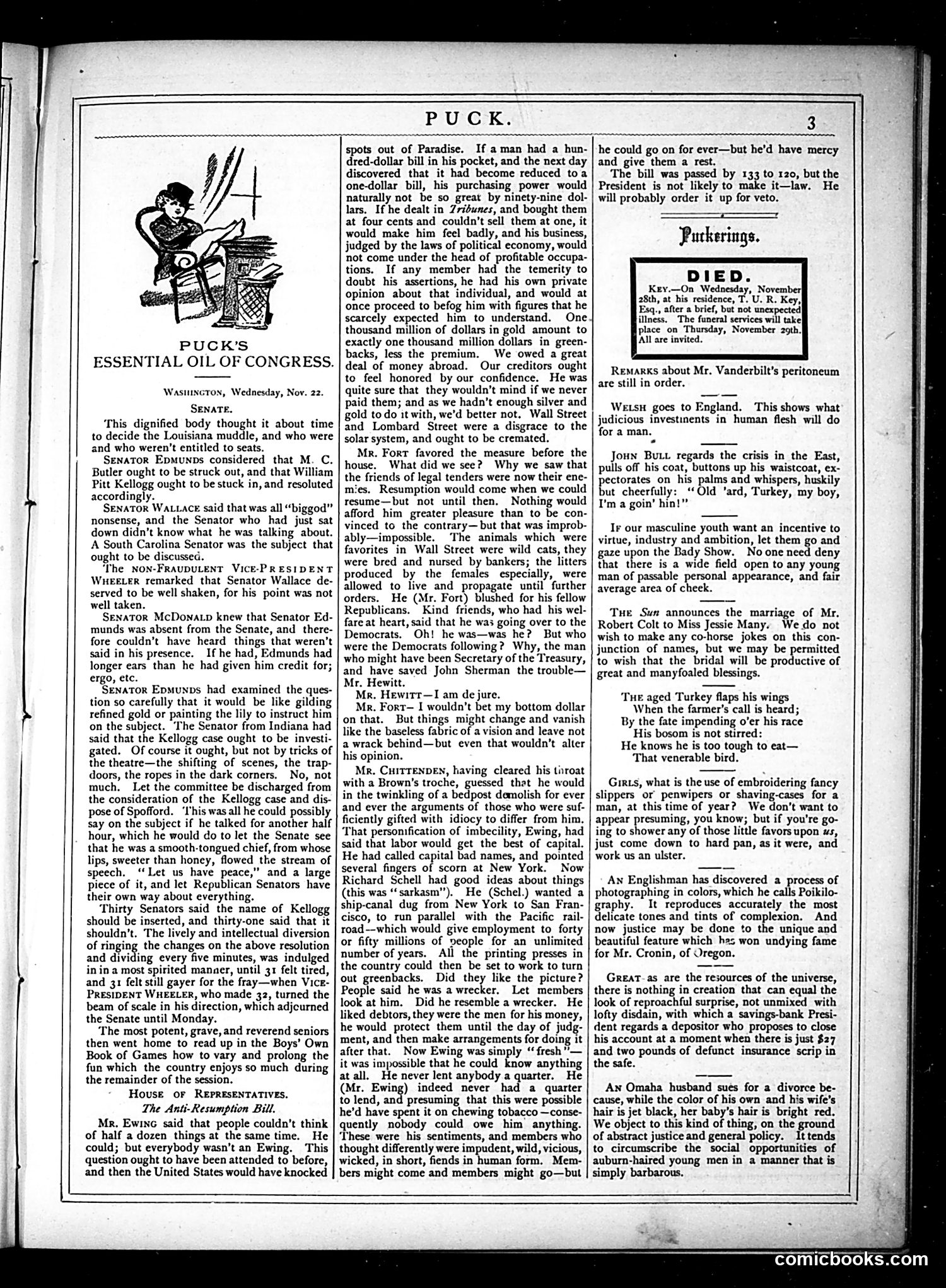
The cartoon depicts a figure (appearing to be a senator or congressman) distilling "essential oil of congress"—a satirical commentary on legislative ineffectiveness. The accompanying text records Senate debate over Louisiana's admission and currency/financial policy, with senators discussing (often nonsensically) various proposals about money supply and banking reform. The satire targets Congress's tendency to produce only vaporous rhetoric from lengthy deliberations. By framing legislative output as an "oil" to be extracted, Puck mocks how little substantive policy results from extensive congressional debate. The cartoon suggests that after all the talking, senators and representatives yield minimal tangible results—just empty distillations of hot air, suitable only for trivial uses.
📄 Transcribed text from this page (OCR, searchable)
Machine-transcribed from the original scan — historical spelling and the odd misread are preserved.
PUCK’S ESSENTIAL OIL OF CONGRESS. Wasinctox, Wednesday, Nov. 22. SENATE. This dignified body thought it about time to decide the Louisiana muddle, and who were and who weren't entitled to seats. SENATOR EpMunps considered that M. C. Butler ought to be struck out, and that William Pitt Kellogg ought to be stuck in, and resoluted accordingly. SENATOR WALLACE said that was all “biggod” nonsense, and the Senator who had just sat down didn’t know what he was talking about. A South Carolina Senator was the subject that ought to be discussed. ‘The NON-FRAUDULENT VICE-PRESIDENT WHEELER remarked that Senator Wallace de- served to be well shaken, for his point was not well taken. Senator McDonatp knew that Senator Ed- munds was absent from the Senate, and there- fore couldn’t have heard things that weren't said in his presence. If he had, Edmunds had longer ears than he had given him credit for; ergo, etc. Senator Epmunps had examined the ques- tion so carefully that it would be like gilding refined gold or painting the lily to instruct him on the subject. The Senator from Indiana had said that the Kellogg case ought to be investi- gated. Of course it ought, but not by tricks of the theatre—the shifting of scenes, the trap- doors, the ropes in the dark corners. No, not much, Let the committee be discharged from the consideration of the Kellogg case and dis- pose of Spofford. ‘I'his was all he could possibly say on the subject if he talked for another half hour, which he would do to let the Senate see that he was a smooth-tongued chief, from whose lips, sweeter than honey, flowed the stream of speech. “Let us have peace,” and a large piece of it, and let Republican Senators have their own way about everything. Thirty Senators said the name of Kellogg should be inserted, and thirty-one said that it shouldn't. The lively and intellectual diversion of rin the changes on the above resolution and dividing every five minutes, was indulged in in a most spirited manner, until 31 felt tired, and 31 felt still gayer for the fray—when Vice- PRESIDENT WHEELER, who made 32, turned the beam of scale in his direction, which adjcurned the Senate until Monday. The most potent, grave, and reverend seniors then went home to read up in the Boys’ Own Book of Games how to vary and prolong the fun which the country enjoys so much during the remainder of the session. House oF REPRESENTATIVES. The Anti-Resumption Bill, Mr. Ewinc said that people couldn't think of half a dozen things at the same time. He could; but everybody wasn’t an Ewing. This question ought to have been attended to before, and then the United States would have knocked PUCK. spots out of Paradise. If aman had a hun- dred-dollar bill in his pocket, and the next day discovered that it had become reduced toa one-dollar bill, his purchasing power would naturally not be so great by ninety-nine dol- lars. If he dealt in 7ridunes, and bought them at four cents and couldn't sell them at one, it would make him feel badly, and his business, judged by the laws of political economy, would not come under the head of profitable occupa- tions. If any member had the temerity to doubt his assertions, he had his own private opinion about that individual, and would at once proceed to befog him with figures that he scarcely expected him to understand. One thousand million of dollars in gold amount to exactly one thousand million dollars in green- backs, less the premium. We owed a great deal of money abroad. Our creditors ought to feel honored by our confidence. He was quite sure that they wouldn’t mind if we never paid them; and as we hadn't enough silver and gold to do it with, we'd better not, Wall Street and Lombard Street were a disgrace to the solar system, and ought to be cremated. Mr. Fort favored the measure before the house. What did we see? Why we saw that the friends of legal tenders were now their ene- mies, Resumption would come when we could resume—but not until then. Nothing would afford him greater pleasure than to be con- vinced to the contrary— but that was improb- ably—impossible. The animals which were favorites in Wall Street were wild cats, they were bred and nursed by bankers; the litters produced by the females especially, were allowed to live and propagate until further orders. He (Mr. Fort) blushed for his fellow Republicans. Kind friends, who had his wel- fare at heart, said that he was going over to the Democrats. Oh! he was—was he? But who were the Democrats following? Why, the man who might have been Secretary of the Treasury, and have saved John Sherman the trouble— Mr. Hewitt. Mr. Hewitr—I am de jure. Mr. Fort— I wouldn’t bet my bottom dollar on that. But things might change and vanish like the baseless fabric of a vision and leave not a wrack behind—but even that wouldn’t alter Mr. Cuitrenpen, having cleared his throat with a Brown's troche, guessed that he would in the twinkling of a bedpost demolish for ever and ever the arguments of those who were suf- ficiently gifted with idiocy to differ from him, ‘That personification of imbecility, Ewing, had said that labor would get the best of capital. He had called capital bad names, and pointed several fingers of scorn at New York. Now Richard Schell had good ideas about things (this was “sarkasm"). He (Schel.) wanted a ship-canal dug from New York to San Fran- cisco, to run parallel with the Pacific rail- road—which would give employment to forty or fifty millions of veople for an unlimited number of years. All the printing presses in the country could then be set to work to turn out greenbacks. Did they like the picture? People said he was a wrecker. Let members look at him. Did he resemble a wrecker. He liked debtors, they were the men for his money, he would protect them until the day of judg- ment, and then make arrangements for doing it after that. Now Ewing was simply ‘fresh "— it was impossible that he could know anything atall. He never lent anybody a quarter. He (Mr. Ewing) indeed never had a quarter to lend, and presuming that this were possible he'd have spent it on chewing tobacco —conse- quently nobody could owe him’ anything. These were his sentiments, and members who thought differently were impudent, wild, vicious, wicked, in short, fiends in human form. Mem- bers might come and members might go—but he could go on for ever—but he'd have mercy and give them a rest. The bill was passed by 133 to 120, but the President is not likely to ¢ it—law. He will probably order it up for veto. Puckerings. DIED. Key.—On Wednesday, November] his residence, T. . R. Key, after a brief, but not unexpected illness. The funeral services will take place on Thursday, November 29th, All are invited. Remarks about Mr. Vanderbilt's peritoneum are still in order. Wetsu goes to England. This shows what judicious investinents in human flesh will do for a man. Joun Butt regards the crisis in the East, pulls off his coat, buttons up his waistcoat, ex- ctorates on his palms and whispers, huskily but cheerfully: “Old ‘ard, Turkey, my boy, I'm a goin’ hin!” Ir our masculine youth want an incentive to virtue, industry and ambition, let them go and gaze upon the Bady Show. No one need deny that there is a wide field open to any young man of passable personal appearance, and fair average area of cheek. Tue Sun announces the marriage of Mr. Robert Colt to Miss Jessie Many. We do not wish to make any co-horse jokes on this con- junction of names, but we may be permitted to wish that the bridal will be productive of great and manyfoaled blessings. ‘Tue aged Turkey flaps his wings When the farmer's call is heard; By the fate impending o'er his race His bosom is not stirred: He knows he is too tough to eat— That venerable bird. Girts, what is the use of embroidering fancy slippers or penwipers or shaving-cases for a man, at this time of year? We don’t want to appear presuming, you know; but if you're go- ing to shower any of those little favors upon ws, just come down to hard pan, as it were, and work us an ulster. Aw Englishman has discovered a process of photographing in colors, which he calls Poikilo- graphy. It reproduces accurately the most delicate tones and tints of complexion. And now justice may be done to the unique and beautiful feature which has won undying fame for Mr. Cronin, of Oregon. Great-as are the resources of the universe, there is nothing in creation that can equal the look of reproachful surprise, not unmixed with lofty disdain, with which a savings-bank Presi- dent regards a depositor who proposes to close his account at a moment when there is just $27 and two pounds of defunct insurance scrip in the safe. An Omaha husband sues for a divorce be- cause, while the color of his own and his wife’s hair is jet black, her baby’s hair is bright red. We object to this kind of thing, on the ground of abstract justice and general policy. It tends to circumscribe the social opportunities of auburn-haired young men in a manner that is simply barbarous. comicbooks.com