
A complete issue · 16 pages · 1877
Puck — October 10, 1877
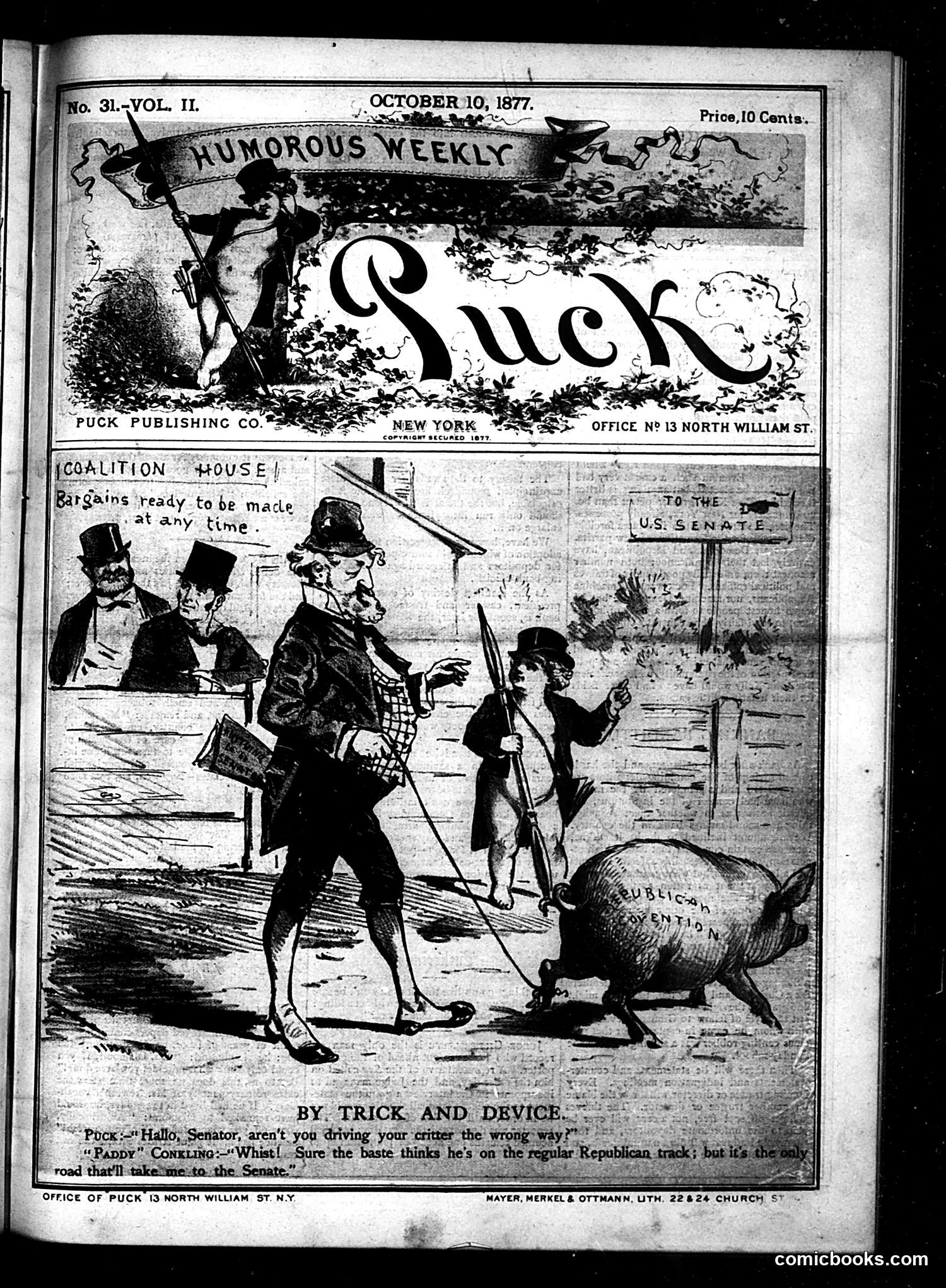
This political cartoon satirizes the 1876 presidential election dispute. The caricatured figures appear to represent Democratic and Republican leadership engaged in electoral manipulation. The "Coalition House" sign suggests backroom dealing between political factions. The central figure (labeled "Paddy Conoling") drives a pig labeled "Republican Convention" off course—the joke being that Republican leadership is steering their own party vehicle wrongly, likely toward corrupt outcomes. The caption suggests Democrats are cynically exploiting Republican mistakes for political advantage. The cartoon reflects post-Civil War tensions and the contested 1876 Hayes-Tilden election, where disputed electoral votes in Southern states created constitutional crisis. Puck uses animal metaphors and caricature to mock both parties' ethical compromises during this turbulent political period.
This page from Puck (No. 15, Madison Street, New York) contains three distinct articles rather than illustrated cartoons: 1. **"Tammany Victorious at the Albany Convention"** — criticism of the Democratic political machine's control in New York State politics and its influence over elections. 2. **"Banking Banditry"** — a commentary on bank failures and the safety (or lack thereof) of savings banks, questioning whether depositors' money is truly secure and criticizing management practices. 3. **"Putterings"** — brief satirical items, including an anecdote about Judge Gildersleeve's handling of a gay reporter, and a reference to Isaac Newton and a dog named Diamond. The page emphasizes Puck's role as a satirical publication critiquing political machines, financial institutions, and social figures of the era.
This page contains three distinct articles rather than political cartoons: 1. **"Eli Perkins's Rival"** - A humorous anecdote about Benjamin Franklin and a competing printer named "Benny," discussing their rivalry over printing speed and quality. The piece satirizes professional competition and boasting in the printing trade. 2. **"Startling Revelations"** - An exposé about a woman imprisoned in London's Whitecross Street Jail, claiming she was wealthy but unjustly incarcerated. This appears to critique the British justice system and debtor's prisons. 3. **"Too Much Science"** - A brief commentary mocking a fashion correspondent's death, suggesting her excessive focus on trivial technical details (spherical trigonometry, geometric proportions) made her unsuited for practical life. These are satirical essays rather than visual cartoons, typical of Puck's written humor content.
This page from Puck magazine contains the opening chapters of a serialized satirical novella titled "The Present, Past and Future: A Moral Tale" by O.D. (author unclear). Rather than political cartoons, this is **literary satire in prose form**. The story follows characters named Alonso, Clarissa, Heinrich Hudson, and William, depicting their moral failings and romantic entanglements. References to "Buffalo and Niagara Falls" and "New York" establish an American setting. The satire appears to mock 19th-century social pretensions, "civilization," and hypocrisy—common Puck themes. The narrative voice criticizes characters' self-deceptions and warns of consequences. However, **without seeing illustrations that may accompany this text, or knowing O.D.'s identity**, the specific satirical targets and contemporary references remain unclear from this page alone.
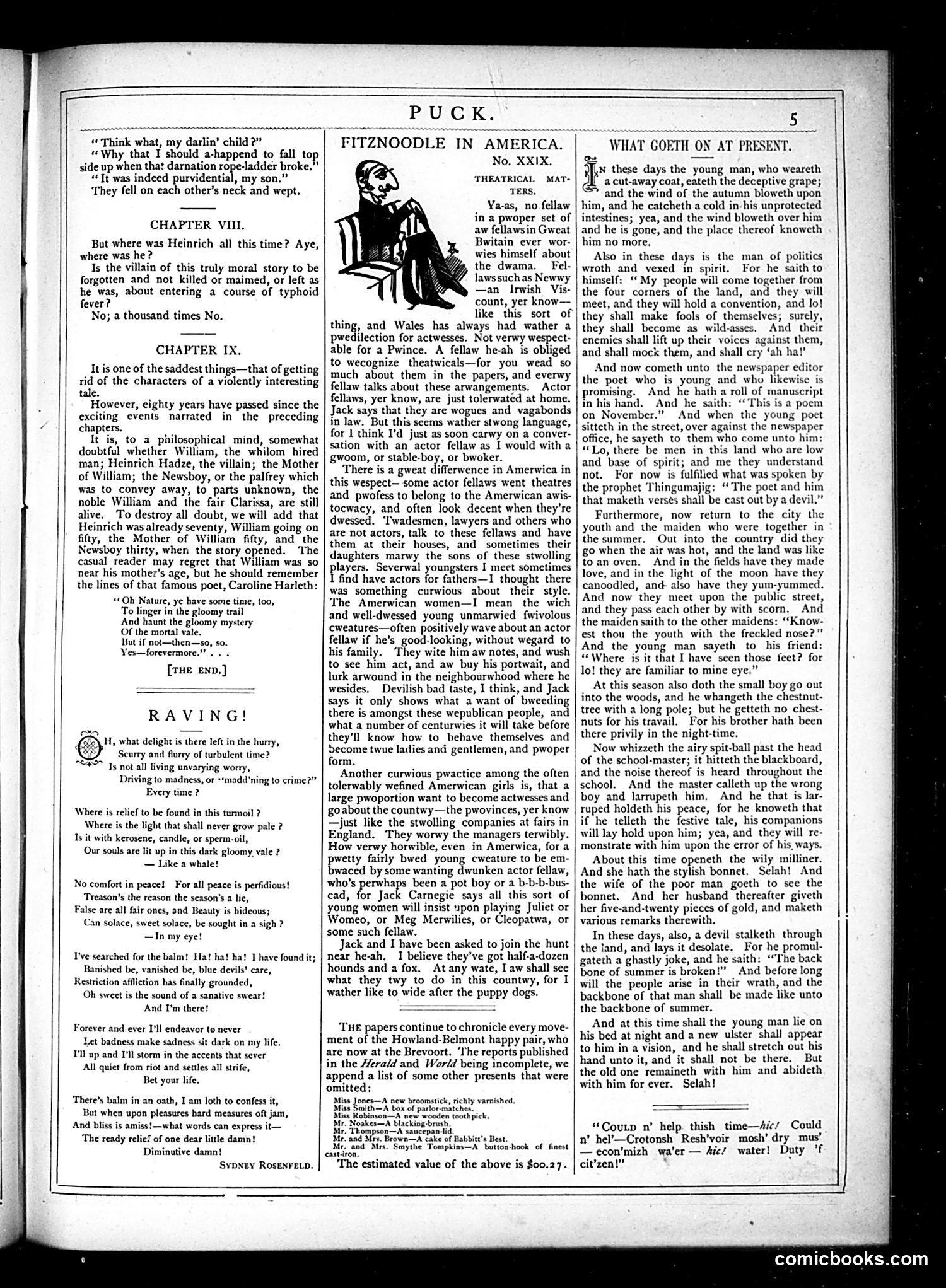
This page contains three distinct sections: **"Fitznoodle in America" (top):** A serialized story with illustration showing a theatrical Irish character. The text discusses Irish and Welsh actors in America, contrasting proper theatrical training with untrained performers who work in variety shows and traveling companies. **"What Goeth On At Present" (right column):** Social commentary on contemporary urban life—young men catching colds, political discourse, newspaper editors, and seasonal activities like chestnut-roasting. The tone is observational rather than explicitly satirical. **"Raving!" (bottom left):** A poem by Sydney Rosenfeld using romantic verse to explore themes of peace, relief, and emotional resolution, appearing unrelated to specific current events. The page mixes entertainment, social observation, and literary content typical of 1880s-90s Puck magazine.
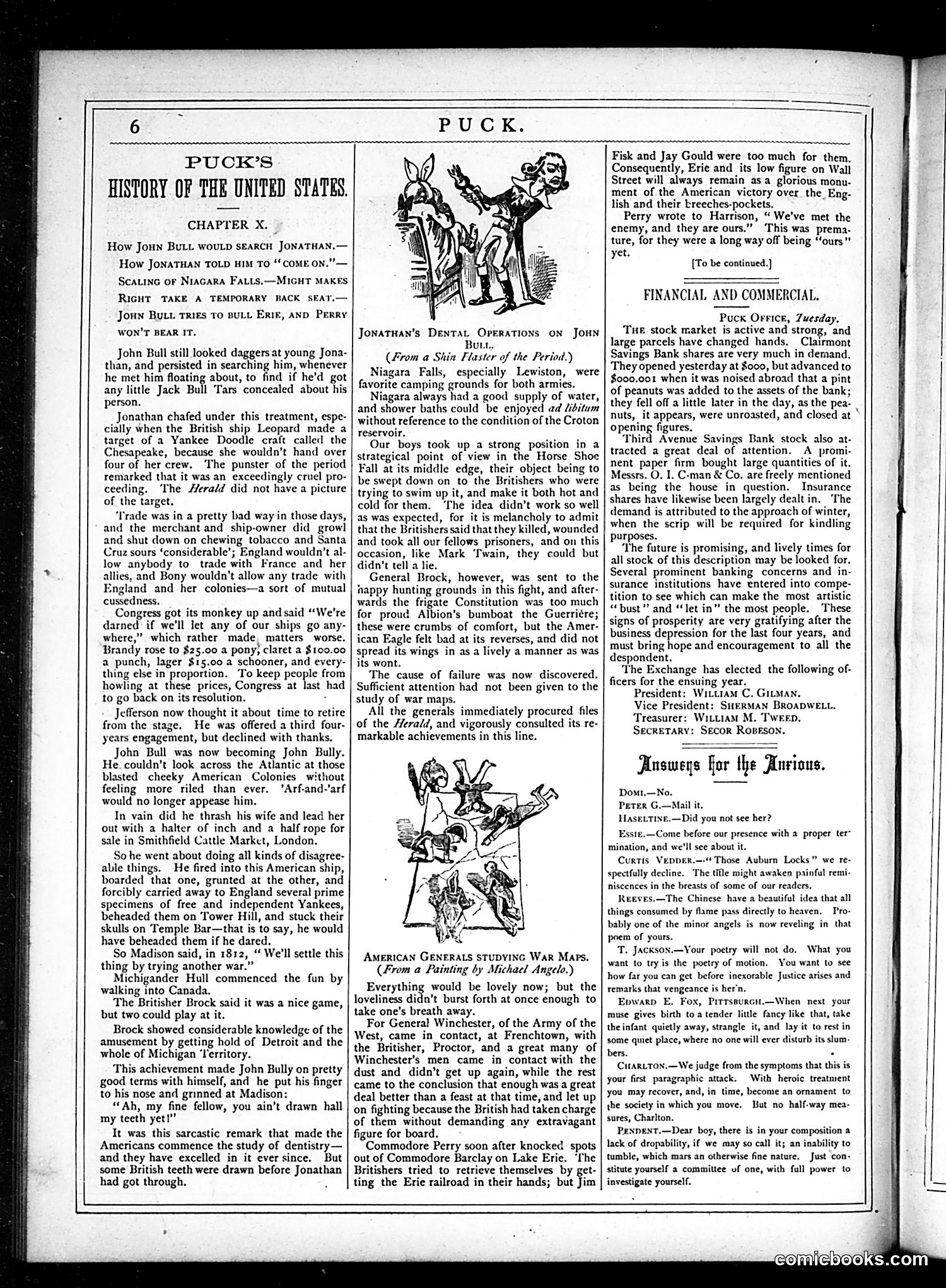
This page contains two distinct sections: a serialized history article about the United States (Chapter X, discussing early American conflicts and figures like John Bull and Jonathan) and an unrelated "Answers for the Anxious" advice column. The main cartoon visible shows **Jonathan's Dental Operations on John Bull**—a dental/medical scene depicting American and British relations. The image uses the personification of "John Bull" (Britain) and "Jonathan" (America) engaging in what appears to be a satirical treatment of diplomatic or commercial conflict, likely referencing trade disputes or military tensions of the era. The "Financial and Commercial" section discusses stock market activity and banking, while the advice column addresses social etiquette questions from readers. Without clearer dates or specific historical context visible on the page, the exact political moment remains somewhat unclear.
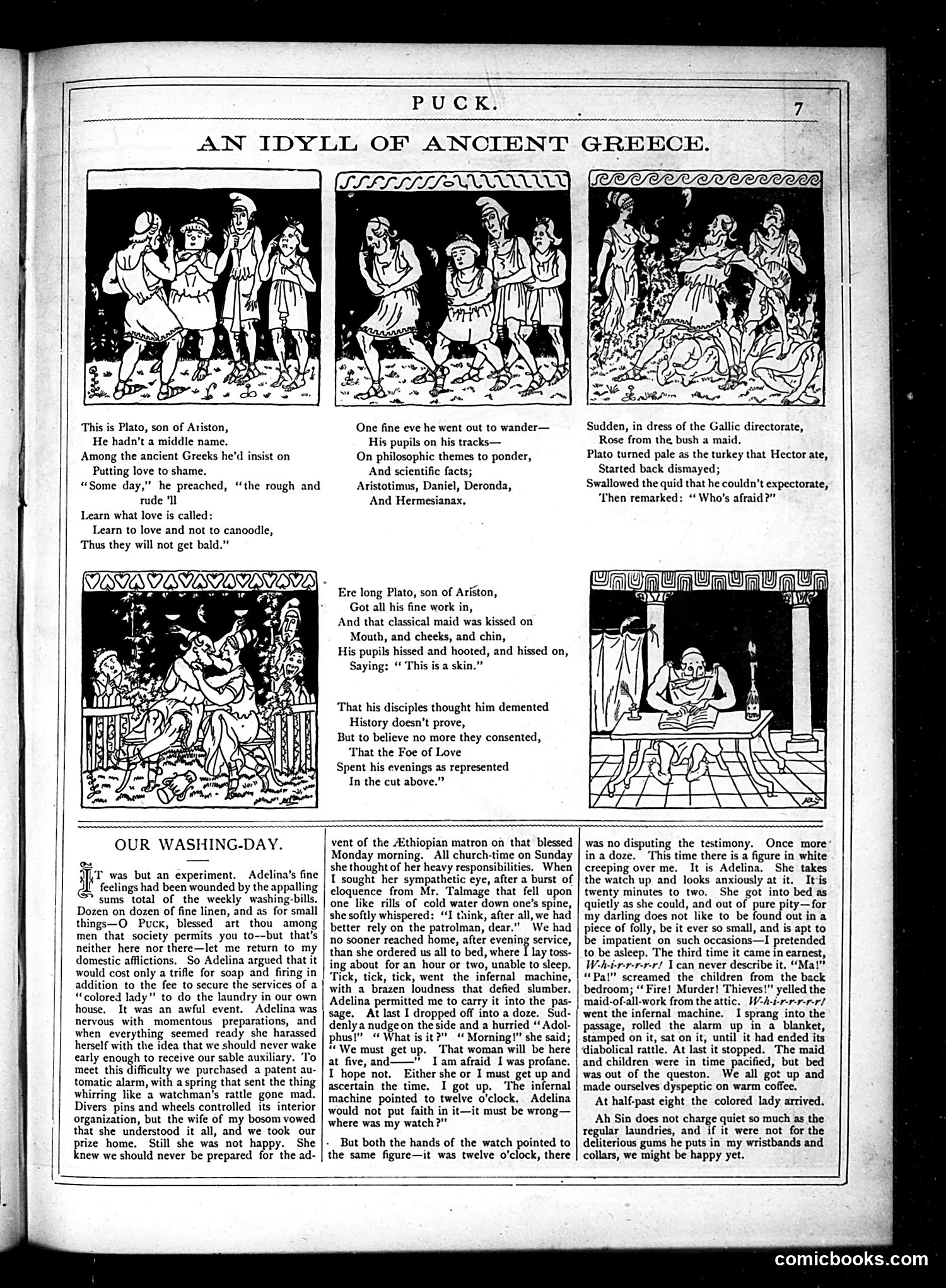
**Top section** presents a mock-classical narrative in four panels about Plato, son of Ariston. The satire mocks philosophical pretension: Plato wanders pondering "Aristotimus, Daniel, Deronda, / And Hermesianus" while his pupils kiss a maid. His disciples believe him mad, but they accept "the Foe of Love" spent evenings as depicted. The joke targets serious intellectuals distracted from romantic/domestic matters by abstract thought. **Bottom section**, "Our Washing-Day," humorously depicts a woman (Adelina) struggling with a newly-invented washing machine. She finds it mechanical, temperamental, and confusing—it points contradictory times. The satire critiques both labor-saving gadgets that complicate housework and women's frustration with "modern conveniences" that create more problems than solutions.
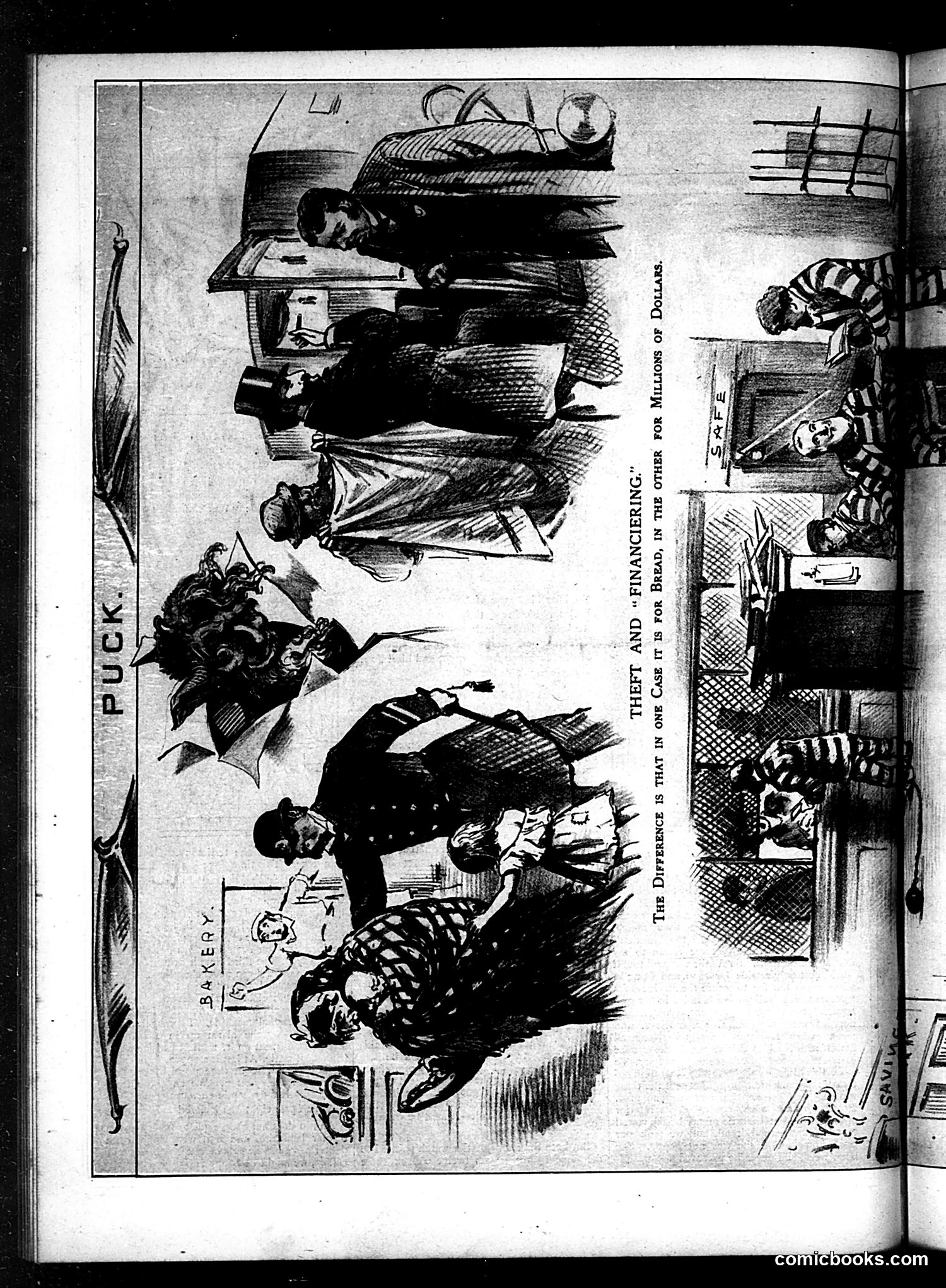
This page contains a political cartoon titled "Theft and Financing" with the subtitle "The Difference is Knit in These Gas It For Bread in Other for Millions of Dollars." The cartoon depicts a contrast between two scenarios: on one side, a poor person appears to be arrested or confronted for petty theft (stealing gas or bread), while on the other side, wealthy figures engage in large-scale financial crimes or fraud involving millions of dollars with apparent impunity. This is classic Gilded Age social satire criticizing economic inequality and the justice system's disparate treatment of rich versus poor criminals. Poor people face serious consequences for survival crimes, while wealthy financiers escape accountability for much grander theft through legal manipulation—a commentary on corruption and class-based justice that remains relevant today.
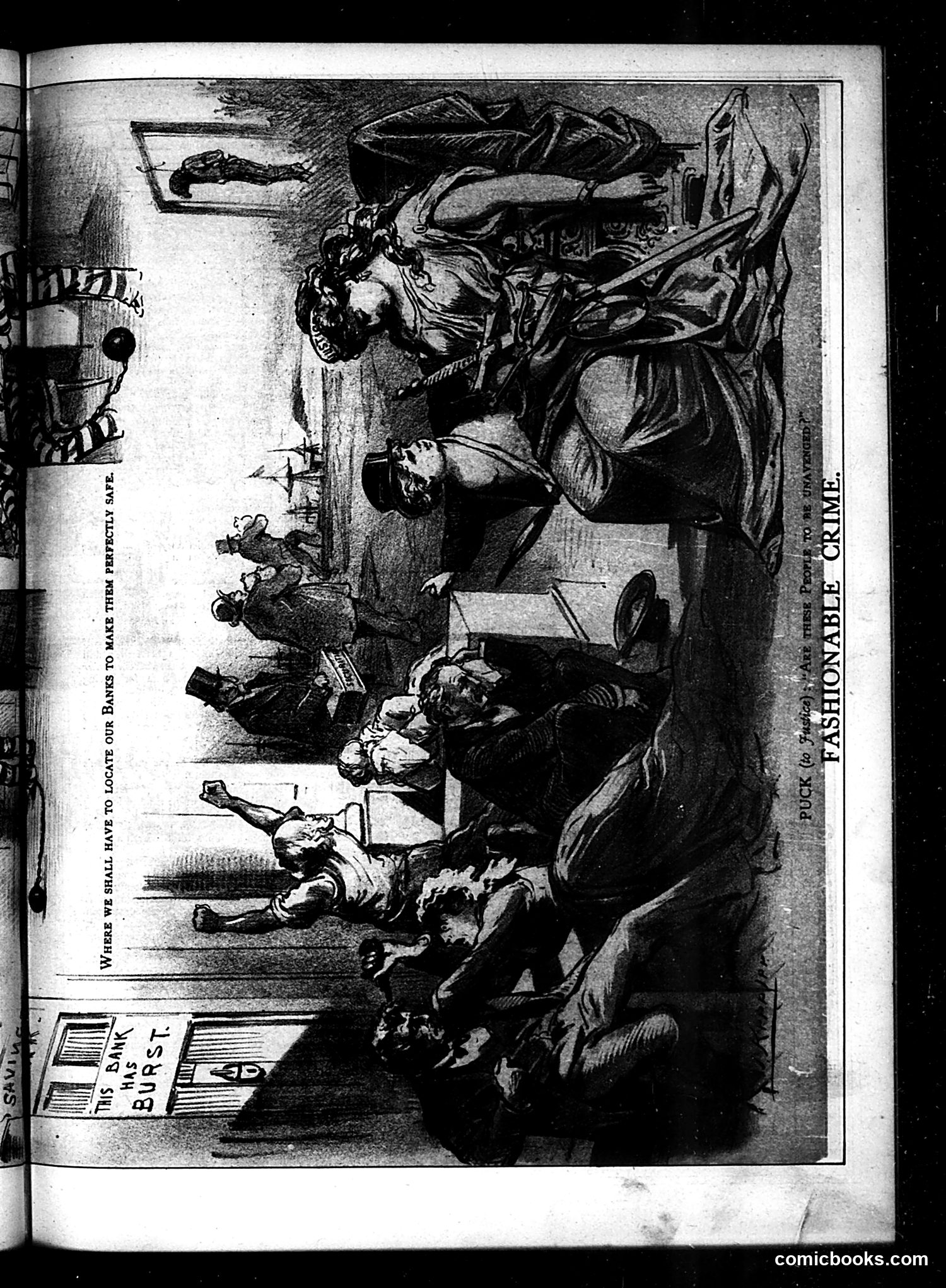
This appears to be a satirical illustration titled "Fashionable Crime" (visible on the right margin). The image depicts a wealthy, well-dressed man in an exaggerated caricature style, positioned above several fallen or prostrate figures below him. The satire critiques how affluent individuals commit crimes with impunity—the "fashionable" reference suggests that wealthy criminals escape consequences that ordinary people would face. The text at the left (partially legible) references "ladies" and "Barnes" making "their presence felt" in some context. The composition deliberately inverts social hierarchy, with the respectable-looking gentleman elevated above the victims or casualties beneath him, visually expressing the Gilded Age critique that wealth insulated the privileged from justice. Without clearer text, specific individuals remain unclear.
This page contains two articles critiquing theatrical productions. The main piece, titled "To a Damaged Character," attacks an unnamed play for its poor quality and lack of merit. The second article, "Marriage," reviews Wallack's Theatre production of a comedy, dated October 10, 1877. The critic praises English comedy's character development but finds this particular play lacking in both originality and substance. He argues the work contains "farcical incidents" rather than genuine drama, comparing it unfavorably to better-constructed plays. The reviewer expresses frustration that audiences are expected to accept mediocre theater, demanding that playwrights provide better storylines and character development. The tone is one of professional disappointment in contemporary dramatic standards.
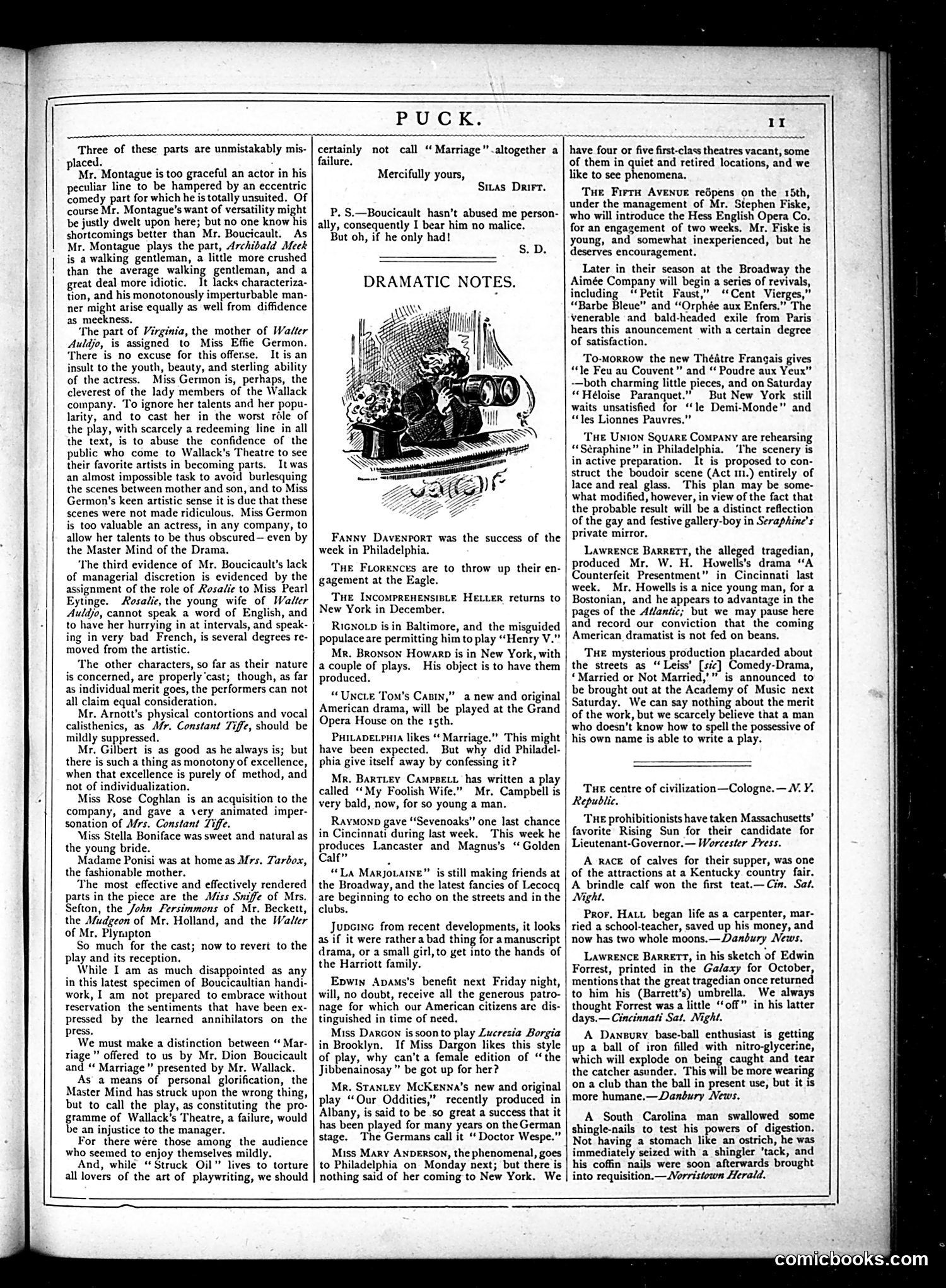
This page contains theatrical criticism and "Dramatic Notes" rather than political cartoons. The small illustration shows a theatrical mask and dramatic props, typical of Puck's arts coverage. The text critiques contemporary theater productions and performances. References include Miss Effie Germon's role in a revival, concerns about casting decisions for various plays, and reviews of productions like "A Constant Tiff" and works by Bouicault. The page discusses whether certain actresses are properly utilized and critiques theatrical management decisions. There's satire aimed at theatrical impresarios' choices and concerns about whether plays constitute genuine artistic merit or mere commercial ventures. The content reflects Puck's role as cultural critic, using humor to evaluate New York theater's quality and artistic integrity during this period.
This page contains prose fiction rather than political satire or cartoons. It's Chapter XXVII of "Two Knaves and a Knave," an English story by Frank Barrett. The narrative depicts domestic drama involving characters named Tom, Mattie, Hugh, and René. The plot concerns marital tension, infidelity suspicions, and financial struggles—Tom fears his wife Mattie is attracted to the wealthy Mr. Hugh Biron. The text explores themes of jealousy, honor, and class anxiety common to Victorian melodrama. No political figures, cartoons, or satirical commentary are visible on this page. It appears to be serialized fiction published in *Puck* magazine, representing the publication's literary content rather than its characteristic satirical cartooning.
This page contains **no political cartoon**. Instead, it features: 1. **"Puck's Finishing" section**: A humor column with short jokes and witty observations about contemporary life, including quips about romance, social behavior, and marriage. 2. **"Honesty the Best Policy"**: A longer satirical article (attributed to the New York Times) about **William Wharton of Missouri**, who invented an improved "thief-trap" device. The satire mocks his proposal to catch burglars using mechanical traps in cellars, arguing this represents misguided thinking about crime prevention. The piece questions whether such elaborate mechanisms could actually work and whether the public would actually adopt them. The page is primarily **text-based humor and social commentary**, not illustrated political satire.
This page contains primarily text content—a humorous short story titled "Henry Puts Up a Shelf" occupying the left column, and "Observations from Easton" in the right column. These are satirical pieces typical of Puck magazine's humor writing. The main story depicts Henry Archibald, a working-class man, attempting domestic tasks (building a shelf) while his wife Mary Jane criticizes his competence and lectures him about drinking and behavior. The humor derives from their marital bickering and class dynamics—her patronizing tone toward his manual labor and his bumbling efforts. The right column contains brief satirical observations on various social topics, including schoolboys, Mormons, Republicans, and business practices. No specific political figures are identifiable in this text-heavy page. The overall tone is gentle domestic and social satire rather than hard political commentary.
This page is primarily **advertisements and announcements** rather than satirical cartoons. The visible content includes: - A section titled "In Memoriam Brigham Young" announcing a reprint of a Puck cartoon depicting Young (the Mormon leader who died in 1877) and his "Mormon's Empty Pillow" - Multiple commercial ads for products like compressed yeast, printing inks, champagne, furniture, and portrait photography services - Notices about Puck's illustrated almanac and patent filing covers The page functions as a back-of-magazine advertising section with one editorial note commemorating a previously published cartoon about a historical religious figure. No active political satire is visible on this particular page.
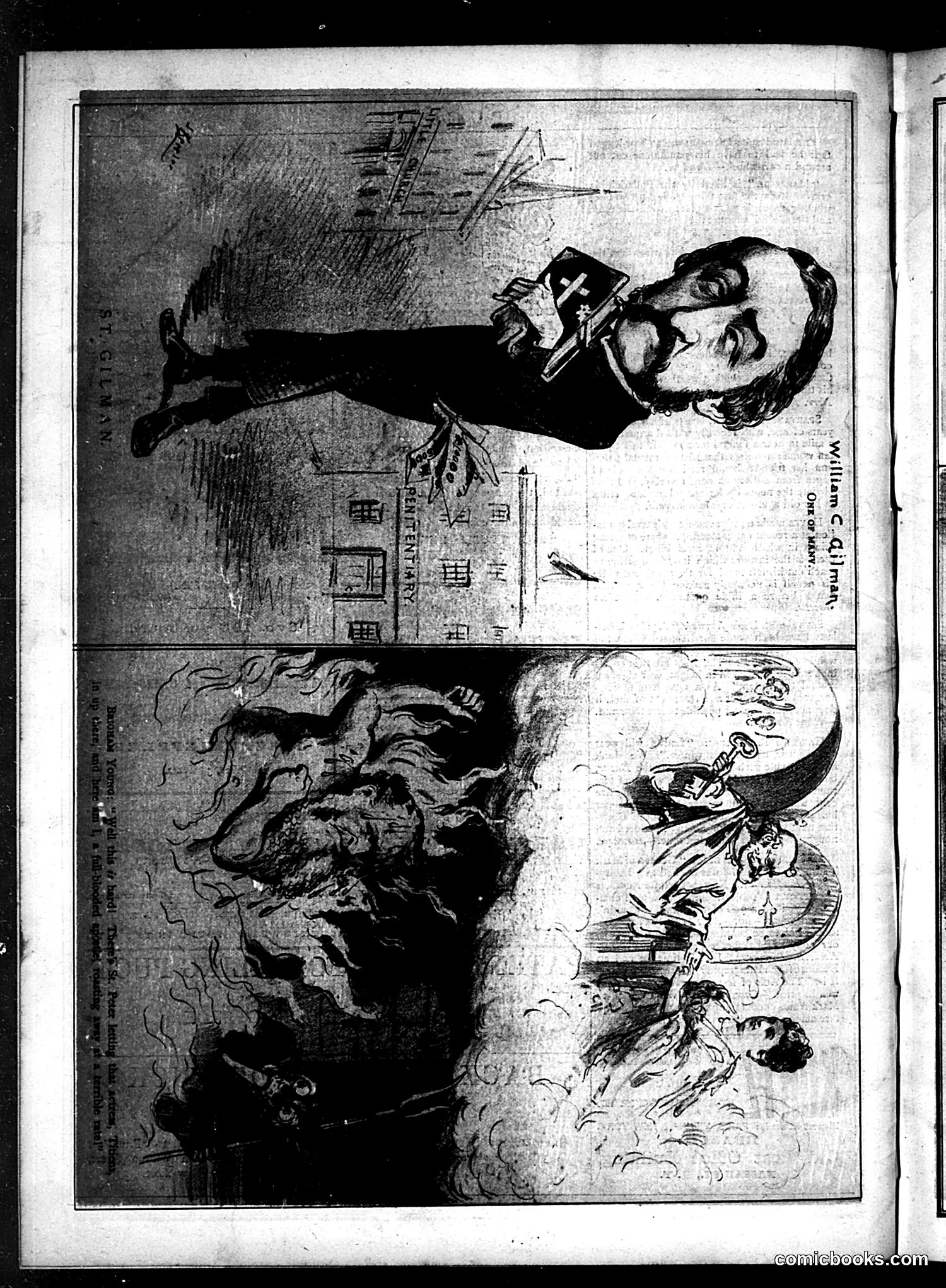
This Puck magazine page contains satirical illustrations, though the OCR text is too degraded to read clearly. The upper cartoon shows a man in formal dress holding what appears to be a document or certificate, standing before a building—likely commenting on some political appointment or institutional matter of the period. The lower panel depicts multiple figures in a classical or allegorical style, possibly representing abstract concepts or political forces. Without legible text identifying the specific figures and historical context, I cannot definitively explain which political event or personalities this satire targets. The artistic style and composition suggest commentary on governance, institutional politics, or social issues contemporary to Puck's publication, but specific attribution remains unclear.