
Puck, 1877-10-10 · page 14 of 16
Puck — October 10, 1877 — page 14: what you’re looking at
What you’re looking at
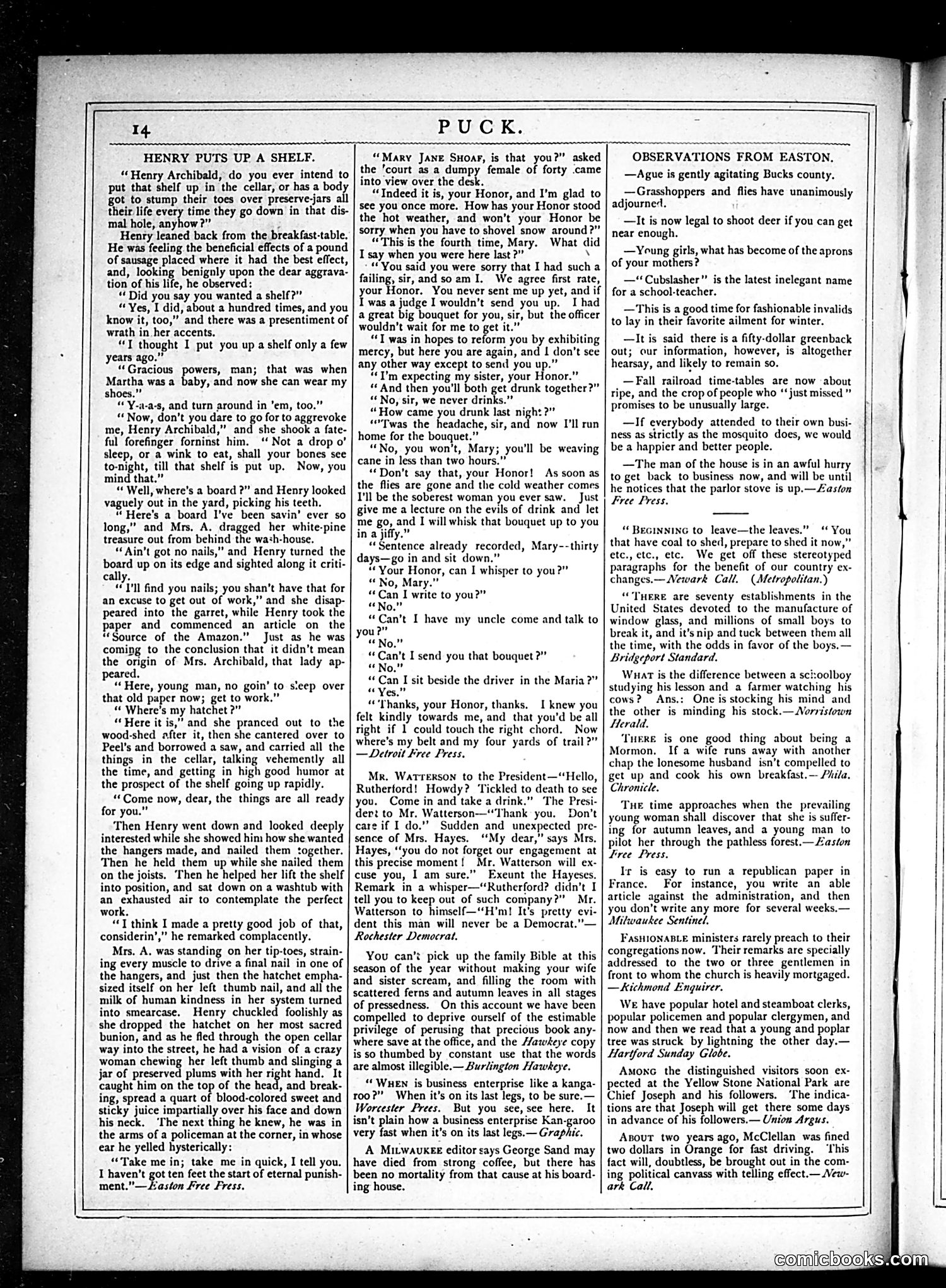
This page contains primarily text content—a humorous short story titled "Henry Puts Up a Shelf" occupying the left column, and "Observations from Easton" in the right column. These are satirical pieces typical of Puck magazine's humor writing. The main story depicts Henry Archibald, a working-class man, attempting domestic tasks (building a shelf) while his wife Mary Jane criticizes his competence and lectures him about drinking and behavior. The humor derives from their marital bickering and class dynamics—her patronizing tone toward his manual labor and his bumbling efforts. The right column contains brief satirical observations on various social topics, including schoolboys, Mormons, Republicans, and business practices. No specific political figures are identifiable in this text-heavy page. The overall tone is gentle domestic and social satire rather than hard political commentary.
📄 Transcribed text from this page (OCR, searchable)
Machine-transcribed from the original scan — historical spelling and the odd misread are preserved.
PUCK. HENRY PUTS UP A SHELF. “Henry Archibald, do you ever intend to put that shelf up in the cellar, or has a bod: ot to stump their toes over preserve-jars their life every time they go down in that dis- mal hole, anyhow?” ; Henry leaned back from the breakfast-table, He was feeling the beneficial effects of a pound of sausage placed where it had the best effect, and, looking benignly upon the dear aggrava- tion of his life, he observed: “Did you say you wanted a shelf?” “Yes, I did, about a hundred times, and you know it, too,” and there was a presentiment of wrath in her accents. “T thought I put you up a shelf only a few years ago.” “Gracious Martha was a shoes.”" “Y-a-a-s, and turn around in ‘em, too.” “Now, don’t you dare to go for to aggrevoke me, Henry Archibald,” and, she shook a fate- ful forefinger forninst him. ‘ Not a drop o’ sleep, or a wink to eat, shall your bones sce to-night, till that shelf is put up. Now, you mind that.” “Well, where's a board ?” and Henry looked vaguely out in the yard, picking his teeth. “Here's a board I’ve been savin’ ever so long,” and Mrs, A. dragged her white-pine treasure out from behind the wash-house. * Ain't got no nails,” and Henry turned the board up on its edge and sighted along it criti- wers, man; that was when aby, and now she can wear my cally, “T'll find you nails; you shan’t have that for an excuse to get out of work,” and she disap- peared into the garret, while Henry took the per and commenced an article on the ‘Source of the Amazon.” Just as he was coming to the conclusion that it didn’t mean the origin of Mrs. Archibald, that lady ap- peare “Here, young man, no goin’ to steep over that old paper now; get to work.” “ Where's my hatchet ?” “Here it is,” and she pranced out to the wood-shed after it, then she cantered over to Peel’s and borrowed a saw, and carried all the things in the cellar, talking vehemently all the time, and getting in high good humor at the prospect of the shelf going up rapidly. “Come now, dear, the things are all ready for you." ‘Then Henry went down and looked deeply interested while she showed him how she wanted the hangers made, and nailed them together. Then he held them up while she nailed them on the joists. Then he helped her lift the shelf into position, and sat down on a washtub with an exhausted air to contemplate the perfect work. “7 think I made a pretty good job of that, considerin’,” he remarked complacently. Mrs. A, was standing on her tip-toes, strain- ing every muscle to drive a final nail in one of the hangers, and just then the hatchet empha- sized itself on her left thumb nail, and all the milk of human kindness in her system turned into smearcase. Henry chuckled foolishly as she dropped the hatchet on her most sacred bunion, and as he fied through the open cellar way into the street, he had a vision of a crazy woman chewing her left thumb and slinging a jar of preserved plums with her right hand. It caught him on the top of the head, and break- ing, spread a quart of blood-colored sweet and sticky juice impartially over his face and down his neck. ‘The next thing he knew, he was in the arms of a policeman at the corner, in whose ear he yelled hysterically: “Take me in; take me in quick, I tell you. I haven't got ten feet the start of eternal punish- ment."—Laston Free Fress. “Mary Jane Suoar, is that you?” asked the ‘court as a dumpy female of forty came into view over the desk. “Indeed it is, your Honor, and I’m glad to see you once more. How has your Honor stood the hot weather, and won’t your Honor be sorry when you have to shovel snow around?” “This is the fourth time, Mary. What did I say when you were here last ?” \ ‘*You said you were sorry that I had such a failing, sir, and so am I. We agree first rate, our Foner. You never sent me up yet, and if was a judge I wouldn’t send you up. I had a great big bouquet for you, sir, but the officer wouldn’t wait for me to get it.”” “T was in hopes to reform you by exhibiting mercy, but here you are again, and | don’t see any other way except to send you up.” “I'm expecting my sister, your Honor.” “And then you'll both get drunk together?” “‘No, sir, we never drinks.” “How came you drunk last night?” ‘“Twas the headache, sir, and now I'll run home for the bouquet.” “No, you won't, Mary; you'll be weaving cane in less than two hours."” “Don’t say that, your Honor! As soon as the flies are gone and the cold weather comes I'll be the soberest woman you ever saw. Just give me a lecture on the evils of drink and let me go, and I will whisk that bouquet up to you in a jiffy.” “Sentence already recorded, Mary--thirty days—go in and sit down,” “Your Honor, can I whisper to you?” “No, Mary.” “Can I write to you?” “No.” “Can't I have my uncle come and talk to you?” “No,” “Can't I send you that bouquet ?” “No,” “Can I sit beside the driver in the Maria?” “Yes,” “Thanks, your Honor, thanks. I knew you felt kindly towards me, and that you'd be all right if 1 could touch the right chord. Now where's my belt and my four yards of trail?” —Detroit Free Press. Mr. Wartrerson to the President—“Hello, Rutherford! Howdy? Tickled to death to see you. Come in and take a drink.” The Presi- dert to Mr. Watterson—“Thank you. Don’t care if I do.’’ Sudden and unexpected pre- sence of Mrs. Hayes. “My dear,” says Mrs. Hayes, ‘‘you do not forget our engagement at this precise moment! Mr. Watterson will ex- cuse you, I am sure.” Exeunt the Hayeses. Remark in a whisper—Rutherford? didn’t I tell you to keep out of such company?” Mr. Watterson to himself—‘“H’m! It’s pretty evi- dent this man will never be a Democrat.”— Rochester Democrat, You can’t pick up the family Bible at this season of the year without making your wife and sister scream, and filling the room with scattered ferns and autumn leaves in all stages of pressedness. On this account we have been compelled to deprive ourself of the estimable privilege of perusing that precious book any- where save at the office, and the Hawkeye copy is so thumbed by constant use that the words are almost illegible. Burlington Hawkeye. “ Wuen is business enterprise like a kanga- roo?” When it’s on its last legs, to be sure.— Worcester Prees. But you see, see here. It isn’t plain how a business enterprise Kan-garoo very fast when it’s on its last legs.— Graphic. A Mitwaukee editor says George Sand may have died from strong coffee, but there has been no mortality from that cause at his board- ing house. EASTON, —Ague is gently agitating Bucks county, —Grasshoppers and flies have unanimously adjourned. —It is now legal to shoot deer if you can get near enough. —Young girls, what has become of the aprons of your mothers? —‘‘Cubslasher”’ is the latest inelegant name for a school-teacher. —This is a good time for fashionable invalids to lay in their favorite ailment for winter. —lIt is said there is a fifty-dollar greenback out; our information, however, is altogether hearsay, and likely to remain so, —Fall railroad time-tables are now about ripe, and the crop of people who ‘just missed ” promises to be unusually large. —If everybody attended to their own busi- ness as strictly as the mosquito does, we would be a happier and better people. —The man of the house is in an awful hurry to get back to business now, and will be until he notices that the parlor stove is up.—£aston Free Press, “ BEGINNING to leave—the leaves “You that have coal to shed, prepare to shed it now,” ete., etc., etc. We get off these stereotyped paragraphs for the benefit of our country ex- changes.— Newark Call, (Metropolitan.) “THERE are seventy establishments in the United States devoted to the manufacture of window glass, and millions of small boys to break it, and it’s nip and tuck between them all the time, with the odds in favor of the boys.— Bridgeport Standard. Wuat is the difference between a sci:oolboy studying his lesson and a farmer watching his cows? Ans,: One is stocking his mind and the other is minding his stock.—Norristown Herald. ‘Tere is one good thing about being a Mormon. If a wife runs away with another chap the lonesome husband isn’t compelled to get up and cook his own breakfast.— /hi/a, Chronicle. Tue time approaches when the prevailing young woman shall discover that she is suffer ing for autumn leaves, and a young man to pilot her through the pathless forest.— aston Liree Press. Ir is easy to run a republican paper in France. For instance, you write an able article against the administration, and then you don’t write any more for several weeks.— Milwaukee Sentinel, FAsHIONABLE ministers rarely preach to their congregations now. Their remarks are specially addressed to the two or three gentlemen in front to whom the church is heavily mortgaged. —Kichmond Enquirer. We have popular hotel and steamboat clerks, popular policemen and popular clergymen, and now and then we read that a young and poplar tree was struck by lightning the other day.— Harlford Sunday Globe. Amonc the distinguished visitors soon ex- pected at the Yellow Stone National Park are Chief Joseph and his followers. ‘The indica- tions are that Joseph will get there some days in advance of his followers.— Union Argus. Apout two years ago, McClellan was fined two dollars in Orange for fast driving. ‘This fact will, doubtless, be brought out in the com- ing poli 1 canvass with telling effect.— Mew- ark Call,