
Puck, 1877-10-10 · page 2 of 16
Puck — October 10, 1877 — page 2: what you’re looking at
What you’re looking at
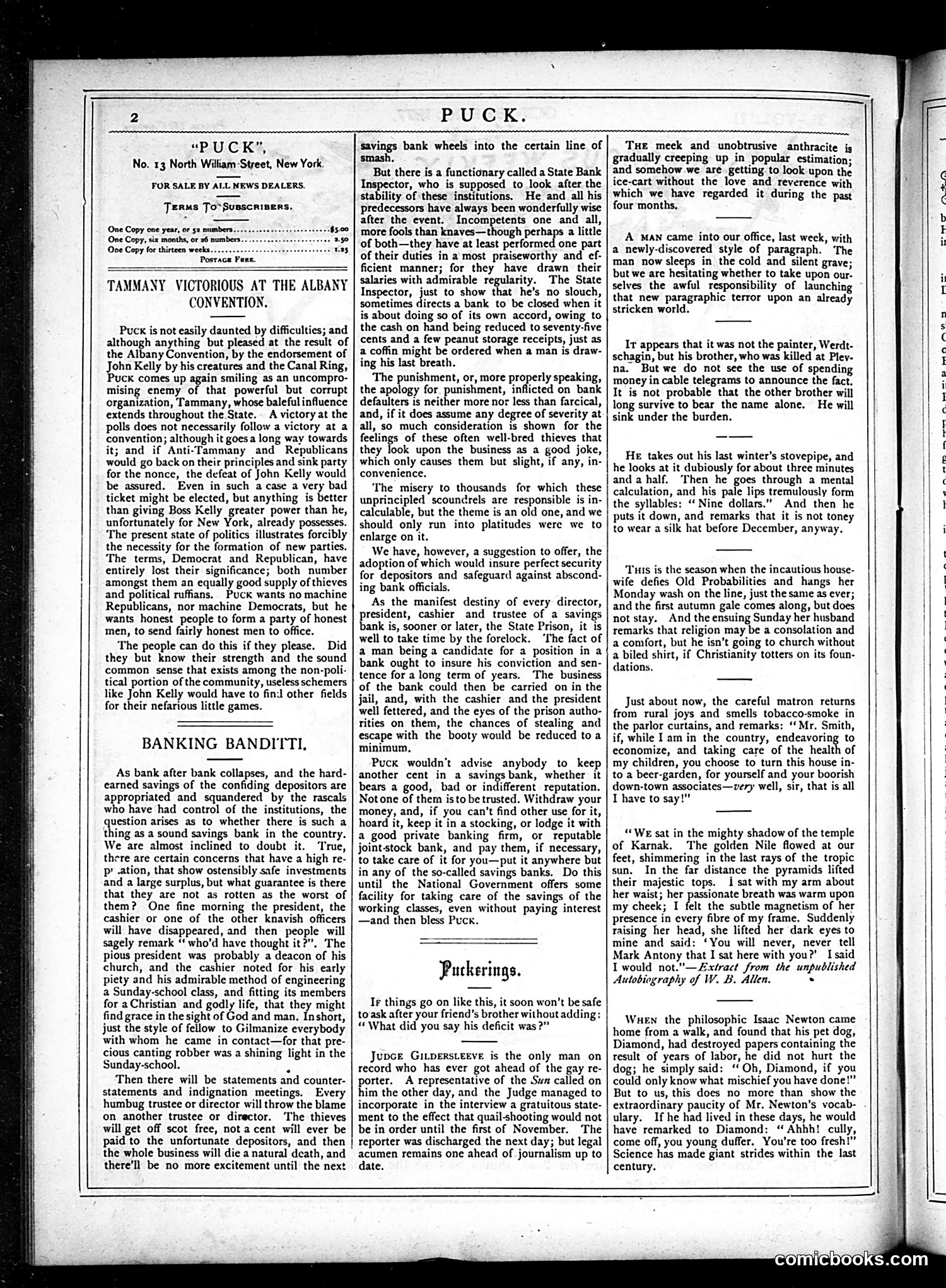
This page from Puck (No. 15, Madison Street, New York) contains three distinct articles rather than illustrated cartoons: 1. **"Tammany Victorious at the Albany Convention"** — criticism of the Democratic political machine's control in New York State politics and its influence over elections. 2. **"Banking Banditry"** — a commentary on bank failures and the safety (or lack thereof) of savings banks, questioning whether depositors' money is truly secure and criticizing management practices. 3. **"Putterings"** — brief satirical items, including an anecdote about Judge Gildersleeve's handling of a gay reporter, and a reference to Isaac Newton and a dog named Diamond. The page emphasizes Puck's role as a satirical publication critiquing political machines, financial institutions, and social figures of the era.
📄 Transcribed text from this page (OCR, searchable)
Machine-transcribed from the original scan — historical spelling and the odd misread are preserved.
PUCK. “PUCK”, No. 13 North William Street, New York. FOR SALE BY ALL NEWS DEALERS. Terms To-Suascriners. ‘One Copy one year, or 52 numbers. One Copy, six months, or 26 numbers One Copy for thirteen weeks... Postace Fat IcroRIOUS AT THE ALBANY CONVENTION. TAMMANY Puck is not easily daunted by difficulties; and although anything but pleased at the result of the Albany Convention, by the endorsement of John Kelly by his creatures and the Canal Ring, Puck comes up again smiling as an uncompro- mising enemy of that powerful but corrupt organization, Tammany, whose baleful influence extends throughout the.State. A victory at the polls does not necessarily follow a victory at a convention; although it goes a long way towards it; and if Anti-Tammany and Republicans would go back on their principles and sink party for the nonce, the defeat of John Kelly would be assured. Even in such a case a very bad ticket might be elected, but anything is better than giving Boss Kelly greater power than he, unfortunately for New York, already possesses. ‘The present state of politics illustrates forcibly the necessity for the formation of new parties. The terms, Democrat and Republican, have entirely lost their significance; both number amongst them an equally good supply of thieves and political ruffians. Puck wants no machine Republicans, nor machine Democrats, but he wants honest people to form a party of honest men, to send fairly honest men to office. The people can do this if they please. Did they but know their strength and the sound common sense that exists among the non-poli- tical portion of the community, useless schemers like John Kelly would have to find other fields for their nefarious little games. BANKING BANDITTI. As bank after bank collapses, and the hard- earned savings of the confiding depositors are appropriated and squandered by the rascals who have had control of the institutions, the juestion arises as to whether there is such a thing as a sound savings bank in the country. We are almost inclined to doubt it. True, there are certain concerns that have a high re- p’ .ation, that show ostensibly safe investments and a large surplus, but what guarantee is there that they are not as rotten as the worst of them? One fine morning the president, the cashier or one of the other knavish officers will have disappeared, and then people will sagely remark ‘who'd have thought it?”. ‘The pious president was probably a deacon of his church, and the cashier noted for his early piety and his admirable method of engineering a Sunday-school class, and fitting its members for aChristian and godly life, that they might find grace in the sight of God and man. Inshort, just the style of fellow to Gilmanize everybody with whom he came in contact—for that pre- cious canting robber was a shining light in the Sunday-school. - Then there will be statements and counter- statements and indignation meetings. Every humbug trustee or director will throw the blame on another trustee or director. The thieves will get off scot free, not acent will ever be paid to the unfortunate depositors, and then the whole business will die a natural death, and there'll be no more excitement until the next savings bank wheels into the certain line of smash. But there is a functionary called a State Bank Inspector, who is supposed to look after the stability of these institutions. He and all his predecessors have always been wonderfully wise after the event. Incompetents one and all, more fools than knaves—though perhaps a little of both—they have at least performed one part of their duties in a most praiseworthy and ef- ficient manner; for they have drawn their salaries with admirable regularity. The State Inspector, just to show tat he’s no slouch, sometimes directs a bank to be closed when it is about doing so of its own accord, owing to the cash on hand being reduced to seventy-five cents and a few peanut storage receipts, just as a coffin might be ordered when a man is draw- ing his last breath. The punishment, or, more properly speaking, the apology for. punishment, inflicted on bank defaulters is neither more nox less than farcical, and, if it does assume any degree of severity at all, so much consideration is shown for the feelings of these often well-bred thieves that they look upon the business as a good joke, which only causes them but slight, if any, in- convenience. ‘The misery to thousands for which these unprincipled scoundrels are responsible is in- calculable, but the theme is an old one, and we should only run into platitudes were we to enlarge on it. We have, however, a suggestion to offer, the adoption of which would insure perfect security for depositors and safeguard against abscond- ing bank officials. As the manifest destiny of every director, president, cashier and trustee of a savings bank is, sooner or later, the State Prison, it is well to take time by the forelock. ‘The fact of a man being a candidate for a position in a bank ought to insure his conviction and sen- tence for a long term of years. The business of the bank could then be carried on in the jail, and, with the cashier and the president well fettered, and the eyes of the prison autho- tities on them, the chances of stealing and escape with the booty would be reduced to a minimum, Puck wouldn't advise anybody to keep another cent in a savings bank, whether it bears a good, bad or indifferent reputation. Notone of them isto be trusted. Withdraw your money, and, if you can’t find other use for it, hoard it, keep it in a stocking, or lodge it with a good private banking firm, or reputable joint-stock bank, and pay them, if necessary, to take care of it for you—put it anywhere but in any of the so-called savings banks. Do this until the National Government offers some facility for taking care of the savings of the working classes, even without paying interest —and then bless Puck. Puckerings. Ir things go on like this, it soon won't be safe toask after your friend's brother without adding: “What did you say his deficit was?” Jupce Gitpersteeve is the only man on record who has ever got ahead of the gay re- porter. A representative of the Sun called on him the other day, and the Judge managed to incorporate in the interview a gratuitous state- ment to the effect that quail-shooting would not be in order until the first of November. The reporter was discharged the next day; but legal acumen remains one ahead of journalism up to date. Tue meek and unobtrusive anthracite is gradually creeping up in popular estimation; and somehow we are getting to look upon the ice-cart without the love and reverence with which we have regarded it during the past four months, A MAN came into our office, last weck, with a newly-discovered style of paragraph. The man now sleeps in the cold and silent grave; but we are hesitating whether to take upon our- selves the awful responsibility of launching that new paragraphic terror upon an already stricken world. It appears that it was not the painter, Werdt- schagin, but his brother, who was killed at Plev- na. But we do not see the use of spending money in cable telegrams to announce the fact. It is not probable that the other brother will long survive to bear the name alone. He will sink under the burden. He takes out his last winter’s stovepipe, and he looks at it dubiously for about three minutes and ahalf. Then he goes through a mental calculation, and his pale lips tremulously form the syllables: “Nine dollars." And then he puts it down, and remarks that it is not toney to wear a silk hat before December, anyway, ‘Tuts is the season when the incautious house- wife defies Old Probabilities and hangs her Monday wash on the line, just the same as ever; and the first autumn gale comes along, but does not stay. And the ensuing Sunday her husband remarks that religion may be a consolation and a comfort, but he isn’t going to church without a biled shirt, if Christianity totters on its foun- dations. Just about now, the careful matron returns from rural joys and smells tobacco-smoke in the parlor curtains, and remarks: ‘Mr. Smith, if, while Iam in the country, endeavoring to economize, and taking care of the health of my children, you choose to turn this house in- to a becr-garden, for yourself and your boorish down-town associates—very well, sir, that is all T have to say!” “We sat in the mighty shadow of the temple of Karnak. The golden Nile flowed at our feet, shimmering in the last rays of the tropic sun. In the far distance the pyramids lifted their majestic tops. 1 sat with my arm about her waist; her passionate breath was warm upon my cheek; I felt the subtle magnetism of her presence in every fibre of my frame. Suddenly raising her head, she lifted her dark eyes to mine and said: ‘You will never, never tell Mark Antony that I sat here with you?’ Isaid I would not.”"—£xtract from the unpublished Autobiography of W. B. Alten, . Wuen the philosophic Isaac Newton came home from a walk, and found that his pet dog, Diamond, had destroyed papers containing the result of years of labor, he did not hurt the dog; he simply said: “Oh, Diamond, if you could only know what mischief you have done!” But to us, this does no more than show the extraordinary paucity of Mr. Newton's vocab- ulary. If he had lived in these days, he would have remarked to Diamond: “ Ahhh! cully, come off, you young duffer. You're too fresh!” Science has made giant strides within the last century. bet ce nt pa yeny hi ee ea a ea ar ee eee