
Puck, 1877-10-10 · page 3 of 16
Puck — October 10, 1877 — page 3: what you’re looking at
What you’re looking at
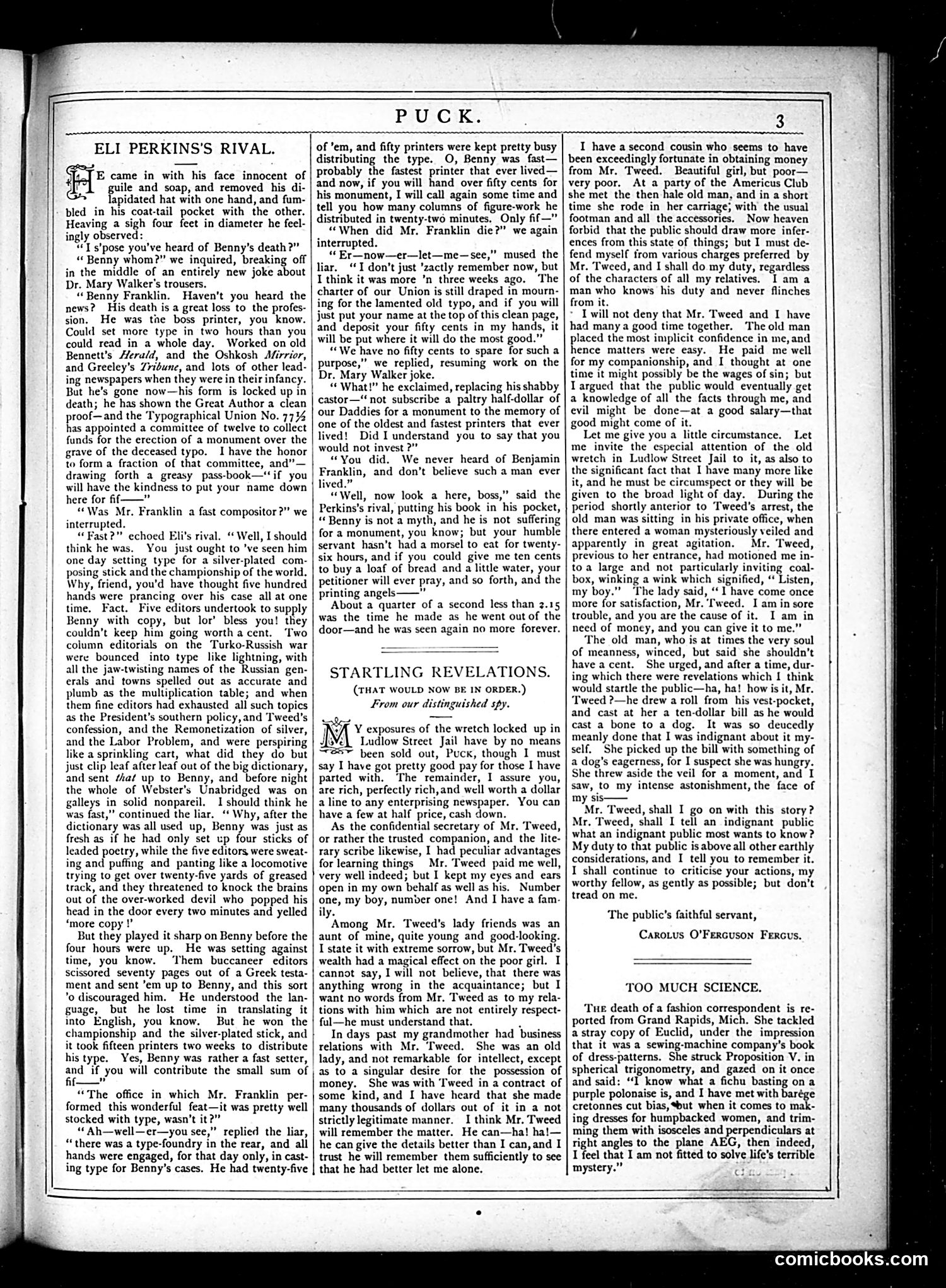
This page contains three distinct articles rather than political cartoons: 1. **"Eli Perkins's Rival"** - A humorous anecdote about Benjamin Franklin and a competing printer named "Benny," discussing their rivalry over printing speed and quality. The piece satirizes professional competition and boasting in the printing trade. 2. **"Startling Revelations"** - An exposé about a woman imprisoned in London's Whitecross Street Jail, claiming she was wealthy but unjustly incarcerated. This appears to critique the British justice system and debtor's prisons. 3. **"Too Much Science"** - A brief commentary mocking a fashion correspondent's death, suggesting her excessive focus on trivial technical details (spherical trigonometry, geometric proportions) made her unsuited for practical life. These are satirical essays rather than visual cartoons, typical of Puck's written humor content.
📄 Transcribed text from this page (OCR, searchable)
Machine-transcribed from the original scan — historical spelling and the odd misread are preserved.
PUCK. _—= ae 3 ELI PERKINS'S RIVAL. E came in with his face innocent of ae uile and soap, and removed his di- lapidated hat with one hand, and fum- bled in his coat-tail pocket with the other. Heaving a sigh four feet in diameter he feel- ingly observed: “1 s'pose you've heard of Benny’s death?” “Benny whom?” we inquired, breaking off in the middle of an entirely new joke about Dr. Mary Walker's trousers. “Benny Franklin. Haven't you heard the news? His death is a great loss to the profes- sion. He was the boss printer, you know. Could set more type in two hours than you could read in a whole day. Worked on old Bennett’s Hera/d, and the Oshkosh Afirrior, and Greeley’s Zriéune, and lots of other lead- ing newspapers when they were in their infancy. But he’s gone now—his form is locked up in death; he has shown the Great Author a clean proof—and the Typographical Union No. 77% has appointed a committee of twelve to collect funds for the erection of a monument over the grave of the deceased typo. I have the honor to form a fraction of that committee, and”— drawing forth a greasy pass-book—‘‘if you will have the kindness to put your name down here for fif——” “Was Mr. Franklin a fast compositor ?” we interrupted. “Fast?” echoed Eli’s rival. “ Well, I should think he was. You just ought to 've seen him one day setting type for a silver-plated com- posing stick and the championship of the world, Why, friend, you'd have thought five hundred hands were prancing over his case all at one time, Fact. Five editors undertook to supply Benny with copy, but lor’ bless you! they couldn't keep him going worth a cent. Two column editorials on the Turko-Russish war were bounced into type like lightning, with all the jaw-twisting names of the Russian gen- erals and towns spelled out as accurate and plumb as the multiplication table; and when them fine editors had exhausted all such topics as the President's southern policy, and Tweed’s confession, and the Remonetization of silver, and the Labor Problem, and were perspiring like a sprinkling cart, what did they do but just clip leaf after leaf out of the big dictionary, and sent ¢Aat up to Benny, and before night the whole of Webster’s Unabridged was on galleys in solid nonpareil, I should think he was fast,” continued the liar. “ Why, after the dictionary was all used up, Benny was just as fresh as if he had only set up four sticks of leaded poetry, while the five editors were sweat- ing and puffing and panting like a locomotive trying to get over twenty-five yards of greased track, and they threatened to knock the brains out of the over-worked devil who popped his head in the door every two minutes and yelled ‘more copy !” But they played it sharp on Benny before the four hours were up. He was setting against time, you know. ‘Them buccaneer editors scissored seventy pages out of a Greek testa- ment and sent ’em up to Benny, and this sort ’o discouraged him. He understood the lan- guage, but he lost time in translating it into English, you know. But he won the championship and the silver-plated stick, and | it took fifteen printers two weeks to distribute his type. Yes, Benny was rather a fast setter, one if you will contribute the small sum of “The office in which Mr. Franklin per- formed this wonderful feat—it was pretty well stocked with type, wasn’t it?” “ Ah—well—er—you see,” replied the liar, “ there was a type-foundry in the rear, and all hands were engaged, for that day only, in cast- ing type for Benny’s cases. He had twenty-five of ’em, and fifty printers were kept pretty busy distributing the type. O, Benny was fast— probably the fastest printer that ever lived— and now, if you will hand over fifty cents for his monument, I will call again some time and tell you how many columns of figure-work he distributed in twenty-two minutes. Only fif—" “When did Mr. Franklin die?” we again interrupted. “ Er—now—er—let—me—see,” mused the liar, ‘I don’t just 'zactly remember now, but I think it was more ’n three weeks ago. ‘The charter of our Union is still draped in mourn- ing for the lamented old typo, and if you will | just put your name at the top of this clean page, and deposit your fifty cents in my hands, it will be put where it will do the most good.” ‘We have no fifty cents to spare for such a purpose,” we replied, resuming work on the Dr. Mary Walker joke. “‘ What!” he exclaimed, replacing his shabby castor—“ not subscribe a paltry half-dollar of our Daddies for a monument to the memory of one of the oldest and fastest printers that ever lived! Did I understand you to say that you would not invest ?”” “You did. We never heard of Benjamin Franklin, and don’t believe such a man ever | lived.” “Well, now look a here, boss,” said the Perkins’s rival, putting his book in his pocket, “Benny is not a myth, and he is not suffering for a monument, you know; but your humble servant hasn’t had a morsel to eat for twenty- six hours, and if you could give me ten cents to buy a loaf of bread and a little water, your petitioner will ever pray, and so forth, and the printing angels: u About a quarter of a second less than 2.15 was the time he made as he went out of the door—and he was seen again no more forever. STARTLING REVELATIONS. (THAT WOULD NOW BE IN ORDER.) From our distinguished spy. Y exposures of the wretch locked up in ANe) Ludlow Street Jail have by no means “65> been sold out, Puck, though I must say I have got pretty good pay for those I have parted with. The remainder, I assure you, are rich, perfectly rich,and well worth a dollar a line to any enterprising newspaper. You can have a few at half price, cash down. As the confidential secretary of Mr. Tweed, or rather the trusted companion, and the lite- rary scribe likewise, I had peculiar advantages for learning things Mr. Tweed paid me well, very well indeed; but I kept my cyes and ears open in my own behalf as well as his. Number one, my boy, number one! And I have a fam- ily. Y among Mr. Tweed's lady friends was an aunt of mine, quite young and good-looking. I state it with extreme sorrow, but Mr. Tweed’s. wealth had a magical effect on the poor girl. I cannot say, I will not believe, that there was anything wrong in the acquaintance; but I want no words from Mr. Tweed as to my rela- tions with him which are not entirely respect- ful—he must understand that. . In days past my grandmother had business relations with Mr. Tweed. She was an old lady, and not remarkable for intellect, except as to a singular desire for the possession of money. She was with ‘weed in a contract of some kind, and I have heard that she made many thousands of dollars out of it in a not strictly legitimate manner. I think Mr. Tweed will remember the matter. He can—ha! ha!— he can give the details better than I can, and I trust he will remember them sufficiently to see that he had better let me alone. I have a second cousin who seems to have been exceedingly fortunate in obtaining money from Mr. Tweed. Beautiful girl, but poor— very poor. At a party of the Americus Club she met the then hale old man, and in a short time she rode in her carriage; with the usual footman and all the accessories. Now heaven forbid that the public should draw more infer- ences from this state of things; but I must de- fend myself from various charges preferred by Mr. Tweed, and I shall do my duty, regardless of the characters of all my relatives. I am a man who knows his duty and never flinches from it. I will not deny that Mr. Tweed and I have had many a good time together. The old man placed the most implicit confidence in me, and hence matters were easy. He paid me well for my companionship, and I thought at one time it might possibly be the wages of sin; but Targued that the public would eventually get a knowledge of all the facts through me, and evil might be done—at a good salary—that good might come of it. Let me give you a little circumstance. Let me invite the especial attention of the old wretch in Ludlow Street Jail to it, as also to the significant fact that I have many more like it, and he must be circumspect or they will be given to the broad light of day. During the period shortly anterior to Tweed’s arrest, the old man was sitting in his private office, when there entered a woman mysteriously veiled and apparently in great agitation. Mr. Tweed, previous to her entrance, had motioned me in- toa large and not particularly inviting coal- box, winking a wink which signified, “ Listen, my boy.” ‘The lady said, “I have come once more for satisfaction, Mr. ‘Tweed. I am in sore trouble, and you are the cause of it. I am in need of money, and you can give it to me.” The old man, who is at times the very soul of meanness, winced, but said she shouldn’t have accent. She urged, and after a time, dur- ing which there were revelations which I think would startle the public—ha, ha! how is it, Mr. ‘Tweed ?—he drew a roll from his vest-pocket, and cast at her a ten-dollar bill as he would cast a bone to a dog. It was so deucedly meanly done that I was indignant about it my- self. She picked up the bill with something of a dog’s eagerness, for I suspect she was hungry. She threw aside the veil for a moment, and I saw, to my intense astonishment, the face of my sis—— Mr. Tweed, shall I go on with this story? Mr. Tweed, shall I tell an indignant public what an indignant public most wants to know? My duty to that public is above all other earthly considerations, and I tell you to remember it. I shall continue to criticise your actions, my worthy fellow, as gently as possible; but don’t tread on me. The public's faithful servant, Carotus O’Fercuson Fercus. TOO MUCH SCIENCE. ‘Tue death of a fashion correspondent is re- ported from Grand Rapids, Mich. She tackled astray copy of Euclid, under the impression that it was a sewing-machine company’s book of dress-patterns. She struck Proposition V. in spherical trigonometry, and gazed on it once and said: ‘1 know what a fichu basting on a purple polonaise is, and I have met with barége cretonnes cut bias, “but when it comes to mak- ing dresses for humpbacked women, and trim- ming them with isosceles and perpendiculars at right angles to the plane AEG, then indeed, I feel that I am not fitted to solve life's terrible mystery.” ; comicbooks.com